








Miniature Harmonic Drive for Minimally Invasive Surgical Robots
Why Minimally Invasive Surgical Robots Require Miniature Precision Transmission?
Minimally invasive surgical robots place some of the most demanding requirements on precision transmission systems.
Unlike conventional industrial robots, a surgical robot must achieve precise motion within a highly constrained mechanical envelope. The transmission system may need to control a small surgical instrument, wrist joint, end-effector, or flexible mechanism while maintaining compact dimensions, low backlash, high positioning accuracy, and reliable repeatability.
The challenge becomes even greater when the transmission mechanism needs to be integrated close to the distal end of a surgical instrument.
This is where a miniature harmonic drive can provide an important transmission option.
HONPINE develops miniature harmonic reducer solutions for compact robotic mechanisms where conventional gearboxes may occupy too much space or introduce excessive transmission clearance.
The HONPINE CSF-mini series is designed around the requirements of miniature precision motion systems, providing a compact transmission solution for applications such as surgical robotics, miniature robotic joints, precision instruments, optical mechanisms, and other space-constrained equipment.
Two Transmission Architectures for Minimally Invasive Surgical Robots
The transmission architecture has a major influence on how a harmonic reducer can be integrated into a surgical robotic system.
From a mechanical perspective, two approaches are particularly relevant.
External Actuation with Tendon-Driven Transmission
In an externally driven architecture, the motor and reduction mechanism are positioned outside the patient's body or outside the narrow instrument shaft.
The external drive unit generates the required motion, while tendons or cables transmit the movement through the instrument shaft to the distal mechanism.
For this architecture, the mini harmonic gearbox does not necessarily need to be installed inside the surgical instrument itself.
Instead, the harmonic reducer can be integrated into the external actuator or drive module.
This arrangement provides more available space for the transmission components and can simplify access for maintenance and system integration.
The key engineering challenge then shifts to the tendon transmission system.
Cable elasticity, friction, routing, pretension, and hysteresis can influence the relationship between motor-side motion and distal-end motion. As the distance between the actuator and end-effector increases, these effects can become increasingly important for high-precision motion control.
Miniature Harmonic Drive Integrated into the Distal Instrument
A different architecture places the miniature transmission directly inside the instrument or close to the distal wrist joint.
In this configuration, a miniature harmonic drive can potentially replace part of the long tendon transmission path.
The actuator and reduction mechanism are positioned much closer to the moving joint, allowing the transmission to become more direct.
This architecture is particularly attractive for next-generation compact surgical robots, flexible endoscopic robots, miniature robotic instruments, and other systems where distal motion performance is critical.
However, the engineering requirements become substantially more demanding.
The harmonic gearbox must occupy an extremely small space while still providing the required torque, positioning performance, mechanical strength, and service reliability.
Why a Miniature Harmonic Drive Can Be Valuable at the Robotic Instrument Joint?
One of the fundamental advantages of moving the transmission closer to the joint is the reduction of long flexible transmission paths.
A tendon-driven mechanism can introduce elasticity and hysteresis between the actuator and the distal joint. These effects may complicate precise position control and force-related control strategies.
With a miniature harmonic drive positioned closer to the joint, the transmission path can become more compact and mechanically direct.
This can provide several potential engineering advantages:
Reduced transmission elasticity
A shorter mechanical transmission path can reduce the influence of long flexible tendons and cables on motion response.
More direct joint control
Placing the reduction mechanism close to the joint can make the relationship between actuator motion and joint motion more direct.
Compact precision transmission
A miniature harmonic gearbox can provide a high reduction ratio within a limited installation envelope.
Low-backlash motion
Low transmission backlash is important when the distal joint needs precise bidirectional positioning.
High integration potential
A miniature reducer can be integrated with miniature motors, encoders, bearings, and other components to create a compact robotic joint.
These characteristics make miniature harmonic transmission technology particularly interesting for advanced robotic instruments.
The Core Challenge: Transmission Size
Miniaturization is one of the biggest engineering challenges in surgical robotic transmission systems.
A conventional industrial robot may have sufficient installation space for a relatively large reducer, motor, bearing, encoder, and brake.
A surgical instrument is fundamentally different.
The mechanical envelope can be extremely limited, particularly near the distal end of the instrument.
When the available diameter approaches the size of only a few millimeters or around the centimeter scale, every component becomes part of the packaging problem.
The reducer must compete for space with the motor, bearings, encoder, structural components, wiring, and other mechanisms.
This creates a difficult engineering balance:
Smaller dimensions cannot come at the expense of required transmission performance.
This is one of the areas where miniature harmonic drive technology becomes particularly challenging.
Why Miniaturizing a Harmonic Gearbox Is Not Simply Scaling Down a Standard Reducer?
A common misconception is that a miniature harmonic gearbox can be created simply by reducing the dimensions of a larger harmonic reducer.
In practice, miniaturization introduces a different set of manufacturing and engineering challenges.
As the size of critical components decreases, manufacturing tolerances become increasingly significant relative to the overall component dimensions.
The flexspline, circular spline, wave generator, bearing interfaces, and other precision components must maintain the required geometric relationships within a very small mechanical envelope.
At the same time, the smaller structure must still withstand repeated loads and maintain stable meshing characteristics.
This means miniature harmonic reducer development requires more than geometric scaling.
It requires dedicated optimization of structure, materials, manufacturing processes, assembly tolerances, and performance validation.
HONPINE CSF-Mini: Miniature Harmonic Transmission for Compact Robotic Systems
HONPINE's CSF-mini miniature harmonic reducer series is developed for compact precision transmission applications where installation space is a critical constraint.
The CSF-mini family provides a solution for engineers looking to integrate harmonic reduction into smaller robotic mechanisms without using a conventional large-size harmonic gearbox.
Depending on the required system architecture, a miniature harmonic reducer can be combined with a motor, encoder, bearing, and control system to create a compact precision joint.
This architecture is relevant to miniature robot joints, robotic instruments, optical mechanisms, precision positioning systems, and other applications where transmission volume directly affects the overall equipment design.
For medical and surgical robotics, the specific integration method must be evaluated according to the complete instrument architecture and applicable system requirements.
CSF-Mini for Miniature Robotic Joints
Miniature robotic joints require a combination of characteristics that can be difficult to achieve simultaneously.
The joint needs to be small enough to fit inside the available mechanical envelope, while still providing sufficient output torque and precise bidirectional motion.
A miniature harmonic gearbox can serve as the reduction stage between a compact motor and the robotic joint.
The resulting architecture can be used in applications where designers need to balance:
Limited installation space
High reduction ratio
Low backlash
Precise angular positioning
Compact mechanical integration
Repeated bidirectional movement
High torque density
These requirements are relevant not only to surgical robots but also to miniature manipulators, flexible robots, inspection mechanisms, optical systems, and specialized robotic joints.
Miniature Harmonic Drive for Endoscopic and Flexible Robotic Systems
Flexible endoscopic robots introduce another level of mechanical complexity.
The instrument must navigate through a constrained pathway while controlling multiple degrees of freedom at the distal end.
Traditional long transmission mechanisms can introduce friction, elasticity, hysteresis, and routing complexity.
A miniature harmonic drive integrated near a distal joint offers a fundamentally different design approach.
Instead of transmitting all motion from a relatively distant actuator through a long flexible mechanism, the reduction mechanism can be positioned closer to the joint.
This can simplify the mechanical transmission path and potentially improve the controllability of the distal mechanism.
However, such integration requires careful consideration of available space, thermal behavior, sterilization requirements, sealing, materials, lubrication, assembly, and the overall medical-device architecture.
These requirements must be evaluated at the system level rather than by selecting the reducer based only on its external dimensions.
Precision Matters More as the Transmission Gets Smaller
Miniaturization increases the importance of manufacturing precision.
When the reducer becomes smaller, even a small dimensional deviation can represent a significant proportion of the component geometry.
For this reason, the performance of a miniature harmonic drive depends heavily on the precision of its critical components and their assembly relationship.
HONPINE focuses on the manufacturing consistency of key transmission components, including the flexspline, circular spline, and wave generator.
For miniature applications, the objective is not simply to manufacture a smaller gearbox.
The objective is to maintain stable transmission characteristics within a significantly smaller mechanical envelope.
Low Backlash in Miniature Robotic Transmission
Backlash becomes particularly important when a miniature gearbox is used for precision robotic positioning.
In a surgical robotic mechanism, small angular errors at the transmission stage can influence the final position of a distal instrument.
The effect becomes even more significant when the instrument incorporates multiple joints or when errors accumulate through a serial mechanism.
A low-backlash miniature harmonic drive can help reduce mechanical clearance within the reduction stage and provide a more predictable relationship between motor rotation and output motion.
However, actual system accuracy depends on more than the reducer.
Encoder resolution, bearing clearance, structural deformation, motor control, assembly tolerances, and the mechanical architecture all contribute to final positioning performance.
Therefore, the miniature harmonic gearbox should be evaluated as part of the complete motion-control system.
Size Is Only One Part of Miniature Harmonic Drive Selection
For a highly compact robotic mechanism, choosing the smallest possible reducer is not necessarily the best solution.
The reducer must be evaluated according to the complete operating requirements.
Important considerations include output torque, reduction ratio, rotational speed, allowable load, backlash, torsional stiffness, operating cycle, installation dimensions, shaft configuration, bearing arrangement, encoder integration, and environmental requirements.
For surgical robotics, additional system-level requirements may also apply depending on whether the transmission is positioned inside or outside the patient-contact portion of the instrument.
This distinction is critical.
A reducer intended for an external actuator should not automatically be assumed to be suitable for integration into a distal surgical instrument.
The final selection must be based on the complete instrument design and applicable validation requirements.
External Drive or Distal Miniature Harmonic Drive?
The choice between an external tendon-driven architecture and a distal miniature harmonic drive depends on the priorities of the robotic system.
An external drive architecture can provide more installation space for the motor and reduction mechanism and may simplify mechanical access.
A distal miniature harmonic drive can provide a more compact and direct transmission architecture, potentially reducing the influence of long tendon transmission.
Neither architecture is universally superior.
The appropriate solution depends on the instrument diameter, number of degrees of freedom, required joint torque, motion accuracy, transmission distance, environmental conditions, sterilization strategy, and overall system architecture.
For this reason, HONPINE recommends evaluating the transmission architecture before selecting the reducer model.
Why Miniature Harmonic Drives Are Relevant to the Future of Surgical Robotics?
As surgical robotic systems continue to become smaller and more dexterous, transmission technology must evolve accordingly.
Future robotic instruments may require more degrees of freedom within smaller mechanical envelopes.
This creates demand for increasingly compact motors, encoders, bearings, transmissions, and integrated control systems.
A miniature harmonic drive provides one potential solution for achieving high-ratio precision transmission within a limited space.
The technology is especially relevant where the robotic mechanism requires compact dimensions, precise angular motion, and low mechanical backlash.
For HONPINE, miniature harmonic transmission is not limited to one specific medical robot architecture.
The same engineering principles can also apply to miniature robotic joints, optical positioning systems, precision instruments, compact manipulators, and other space-constrained mechanisms.
Why Choose HONPINE for Miniature Harmonic Drive Solutions?
HONPINE develops harmonic reducer products for precision motion systems where size, accuracy, transmission performance, and integration requirements must be considered together.
The CSF-mini series provides a miniature harmonic gearbox option for engineers developing compact robotic and precision mechanisms.
HONPINE can support customers in evaluating reducer size, reduction ratio, output requirements, installation configuration, and integration requirements according to the target application.
For advanced robotic systems, the most suitable transmission solution is not always the smallest available gearbox.
It is the gearbox that provides the required transmission performance while fitting into the mechanical architecture and supporting the required operating conditions.
This system-level approach is particularly important when developing miniature robotic joints and highly constrained mechanisms.
Conclusion
Minimally invasive surgical robotics represents one of the most demanding application areas for miniature precision transmission.
Whether the system uses an external actuator with tendon transmission or integrates a miniature reducer directly into a distal robotic joint, the transmission architecture must address severe constraints in size, precision, mechanical response, and reliability.
A miniature harmonic drive can provide an attractive transmission solution where a compact, high-ratio, low-backlash gearbox is required.
HONPINE's CSF-mini series is designed to address the requirements of miniature precision motion systems and provides a compact mini harmonic gearbox option for robotic joints, precision instruments, optical mechanisms, and other space-constrained applications.
For next-generation minimally invasive robots and miniature robotic systems, the challenge is no longer simply achieving high transmission precision.
The challenge is achieving that precision within an extremely limited mechanical envelope.
This is where miniature harmonic transmission technology becomes increasingly important.
Read More
Learn more about the story of HONPINE and industry trends related to precision transmission.
 What is robot joint actuator?How to Choose the Best Robot Rotary Joint Actuator?In core robot joint transmission solutions, planetary and harmonic rotary actuators each have their own strengths. Choosing the right type based on application requirements is essential to achieve the optimal balance between performance and cost.
 DD Motors VS Harmonic Rotary ActuatorsThis article provides an in-depth comparison between Direct Drive (DD) motors and harmonic rotary actuators, covering their transmission principles, advantages and disadvantages, and typical application fields.
 OMG Ultra Compact Harmonic Drive Joint Module with Built-in Torque SensorHONPINE TCHL series harmonic drive joint module is a game-changing product that achieves disruptive improvements in multiple aspects such as lightweight design, integration level, and connection convenience. This article will analyze its revolutionary enhancements with you.
 The Role of Harmonic Drive Gears in Achieving 5–10 μm Accuracy in Dental Milling MachinesA dental milling machine is a CNC machining system used to directly process digital dental models into restorations such as crowns, bridges, veneers, inlays, and implant abutments. Dental milling machines require far higher operational accuracy and motion stability than ordinary equipment. This article explains how harmonic drive gear help dental milling machines achieve stable, continuous, and controllable operation.
 Why Are Harmonic Rotary Actuators Perfect for Medical Equipment?Harmonic rotary actuators (typically integrated systems consisting of a harmonic drive reducer, frameless torque motor, encoder, and optional brake) are regarded as key components in medical equipment. The core reason is that they simultaneously meet the most stringent medical requirements for precision, compact size, safety, and controllability. The following explanation is structured from three perspectives: technical characteristics, application scenarios, and medical value.
 High-Precision RV Reducers Perfectly Matched for Walking RobotsThe walking axis of a robot is a core component for power transmission and support. RV reducers provide extremely high rigidity, precision, and torque while maintaining a compact size and exceptional reliability, making them an ideal match for the demanding requirements of walking robot joints in terms of load capacity, impact resistance, and precision.
 Lightweight Humanoid Robots Start with Precision TransmissionAs humanoid robots move from experimental prototypes toward practical applications, lightweight design, energy efficiency, motion performance, and long-term reliability are becoming increasingly important. At the center of these challenges is precision transmission. From harmonic reducers and lightweight robot joints to integrated development kits, the design of each core component directly affects the overall performance of a humanoid robot. In this article, Allen Li, Founder of HONPINE, shares his perspective on how precision transmission technology can support the development of lightweight humanoid robots and how HONPINE is extending its expertise from harmonic reducers toward lightweight robot joints and integrated robotics solutions.
 Harmonic Rotary Actuators for Semiconductor Equipment: Precision Motion, Hollow-Shaft Design and FOC ControlHello everyone, I’m Theodore Li, Technical Director at HONPINE. In semiconductor manufacturing equipment, rotary motion is not simply about making a mechanism rotate. Limited installation space, cable and tube routing, low-speed stability, precise positioning and continuously adjustable motion profiles can all influence the performance of the machine. This is why harmonic rotary actuators are becoming an important motion solution for semiconductor equipment. In this article, I will discuss how harmonic transmission, FOC-based motor control, encoder feedback, large hollow-shaft design and flexible mechanical interfaces work together to meet practical semiconductor motion requirements, based on our experience with developing equipment, overhead transport, wafer handling, cleaning and crystal-growth applications.
 Miniature Harmonic Drive for Minimally Invasive Surgical RobotsMinimally invasive surgical robots require highly compact transmission systems that can deliver precise motion within extremely limited mechanical spaces. As robotic instruments become smaller and more dexterous, conventional transmission architectures can face challenges related to size, tendon elasticity, friction, hysteresis, and mechanical integration. A miniature harmonic drive offers one potential approach by providing high-ratio precision transmission, low backlash, and compact dimensions in a small mechanical envelope. In this article, I will explain why miniature harmonic transmission is relevant to surgical robotics, compare external tendon-driven and distal transmission architectures, and discuss the key engineering considerations behind HONPINE’s CSF-mini miniature harmonic reducer for compact robotic joints, flexible robotic instruments, and other precision mechanisms.
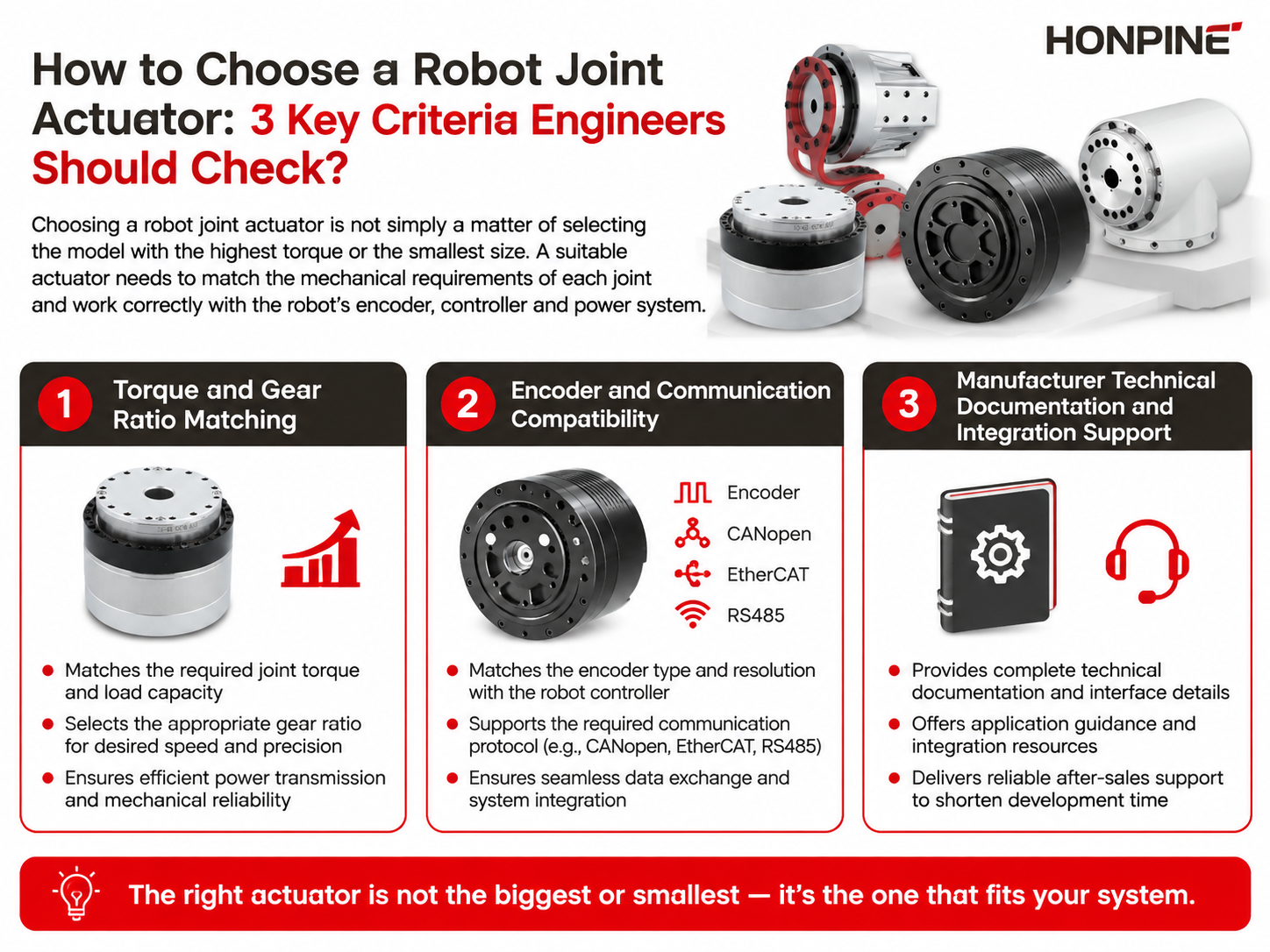
 How to Choose a Robot Joint Actuator: 3 Key Criteria Engineers Should Check?Choosing a robot joint actuator is an engineering decision that affects not only torque and motion performance, but also control stability, mechanical integration, and development time. For industrial robots, collaborative robots, humanoid robots, and other robotic systems, the right actuator must match the actual requirements of each joint while remaining compatible with the robot’s motor, encoder, controller, communication network, and power architecture. In this article, I will explain three key criteria engineers should evaluate when selecting a robot joint actuator: torque and gear ratio matching, encoder and communication compatibility, and the manufacturer’s technical documentation and engineering support.
 Outdoor Robot Joint Solution: Harmonic Joint Module with Built-in Torque SensorHello everyone, I’m Theodore Li, Technical Director at HONPINE. As robots move beyond controlled factory environments, outdoor robotic applications are creating new requirements for robot joint design. Rain, dust, humidity, temperature fluctuations, low-temperature conditions, and unpredictable external loads can all affect how a robotic joint performs in the field. In these environments, a joint needs to provide more than precise rotation. It also needs reliable torque feedback, suitable environmental protection, stable operation under changing temperatures, and practical mechanical integration. In this article, I will explain the key engineering considerations behind our outdoor robot joint solution, including the harmonic joint module, built-in torque sensor, IP65 protection, low-temperature lubrication, cable outlet protection, and mechanical integration, based on our experience with outdoor robotic applications such as solar panel installation, construction, and cleaning robots.
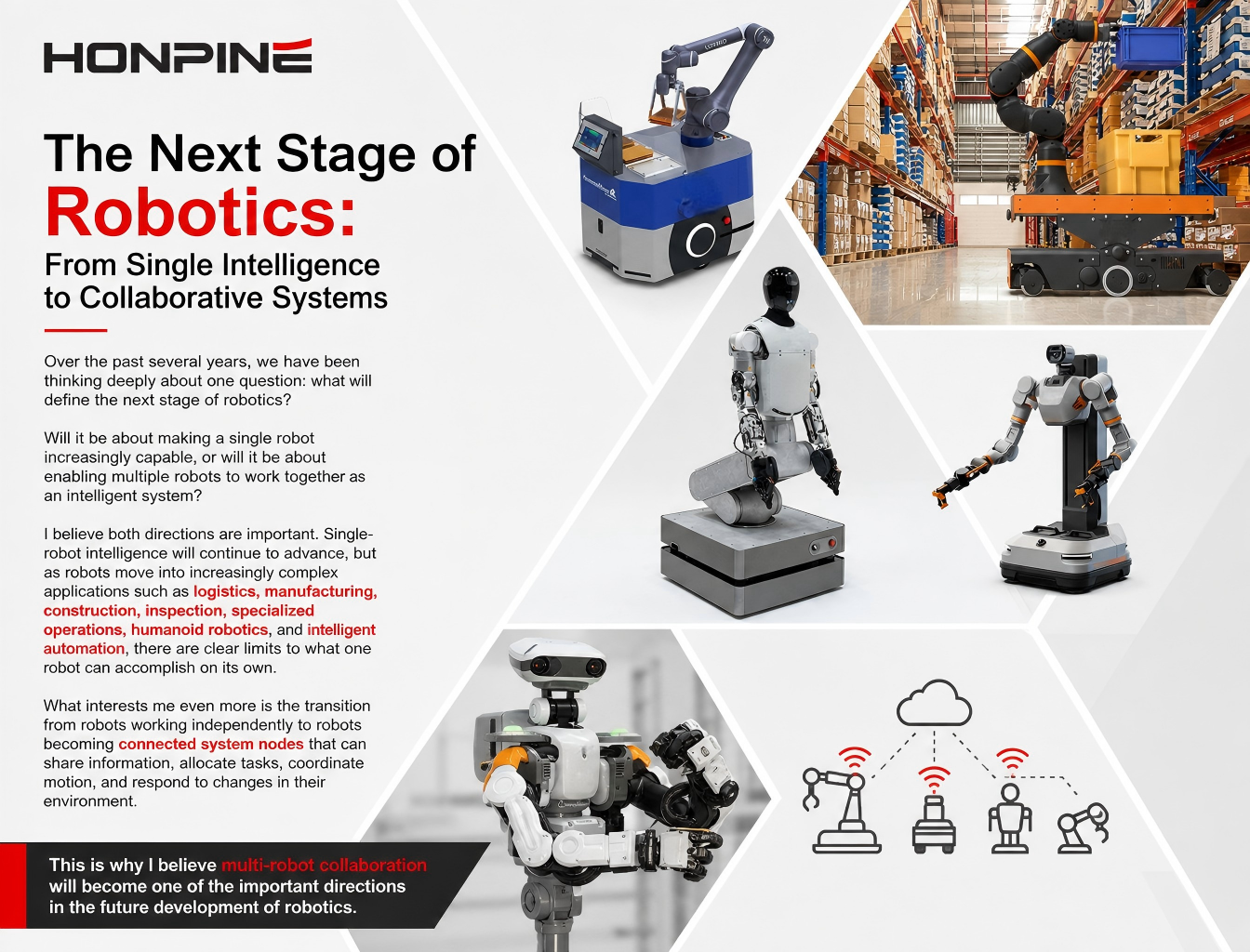
 Multi-Robot Collaboration: From Single-Robot Intelligence to System IntelligenceHello, I’m Allen Li, Founder of HONPINE. As robotics continues to evolve, I believe the next major step will not come only from making individual robots more intelligent, but from enabling multiple robots to work together as coordinated systems. Multi-robot collaboration introduces new requirements for communication, task allocation, motion coordination, state awareness, and safety. This evolution also changes the role of the robot joint. A future intelligent robot joint will need to do more than generate precise motion. With technologies such as dual encoders, torque sensing, integrated drives, real-time communication, and safety functions, the robot joint can become an intelligent motion node connecting robot intelligence with physical movement. In this article, I would like to share how I see the relationship between multi-robot collaboration, system intelligence, and the next generation of HONPINE robot joint modules.

Double Click
We provide harmonic drive reducer,planetary reducer,robot joint motor,robot rotary actuators,RV gear reducer,robot end effector,dexterous robot hand
 The Role of Harmonic Drive Gears in Achieving 5–10 μm Accuracy in Dental Milling MachinesA dental milling machine is a CNC machining system used to directly process digital dental models into restorations such as crowns, bridges, veneers, inlays, and implant abutments. Dental milling machines require far higher operational accuracy and motion stability than ordinary equipment. This article explains how harmonic drive gear help dental milling machines achieve stable, continuous, and controllable operation.
 Why Are Harmonic Rotary Actuators Perfect for Medical Equipment?Harmonic rotary actuators (typically integrated systems consisting of a harmonic drive reducer, frameless torque motor, encoder, and optional brake) are regarded as key components in medical equipment. The core reason is that they simultaneously meet the most stringent medical requirements for precision, compact size, safety, and controllability. The following explanation is structured from three perspectives: technical characteristics, application scenarios, and medical value.
 High-Precision RV Reducers Perfectly Matched for Walking RobotsThe walking axis of a robot is a core component for power transmission and support. RV reducers provide extremely high rigidity, precision, and torque while maintaining a compact size and exceptional reliability, making them an ideal match for the demanding requirements of walking robot joints in terms of load capacity, impact resistance, and precision.
 Harmonic Rotary Actuators for Semiconductor Equipment: Precision Motion, Hollow-Shaft Design and FOC ControlHello everyone, I’m Theodore Li, Technical Director at HONPINE. In semiconductor manufacturing equipment, rotary motion is not simply about making a mechanism rotate. Limited installation space, cable and tube routing, low-speed stability, precise positioning and continuously adjustable motion profiles can all influence the performance of the machine. This is why harmonic rotary actuators are becoming an important motion solution for semiconductor equipment. In this article, I will discuss how harmonic transmission, FOC-based motor control, encoder feedback, large hollow-shaft design and flexible mechanical interfaces work together to meet practical semiconductor motion requirements, based on our experience with developing equipment, overhead transport, wafer handling, cleaning and crystal-growth applications.
 Miniature Harmonic Drive for Minimally Invasive Surgical RobotsMinimally invasive surgical robots require highly compact transmission systems that can deliver precise motion within extremely limited mechanical spaces. As robotic instruments become smaller and more dexterous, conventional transmission architectures can face challenges related to size, tendon elasticity, friction, hysteresis, and mechanical integration. A miniature harmonic drive offers one potential approach by providing high-ratio precision transmission, low backlash, and compact dimensions in a small mechanical envelope. In this article, I will explain why miniature harmonic transmission is relevant to surgical robotics, compare external tendon-driven and distal transmission architectures, and discuss the key engineering considerations behind HONPINE’s CSF-mini miniature harmonic reducer for compact robotic joints, flexible robotic instruments, and other precision mechanisms.
 Why Laser Wobble Welding Systems Need a High-Precision Harmonic Rotary Actuator?Laser wobble welding is increasingly used in battery manufacturing, busbar welding, electronics, medical devices, robotic welding, and other precision manufacturing applications where beam movement must remain accurate and repeatable. In mechanical wobble welding systems, however, weld quality depends not only on laser parameters but also on the precision of the rotary motion mechanism driving the wobble head. Backlash, insufficient torsional rigidity, limited torque density, and positioning errors can directly affect the actual beam trajectory and molten pool stability. This is why a high-precision rotary motion solution is becoming an important part of modern laser wobble welding equipment. A Harmonic Rotary Actuator combines precision transmission, high rigidity, low backlash, and compact integration, making it well suited for mechanical wobble heads that require controlled rotary motion under dynamic loads.
 When Does Outboard Motor Steering Require a Harmonic Rotary Actuator?Electric outboard motor steering is evolving from a simple mechanical function into a precision motion-control application. This article explains when a Harmonic Rotary Actuator becomes a suitable solution and examines the role of precision transmission, low backlash, high torque density, encoder feedback, and compact mechanical integration. It also explores applications in electric boats, autonomous surface vessels, unmanned boats, marine robotics, and electric marine propulsion, helping engineers understand how to select the right rotary actuator according to steering torque, speed, positioning accuracy, operating conditions, and installation requirements.
 How to Choose the Right Robot Joint Actuator for Specialized Robotic Applications?Choosing the right robot joint actuator is no longer simply a matter of comparing torque specifications or selecting a motor and gearbox separately. As humanoid robots, collaborative robots, industrial robotic arms, medical robots, mobile manipulators, and specialized robotic systems become more diverse, robot manufacturers must balance torque, speed, precision, stiffness, weight, installation space, feedback, communication, and safety at the same time. This article explains how engineers can select the right harmonic joint actuator or robot joint motor by starting with the actual application problem and building a joint-level solution that matches the mechanical structure and control requirements of the complete robot.
 Harmonic Rotary Actuator for CNC Rotary Axis: A Precision Solution for Engraving MachinesDiscover how harmonic rotary actuators improve CNC rotary-axis performance for 4-axis and 5-axis engraving machines with precise positioning, low backlash, high rigidity and compact integration.
 12 Tips for Choosing the Right CNC Rotary Table Transmission: Harmonic Reducer, Harmonic Rotary Actuator, DD Motor and Planetary ReducerLearn how to choose the right CNC rotary table transmission based on accuracy, backlash, torque, speed, rigidity, thermal stability and integration. Compare harmonic reducers, harmonic rotary actuators, DD motors, RV reducers and planetary reducers.
 Mini Harmonic Reducer for Small Robot Arms and Desktop 6-Axis Robots
 Inspection Robot Applications: Why Harmonic Gear Motors Are the Preferred Motion Solution?Inspection robots have become essential across modern industries, helping companies automate equipment inspection, improve worker safety, and collect high-quality operational data. From manufacturing plants and power stations to oil & gas facilities, warehouses, railways, and smart cities, autonomous inspection robots are transforming maintenance and asset management.
Every movement of an inspection robot—from rotating a thermal camera to positioning a LiDAR scanner or operating an inspection arm—depends on the accuracy of its motion system. HONPINE Harmonic Gear Motors combine near-zero backlash, compact size, high torque density, and exceptional positioning accuracy, making them an ideal solution for next-generation inspection robots.