

How Should Manufacturers Upgrade Harmonic Joint Modules for Robotic Arms and Embodied AI in 2026?
In 2026, more manufacturers of robotic arms, embodied AI robots, and high-end automation equipment are turning to integrated harmonic joint modulesto upgrade their existing systems. In the past, selection decisions focused primarily on reducer accuracy, load capacity, and repeat positioning accuracy. Today, the requirements have expanded to include force control, dynamic response, system integration, development efficiency, and safety.
For manufacturers looking to improve overall robotic performance, upgrading an integrated harmonic joint module is no longer just about replacing a reducer. It is about improving the capabilities of the entire electromechanical system.
1. Upgrade to an EtherCAT Harmonic Integrated Joint Module
EtherCAT supports multi-axis synchronized control, making it suitable for robotic arms with multiple joints, humanoid robots, and high-dynamic motion systems.
For robotic arm manufacturers, EtherCAT can help reduce communication delays and synchronization errors in multi-axis control while simplifying the communication architecture between the controller and individual joints.
However, actual performance still depends on the communication cycle time, drive implementation, master controller, and overall system configuration. Simply adding an EtherCAT interface does not automatically guarantee high-speed synchronization or better motion performance.
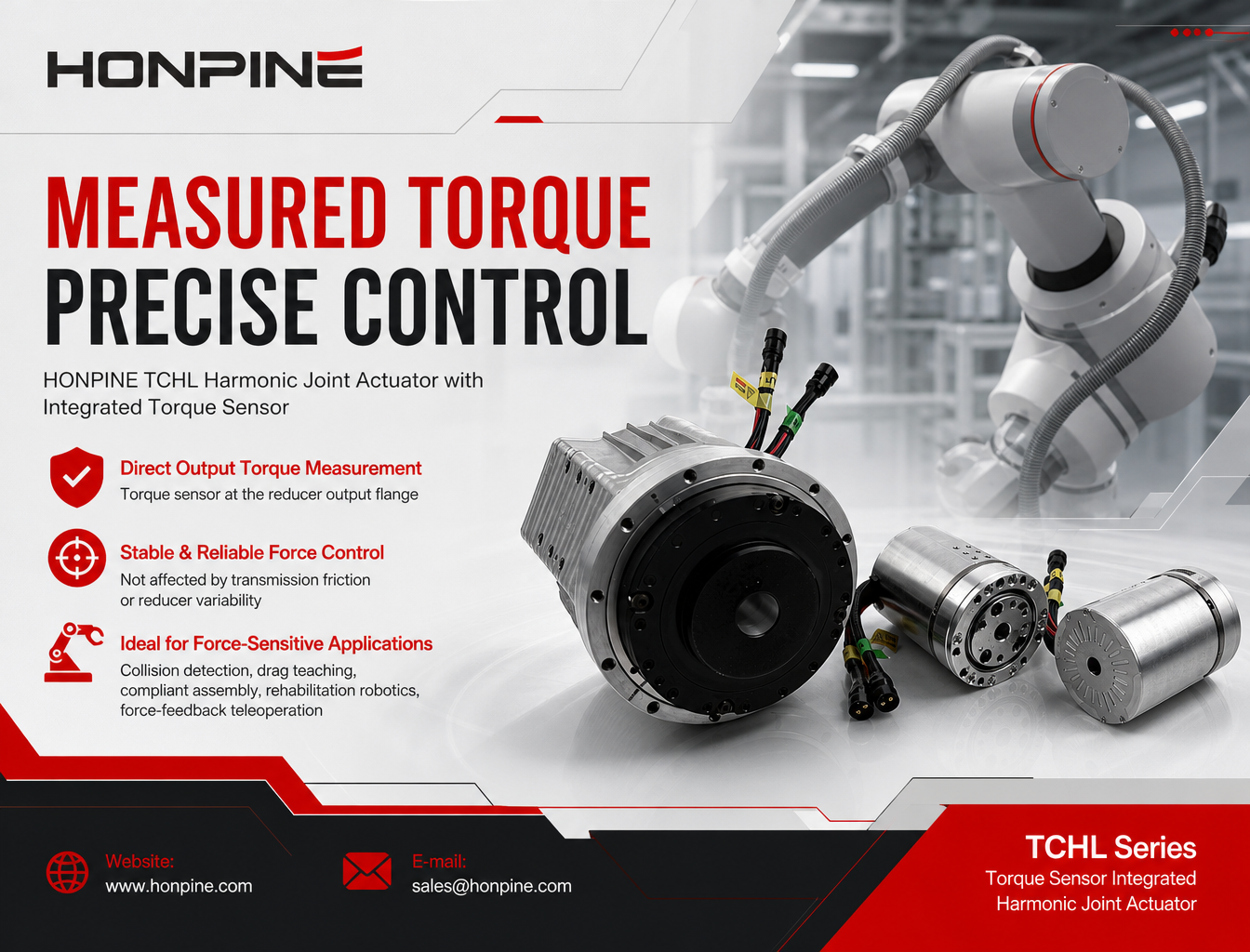
2. Upgrade to a Harmonic Integrated Joint Module with a Built-In Torque Sensor
Traditional robotic joints primarily address two questions: where should the joint move, and how accurately can it reach the target position?
However, in human-robot collaboration, flexible object handling, precision insertion, grinding, and polishing, robots also need to know how much force or torque they are applying.
A built-in torque sensor measures joint output torque in real time and provides feedback for impedance control, compliant motion control, and hybrid force-position control.
This allows robots to do more than execute position commands. They can adjust their movements according to contact forces, enabling more adaptive interaction with objects and the surrounding environment.
For applications involving embodied AI, dexterous manipulation, and collaborative robotics, torque sensing is an important step toward more intelligent and responsive joint control.
3. Upgrade from a Single Encoder to a Dual-Encoder Configuration
Traditional joint modules often rely primarily on a motor-side encoder. An upgraded dual-encoder configuration provides position feedback from both the motor side and the reducer output side.
This arrangement helps identify transmission errors, elastic deformation, and certain abnormal operating conditions. It also provides the feedback needed for more accurate output-position control.
When selecting a dual-encoder harmonic joint module, manufacturers should look beyond the encoder count and verify several important specifications, including:
Whether the encoders are absolute or incremental.
Encoder resolution and measurement accuracy.
The method used to establish position after power-up.
Whether multi-turn position data requires a battery or another backup mechanism.
A dual-encoder configuration can improve observability of the transmission system, but the actual positioning performance still depends on the encoder specifications, mechanical transmission characteristics, and control algorithm.
4. Adopt a Hollow-Shaft Harmonic Integrated Joint Module
Hollow-shaft design is an important consideration in robotic arm and humanoid robot development.
The effective bore diameter, internal routing space, flange dimensions, and axial length directly influence the mechanical structure of a robot.
Further improvements may include a larger usable hollow bore, a more compact axial structure, appropriate bearing support, and better integration of cables, pneumatic lines, and sensor wiring.
These factors are particularly important for shoulder, wrist, and waist joints in humanoid robots, where multiple mechanical and electrical connections must fit within limited space.
A well-designed hollow-shaft harmonic joint module can simplify internal cable routing, reduce structural complexity, and provide greater flexibility during robotic system integration.
5. Upgrade Thermal Management: Focus on Continuous Torque Rather Than Short-Term Peak Torque
For robotic arms that maintain their posture for extended periods or perform frequent acceleration and deceleration, temperature rise can be more important than short-term peak torque.
Manufacturers should evaluate motor winding temperature monitoring, reducer temperature rise, drive thermal protection, torque derating curves, and continuous torque after thermal equilibrium has been reached.
Peak torque alone does not provide a complete picture of a joint module's working capability.
If a supplier specifies peak torque without providing continuous torque ratings and the associated test conditions, it becomes more difficult to assess whether the module can reliably meet the application's requirements.
When upgrading a harmonic integrated joint module, thermal performance should therefore be evaluated under realistic operating conditions, including duty cycle, ambient temperature, cooling conditions, and motion profile.
6. Upgrade Safety with a Brake and Safe Torque Off (STO)
For collaborative robotic arms, humanoid robots, and high-load joints, safety considerations extend beyond the mechanical brake.
Manufacturers should also evaluate Safe Torque Off (STO), overcurrent protection, overtemperature protection, communication fault handling, and fault recovery mechanisms.
An important distinction must be made: STO generally prevents the drive from actively generating motor torque. It is not a mechanical brake and does not guarantee that a vertical axis or suspended load will remain stationary.
If an application requires a load to be held safely when power is removed, the braking arrangement and the overall safety architecture must be evaluated separately.
For human-robot collaboration, safety requirements must also be assessed and validated at the complete robot-system level rather than relying solely on the safety features of an individual joint module.
7. Upgrade the Motor for Higher Torque Density and Better Dynamic Response
When evaluating the frameless torque motor inside a harmonic integrated joint module, manufacturers should consider torque density, rotor inertia, winding temperature rise, peak current, and smooth operation at low speeds.
For space-constrained robotic arms, the objective is not simply to install a larger motor. It is to achieve better continuous output capability and dynamic performance within the available volume and weight limits.
A motor with lower rotor inertia can help improve acceleration and deceleration response, while appropriate electromagnetic design and thermal management can support more demanding operating cycles.
The final performance depends on the combined characteristics of the motor, harmonic reducer, bearings, encoder feedback, and control system.
Therefore, motor selection should be based on the operating requirements of the complete joint module rather than on a single torque or power rating.
8. Upgrade the Drive from Basic Servo Control to Advanced Force Control
In addition to the EtherCAT communication interface, manufacturers should evaluate the performance of the current, velocity, and position control loops, as well as the drive's support for torque control, impedance control, feedforward compensation, filtering, and parameter tuning tools.
A meaningful upgrade is one in which the drive, torque sensor, and encoders operate together as a coordinated closed-loop system, rather than simply adding another communication interface.
Sensor data refresh rates, control cycle times, and actual force-control bandwidth should all be verified under the intended operating conditions.
For embodied AI robots and collaborative robotic systems, these capabilities can influence how effectively a joint responds to external forces, maintains stable contact, and performs precise interaction tasks.
Ultimately, the value of an integrated harmonic joint module lies not in the number of features it includes, but in how effectively those features work together in the final application.
Conclusion: Upgrade the Entire Joint System, Not Just Individual Components
Competition among collaborative robot manufacturers, embodied AI developers, and high-end automation equipment suppliers is no longer determined by a single technical specification.
What matters is how well the system performs in real applications, how efficiently it can be integrated and developed, how reliably it can be delivered, and whether its overall cost is competitive.
At HONPINE, as a manufacturer of harmonic integrated joint modules, we focus on moving beyond the performance of individual components toward the capabilities of the complete electromechanical system.
From EtherCAT communication and built-in torque sensing to dual-encoder feedback, hollow-shaft integration, thermal management, safety functions, motor optimization, and advanced drive control, each upgrade should address a specific engineering requirement.
Contact HONPINE to learn more about our harmonic integrated joint modules and explore suitable solutions for robotic arms, humanoid robots, embodied AI, and high-end automation equipment.
Read More
Learn more about the story of HONPINE and industry trends related to precision transmission.
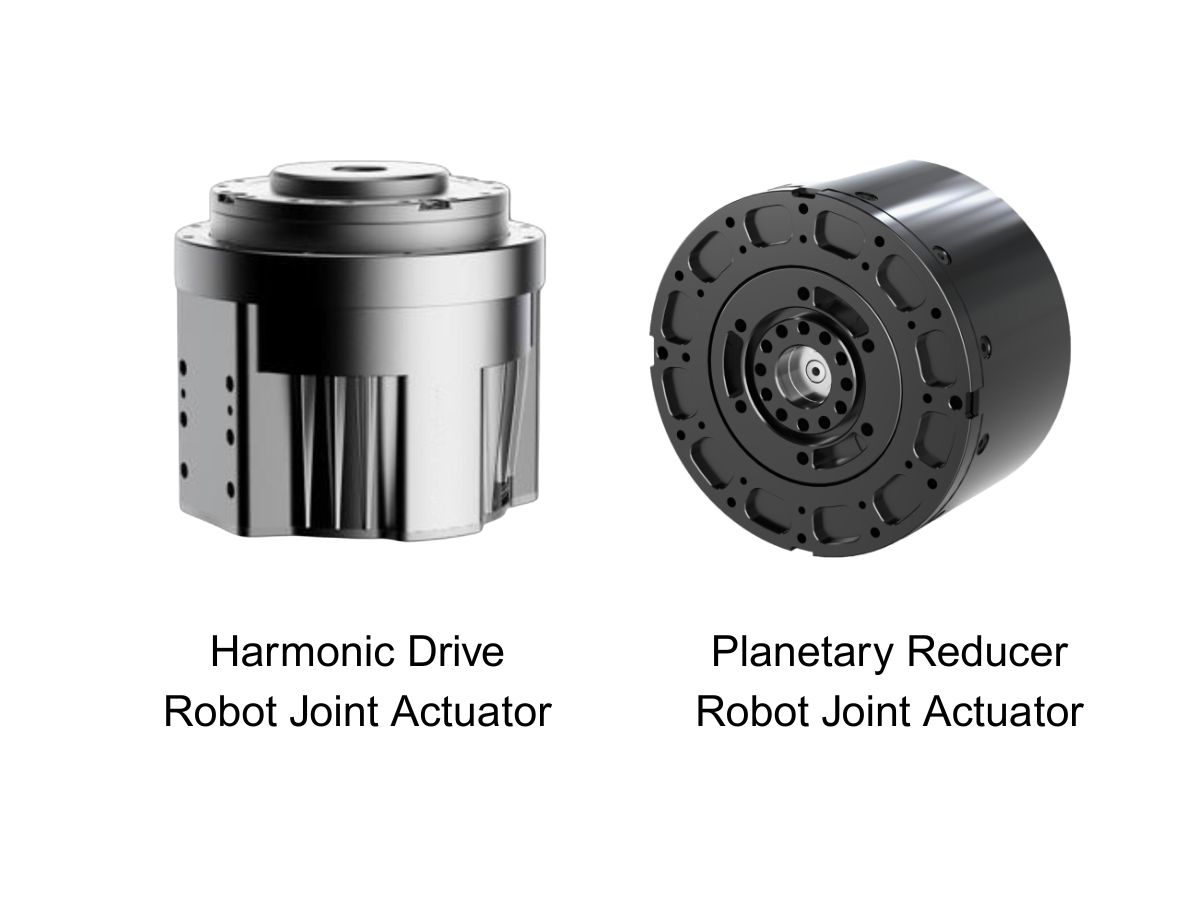
 What is robot joint actuator?How to Choose the Best Robot Rotary Joint Actuator?In core robot joint transmission solutions, planetary and harmonic rotary actuators each have their own strengths. Choosing the right type based on application requirements is essential to achieve the optimal balance between performance and cost.
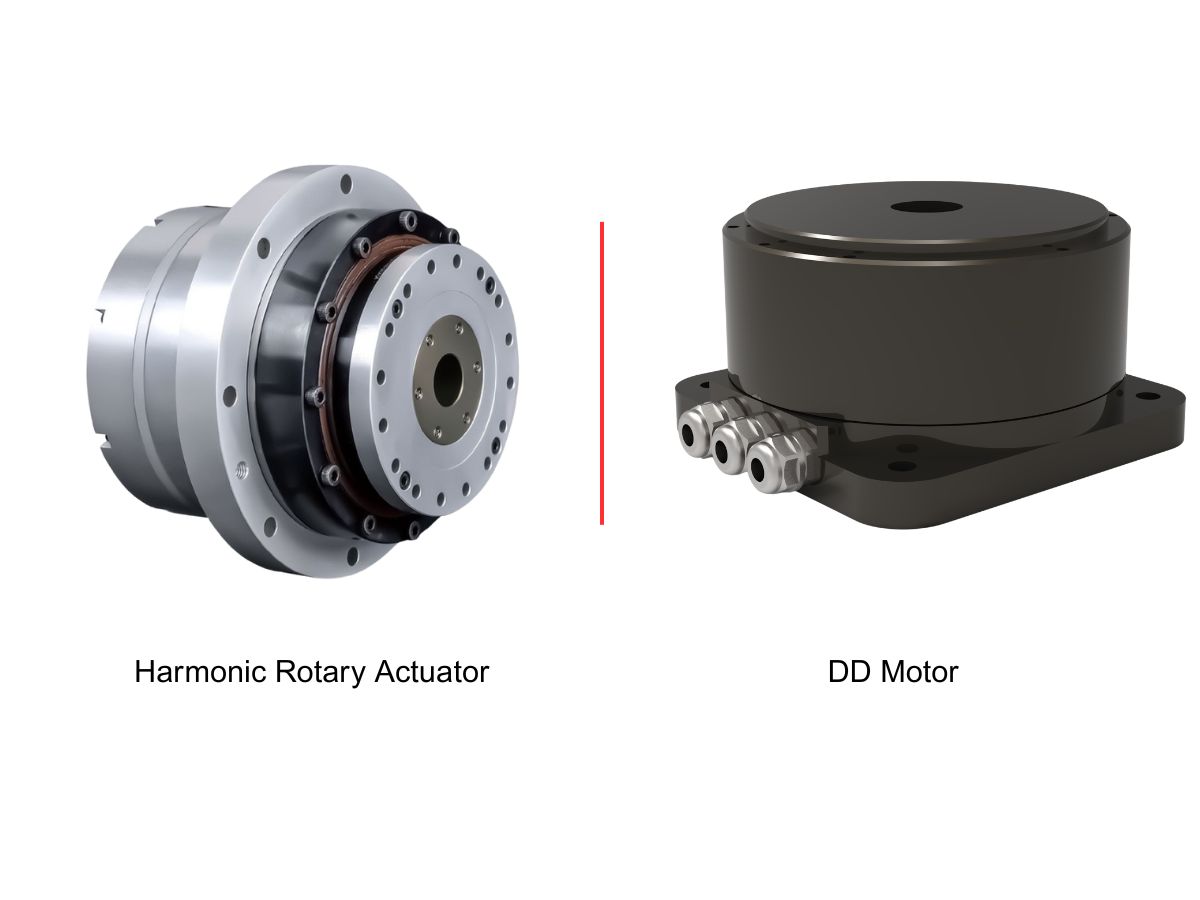
 DD Motors VS Harmonic Rotary ActuatorsThis article provides an in-depth comparison between Direct Drive (DD) motors and harmonic rotary actuators, covering their transmission principles, advantages and disadvantages, and typical application fields.
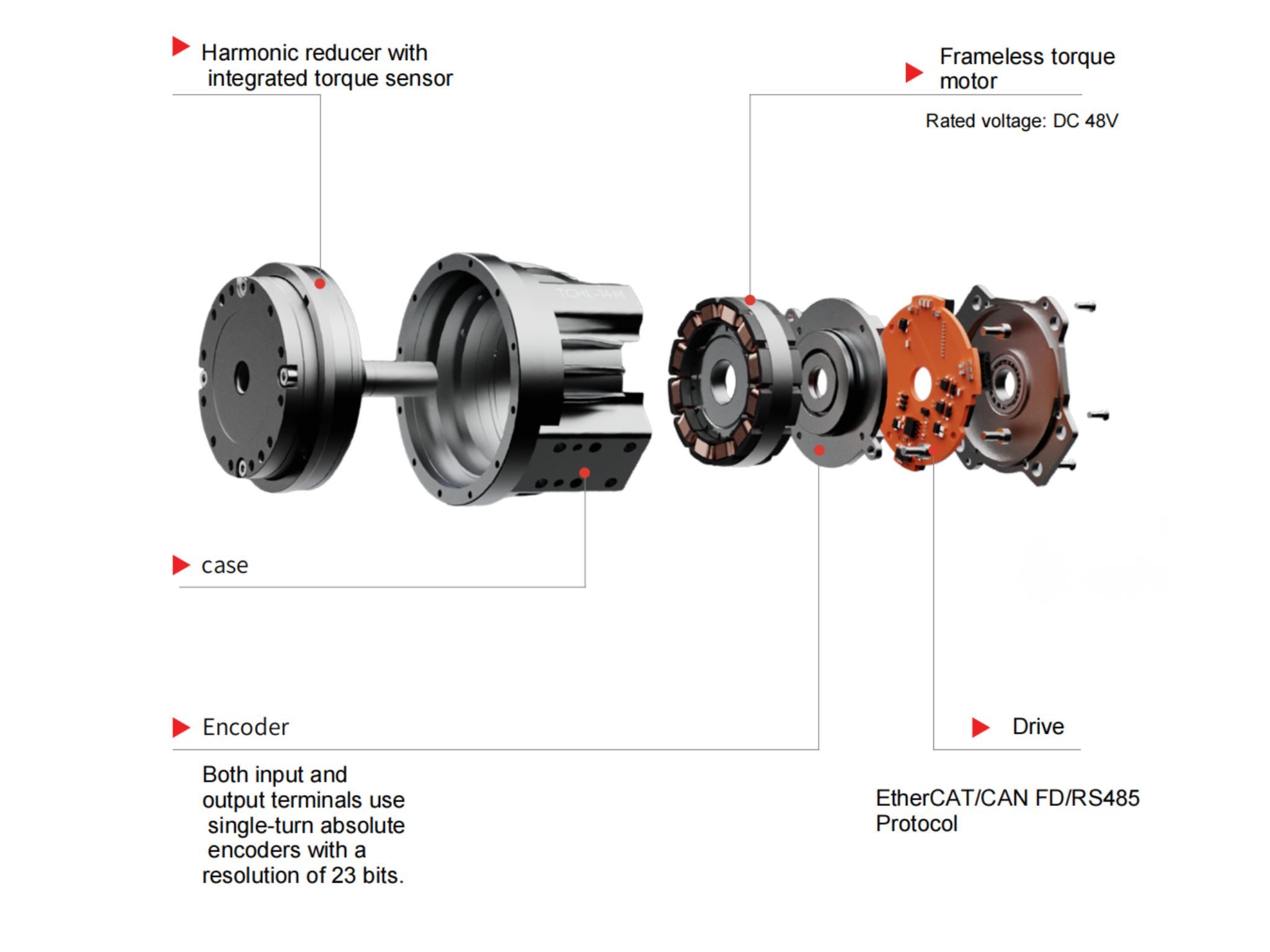
 OMG Ultra Compact Harmonic Drive Joint Module with Built-in Torque SensorHONPINE TCHL series harmonic drive joint module is a game-changing product that achieves disruptive improvements in multiple aspects such as lightweight design, integration level, and connection convenience. This article will analyze its revolutionary enhancements with you.
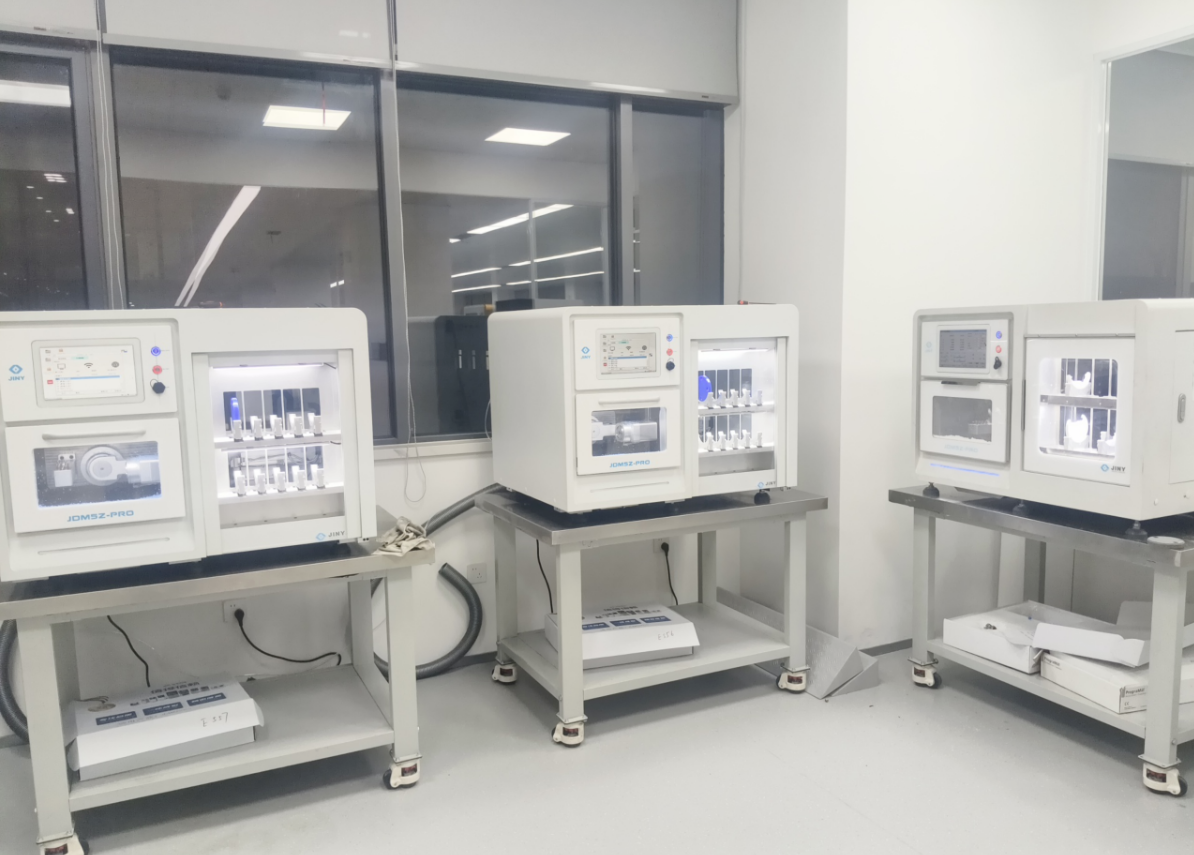
 The Role of Harmonic Drive Gears in Achieving 5–10 μm Accuracy in Dental Milling MachinesA dental milling machine is a CNC machining system used to directly process digital dental models into restorations such as crowns, bridges, veneers, inlays, and implant abutments. Dental milling machines require far higher operational accuracy and motion stability than ordinary equipment. This article explains how harmonic drive gear help dental milling machines achieve stable, continuous, and controllable operation.
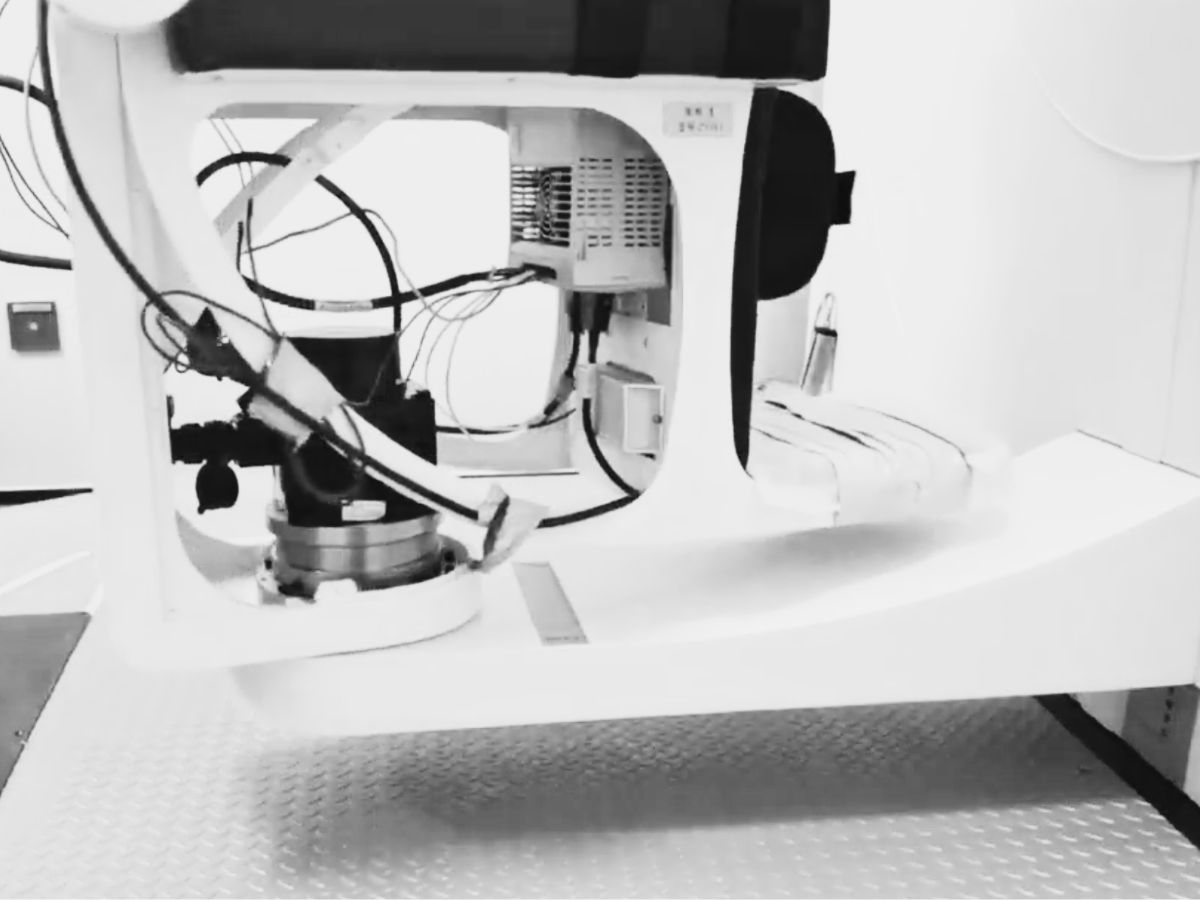
 Why Are Harmonic Rotary Actuators Perfect for Medical Equipment?Harmonic rotary actuators (typically integrated systems consisting of a harmonic drive reducer, frameless torque motor, encoder, and optional brake) are regarded as key components in medical equipment. The core reason is that they simultaneously meet the most stringent medical requirements for precision, compact size, safety, and controllability. The following explanation is structured from three perspectives: technical characteristics, application scenarios, and medical value.
 High-Precision RV Reducers Perfectly Matched for Walking RobotsThe walking axis of a robot is a core component for power transmission and support. RV reducers provide extremely high rigidity, precision, and torque while maintaining a compact size and exceptional reliability, making them an ideal match for the demanding requirements of walking robot joints in terms of load capacity, impact resistance, and precision.
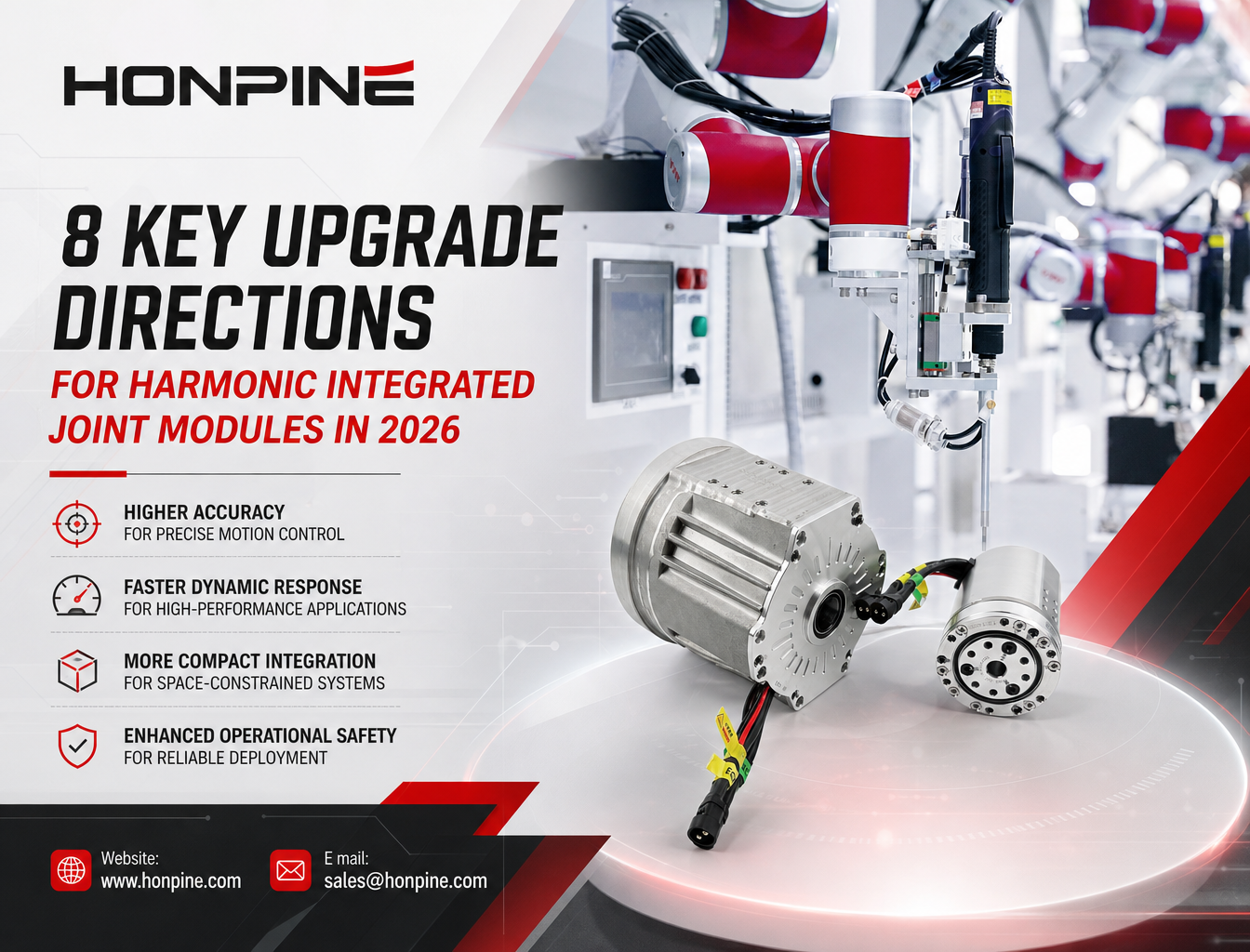
 How Should Manufacturers Upgrade Harmonic Joint Modules for Robotic Arms and Embodied AI in 2026?For engineers planning a robotic system upgrade, the right joint module depends on more than a single specification. EtherCAT synchronization, output-side position feedback, real-time torque measurement, continuous torque capability, and integrated safety functions must work together to meet the demands of the application. By evaluating these factors as a complete electromechanical system, manufacturers can make more informed decisions about joint module selection, integration, and long-term performance.
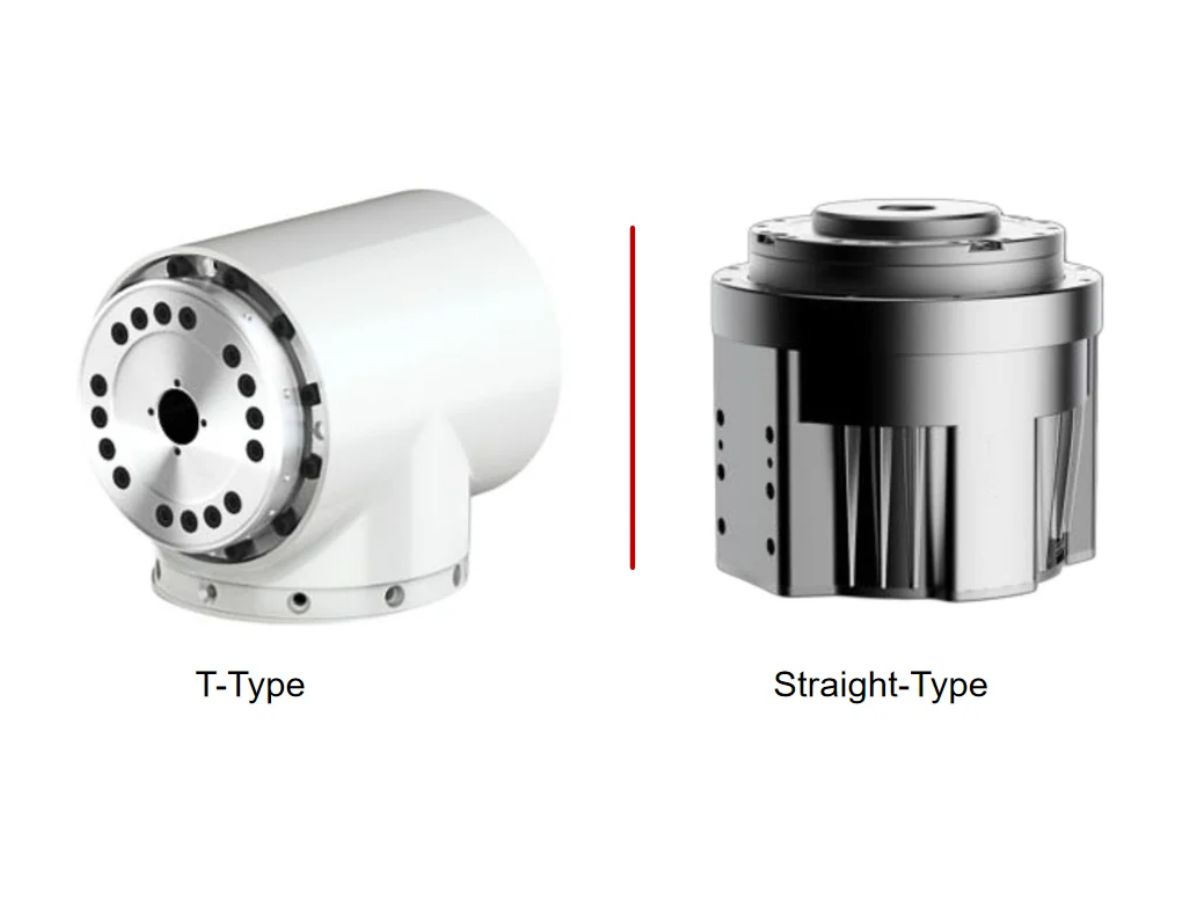
 Should You Choose a T-Type or Straight-Type Harmonic Joint Module for a Collaborative Robot?Choosing the right harmonic joint module is essential when designing a compact, high-performance collaborative robot. Should you use a TCHL straight-type or an HTS T-type harmonic joint module? Although both configurations can support precise robotic motion, their different output flange geometries affect installation space, link connections, cable routing, and mechanical integration. In this guide, Theodore Li, Technical Director at HONPINE, explains the key differences between the two designs, their advantages and limitations, and how to select the most suitable configuration for your collaborative robotic arm.
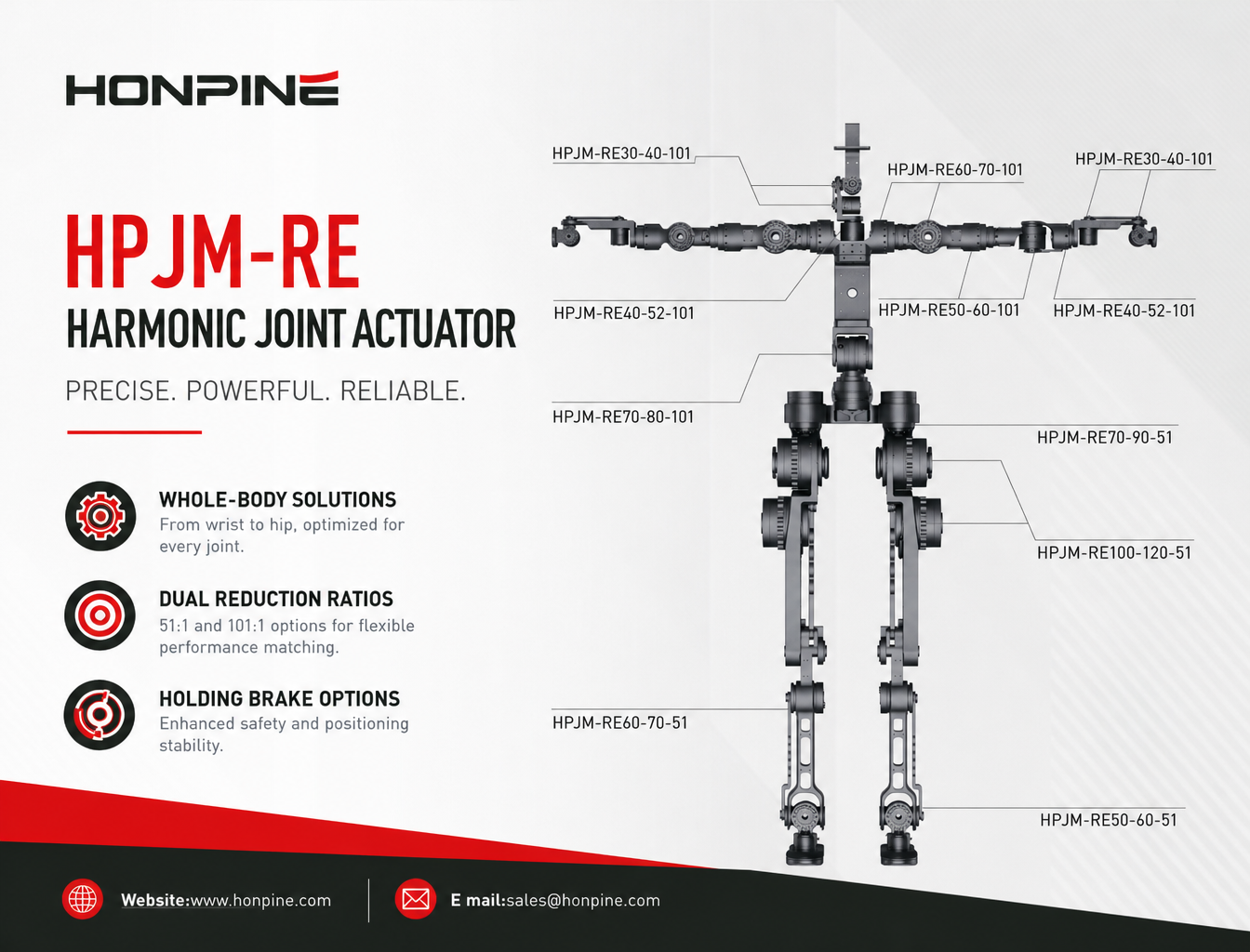
 The Complete Harmonic Joint Actuator Solution for Humanoid Robots: HPJM Series Selection GuideA complete guide to selecting harmonic joint actuators for humanoid robots. Explore HONPINE HPJM models for wrist, elbow, shoulder, waist, hip, knee, and ankle joints, with practical considerations for torque capacity, reduction ratios, dynamic response, and holding brake configurations.
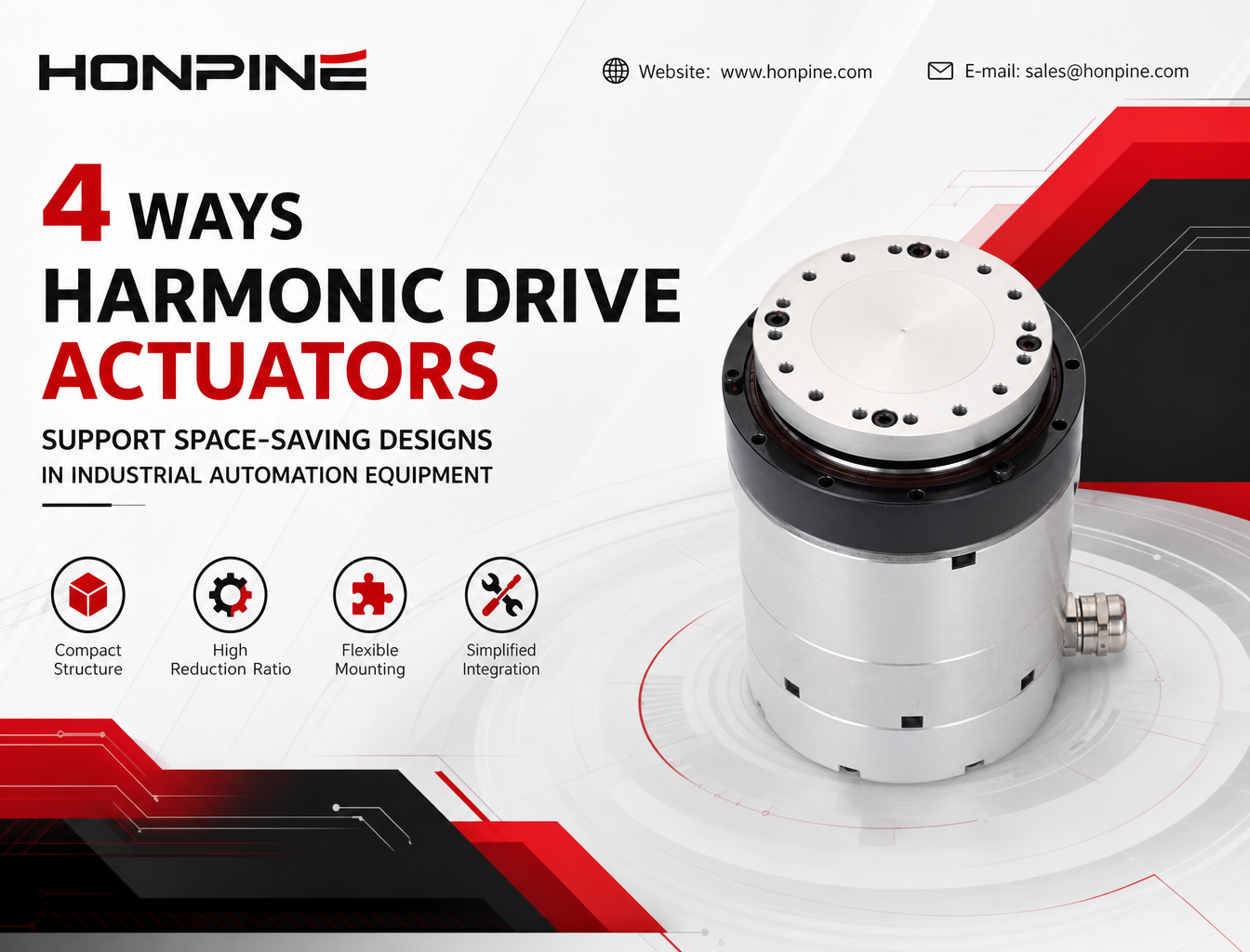
 Why Are Harmonic Drive Actuators Ideal for Space-Constrained Industrial Automation Equipment?In modern industrial automation, limited installation space often makes mechanical design more challenging. Harmonic drive actuators offer a compact motion-control solution by integrating key drive components into a single unit. Their high reduction ratios, streamlined mechanical structures, and flexible mounting options can help equipment manufacturers reduce space requirements, simplify assembly, and optimize internal layouts. This article explores four ways integrated harmonic drive actuators support space-saving designs in industrial automation equipment.
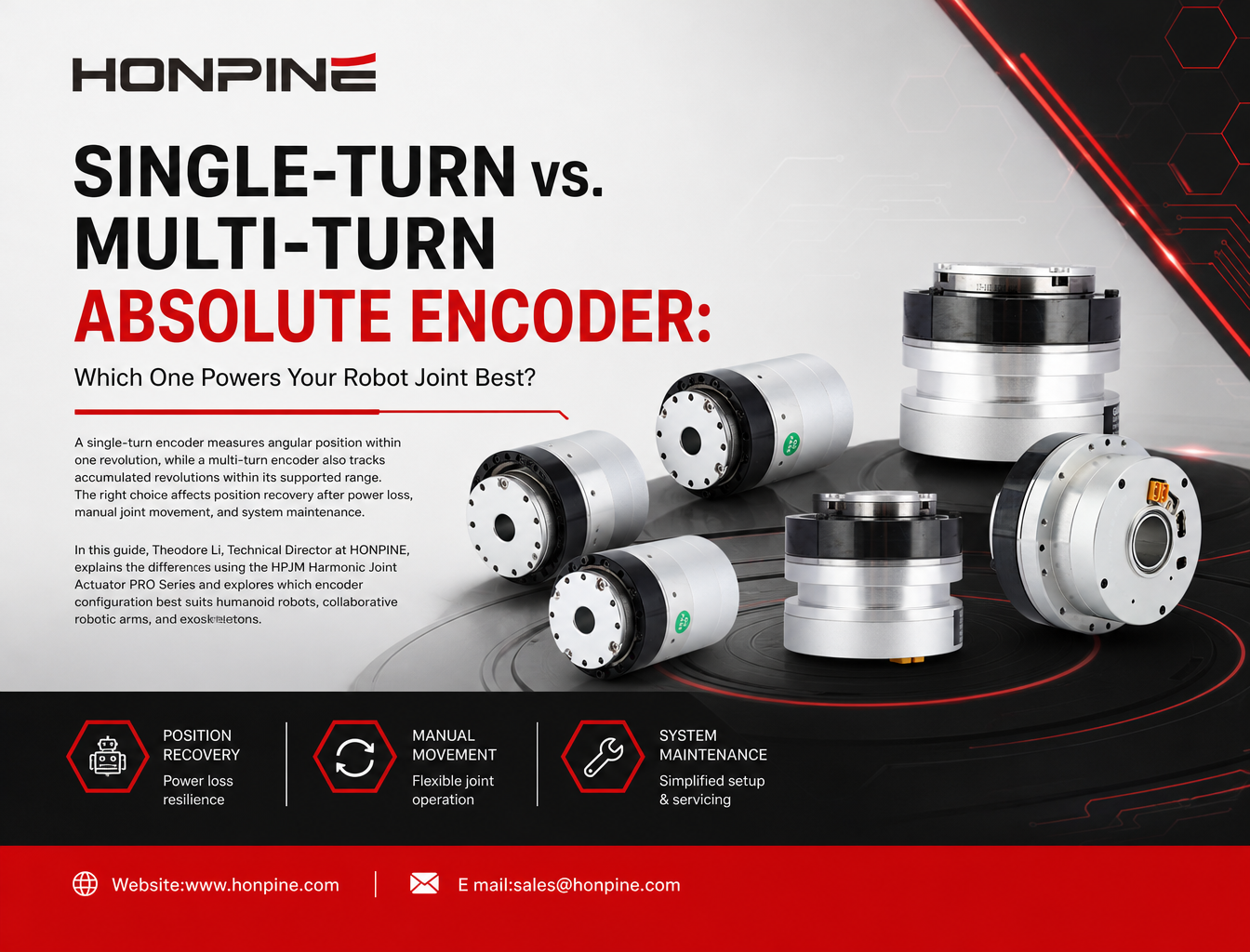
 Single-Turn vs. Multi-Turn Absolute Encoders for Robot Joint Modules: How to Choose?This guide compares single-turn and multi-turn absolute encoders for robot joint modules, explaining how they differ in position feedback, power-off position retention, and maintenance requirements. Learn how to select the right encoder configuration for humanoid robots, collaborative robotic arms, and exoskeletons using the HONPINE HPJM Harmonic Joint Actuator PRO Series as an example.
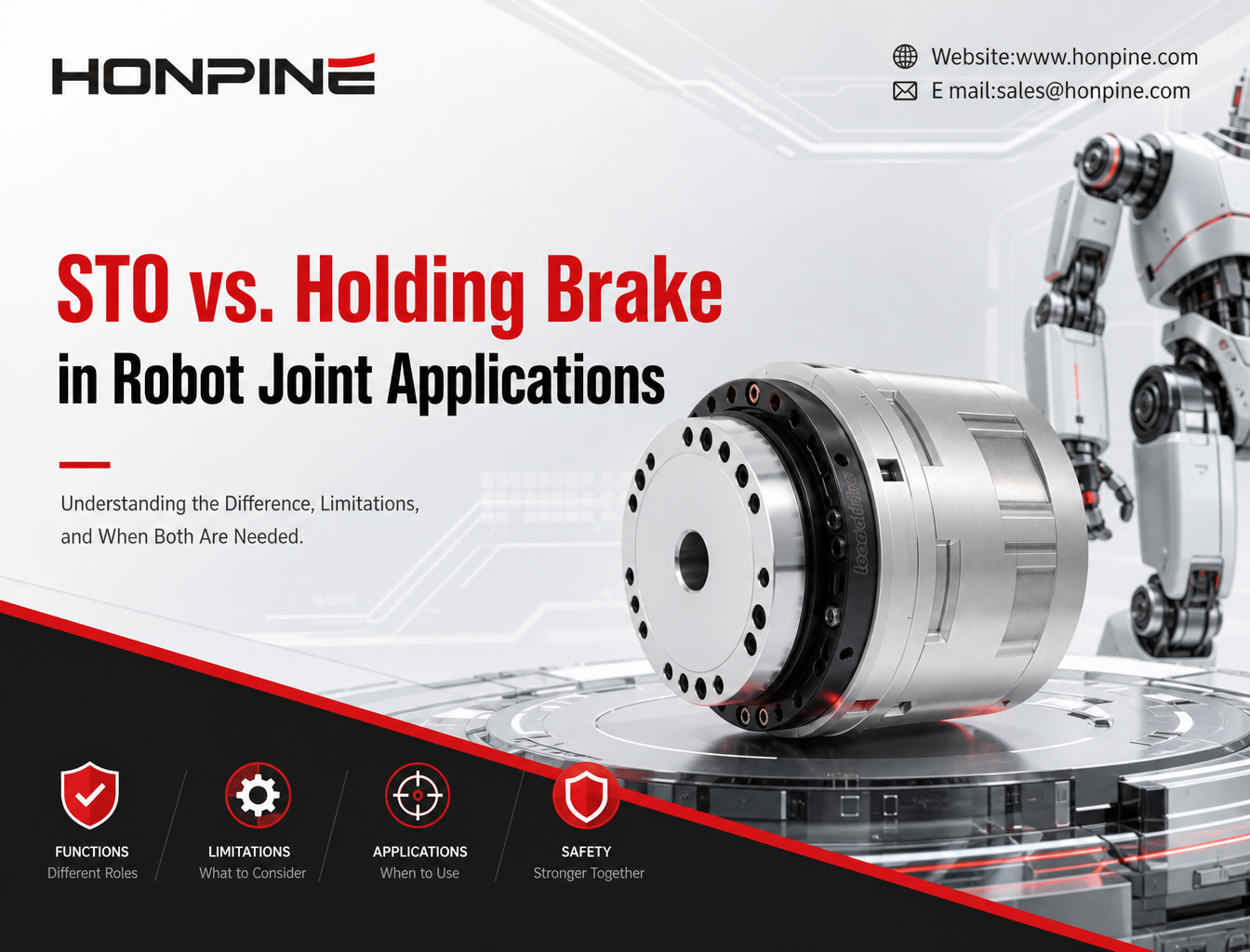
 STO vs. Holding Brake in Robot Joint Modules: What Is the Difference for Robot Safe Control?STO (Safe Torque Off) and holding brakes play different roles in robot joint safety. While STO prevents a motor from generating driving torque, a holding brake mechanically resists joint movement and helps retain loads when the motor is disabled. Understanding the difference is essential when selecting a robot joint module for humanoid robots, collaborative robots, and industrial automation. In this article, Theodore Li, Technical Director at HONPINE, explains how these functions work, their limitations, and when both should be considered in a harmonic integrated joint actuator such as the HONPINE HAG series.
Double Click
We provide harmonic drive reducer,planetary reducer,robot joint motor,robot rotary actuators,RV gear reducer,robot end effector,dexterous robot hand
 What is robot joint actuator?How to Choose the Best Robot Rotary Joint Actuator?In core robot joint transmission solutions, planetary and harmonic rotary actuators each have their own strengths. Choosing the right type based on application requirements is essential to achieve the optimal balance between performance and cost.
 DD Motors VS Harmonic Rotary ActuatorsThis article provides an in-depth comparison between Direct Drive (DD) motors and harmonic rotary actuators, covering their transmission principles, advantages and disadvantages, and typical application fields.
 OMG Ultra Compact Harmonic Drive Joint Module with Built-in Torque SensorHONPINE TCHL series harmonic drive joint module is a game-changing product that achieves disruptive improvements in multiple aspects such as lightweight design, integration level, and connection convenience. This article will analyze its revolutionary enhancements with you.
 How Should Manufacturers Upgrade Harmonic Joint Modules for Robotic Arms and Embodied AI in 2026?For engineers planning a robotic system upgrade, the right joint module depends on more than a single specification. EtherCAT synchronization, output-side position feedback, real-time torque measurement, continuous torque capability, and integrated safety functions must work together to meet the demands of the application. By evaluating these factors as a complete electromechanical system, manufacturers can make more informed decisions about joint module selection, integration, and long-term performance.
 Should You Choose a T-Type or Straight-Type Harmonic Joint Module for a Collaborative Robot?Choosing the right harmonic joint module is essential when designing a compact, high-performance collaborative robot. Should you use a TCHL straight-type or an HTS T-type harmonic joint module? Although both configurations can support precise robotic motion, their different output flange geometries affect installation space, link connections, cable routing, and mechanical integration. In this guide, Theodore Li, Technical Director at HONPINE, explains the key differences between the two designs, their advantages and limitations, and how to select the most suitable configuration for your collaborative robotic arm.
 The Complete Harmonic Joint Actuator Solution for Humanoid Robots: HPJM Series Selection GuideA complete guide to selecting harmonic joint actuators for humanoid robots. Explore HONPINE HPJM models for wrist, elbow, shoulder, waist, hip, knee, and ankle joints, with practical considerations for torque capacity, reduction ratios, dynamic response, and holding brake configurations.
 Why Are Harmonic Drive Actuators Ideal for Space-Constrained Industrial Automation Equipment?In modern industrial automation, limited installation space often makes mechanical design more challenging. Harmonic drive actuators offer a compact motion-control solution by integrating key drive components into a single unit. Their high reduction ratios, streamlined mechanical structures, and flexible mounting options can help equipment manufacturers reduce space requirements, simplify assembly, and optimize internal layouts. This article explores four ways integrated harmonic drive actuators support space-saving designs in industrial automation equipment.
 Single-Turn vs. Multi-Turn Absolute Encoders for Robot Joint Modules: How to Choose?This guide compares single-turn and multi-turn absolute encoders for robot joint modules, explaining how they differ in position feedback, power-off position retention, and maintenance requirements. Learn how to select the right encoder configuration for humanoid robots, collaborative robotic arms, and exoskeletons using the HONPINE HPJM Harmonic Joint Actuator PRO Series as an example.
 STO vs. Holding Brake in Robot Joint Modules: What Is the Difference for Robot Safe Control?STO (Safe Torque Off) and holding brakes play different roles in robot joint safety. While STO prevents a motor from generating driving torque, a holding brake mechanically resists joint movement and helps retain loads when the motor is disabled. Understanding the difference is essential when selecting a robot joint module for humanoid robots, collaborative robots, and industrial automation. In this article, Theodore Li, Technical Director at HONPINE, explains how these functions work, their limitations, and when both should be considered in a harmonic integrated joint actuator such as the HONPINE HAG series.
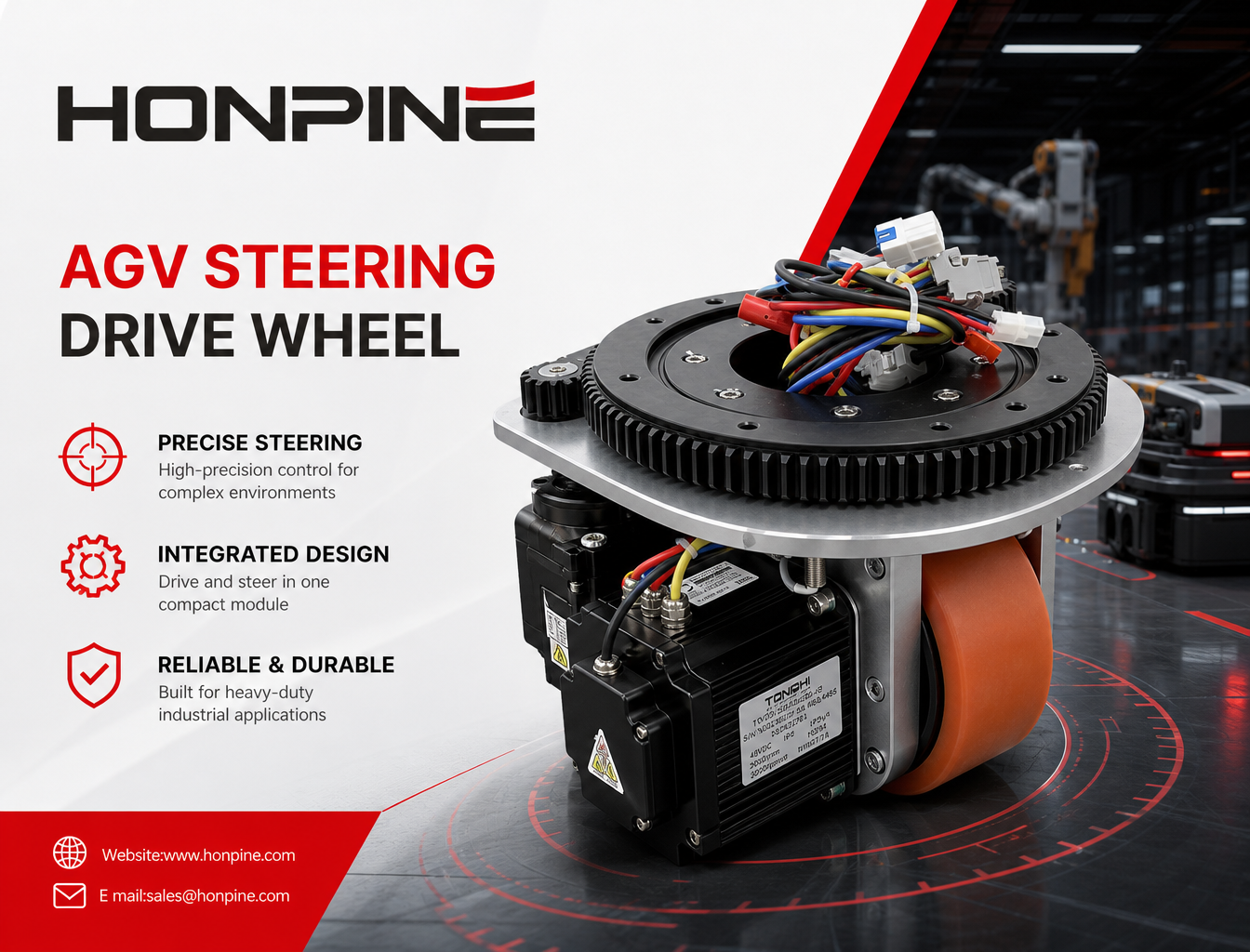
 AGV Robot Steering Drive Wheel: A Comprehensive Guide to Components, Applications, and SelectionAn AGV steering drive wheel integrates traction and active steering to support flexible movement in industrial mobile robots. This guide explains its main components, working principles, industrial applications, and key selection factors, including load capacity, traction torque, steering torque, wheel diameter, speed, and control interfaces. Discover how to choose a suitable steering drive module for AGVs, AMRs, autonomous forklifts, and heavy-duty material handling systems.
 How Does a Harmonic Joint Actuator with a Torque Sensor Improve Robot Force Control?Learn how the HONPINE TCHL harmonic joint actuator uses an integrated output torque sensor to support force feedback, collision detection, compliant assembly, rehabilitation robotics, and teleoperation.
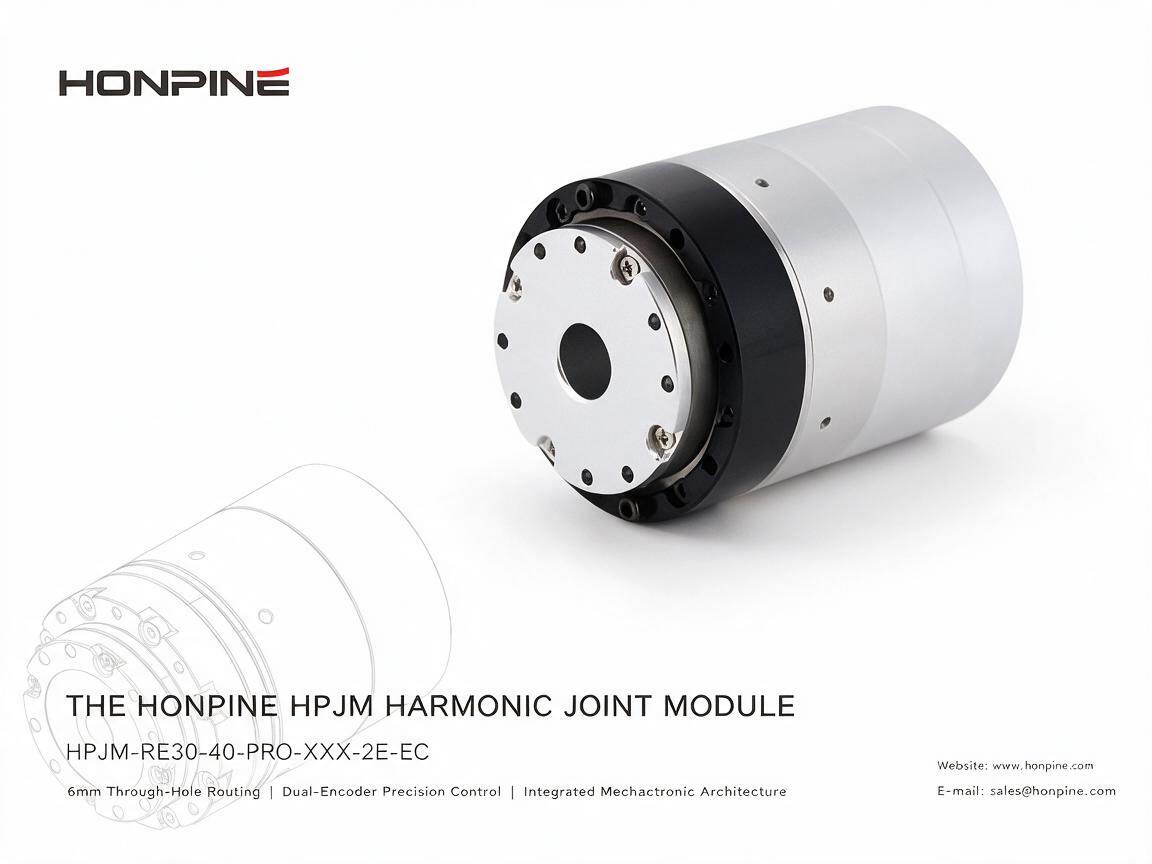
 Ultra-Compact Harmonic Joint Module with a 6 mm Hollow ShaftAs humanoid robots and compact robotic systems evolve, joint modules must deliver high torque density, precise motion control, and flexible cable routing within increasingly limited installation space. The HONPINE HPJM-RE30-40-PRO harmonic joint module addresses these challenges with a compact design, a 6 mm hollow shaft, dual-encoder feedback, and an integrated motor and FOC drive. In this article, we explore its key design features and explain how its hollow-shaft structure, EtherCAT connectivity, and flexible mounting options support the development of humanoid robots, drones, optical platforms, and precision automation equipment.