

How Does a Harmonic Joint Actuator with a Torque Sensor Improve Robot Force Control?
For engineers developing humanoid robots, collaborative robots, and force-controlled robotic systems, choosing an integrated robot joint involves more than comparing rated torque, speed, and dimensions. One critical distinction is whether a joint estimates torque from motor current or directly measures actual torque at the reducer output.
Many servo joints advertised as supporting force control rely primarily on motor-current-based torque estimation. However, friction and transmission characteristics within a harmonic reducer can affect the relationship between motor-side torque and the torque delivered to the external mechanism. This can complicate collision detection, force estimation, and compliant motion control.
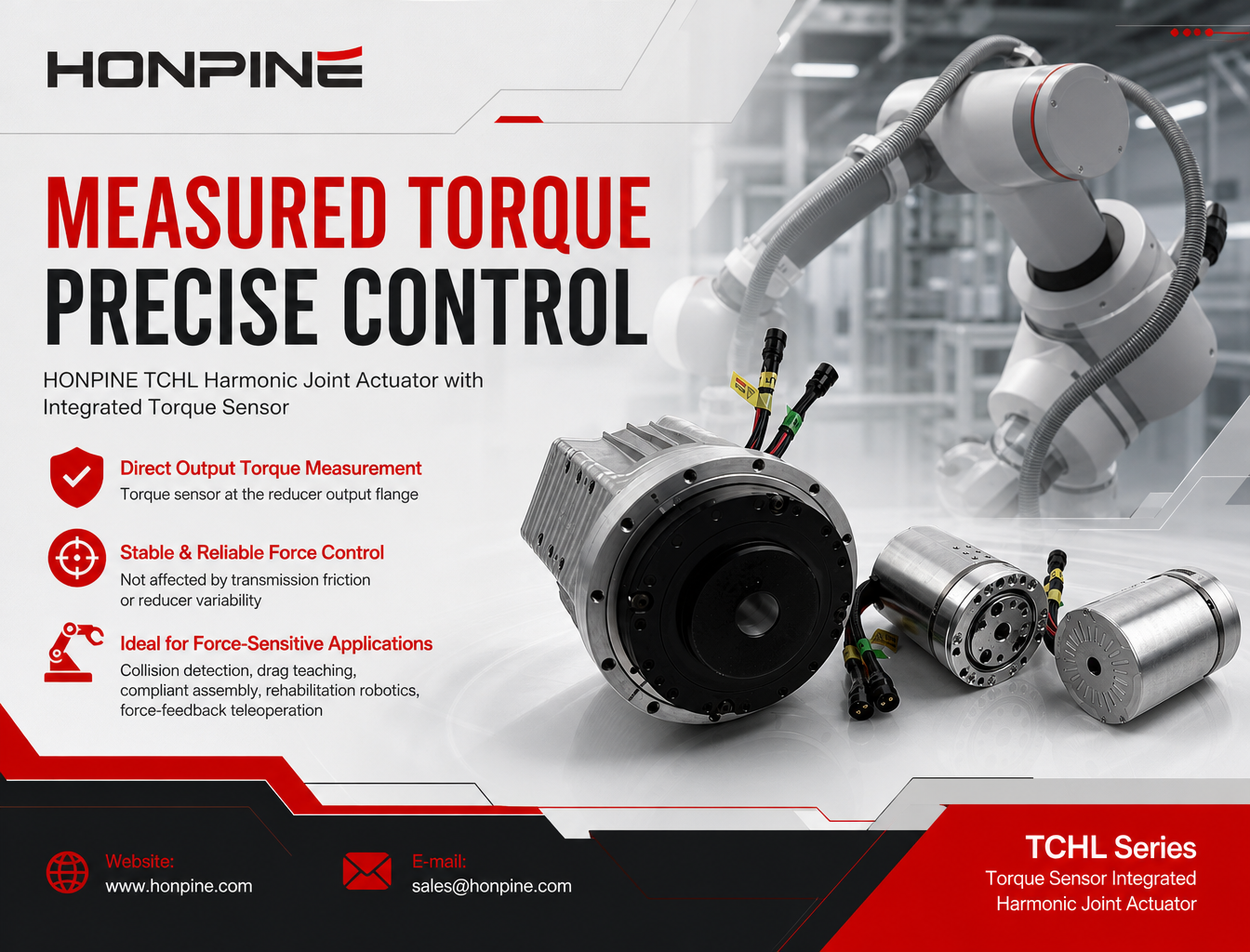
The HONPINE TCHL harmonic joint actuator integrates a torque sensor at the harmonic reducer output flange, enabling direct measurement of output torque. By providing feedback from the joint's output side, it gives robot controllers a more direct signal for force-sensitive applications, including collision detection, drag teaching, compliant assembly, rehabilitation robotics, and force-feedback teleoperation.
This article explains the difference between estimated and measured torque and explores practical applications of the HONPINE TCHL torque-sensor-equipped harmonic joint module.
Motor-Current-Based Torque Estimation vs. Actual Output Torque Measurement
Why Motor Current Does Not Equal Output Torque?
In many conventional servo joints, torque is estimated from motor current. This approach can be useful for motion control, but motor current primarily reflects the electromagnetic torque generated by the motor. It does not directly measure the torque transmitted to the external load.
After passing through a harmonic reducer, the relationship between motor-side torque and output torque can be affected by transmission friction, hysteresis, backlash-related behavior, and operating conditions.
Several practical challenges may arise:
Torque readings during unloaded motion: Friction inside the reducer can generate resistance torque even when the joint is not carrying a substantial external load.
Different readings in opposite directions: Transmission friction and hysteresis can cause different estimated torque values during forward and reverse movement under comparable external loads.
Collision detection trade-offs: A threshold set too high may delay collision detection, while a threshold set too low may trigger false alarms during normal movement.
For applications requiring sensitive force detection, relying exclusively on motor-current estimation may therefore be insufficient.
How the HONPINE TCHL Output Torque Sensor Works?
The torque-sensor-equipped HONPINE TCHL-TM / TH versions place a torque sensor at the output flange of the harmonic reducer. Rather than inferring torque solely from motor current, the joint directly measures torque at the output side.
According to the supplied product specifications, the torque feedback can be read from object-dictionary entry 0x303A, with a unit of 0.01 N·m.
The specified output torque sensor performance includes:
Torque sensor resolution: 0.5% F.S.
Output torque measurement accuracy: 1% F.S.
Torque feedback from the reducer output side.
Here, F.S. means full scale. The percentages should be interpreted according to the sensor's defined full-scale range and the manufacturer's measurement conditions.
Direct output torque measurement provides a more representative signal of the torque transmitted to the external mechanism. It can reduce the influence of uncertainty associated with estimating output torque from motor current, although the sensor itself still has measurement noise, calibration limits, and dynamic response constraints.
Real-World Applications of the HONPINE TCHL Harmonic Joint Actuator
The following applications illustrate how output torque feedback can be used in humanoid robots, collaborative robots, and other force-sensitive robotic systems. The appropriate control mode and safety architecture depend on the robot design, controller capabilities, and application requirements.
1. Whole-Body Force Sensing for Humanoid Robots
Typical control approach: CSP (Cyclic Synchronous Position) mode with output torque feedback.
In a humanoid robot, force information from multiple joints can support coordinated motion control, contact detection, and interaction with the surrounding environment.
Adaptive walking and gait control
Hip, knee, and ankle joints can provide output torque feedback to help the controller estimate contact conditions and adjust joint commands during walking. This information can support adaptation to slopes, uneven terrain, and changes in ground contact, helping improve gait stability.
Whole-body collision detection
When torque feedback is available across multiple joints, the controller can monitor unexpected external interactions at the arms, torso, and legs, rather than relying only on a force sensor at the end effector. This can support broader collision-detection coverage, provided the detection algorithms account for gravity, inertia, acceleration, and normal contact forces.
Drag teaching and trajectory recording
An operator can manually guide selected robot joints while the controller uses torque feedback to help identify external forces. The system can record the resulting motion trajectory for later playback. This may reduce the need for an additional external force sensor in some teaching applications.
Joint health monitoring
Torque waveforms collected during walking and other movements can help identify changes in friction, abnormal resistance, sticking, or other deviations from expected joint behavior. These signals can contribute to condition monitoring and maintenance planning, but they do not independently establish that a harmonic reducer is worn or damaged.
2. Rehabilitation and Assistive Exoskeleton Robots
Typical control approach: CSP position control, with closed-loop torque control where supported and appropriate.
Rehabilitation and assistive exoskeletons must coordinate robot-generated torque with human movement. Output torque feedback can help the controller respond to user effort and changes in external loading.
Lower-limb rehabilitation exoskeletons
Joint torque feedback can contribute to estimating the user's movement intention and coordinating assistance during standing, walking, and rehabilitation exercises. The controller can adjust assistance according to the selected rehabilitation strategy and measured joint behavior.
Upper-limb assistive exoskeletons
Output torque feedback can support force assistance when users lift or manipulate loads. The controller can regulate assistance and reduce commanded torque when predefined force or load limits are approached.
Important safety consideration: Rehabilitation equipment interacts directly with the human body. If the application uses the TCHL's 0xFF closed-loop torque-control mode, the relevant speed-limit parameter identified as 3401h in the supplied control documentation must be configured and validated according to the manufacturer's instructions. The parameter's exact definition and units should be confirmed against the applicable firmware and object dictionary. Appropriate mechanical limits, emergency stops, fault handling, and independent safety measures are also necessary.
3. Flexible Operation of Collaborative Robot Arms
Typical control approach: CSP mode with joint torque feedback.
Collaborative robots often need to operate near people while performing tasks that require controlled contact, compliance, or force-sensitive motion.
Collision detection and compliant response
Torque feedback from multiple joints can help a robot detect unexpected contact at different points along its structure. Depending on the safety architecture, the robot may respond by reducing speed, yielding, or stopping.
However, an integrated torque sensor alone does not establish collaborative safety. The complete robot application must be risk-assessed and validated against applicable safety requirements.
Precision assembly
During screw fastening, snap-fit assembly, and component insertion, joint torque feedback can help the controller identify rising resistance or unexpected contact. When a jam or abnormal load is detected, the robot can stop or adjust its movement to reduce the risk of damaging delicate plastic parts and electronic components.
When an end-effector force sensor is still recommended
For precision grinding or polishing involving very small lateral forces at the tool tip, a six-axis force/torque sensor near the end effector may still be the better choice. Joint torque sensing is particularly useful for monitoring joint-level loading and supporting compliant motion, while a tool-mounted sensor measures forces and moments closer to the actual working point.
4. Press-Fitting and Clamping Applications
In press-fitting, clamping, and test fixtures, the TCHL output torque signal can support controlled contact and force-related process monitoring.
The controller can use torque feedback to detect when a workpiece contacts a fixture, identify an increase in resistance, and adjust motion to accommodate small positional deviations. With a suitable mechanical model and calibrated tooling, joint torque can help regulate the pressing process.
It is important to distinguish joint torque from the actual linear pressing force. Converting output torque into contact force requires consideration of the mechanism's geometry, leverage, friction, and other load-path characteristics.
5. Tension Control for Winding and Unwinding
Wire, film, and roll-to-roll handling systems often require stable tension to prevent material breakage, stretching, or deformation.
A torque-sensor-equipped joint can provide output torque feedback for a controller that regulates winding or unwinding torque. Where the mechanical arrangement permits, this feedback can support tension regulation and help the system respond to changing material loads.
Maximum rotational speed and acceleration should also be limited according to the material, reel diameter, inertia, and equipment design. Output torque alone is not a direct measurement of web tension; the relationship depends on the winding radius and transmission mechanism.
6. Grinding and Deburring
During grinding and deburring, a robot must maintain suitable contact with the workpiece despite small positional errors and variations in surface geometry.
Output torque feedback can help the controller monitor joint loading and adjust movement to maintain a more compliant interaction. This can support deburring of castings and machined components while reducing excessive contact loads.
For applications requiring precise regulation of tool-tip contact force, the control system may also need an end-effector force sensor, a calibrated force model, or additional process feedback.
7. Master-Slave Force-Feedback Teleoperation
Typical control approach: 0xFF closed-loop torque-control mode, subject to controller and firmware support.
Force-feedback teleoperation allows an operator to manipulate a remote robot while receiving information about the forces encountered at the remote site.
Master side: Torque sensors in the operator-side joints measure the interaction between the operator and the master device.
Slave side: The remote robot uses the supported closed-loop torque-control mode to reproduce commanded torque or interaction behavior within configured limits.
With an appropriate bilateral control architecture, the system can return remote contact-force information to the operator, helping them perceive environmental resistance during remote manipulation.
Potential applications include hazardous-environment inspection, specialized emergency-response operations, and remote handling in areas that are difficult or dangerous for people to access.
The master and slave signals must be appropriately scaled and stabilized. Communication delay, unexpected contact, and loss of connection must be addressed to prevent unstable or unsafe force feedback.
8. Laboratory Research and Test Fixtures
The TCHL harmonic joint actuator can also serve as an actuator and measurement component in robotics research and mechanical testing.
Joint endurance and torque-loading tests
In a test fixture, a joint operating in a supported closed-loop torque-control mode can apply controlled torque profiles to a component or test assembly. The integrated output torque sensor can provide feedback for monitoring the applied torque and comparing commanded and measured values.
Test accuracy depends on the fixture's stiffness, alignment, calibration, control bandwidth, and measurement uncertainty.
University and research platforms
For humanoid robotics and force-control research, output torque feedback can support:
Impedance-control algorithm development using CSP position control and torque feedback.
Manual guidance and drag-teaching experiments.
Joint-level contact detection and compliant motion research.
Closed-loop torque-control experiments using the supported 0xFF mode.
These capabilities allow researchers to explore different force-control strategies without necessarily adding a separate torque sensor to every joint, depending on the requirements of the experiment.
HONPINE TCHL Harmonic Joint Actuator — Technical Specifications
The following table summarizes the supplied torque-sensing and torque-output specifications for the TCHL series.
The torque values above are reproduced from the supplied specifications. Confirm the torque unit, assumed to be N·m, before publication.
Confirm whether “2000 rpm” refers to motor speed or output speed, and whether all listed continuous torque ratings apply under the same operating conditions.
The dash indicates that the corresponding specification was not provided for TCHL-11; it does not necessarily mean the function is unavailable.
Confirm the definition and measurement conditions of the stated ±3% F.S. noise floor, as well as the method used to determine sensor resolution and accuracy.
How to Choose a Torque-Sensor-Equipped Robot Joint?
When evaluating an integrated joint for humanoid or collaborative robots, engineers should look beyond whether the product is described as supporting force control.
First, determine where the torque signal originates. Motor-current-based estimation and direct output torque measurement are different approaches, with different limitations.
Next, check the sensor's measurement range, resolution, accuracy, noise, response characteristics, and calibration conditions. These specifications influence how effectively the feedback can be used for collision detection, compliant motion, and torque regulation.
The control interface and operating modes are equally important. Confirm support for the required communication protocol, object-dictionary entries, feedback units, CSP operation, and closed-loop torque-control functions. Also verify the behavior of speed limits, overload handling, communication faults, and emergency-stop logic.
Finally, match the joint's continuous and peak torque, speed, size, mass, and thermal characteristics to the application. A sensor-equipped joint is only one part of a force-control system; robot dynamics, control algorithms, mechanical design, and system-level safety validation remain essential.
Conclusion — Build Better Force-Sensing Robots with HONPINE TCHL
As humanoid and collaborative robotics advance, reliable force feedback is becoming increasingly important for compliant movement, contact detection, assembly, rehabilitation, and remote manipulation.
The HONPINE TCHL harmonic joint actuator integrates torque sensing at the reducer output side, providing direct output torque feedback rather than relying exclusively on motor-current-based estimation. When combined with suitable control algorithms and validated system-level safeguards, this feedback can support a wide range of force-sensitive robotic applications.
For engineers selecting an integrated robot joint, the key question is not simply whether a joint supports force control, but how torque is measured, how feedback is used, and how the complete system responds to unexpected contact and faults.
Contact HONPINE to learn more about TCHL torque-sensor-equipped harmonic joint actuators, technical documentation, and integration options for humanoid robots, collaborative robot arms, exoskeletons, and research platforms.

About Author
Theodore Li serves as the Technical Director at HONPINE, overseeing the R&D strategy for replication products, guiding team selection, and managing both pre-sales and after-sales operations.

Read More
Learn more about the story of HONPINE and industry trends related to precision transmission.
 What is robot joint actuator?How to Choose the Best Robot Rotary Joint Actuator?In core robot joint transmission solutions, planetary and harmonic rotary actuators each have their own strengths. Choosing the right type based on application requirements is essential to achieve the optimal balance between performance and cost.
 DD Motors VS Harmonic Rotary ActuatorsThis article provides an in-depth comparison between Direct Drive (DD) motors and harmonic rotary actuators, covering their transmission principles, advantages and disadvantages, and typical application fields.
 OMG Ultra Compact Harmonic Drive Joint Module with Built-in Torque SensorHONPINE TCHL series harmonic drive joint module is a game-changing product that achieves disruptive improvements in multiple aspects such as lightweight design, integration level, and connection convenience. This article will analyze its revolutionary enhancements with you.
 The Role of Harmonic Drive Gears in Achieving 5–10 μm Accuracy in Dental Milling MachinesA dental milling machine is a CNC machining system used to directly process digital dental models into restorations such as crowns, bridges, veneers, inlays, and implant abutments. Dental milling machines require far higher operational accuracy and motion stability than ordinary equipment. This article explains how harmonic drive gear help dental milling machines achieve stable, continuous, and controllable operation.
 Why Are Harmonic Rotary Actuators Perfect for Medical Equipment?Harmonic rotary actuators (typically integrated systems consisting of a harmonic drive reducer, frameless torque motor, encoder, and optional brake) are regarded as key components in medical equipment. The core reason is that they simultaneously meet the most stringent medical requirements for precision, compact size, safety, and controllability. The following explanation is structured from three perspectives: technical characteristics, application scenarios, and medical value.
 High-Precision RV Reducers Perfectly Matched for Walking RobotsThe walking axis of a robot is a core component for power transmission and support. RV reducers provide extremely high rigidity, precision, and torque while maintaining a compact size and exceptional reliability, making them an ideal match for the demanding requirements of walking robot joints in terms of load capacity, impact resistance, and precision.
 How Does a Harmonic Joint Actuator with a Torque Sensor Improve Robot Force Control?Learn how the HONPINE TCHL harmonic joint actuator uses an integrated output torque sensor to support force feedback, collision detection, compliant assembly, rehabilitation robotics, and teleoperation.
 Harmonic Drive Actuator Accuracy: Why It Should Be Evaluated at Four LevelsHarmonic drive actuator accuracy involves more than encoder resolution. Why should engineers evaluate it at four levels? Resolution, repeatability, unidirectional positioning accuracy, and bidirectional positioning accuracy describe different aspects of motion performance. Understanding these differences helps engineers select harmonic rotary actuators for semiconductor equipment, EFEM systems, and 3C automation without confusing theoretical encoder increments with actual positioning performance.
 Why Do Many Customers Choose HONPINE HPJM Harmonic Joint Modules for Just 2 mm More Hollow Bore Diameter?Why do many customers choose HONPINE HPJM harmonic joint modules for just 2 mm more hollow bore diameter? In compact robotic joints, this small dimensional difference can create a surprisingly large increase in available space. Because the cross-sectional area of a circular bore increases with the square of its diameter, an extra 2 mm can significantly improve internal cable routing and simplify system integration. This article examines the impact of hollow bore diameter, compares selected HONPINE HPJM models with comparable harmonic joint modules, and explains why bore size matters in humanoid robots, collaborative robots, and industrial automation.
 Harmonic Drive Backlash in Arcmin: What the Specification Really Tells YouChoosing the right force control harmonic joint actuator involves more than comparing torque and dimensions. Torque sensor specifications, encoder feedback, communication protocols, functional safety, and hollow-shaft size can all affect system integration and control performance. In this guide, HONPINE Technical Director compares the TCHL and HAG harmonic joint actuator series, explaining their key differences and providing a practical selection framework for humanoid robots, collaborative manipulators, precision assembly, polishing, and other force-controlled applications.
 How to Choose a Force Control Harmonic Joint Actuator? An In-Depth Comparison of HONPINE TCHL and HAGChoosing the right force control harmonic joint actuator involves more than comparing torque and dimensions. Torque sensor specifications, encoder feedback, communication protocols, functional safety, and hollow-shaft size can all affect system integration and control performance. In this guide, HONPINE Technical Director compares the TCHL and HAG harmonic joint actuator series, explaining their key differences and providing a practical selection framework for humanoid robots, collaborative manipulators, precision assembly, polishing, and other force-controlled applications.
 HONPINE TCHL Harmonic Joint Modules: Robotic Force Control and Real-World ApplicationsHello everyone, I’m Theodore Li, Technical Director at HONPINE.
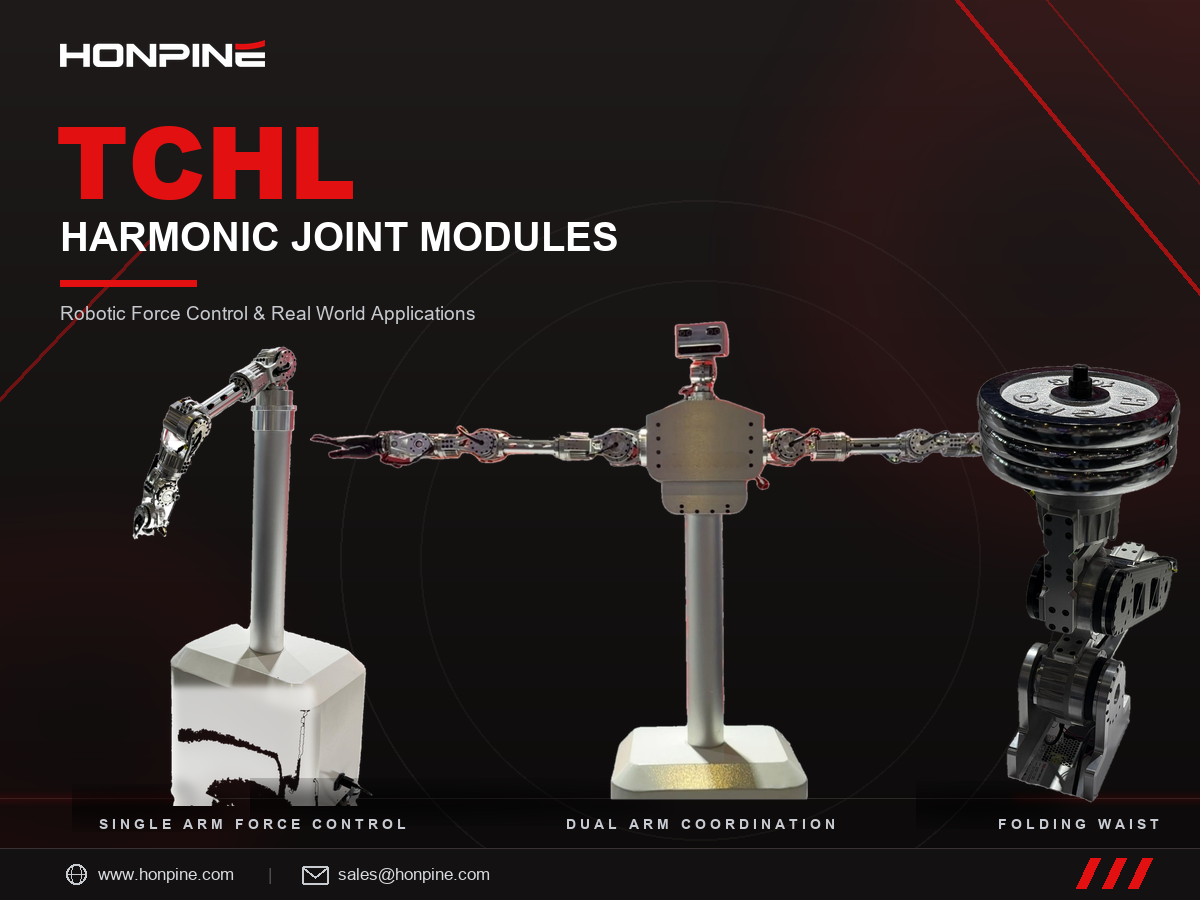
HONPINE TCHL harmonic joint modules have been deployed in a range of robotic motion-control applications, including dual-arm humanoid robots, single-arm compliant force control, and folding waist mechanisms for wheeled humanoid robots. As integrated motion components, they support a wide range of applications in robotics, intelligent manufacturing, and industrial automation.
From core components to integrated motion units, HONPINE showcases the possibilities of precision transmission technology across different robotic applications through a diverse product portfolio and practical motion demonstrations.
Double Click
We provide harmonic drive reducer,planetary reducer,robot joint motor,robot rotary actuators,RV gear reducer,robot end effector,dexterous robot hand
 What is robot joint actuator?How to Choose the Best Robot Rotary Joint Actuator?In core robot joint transmission solutions, planetary and harmonic rotary actuators each have their own strengths. Choosing the right type based on application requirements is essential to achieve the optimal balance between performance and cost.
 DD Motors VS Harmonic Rotary ActuatorsThis article provides an in-depth comparison between Direct Drive (DD) motors and harmonic rotary actuators, covering their transmission principles, advantages and disadvantages, and typical application fields.
 OMG Ultra Compact Harmonic Drive Joint Module with Built-in Torque SensorHONPINE TCHL series harmonic drive joint module is a game-changing product that achieves disruptive improvements in multiple aspects such as lightweight design, integration level, and connection convenience. This article will analyze its revolutionary enhancements with you.
 How Does a Harmonic Joint Actuator with a Torque Sensor Improve Robot Force Control?Learn how the HONPINE TCHL harmonic joint actuator uses an integrated output torque sensor to support force feedback, collision detection, compliant assembly, rehabilitation robotics, and teleoperation.
 Harmonic Drive Actuator Accuracy: Why It Should Be Evaluated at Four LevelsHarmonic drive actuator accuracy involves more than encoder resolution. Why should engineers evaluate it at four levels? Resolution, repeatability, unidirectional positioning accuracy, and bidirectional positioning accuracy describe different aspects of motion performance. Understanding these differences helps engineers select harmonic rotary actuators for semiconductor equipment, EFEM systems, and 3C automation without confusing theoretical encoder increments with actual positioning performance.
 Why Do Many Customers Choose HONPINE HPJM Harmonic Joint Modules for Just 2 mm More Hollow Bore Diameter?Why do many customers choose HONPINE HPJM harmonic joint modules for just 2 mm more hollow bore diameter? In compact robotic joints, this small dimensional difference can create a surprisingly large increase in available space. Because the cross-sectional area of a circular bore increases with the square of its diameter, an extra 2 mm can significantly improve internal cable routing and simplify system integration. This article examines the impact of hollow bore diameter, compares selected HONPINE HPJM models with comparable harmonic joint modules, and explains why bore size matters in humanoid robots, collaborative robots, and industrial automation.
 Harmonic Drive Backlash in Arcmin: What the Specification Really Tells YouChoosing the right force control harmonic joint actuator involves more than comparing torque and dimensions. Torque sensor specifications, encoder feedback, communication protocols, functional safety, and hollow-shaft size can all affect system integration and control performance. In this guide, HONPINE Technical Director compares the TCHL and HAG harmonic joint actuator series, explaining their key differences and providing a practical selection framework for humanoid robots, collaborative manipulators, precision assembly, polishing, and other force-controlled applications.
 How to Choose a Force Control Harmonic Joint Actuator? An In-Depth Comparison of HONPINE TCHL and HAGChoosing the right force control harmonic joint actuator involves more than comparing torque and dimensions. Torque sensor specifications, encoder feedback, communication protocols, functional safety, and hollow-shaft size can all affect system integration and control performance. In this guide, HONPINE Technical Director compares the TCHL and HAG harmonic joint actuator series, explaining their key differences and providing a practical selection framework for humanoid robots, collaborative manipulators, precision assembly, polishing, and other force-controlled applications.
 HONPINE TCHL Harmonic Joint Modules: Robotic Force Control and Real-World ApplicationsHello everyone, I’m Theodore Li, Technical Director at HONPINE.
HONPINE TCHL harmonic joint modules have been deployed in a range of robotic motion-control applications, including dual-arm humanoid robots, single-arm compliant force control, and folding waist mechanisms for wheeled humanoid robots. As integrated motion components, they support a wide range of applications in robotics, intelligent manufacturing, and industrial automation.
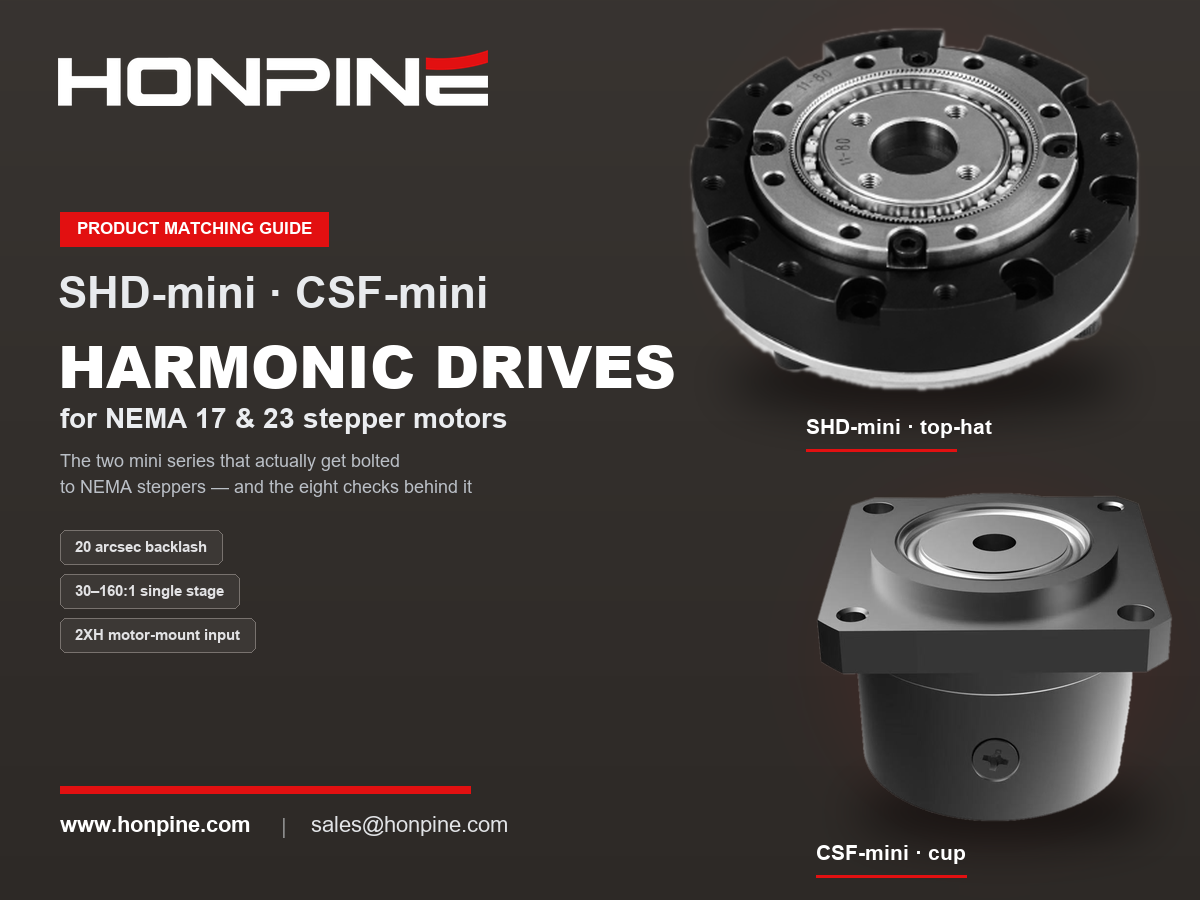
From core components to integrated motion units, HONPINE showcases the possibilities of precision transmission technology across different robotic applications through a diverse product portfolio and practical motion demonstrations. NEMA 17 & NEMA 23 Harmonic Drive Matching Guide: Pairing Stepper Motors with Harmonic ReducersPairing a stepper motor with a harmonic drive is not a budget compromise. A stepper's weak points — the coarse step angle, torque collapse above roughly 400 rpm, and the lack of a precision transmission — are exactly what a harmonic drive fixes: it pulls the operating point into the low-speed, high-torque sweet spot, refines a 1.8° step angle into arc-second resolution, and delivers near-zero backlash. This guide explains what NEMA frame sizes mean at the mounting interface, which harmonic frames match NEMA 17 and NEMA 23, the eight checks to run in order — including the input-side no-load starting torque most often missed — and the pairing's real weakness: silent failure. Includes HONPINE SHD and CSF specifications.
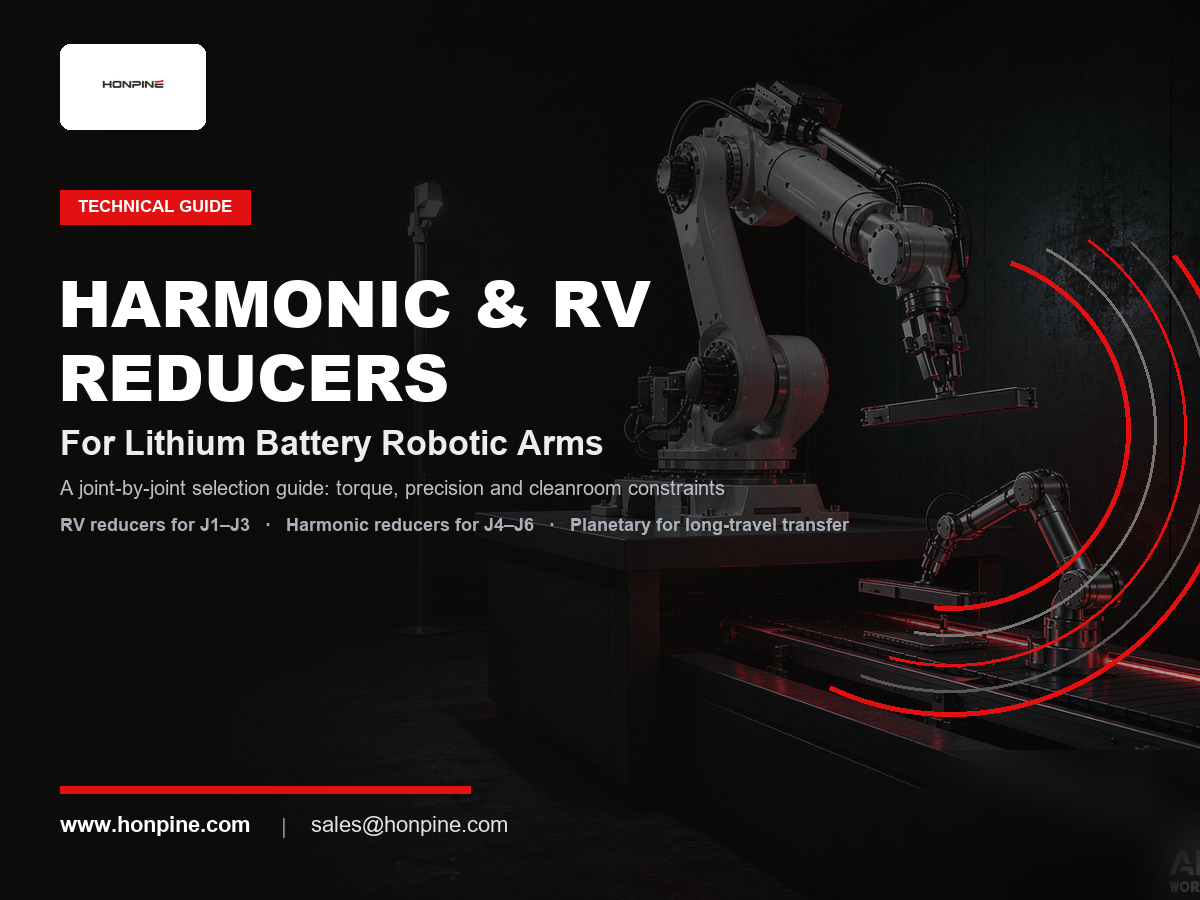
 Harmonic vs. RV Reducers for Lithium Battery Robotic Arms: A Joint-by-Joint Selection GuideIn lithium battery plants, reducer selection for a robotic arm is not about finding one "best" gearbox — it is about dividing work by joint. RV reducers take the shoulder and elbow (J1–J3), where stiffness, shock resistance, and long life matter most; harmonic reducers take the wrist (J4–J6), where near-zero backlash, high torque density, and low weight decide positioning accuracy. Planetary gearboxes cover long-travel Cartesian transfer at lower cost. Lithium battery production then adds three stricter filters: extreme repeatability (±0.02–0.05 mm), 24/7 high-duty cycles, and zero tolerance for metal particle contamination. This guide explains the logic behind joint-by-joint selection, compares the three reducer types, and maps typical configurations for every station.
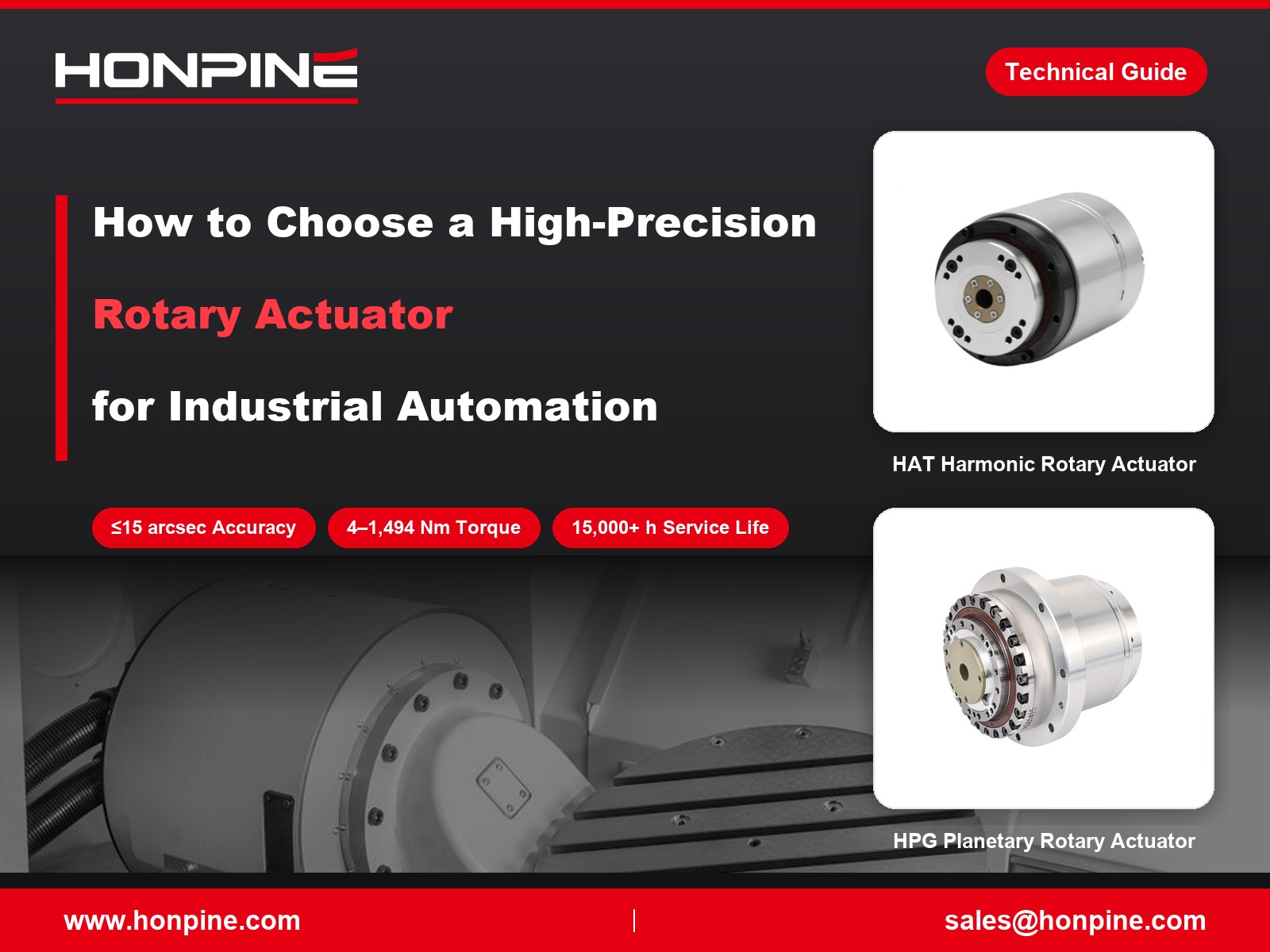
 How to Choose High-Precision Rotary Actuators for Industrial Automation?High-precision rotary actuators play an important role in industrial automation, where positioning accuracy, repeatability, durability and installation flexibility directly affect equipment performance. HONPINE offers four main series of precision rotary actuators, including HAT, HAM and HAS harmonic rotary actuators and HPG low-backlash planetary actuators. With torque ratings ranging from 4 to 1,494 Nm across the product range, these solutions are designed for applications in semiconductor manufacturing, 3C automation, laser processing and CNC machine tools. Learn how to identify the right rotary actuator based on operating conditions, precision requirements and mechanical integration needs.