

How to Choose High-Precision Rotary Actuators for Industrial Automation?
High-precision rotary actuators are essential motion-control components in industrial automation. They help improve positioning consistency, operating efficiency and equipment flexibility. However, selecting the right actuator can be challenging when product specifications vary, operating conditions are demanding, and long-term reliability is critical.
For precision industrial automation, HONPINE commonly provides externally driven harmonic rotary actuatorsand Self Anti-Backlash Planetary Rotary Actuator. These solutions are designed to meet different requirements for torque, positioning performance, mechanical integration and environmental protection.
In this article, we introduce four key HONPINE precision rotary actuator series and explain their main features, performance specifications and typical industrial applications.
Which High-Precision Rotary Actuator Series Does HONPINE Offer?
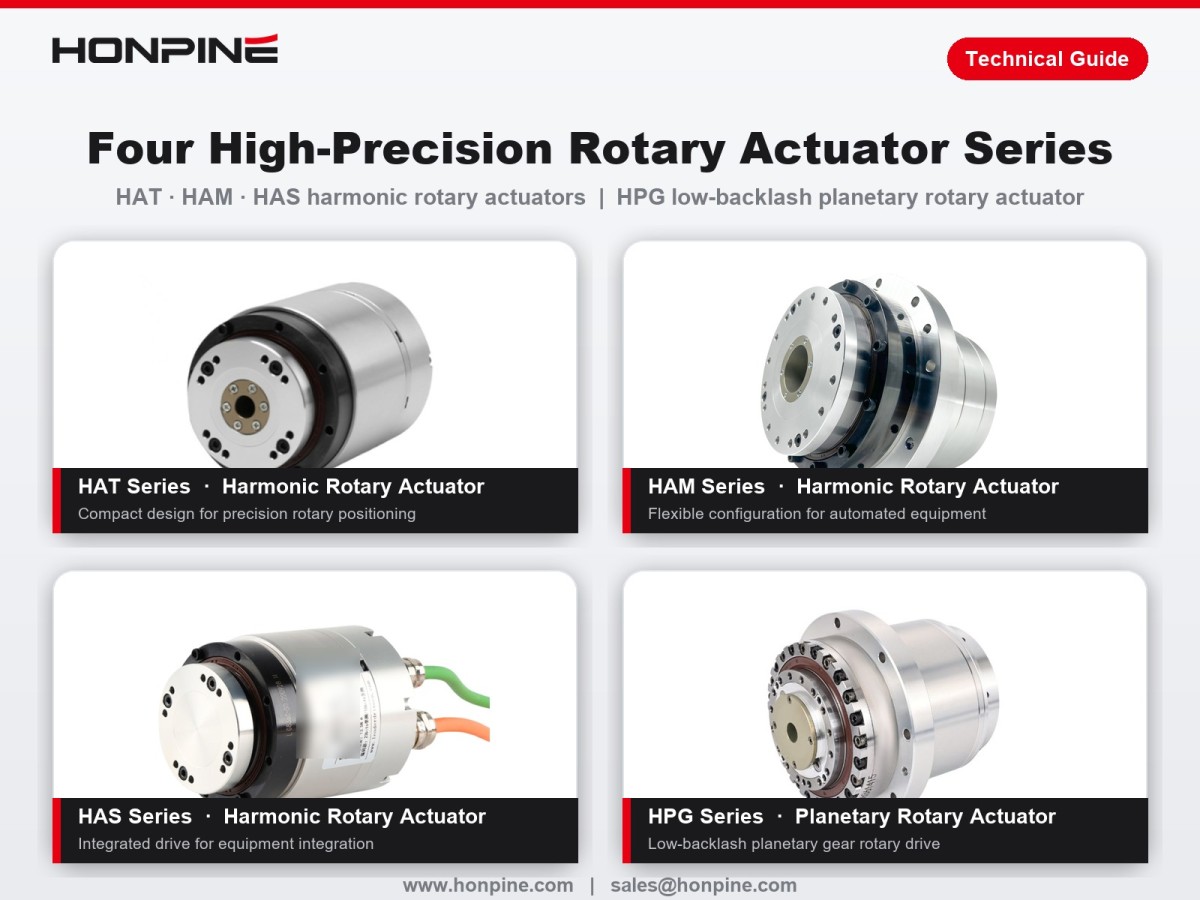
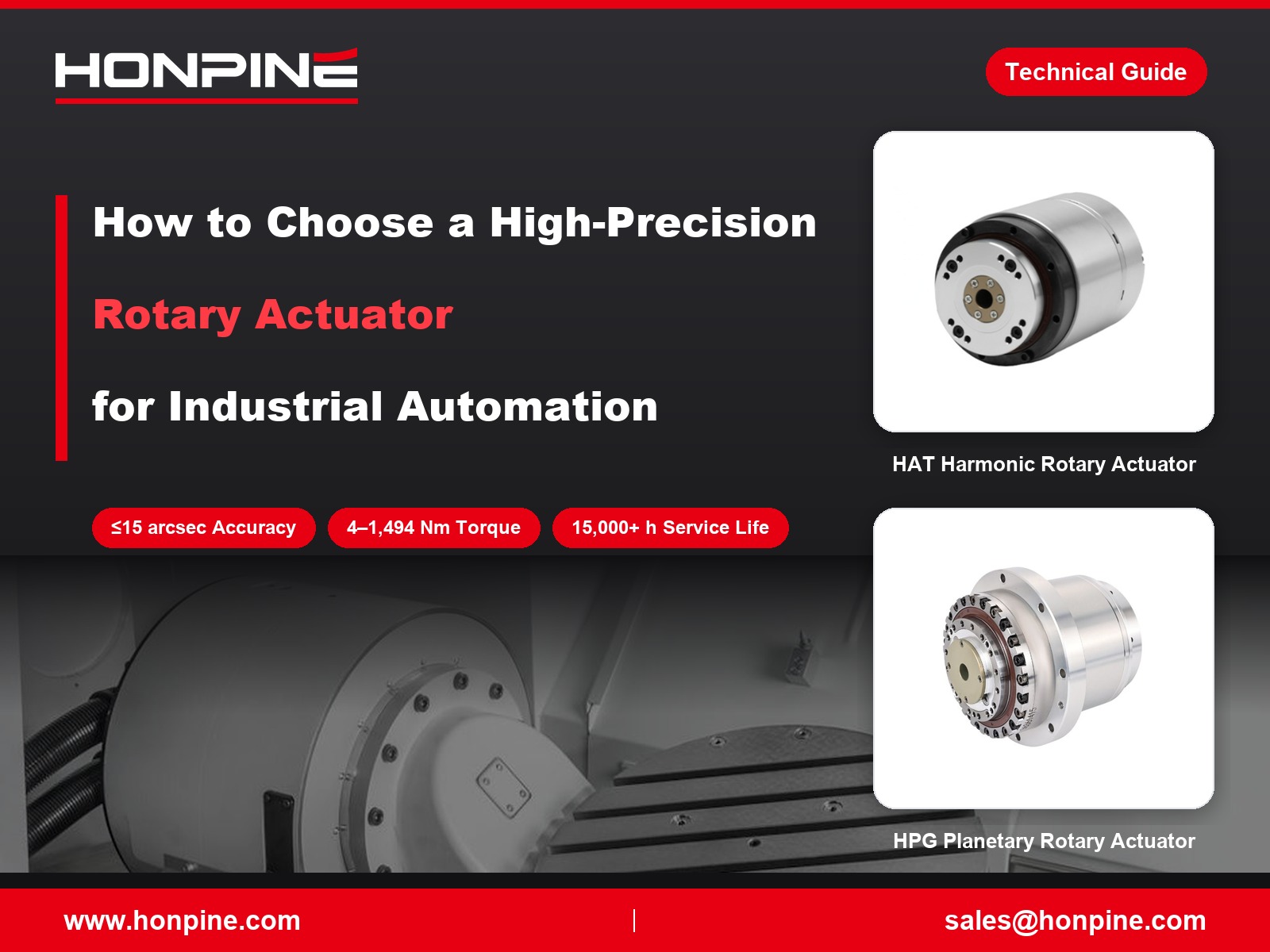
HONPINE focuses on four main series of high-precision rotary actuators: HAT, HAM and HAS harmonic rotary actuators, and HPG low-backlash planetary rotary actuators.
Each series offers different structural configurations and performance characteristics, allowing equipment manufacturers to select a suitable solution according to their application requirements.
HAT Harmonic Rotary Actuator
Designed for precision rotary motion applications requiring compact transmission and controlled positioning.
HAM Harmonic Rotary Actuator
Provides another harmonic transmission solution for automated equipment with specific torque, installation and motion-control requirements.
HAS Harmonic Rotary Actuator
Suitable for precision rotary positioning applications where transmission performance and equipment integration are important.
HPG Low-Backlash Planetary Rotary Actuator
Designed for applications requiring reduced transmission backlash and a planetary gear-based rotary drive solution.
The appropriate series depends on the required torque, reduction ratio, positioning performance, operating speed, installation space and working environment. Detailed specifications should be checked for the individual model.
Why Choose HONPINE High-Precision Rotary Actuators?
A Wide Torque Range for Different Automation Requirements
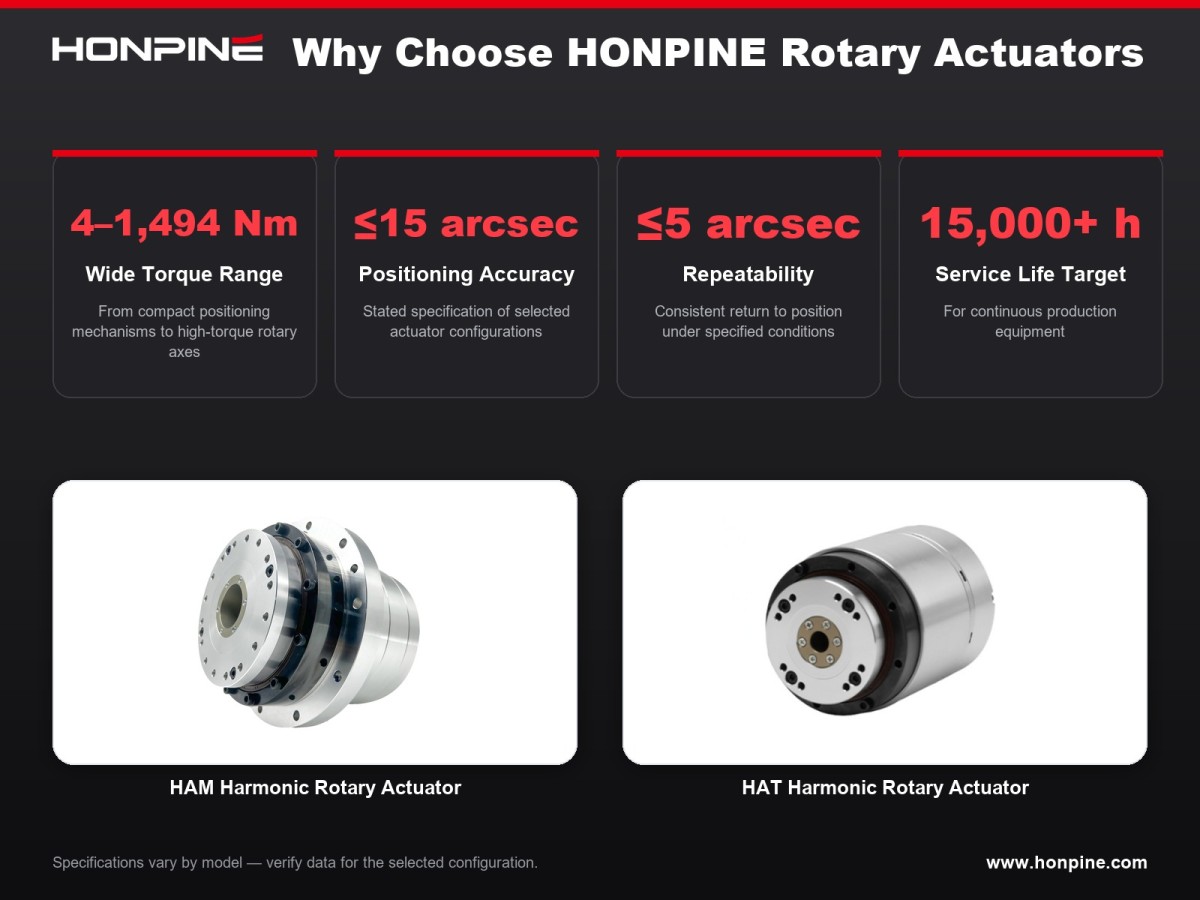
HONPINE precision rotary actuators cover a torque range of approximately 4–1,494 Nm across the product portfolio. This range allows equipment designers to evaluate different actuator sizes for applications ranging from compact positioning mechanisms to higher-torque rotary axes.
Operating voltage options include 48 V and 220 V, depending on the actuator configuration. When selecting a model, engineers should also consider rated torque, peak torque, output speed, duty cycle and acceleration requirements rather than relying on torque alone.
Precision Positioning and Repeatability
Positioning performance is especially important in semiconductor equipment, precision assembly and CNC rotary systems.
According to HONPINE's stated product specifications, selected rotary actuator configurations can offer positioning accuracy of ≤15 arcsec and repeatability of ≤5 arcsec. These figures should be verified against the specifications and test conditions of the particular model.
Positioning accuracy and repeatability describe different aspects of motion performance. Accuracy concerns the deviation from a commanded or reference position, while repeatability describes how consistently the actuator returns to the same position under specified conditions.
For demanding applications, engineers should evaluate both parameters alongside transmission stiffness, load conditions, encoder feedback and control-system performance.
Sealed Designs for Demanding Operating Environments
Dust, oil contamination and other environmental factors can affect the reliability of precision motion systems. A suitable actuator design can help protect critical transmission components and reduce maintenance requirements.
HONPINE offers sealed actuator configurations intended for demanding industrial environments. Depending on the model and its protection rating, these designs may be suitable for equipment exposed to dust or oil contamination.
Before installation, confirm the actual ingress protection rating, temperature limits, lubrication requirements and maintenance recommendations for the selected actuator. Environmental suitability should be established from the model-specific documentation rather than assumed from the term "sealed."
Long Service Life and Verified Performance Data
Service life is an important consideration when selecting a rotary actuator for continuous production equipment. HONPINE states a service-life target exceeding 15,000 hours for its precision rotary actuator offerings.
Actual service life depends on load, speed, duty cycle, temperature, installation quality and maintenance conditions. Equipment manufacturers should therefore confirm the applicable service-life data and test conditions for the intended model.
Reviewing documented performance data is also important when comparing suppliers. Test conditions, measurement methods and the distinction between nominal and measured values should be clear before a product is approved for production use.
Where Are HONPINE Precision Rotary Actuators Used?
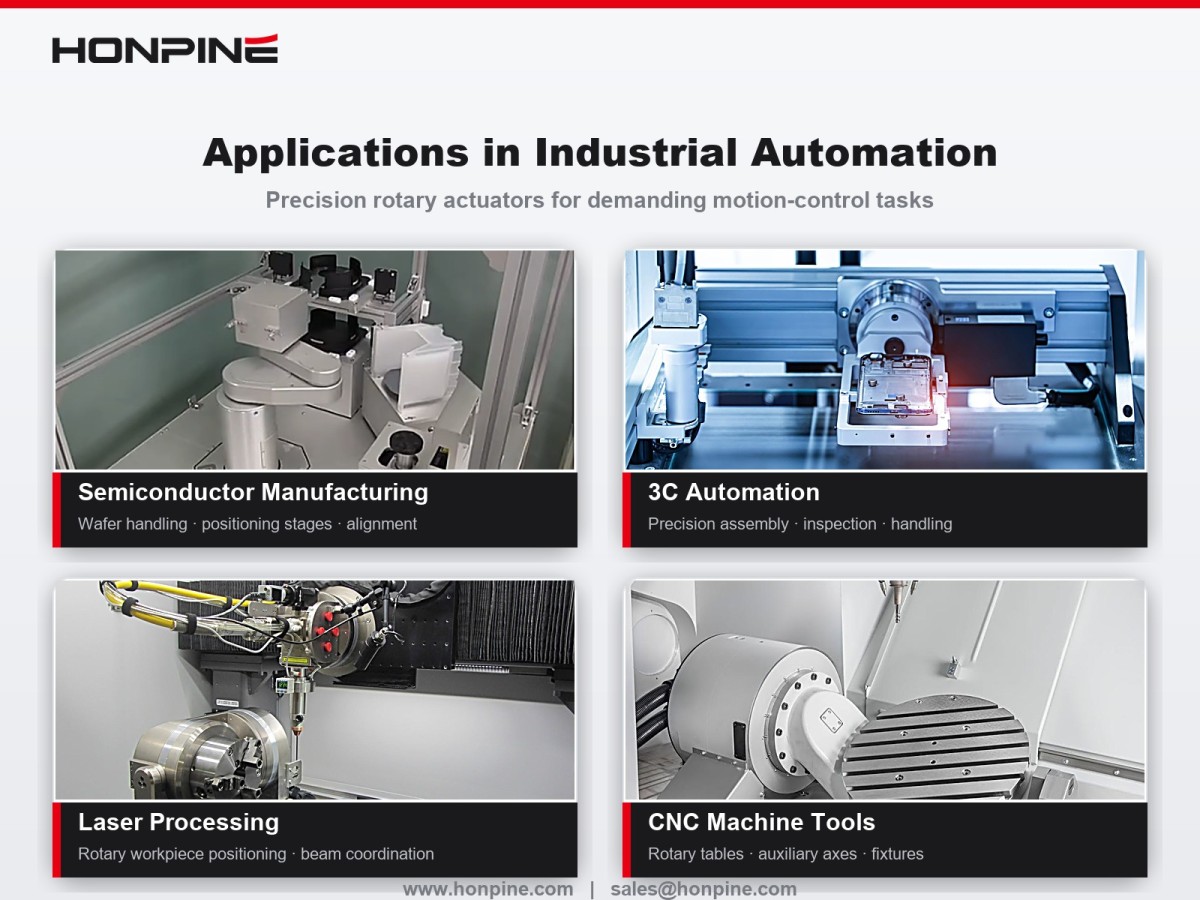
HONPINE offers more than 100 actuator models and configurations for different industrial motion-control requirements. Four important application areas include semiconductor equipment, 3C automation, laser processing and CNC machine tools.
Semiconductor Manufacturing Equipment
Semiconductor manufacturing equipment often requires compact rotary positioning mechanisms, consistent motion and reliable operation over repeated production cycles.
Precision rotary actuators can be evaluated for wafer-handling mechanisms, rotary positioning stages, alignment systems and other automated equipment that requires controlled angular movement.
When choosing an actuator for semiconductor applications, engineers should consider positioning requirements, cleanliness, available installation space, thermal stability and the operating environment.
3C Automation
3C automation covers manufacturing processes for computers, communications devices and consumer electronics. Assembly, inspection and handling equipment may require frequent angular corrections and repeatable positioning within compact mechanisms.
Harmonic rotary actuators can be considered for precision assembly axes, rotating fixtures and automated inspection stations. Low-backlash transmission characteristics can help reduce the influence of mechanical clearance during directional changes.
The final selection should account for cycle time, payload inertia, positioning requirements and the mechanical design of the equipment.
Laser Processing Equipment
Laser processing systems may use rotary axes to position workpieces, orient components or coordinate motion with a laser head.
A suitable precision rotary actuator can support controlled angular movement and repeatable positioning in these mechanisms. Selection should consider the required angular accuracy, acceleration, load inertia, operating speed and integration with the motion controller.
For applications involving heat, dust or process contamination, the actuator's environmental protection and thermal operating limits should also be confirmed.
CNC Machine Tools
CNC machine tools and rotary tables require appropriate combinations of torque, stiffness, positioning accuracy and repeatability.
Harmonic rotary actuators and low-backlash planetary rotary actuators can be evaluated for auxiliary rotary axes, positioning fixtures and specialized machine-tool mechanisms, depending on the machine's load and dynamic requirements.
For demanding machining applications, engineers should pay particular attention to cutting-force effects, torsional stiffness, continuous and peak torque, thermal behavior and positioning performance under load.
How to Select the Right Precision Rotary Actuator?
Choosing an actuator should begin with the actual motion requirements rather than a single headline specification.
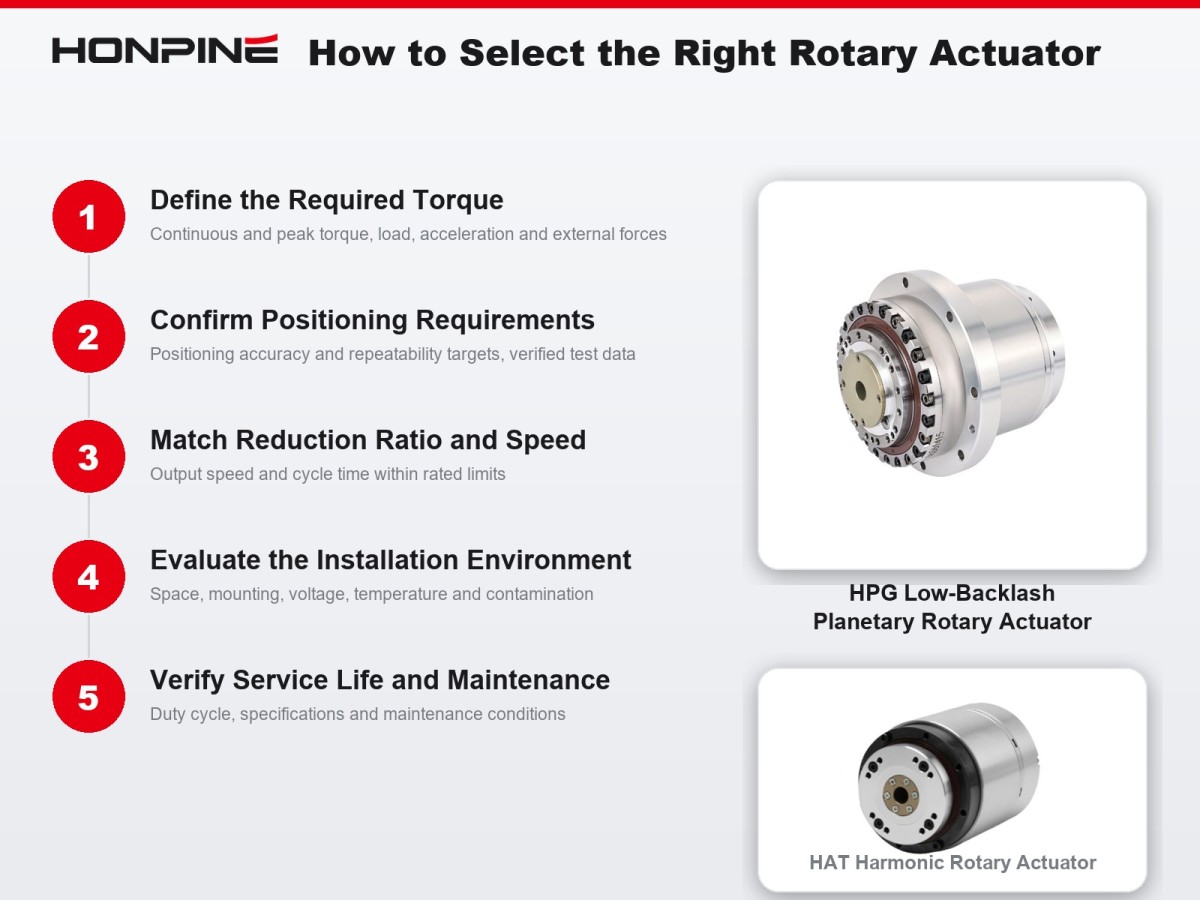
1. Define the Required Torque
Calculate the torque needed for the load, acceleration, deceleration and external forces. Distinguish between continuous operating torque and peak torque.
2. Confirm Positioning Requirements
Establish the required positioning accuracy and repeatability, then check the relevant model's test data and feedback configuration.
3. Match the Reduction Ratio and Speed
Ensure the actuator can achieve the required output speed and cycle time while operating within its rated limits.
4. Evaluate the Installation Environment
Check available space, mounting interfaces, voltage, cabling, temperature, contamination and protection requirements.
5. Verify Service-Life and Maintenance Conditions
Review the manufacturer's specifications and confirm that the actuator is suitable for the intended duty cycle and operating conditions.
A properly selected rotary actuator should meet the combined requirements for torque, positioning performance, speed, installation and reliability.
Find a Suitable HONPINE Rotary Actuator for Your Application
HONPINE provides HAT, HAM and HAS harmonic rotary actuators, together with HPG zero-backlash planetary rotary actuators, for a range of precision industrial automation applications.
Whether you are developing semiconductor equipment, 3C automation systems, laser processing machines or CNC rotary mechanisms, selecting the right actuator begins with understanding your motion requirements and working conditions.
Contact HONPINE to request product specifications and technical support. Share your required torque, reduction ratio, positioning targets, operating voltage and installation drawings so that our technical team can help evaluate a suitable configuration.
Website: https://www.honpine.com
Email: sales@honpine.com
Read More
Learn more about the story of HONPINE and industry trends related to precision transmission.
 What is robot joint actuator?How to Choose the Best Robot Rotary Joint Actuator?In core robot joint transmission solutions, planetary and harmonic rotary actuators each have their own strengths. Choosing the right type based on application requirements is essential to achieve the optimal balance between performance and cost.
 DD Motors VS Harmonic Rotary ActuatorsThis article provides an in-depth comparison between Direct Drive (DD) motors and harmonic rotary actuators, covering their transmission principles, advantages and disadvantages, and typical application fields.
 OMG Ultra Compact Harmonic Drive Joint Module with Built-in Torque SensorHONPINE TCHL series harmonic drive joint module is a game-changing product that achieves disruptive improvements in multiple aspects such as lightweight design, integration level, and connection convenience. This article will analyze its revolutionary enhancements with you.
 The Role of Harmonic Drive Gears in Achieving 5–10 μm Accuracy in Dental Milling MachinesA dental milling machine is a CNC machining system used to directly process digital dental models into restorations such as crowns, bridges, veneers, inlays, and implant abutments. Dental milling machines require far higher operational accuracy and motion stability than ordinary equipment. This article explains how harmonic drive gear help dental milling machines achieve stable, continuous, and controllable operation.
 Why Are Harmonic Rotary Actuators Perfect for Medical Equipment?Harmonic rotary actuators (typically integrated systems consisting of a harmonic drive reducer, frameless torque motor, encoder, and optional brake) are regarded as key components in medical equipment. The core reason is that they simultaneously meet the most stringent medical requirements for precision, compact size, safety, and controllability. The following explanation is structured from three perspectives: technical characteristics, application scenarios, and medical value.
 High-Precision RV Reducers Perfectly Matched for Walking RobotsThe walking axis of a robot is a core component for power transmission and support. RV reducers provide extremely high rigidity, precision, and torque while maintaining a compact size and exceptional reliability, making them an ideal match for the demanding requirements of walking robot joints in terms of load capacity, impact resistance, and precision.
 How to Choose High-Precision Rotary Actuators for Industrial Automation?High-precision rotary actuators play an important role in industrial automation, where positioning accuracy, repeatability, durability and installation flexibility directly affect equipment performance. HONPINE offers four main series of precision rotary actuators, including HAT, HAM and HAS harmonic rotary actuators and HPG low-backlash planetary actuators. With torque ratings ranging from 4 to 1,494 Nm across the product range, these solutions are designed for applications in semiconductor manufacturing, 3C automation, laser processing and CNC machine tools. Learn how to identify the right rotary actuator based on operating conditions, precision requirements and mechanical integration needs.
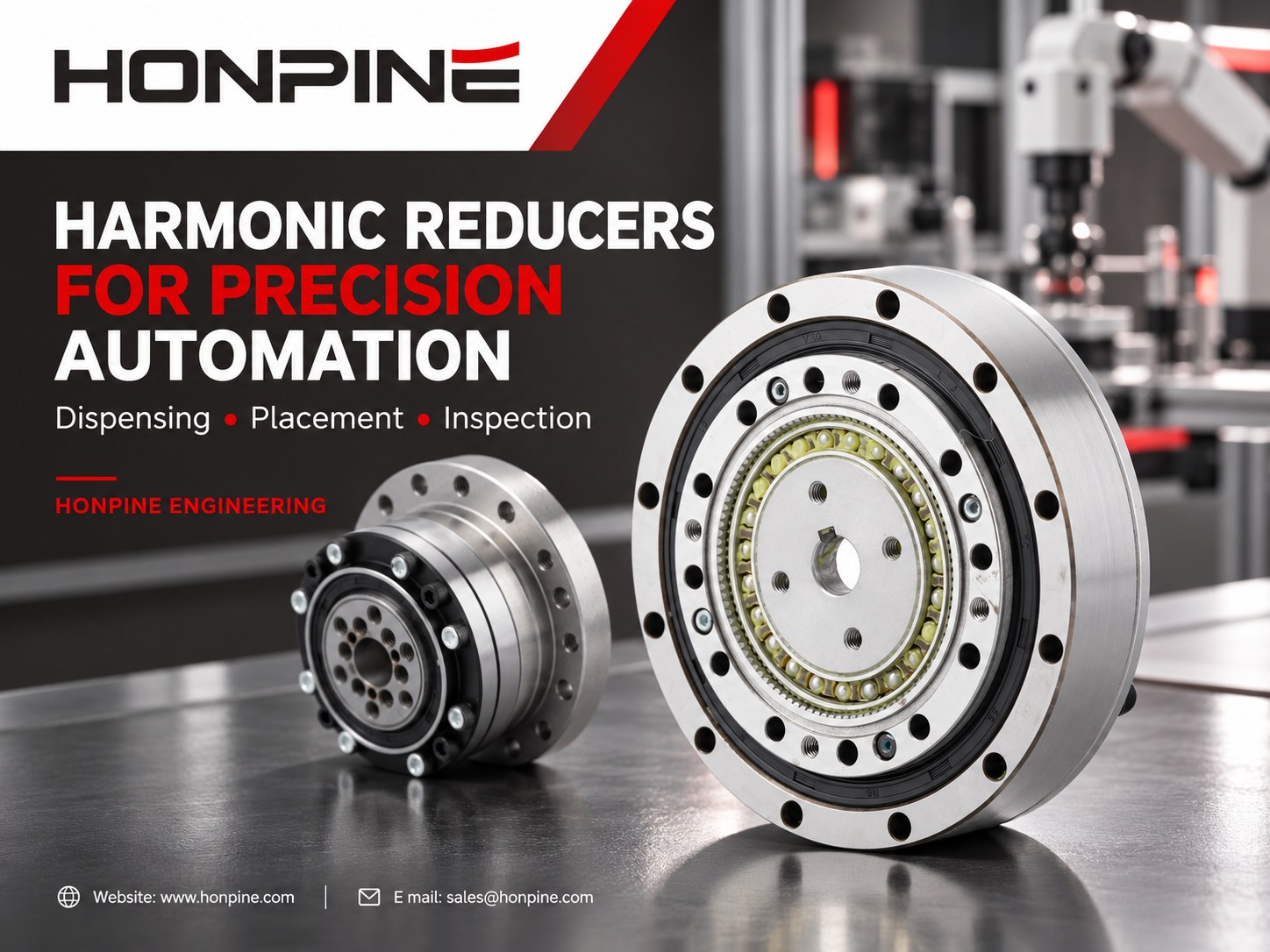
 Why Are Harmonic Reducers Suitable for High-Precision Automation Equipment?Precision automation equipment depends on consistent rotary motion, reliable positioning and compact transmission design. From dispensing head orientation and component angular alignment to automated inspection indexing, harmonic reducers offer a practical solution for applications requiring low backlash and high reduction ratios in limited installation space. This article explains how harmonic reducers support repeatable motion, compares key design configurations, and outlines how to select a suitable reduction ratio and reducer structure based on load, speed, accuracy and machine cycle-time requirements.
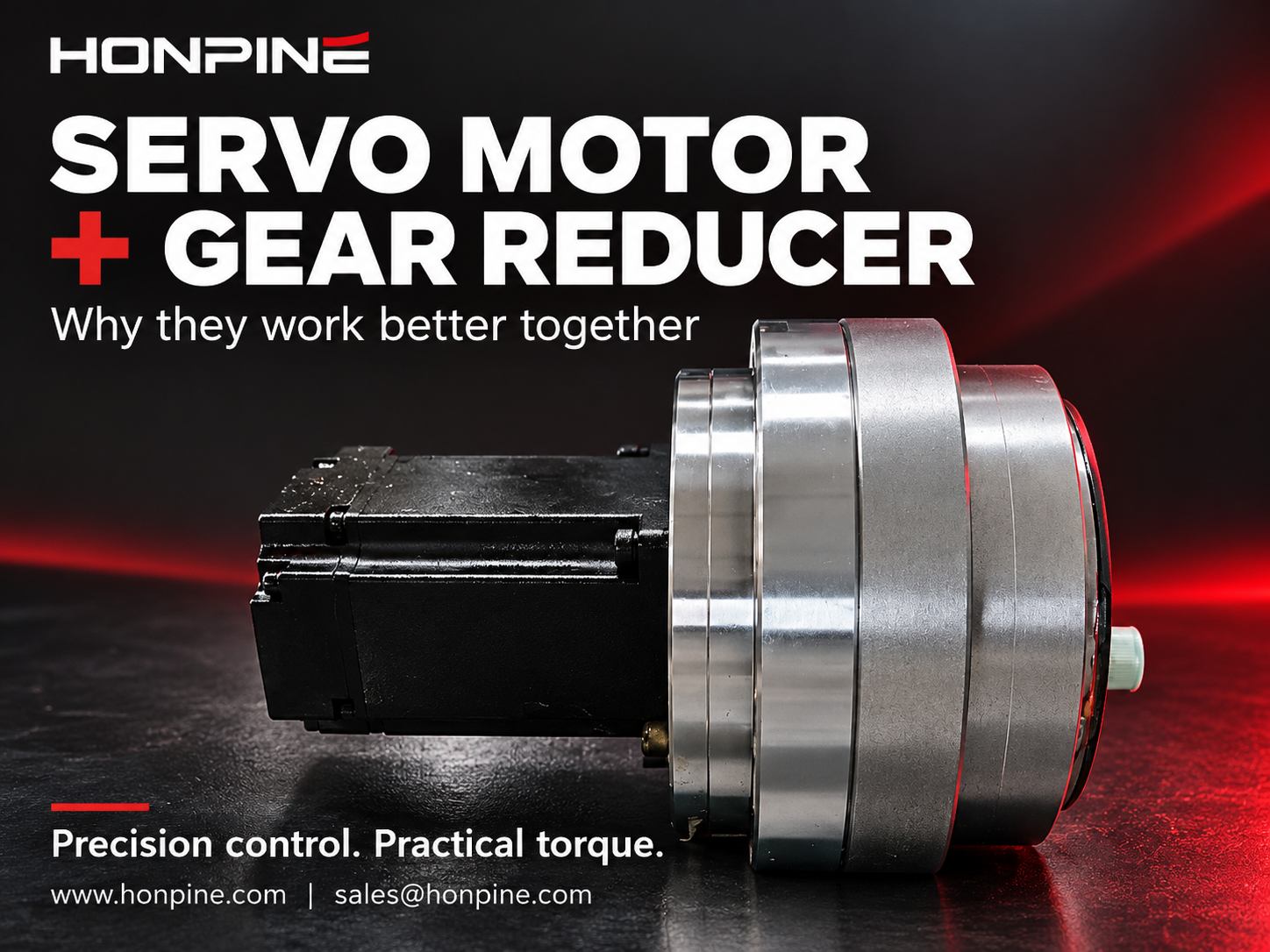
 Why Are Servo Motors and Gear Reducers an Ideal Match?Servo motors provide fast, precise motion control, while gear reducers adapt their speed and torque to the load. This guide explains how servo motors and gear reducers work together through torque multiplication, reflected inertia reduction and finer theoretical position resolution. Learn how inertia matching, backlash, torsional stiffness and reduction ratio influence performance in robotics and industrial automation.
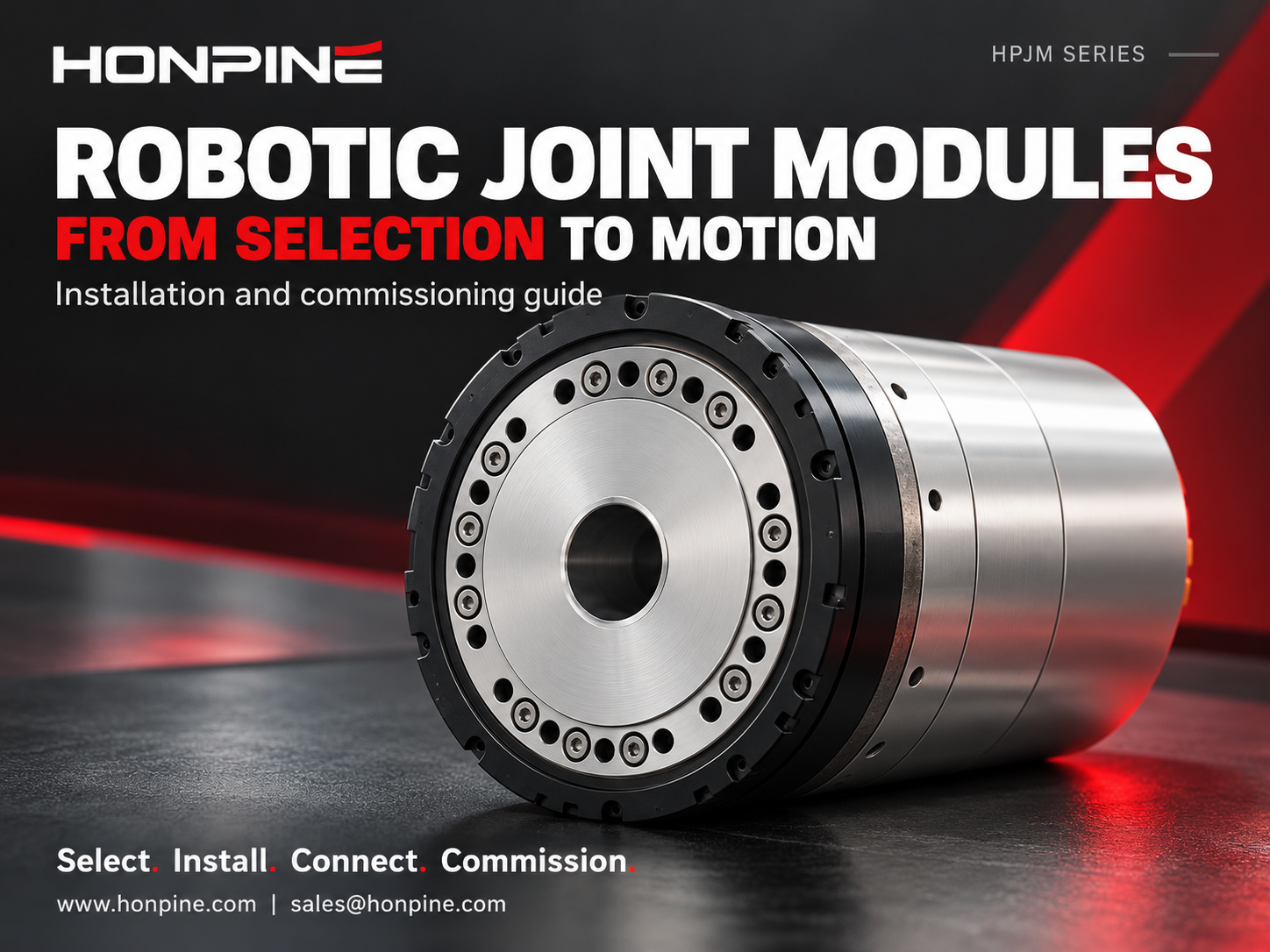
 How to Select and Use Robotic Joint Modules?How do you take robotic joint modules from selection to controlled motion? Using the HONPINE HPJM harmonic joint module as an example, Technical Director Theodore Li explains the key steps in mechanical installation, electrical wiring, CAN and EtherCAT configuration, and control commissioning. Learn what to confirm before integration and how to approach setup so each joint can respond correctly to your controller.
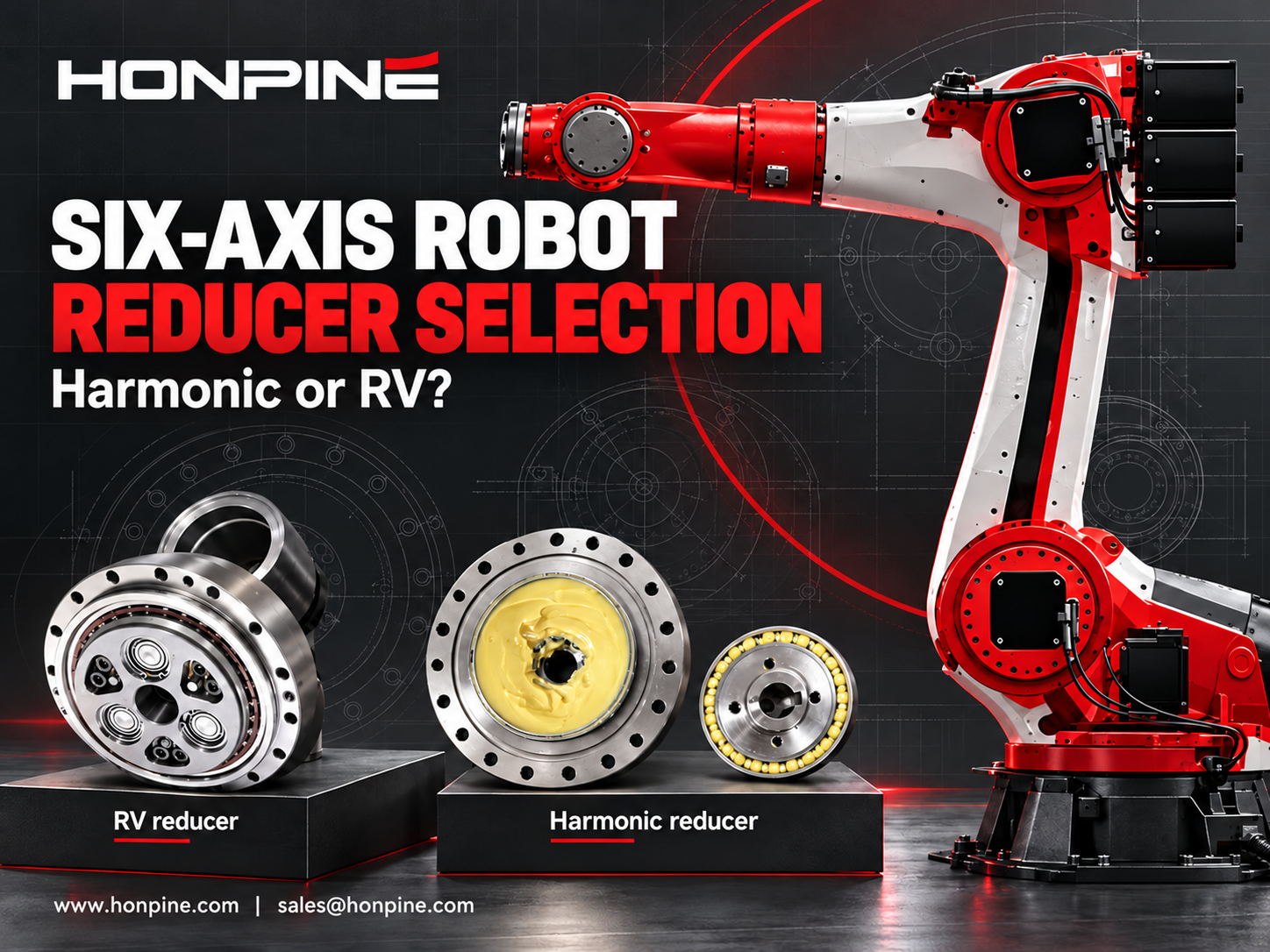
 How to Select Harmonic and RV Reducers for Each Axis of a Six-Axis Robot?What determines whether a six-axis robot joint needs a harmonic reducer or an RV reducer? The answer depends on torque, inertia, impact loads, bearing loads and installation space. This guide explains how to evaluate harmonic and RV reducers for the base, shoulder, elbow and wrist, with practical checks for stiffness, backlash and service life. Use the requirements of each axis to select a suitable reducer configuration.
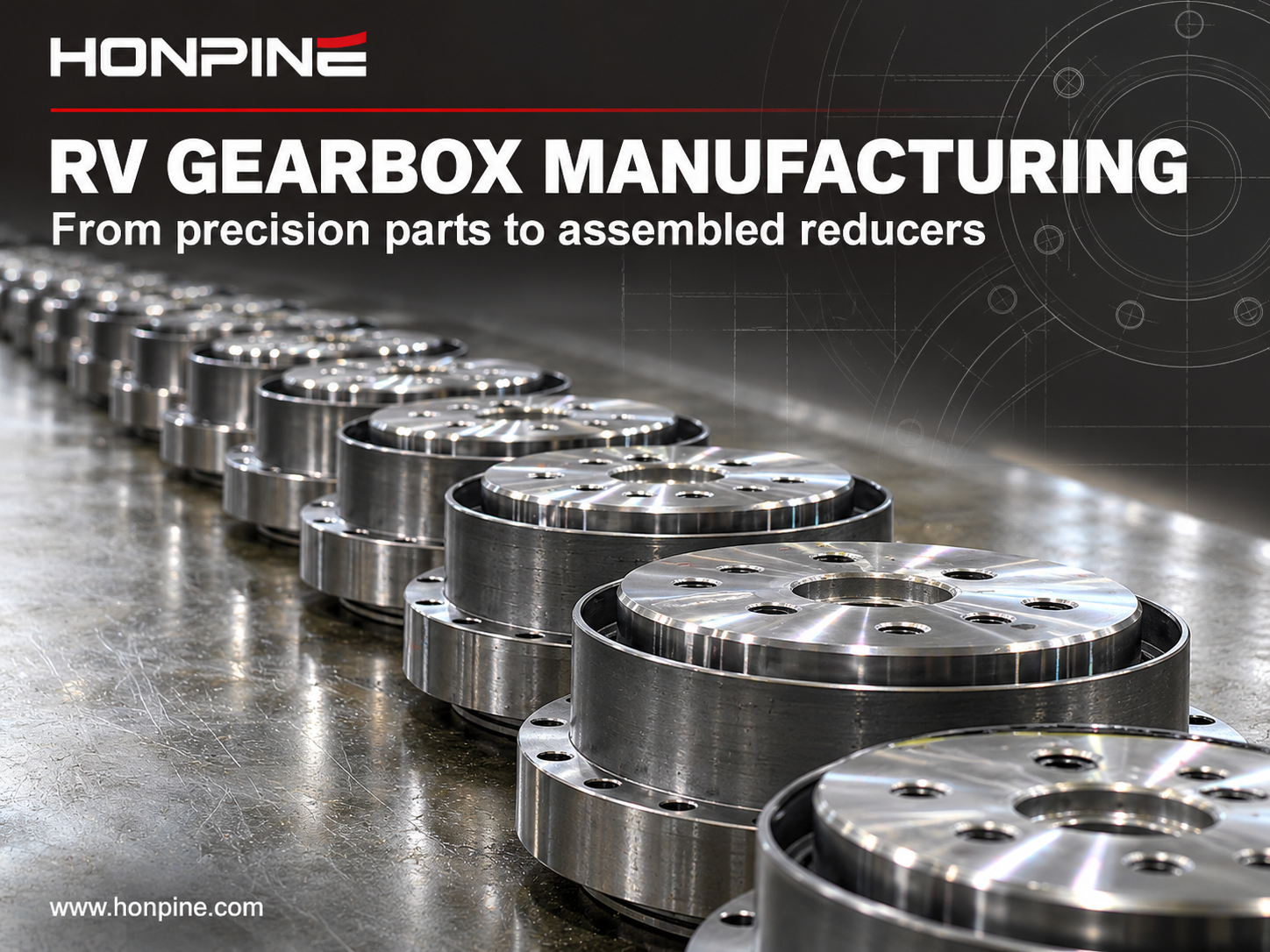
 Top 7 RV Reducer Gearbox Manufacturers: Why Does Nabtesco Still Dominate?What sets RV reducer gearbox manufacturers apart, and why does Nabtesco remain a benchmark in this market? RV reducer production demands precise component machining, careful assembly and extensive engineering know-how. This article introduces seven manufacturers across RV reducers and related transmission technologies, examines the strengths behind Nabtesco's position, and explores HONPINE's development capabilities to help you understand the supplier landscape.
Double Click
We provide harmonic drive reducer,planetary reducer,robot joint motor,robot rotary actuators,RV gear reducer,robot end effector,dexterous robot hand
 What is robot joint actuator?How to Choose the Best Robot Rotary Joint Actuator?In core robot joint transmission solutions, planetary and harmonic rotary actuators each have their own strengths. Choosing the right type based on application requirements is essential to achieve the optimal balance between performance and cost.
 DD Motors VS Harmonic Rotary ActuatorsThis article provides an in-depth comparison between Direct Drive (DD) motors and harmonic rotary actuators, covering their transmission principles, advantages and disadvantages, and typical application fields.
 OMG Ultra Compact Harmonic Drive Joint Module with Built-in Torque SensorHONPINE TCHL series harmonic drive joint module is a game-changing product that achieves disruptive improvements in multiple aspects such as lightweight design, integration level, and connection convenience. This article will analyze its revolutionary enhancements with you.
 How to Choose High-Precision Rotary Actuators for Industrial Automation?High-precision rotary actuators play an important role in industrial automation, where positioning accuracy, repeatability, durability and installation flexibility directly affect equipment performance. HONPINE offers four main series of precision rotary actuators, including HAT, HAM and HAS harmonic rotary actuators and HPG low-backlash planetary actuators. With torque ratings ranging from 4 to 1,494 Nm across the product range, these solutions are designed for applications in semiconductor manufacturing, 3C automation, laser processing and CNC machine tools. Learn how to identify the right rotary actuator based on operating conditions, precision requirements and mechanical integration needs.
 Why Are Harmonic Reducers Suitable for High-Precision Automation Equipment?Precision automation equipment depends on consistent rotary motion, reliable positioning and compact transmission design. From dispensing head orientation and component angular alignment to automated inspection indexing, harmonic reducers offer a practical solution for applications requiring low backlash and high reduction ratios in limited installation space. This article explains how harmonic reducers support repeatable motion, compares key design configurations, and outlines how to select a suitable reduction ratio and reducer structure based on load, speed, accuracy and machine cycle-time requirements.
 Why Are Servo Motors and Gear Reducers an Ideal Match?Servo motors provide fast, precise motion control, while gear reducers adapt their speed and torque to the load. This guide explains how servo motors and gear reducers work together through torque multiplication, reflected inertia reduction and finer theoretical position resolution. Learn how inertia matching, backlash, torsional stiffness and reduction ratio influence performance in robotics and industrial automation.
 How to Select and Use Robotic Joint Modules?How do you take robotic joint modules from selection to controlled motion? Using the HONPINE HPJM harmonic joint module as an example, Technical Director Theodore Li explains the key steps in mechanical installation, electrical wiring, CAN and EtherCAT configuration, and control commissioning. Learn what to confirm before integration and how to approach setup so each joint can respond correctly to your controller.
 How to Select Harmonic and RV Reducers for Each Axis of a Six-Axis Robot?What determines whether a six-axis robot joint needs a harmonic reducer or an RV reducer? The answer depends on torque, inertia, impact loads, bearing loads and installation space. This guide explains how to evaluate harmonic and RV reducers for the base, shoulder, elbow and wrist, with practical checks for stiffness, backlash and service life. Use the requirements of each axis to select a suitable reducer configuration.
 Top 7 RV Reducer Gearbox Manufacturers: Why Does Nabtesco Still Dominate?What sets RV reducer gearbox manufacturers apart, and why does Nabtesco remain a benchmark in this market? RV reducer production demands precise component machining, careful assembly and extensive engineering know-how. This article introduces seven manufacturers across RV reducers and related transmission technologies, examines the strengths behind Nabtesco's position, and explores HONPINE's development capabilities to help you understand the supplier landscape.
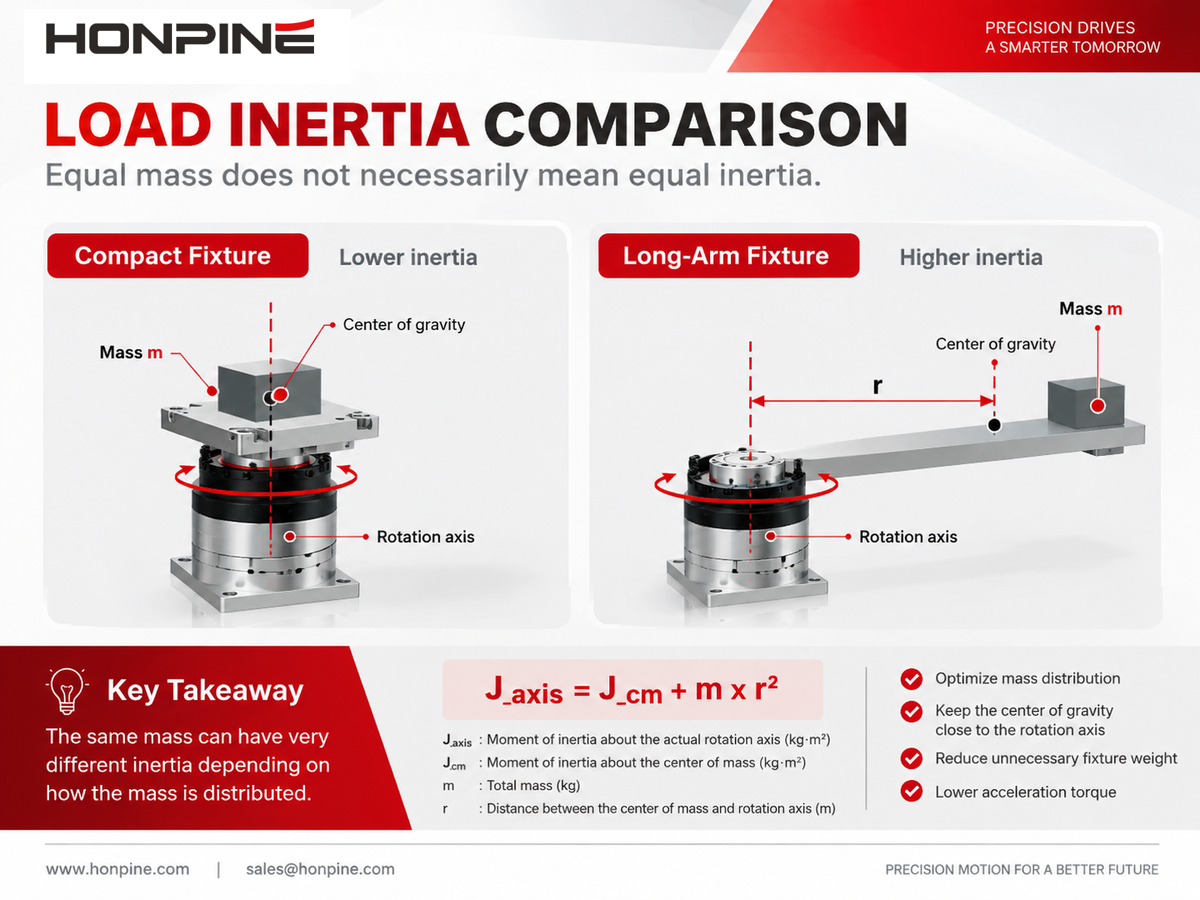
 How to Calculate Torque for a Harmonic Rotary Actuator in a Flipping Mechanism?How much torque does a harmonic rotary actuator need to flip a 10 kg load through 180 degrees? The answer depends on more than weight. Center-of-gravity offset, load inertia, acceleration and operating frequency all affect actuator selection. In this guide, Theodore Li, Technical Director at HONPINE, explains the calculation process using a horizontal-axis flipping example and outlines the checks needed for peak torque, continuous operation, output speed and bearing loads.
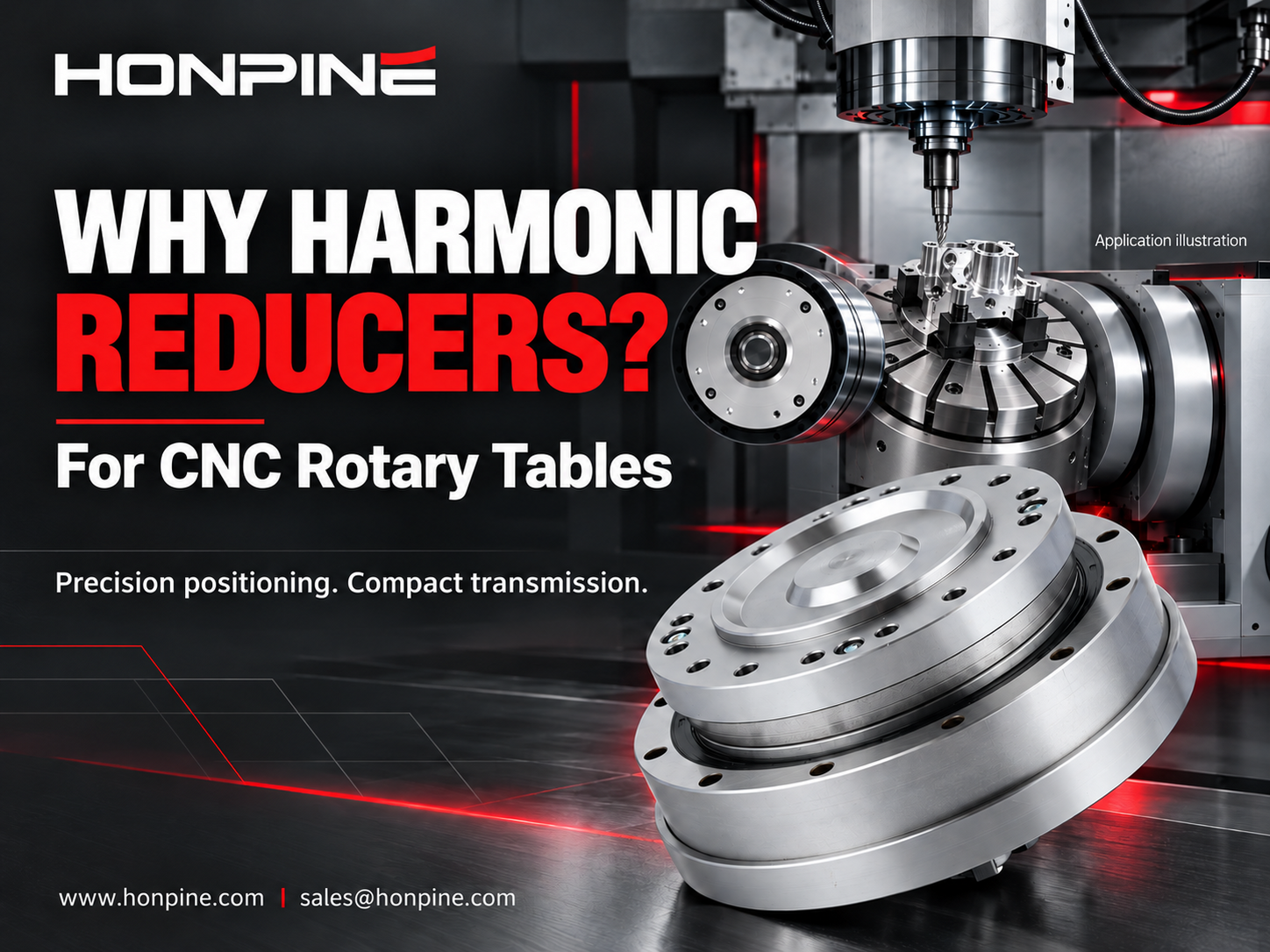
 Why Are Harmonic Reducers Suitable for CNC Machine Tool Rotary Tables?Why choose harmonic reducers for CNC rotary tables? Accurate indexing depends on more than the motor: backlash, torsional stiffness and torque capacity all affect how reliably a rotary table holds its position during machining. This guide explains the key transmission requirements of fourth and fifth axis rotary tables, explores common machine tool applications, and introduces HONPINE harmonic reducer configurations for different installation and load requirements.
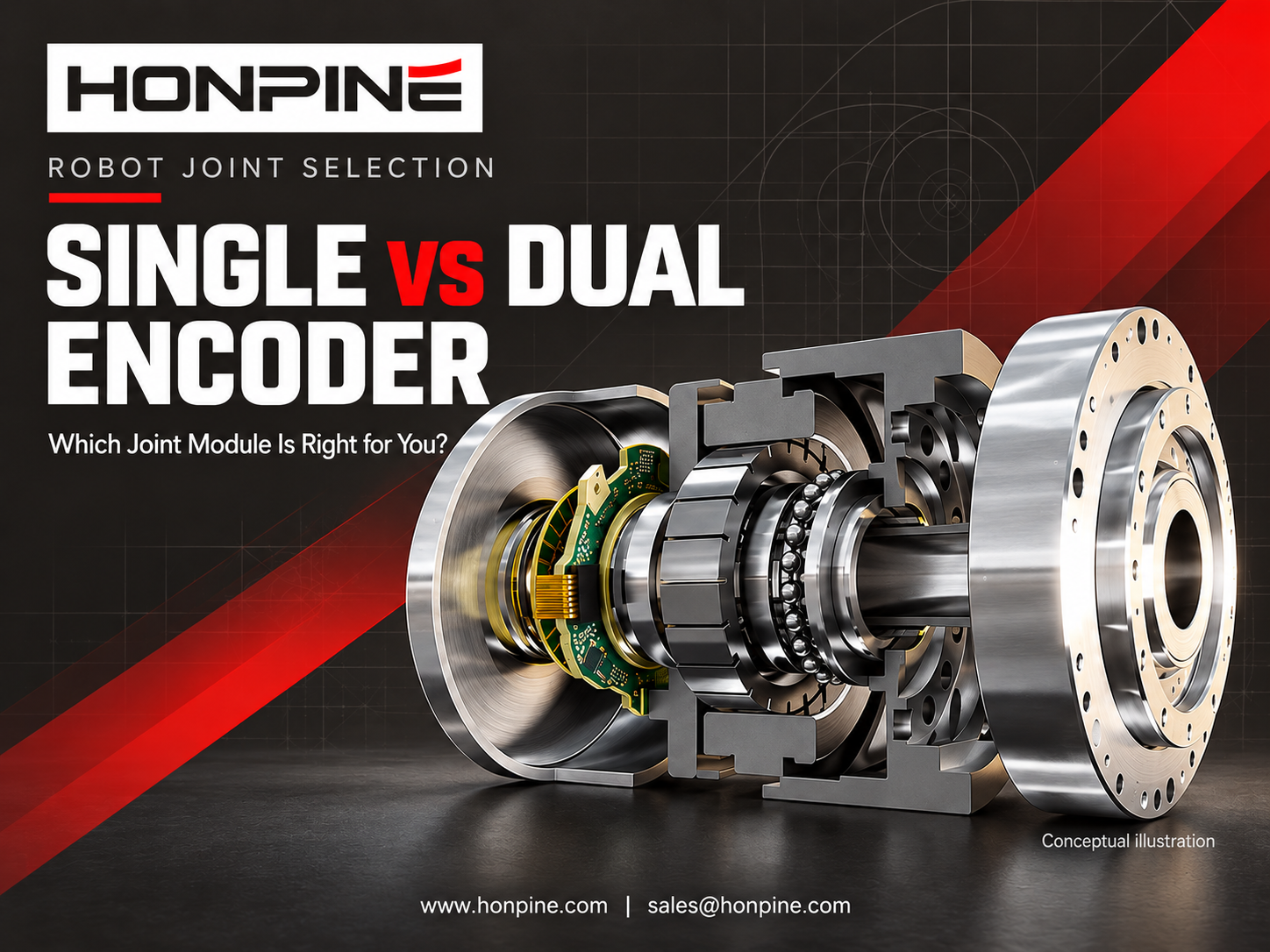
 What’s the Difference Between Single and Dual Encoder Robot Joint Modules?Does your robot need a dual encoder joint module, or is a single encoder enough? The answer depends on positioning requirements, transmission behavior, force control strategy and budget. This guide compares motor-side and output-side feedback, explains where dual encoders can improve control, and examines their costs and limitations. Learn when a single encoder can meet your needs and when additional output feedback is worth considering.