

How Do Planetary Gearboxes Reduce Speed and Increase Torque in High-Precision Automation Equipment?
In industrial automation, robotics, and CNC machinery, planetary gearboxes are essential transmission components for reducing speed while increasing torque. Although engineers use them every day, their operating principles, selection criteria, and maintenance requirements are not always fully understood.
This article provides a comprehensive overview of planetary gearboxes, covering their working principles, key advantages, typical applications, selection methods, and troubleshooting tips to help engineers choose the right solution for high-precision automation equipment.
1. Understanding Planetary Gearbox Operation in Three Steps
The core of a planetary gearbox is its classic sun gear, planet gears, and internal ring gear arrangement. Although the structure looks sophisticated, its operating principle is relatively straightforward.
Step 1: Power Input Through the Sun Gear
The motor drives the central sun gear at high speed, making it the input component of the transmission system.
Step 2: Planet Gears Rotate and Revolve
Three or four planet gears mesh simultaneously with the sun gear and the internal ring gear. Each planet gear rotates around its own axis while revolving around the sun gear.
Step 3: Speed Reduction and Torque Increase
The planet gears drive the planet carrier, which delivers power at a lower speed and higher torque.
For example, with a reduction ratio of 100:1, an input speed of 1,500 rpm can theoretically be reduced to 15 rpm, while the output torque increases by approximately 100 times, before accounting for transmission losses.
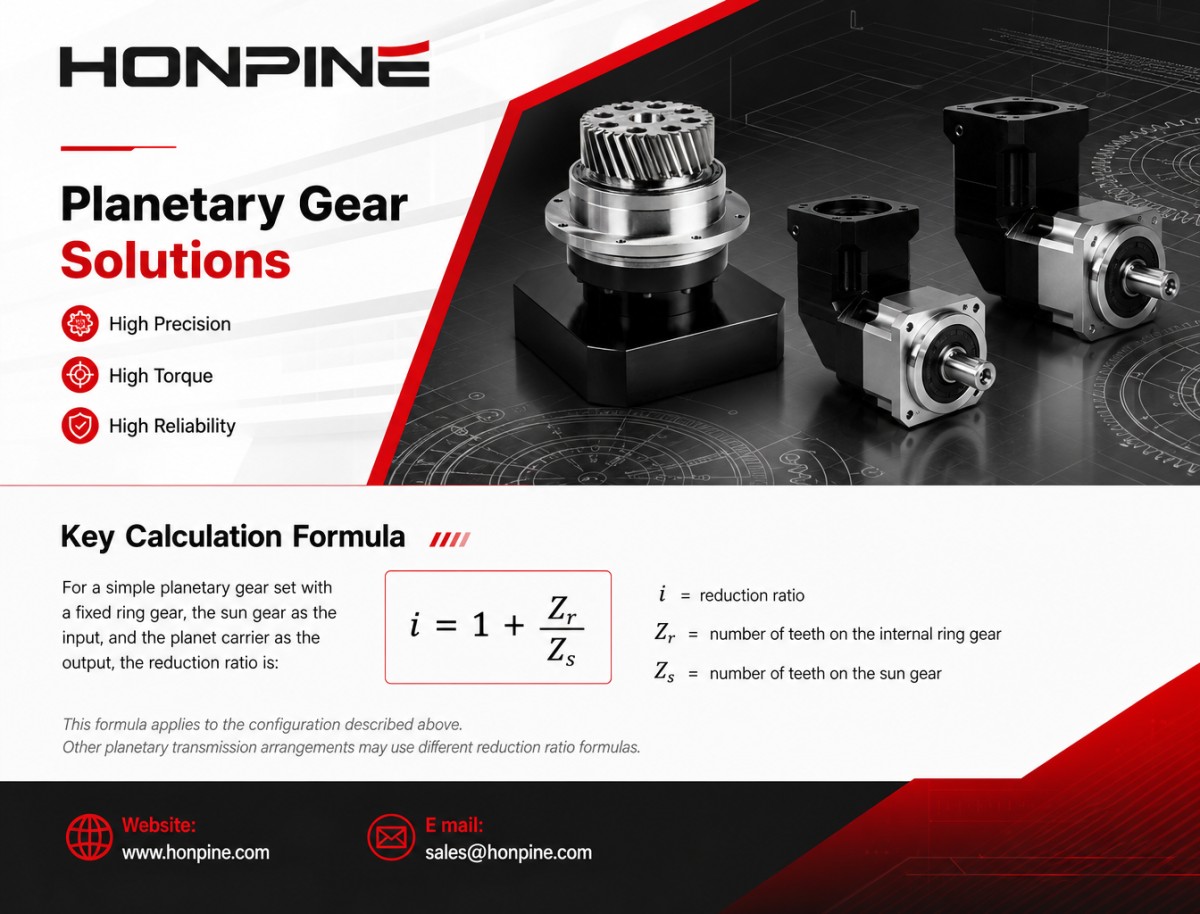
Key Calculation Formula
For a simple planetary gear set with a fixed ring gear, the sun gear as the input, and the planet carrier as the output, the reduction ratio is:
[
i = 1 + frac{Z_r}{Z_s}
]
Where:
(i) = reduction ratio
(Z_r) = number of teeth on the internal ring gear
(Z_s) = number of teeth on the sun gear
This formula applies to the configuration described above. Other planetary transmission arrangements may use different reduction ratio formulas.
2. Four Key Advantages: Why Are Planetary Gearboxes Widely Used in Automation?
Compared with other transmission solutions, such as worm gear reducers and conventional gear reduction mechanisms, planetary gearboxes offer a balanced combination of compact size, precision, stiffness, and efficiency. These characteristics make them an attractive choice for precision automation equipment.
2.1 High Stiffness and Precision
The simultaneous engagement of multiple gear teeth helps distribute loads and contributes to high torque capacity and torsional stiffness.
Precision planetary gearboxes can offer backlash of ≤3 arcmin, with some high-precision models achieving even lower values. These characteristics make them suitable for industrial robot joints, precision fixtures, and positioning mechanisms that require consistent and repeatable motion.
Actual positioning performance also depends on gear manufacturing accuracy, bearing arrangements, mounting quality, and servo control.
2.2 Compact Structure and High Power Density
The coaxial input and output arrangement allows planetary gearboxes to deliver substantial torque within a relatively compact package.
Compared with some conventional reducer designs, their compact structure can simplify integration into space-constrained equipment and help engineers optimize overall machine dimensions.
2.3 High Transmission Efficiency
High-quality planetary gearboxes can achieve transmission efficiencies of 97% or higher, depending on the model, reduction ratio, number of stages, lubrication, and operating conditions.
High efficiency helps reduce power losses and heat generation, making planetary gearboxes suitable for automation production lines that require continuous operation.
2.4 Adaptability to Different Operating Environments
Standard planetary gearboxes can meet the requirements of many conventional industrial environments. Customized versions may also be available for applications involving high or low temperatures, dust, or other demanding operating conditions.
The appropriate protection level and environmental compatibility should be confirmed against the specifications of the selected model.
3. Common Applications of Planetary Gearboxes in Automation Equipment
Planetary gearboxes are widely used as precision transmission components across a broad range of industries.
3.1 Industrial Automation and Robotics
Industrial robot joints, collaborative robots used for welding and material handling, and automated guided vehicles (AGVs) or autonomous mobile robots (AMRs) all benefit from compact transmission systems.
Planetary gearboxes can provide the torque multiplication and motion control required for frequent starts and stops, coordinated movement, and repeatable positioning.
3.2 New Energy Equipment
New energy testing equipment and automated assembly fixtures often use precision planetary gearboxes to deliver controlled torque and stable motion.
Properly selected gearboxes can help maintain assembly consistency and support the repeatability requirements of automated production processes.
3.3 CNC Machine Tools and High-End Equipment
Planetary gearboxes can be used in machine tool feed systems, precision positioning mechanisms, and rotary tables.
Their low-backlash characteristics and torsional stiffness can help improve motion stability and positioning performance, supporting high-precision machining when integrated with an appropriate mechanical and control system.
3.4 Medical Equipment and Intelligent Automation
Medical testing equipment, automated inspection instruments, and intelligent material-handling systems may require smooth motion, low noise, and reliable positioning.
Precision planetary gearboxes can be suitable for these applications when their noise levels, backlash, lubrication, and environmental requirements meet the equipment specifications.
4. Four Steps to Selecting the Right Planetary Gearbox
Selecting a planetary gearbox requires more than checking its rated torque. Engineers should evaluate the load, speed, precision, and installation requirements together.
4.1 Step 1: Calculate Torque Requirements and Apply a Safety Factor
A basic estimate of output torque is:
[
T_r = T_m times i times eta
]
Where:
(T_r) = estimated output torque
(T_m) = motor torque at the relevant operating condition
(i) = reduction ratio
(eta) = gearbox transmission efficiency
This formula provides a preliminary estimate. Final selection must also account for acceleration and deceleration, peak torque, external loads, duty cycle, and the gearbox's continuous and intermittent torque limits.
As an initial guideline, the following safety factors may be considered:
Stable, continuous loads, such as conveyor systems: 1.2–1.5
Impact or dynamic loads, such as robotic arms and turning mechanisms: 2–3
These are preliminary reference values rather than universal rules. The required safety factor depends on the actual load profile, operating frequency, inertia, and manufacturer's recommendations.
4.2 Step 2: Select an Appropriate Reduction Ratio
The reduction ratio affects output speed, torque, and overall system performance.
Low-speed, high-torque applications: A ratio of 50:1–100:1 may be worth considering for heavy fixtures and high-load mechanisms. A multistage gearbox may be required, depending on the product design.
Medium-speed, high-precision assembly stations: Ratios of 10:1–50:1 may provide a suitable balance between speed and torque.
High-speed, light-load mechanisms: Ratios of 3:1–10:1 may be appropriate, provided the required output torque is available.
The final ratio should be selected according to the motor's speed-torque characteristics, the required output speed, and the gearbox's permitted maximum input speed.
4.3 Step 3: Choose the Required Backlash Level
Different applications require different levels of transmission precision. Rather than automatically selecting the lowest-backlash gearbox, engineers should match the specification to the actual positioning requirements.
The following ranges can serve as preliminary selection references:
Robotics and precision CNC applications: Backlash ≤3 arcmin
Automated material handling and general-purpose fixtures: 3–10 arcmin
General conveying applications: 10–30 arcmin
These ranges are indicative rather than universal industry standards. Required backlash depends on the machine's positioning accuracy, repeatability, stiffness, and control strategy. Backlash alone does not determine the final positioning accuracy of the entire system.
4.4 Step 4: Avoid Common Installation Mistakes
Check the permissible radial load.
When using a belt pulley or similar transmission component, verify that the resulting radial load remains within the gearbox's allowable limit. An additional support bearing may be necessary to reduce the load on the gearbox output shaft.
Control motor-to-gearbox alignment.
Poor alignment can increase vibration, noise, bearing loads, and wear. A coaxiality deviation of ≤0.05 mm may be used as a preliminary target in some installations, but the permissible tolerance should be confirmed against the motor and gearbox specifications and the coupling requirements.
Use the correct amount of lubricant.
Follow the manufacturer's lubrication instructions. For oil-lubricated models, maintain the specified oil level and avoid overfilling, which can increase churning losses, heat generation, and the risk of leakage. Not all planetary gearboxes use the same lubricant or lubrication method.
5. Contact HONPINE for High-Precision Planetary Gearbox Solutions
Selecting the right planetary gearbox can help improve transmission efficiency, motion stability, and equipment reliability. The key is to match the gearbox's torque capacity, reduction ratio, backlash, input speed, and mounting configuration to the actual operating conditions.
HONPINE offers planetary gearbox solutions for industrial automation, robotics, CNC equipment, and other precision transmission applications.
Contact HONPINE to request a product catalogue, discuss your technical requirements, and explore suitable gearbox models. Sample support and product selection assistance are available for applicable projects.
Read More
Learn more about the story of HONPINE and industry trends related to precision transmission.
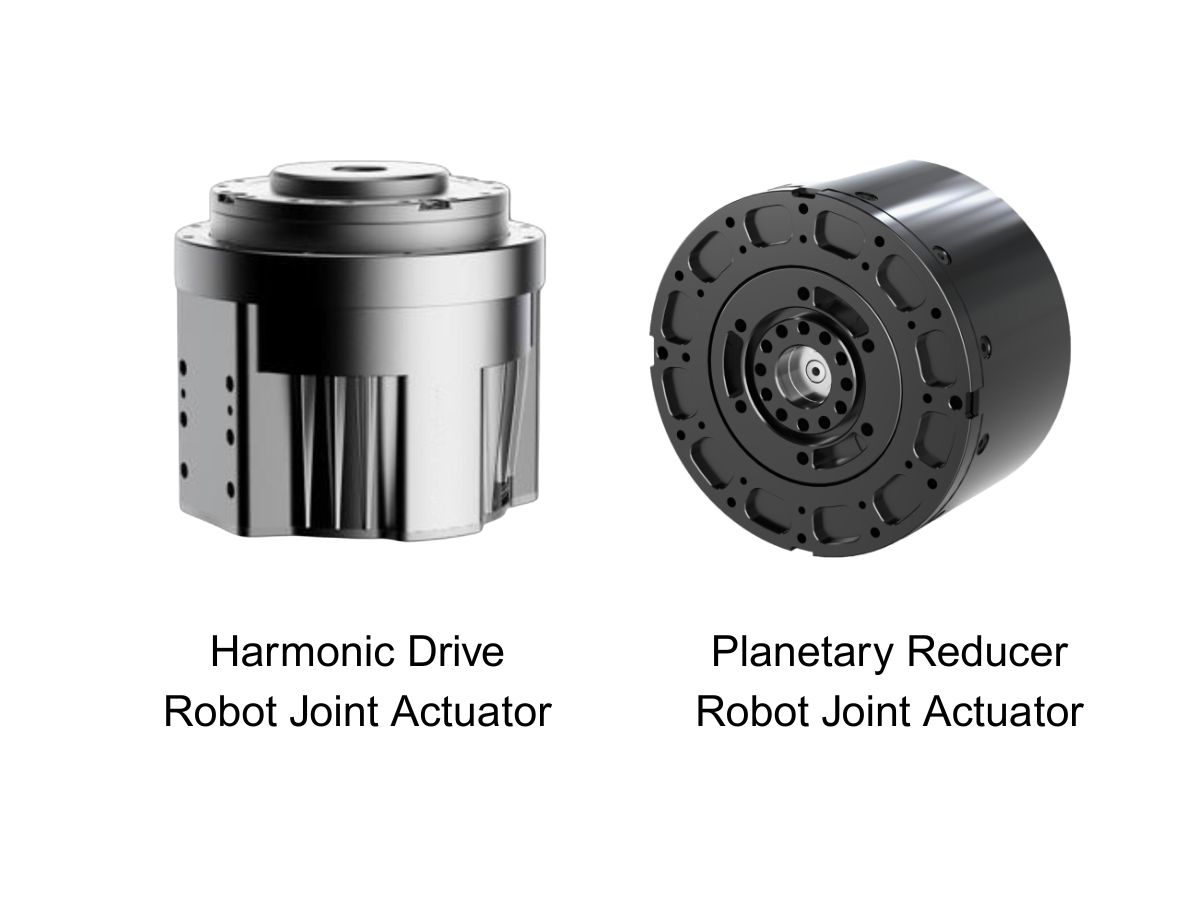
 What is robot joint actuator?How to Choose the Best Robot Rotary Joint Actuator?In core robot joint transmission solutions, planetary and harmonic rotary actuators each have their own strengths. Choosing the right type based on application requirements is essential to achieve the optimal balance between performance and cost.
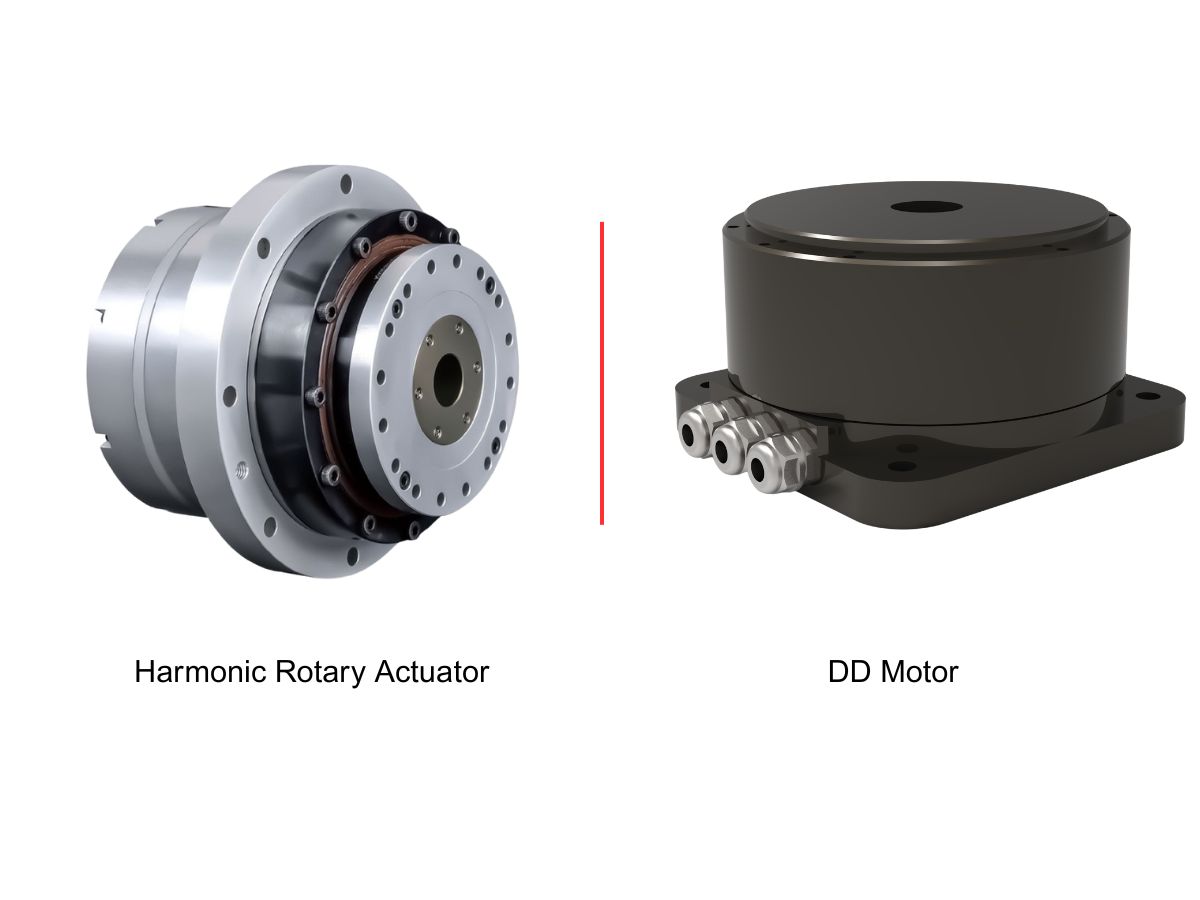
 DD Motors VS Harmonic Rotary ActuatorsThis article provides an in-depth comparison between Direct Drive (DD) motors and harmonic rotary actuators, covering their transmission principles, advantages and disadvantages, and typical application fields.
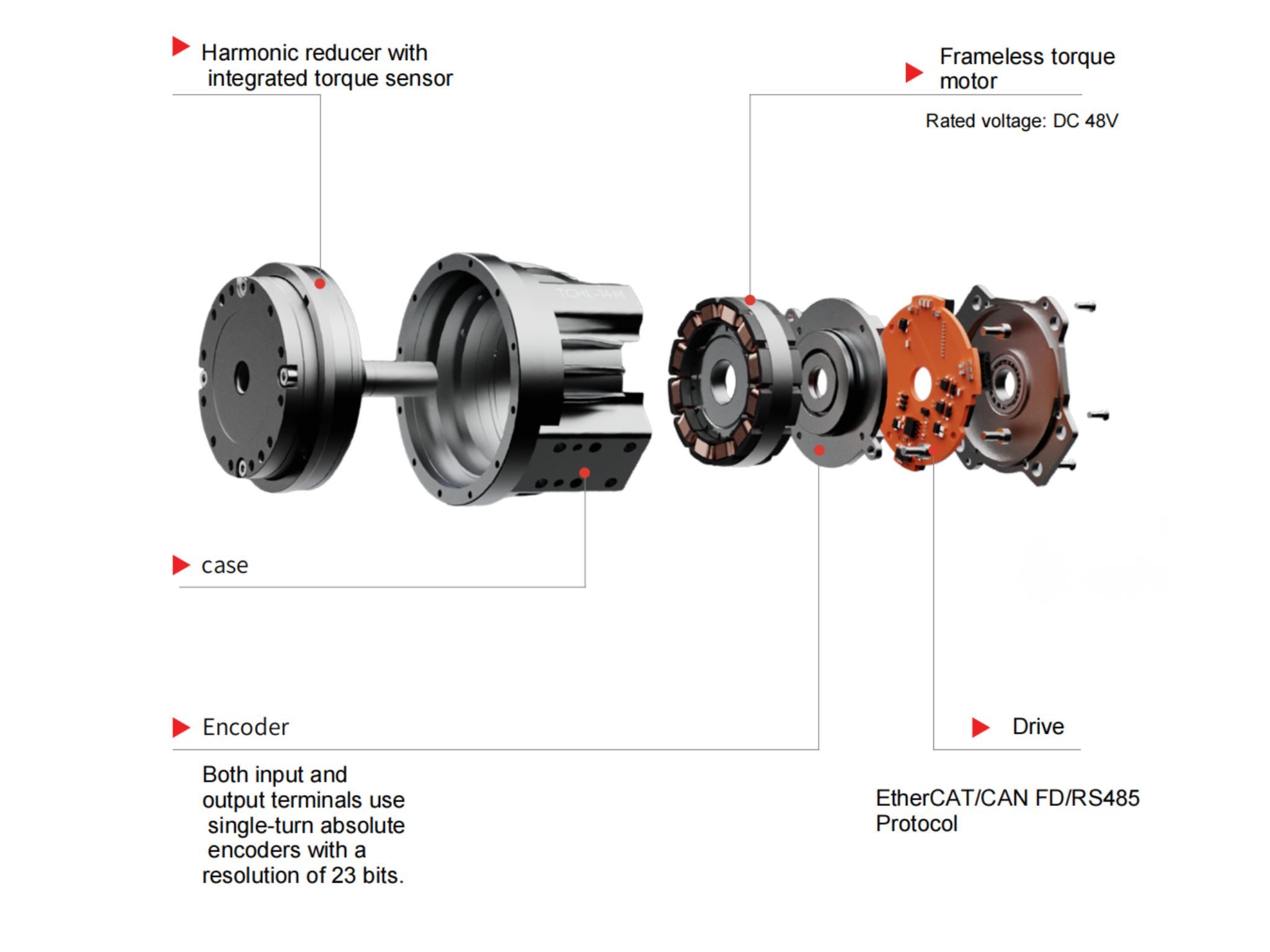
 OMG Ultra Compact Harmonic Drive Joint Module with Built-in Torque SensorHONPINE TCHL series harmonic drive joint module is a game-changing product that achieves disruptive improvements in multiple aspects such as lightweight design, integration level, and connection convenience. This article will analyze its revolutionary enhancements with you.
 The Role of Harmonic Drive Gears in Achieving 5–10 μm Accuracy in Dental Milling MachinesA dental milling machine is a CNC machining system used to directly process digital dental models into restorations such as crowns, bridges, veneers, inlays, and implant abutments. Dental milling machines require far higher operational accuracy and motion stability than ordinary equipment. This article explains how harmonic drive gear help dental milling machines achieve stable, continuous, and controllable operation.
 Why Are Harmonic Rotary Actuators Perfect for Medical Equipment?Harmonic rotary actuators (typically integrated systems consisting of a harmonic drive reducer, frameless torque motor, encoder, and optional brake) are regarded as key components in medical equipment. The core reason is that they simultaneously meet the most stringent medical requirements for precision, compact size, safety, and controllability. The following explanation is structured from three perspectives: technical characteristics, application scenarios, and medical value.
 High-Precision RV Reducers Perfectly Matched for Walking RobotsThe walking axis of a robot is a core component for power transmission and support. RV reducers provide extremely high rigidity, precision, and torque while maintaining a compact size and exceptional reliability, making them an ideal match for the demanding requirements of walking robot joints in terms of load capacity, impact resistance, and precision.
 How Should Manufacturers Upgrade Harmonic Joint Modules for Robotic Arms and Embodied AI in 2026?For engineers planning a robotic system upgrade, the right joint module depends on more than a single specification. EtherCAT synchronization, output-side position feedback, real-time torque measurement, continuous torque capability, and integrated safety functions must work together to meet the demands of the application. By evaluating these factors as a complete electromechanical system, manufacturers can make more informed decisions about joint module selection, integration, and long-term performance.
 How Do Planetary Gearboxes Reduce Speed and Increase Torque in High-Precision Automation Equipment?How does a planetary gearbox reduce speed while increasing torque in high-precision automation equipment? By combining a sun gear, multiple planet gears, and an internal ring gear, a planetary gearbox delivers compact, efficient power transmission for applications that require controlled motion and reliable torque output. From industrial robots and CNC machinery to automated assembly systems, selecting the right gearbox involves more than choosing a reduction ratio. This guide explains how planetary gearboxes work, their key advantages, common applications, and practical selection considerations to help engineers identify a suitable transmission solution.
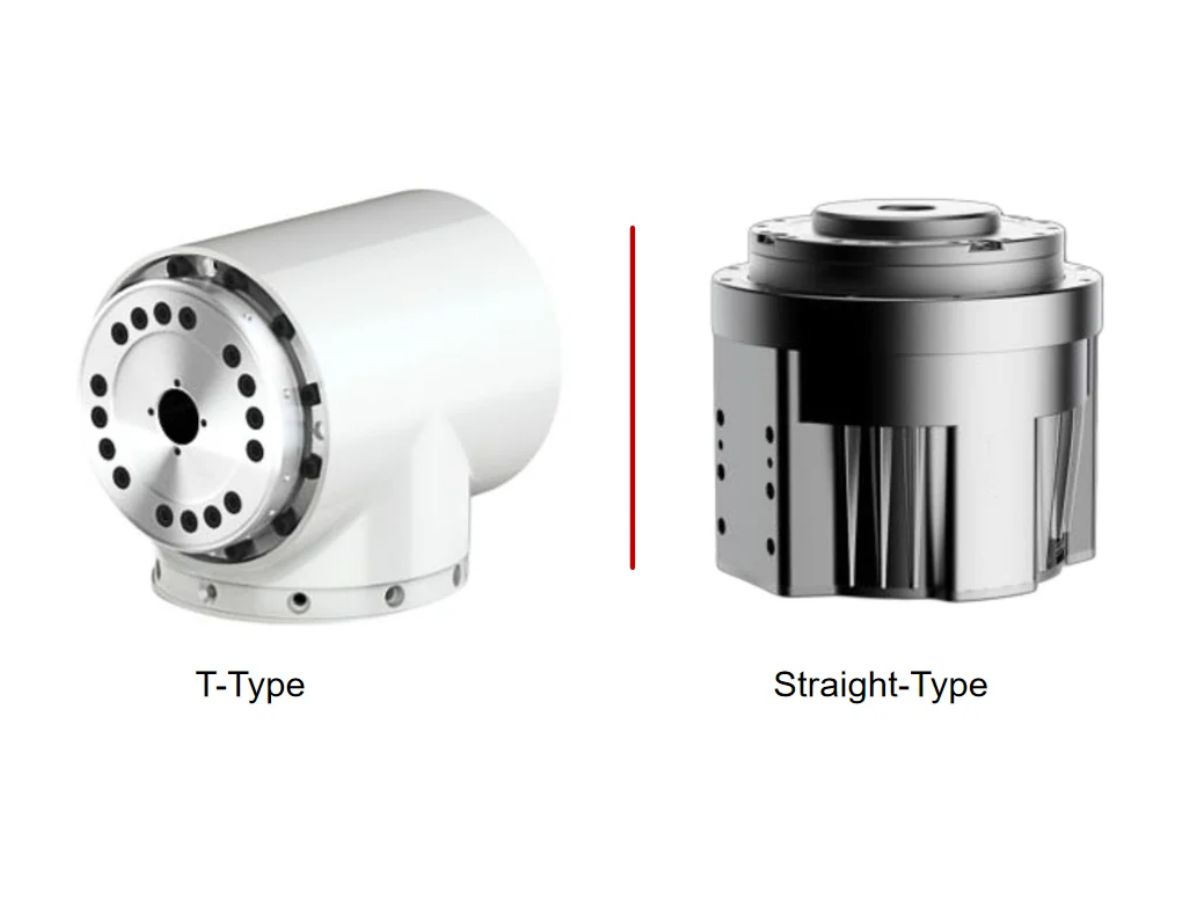
 Should You Choose a T-Type or Straight-Type Harmonic Joint Module for a Collaborative Robot?Choosing the right harmonic joint module is essential when designing a compact, high-performance collaborative robot. Should you use a TCHL straight-type or an HTS T-type harmonic joint module? Although both configurations can support precise robotic motion, their different output flange geometries affect installation space, link connections, cable routing, and mechanical integration. In this guide, Theodore Li, Technical Director at HONPINE, explains the key differences between the two designs, their advantages and limitations, and how to select the most suitable configuration for your collaborative robotic arm.
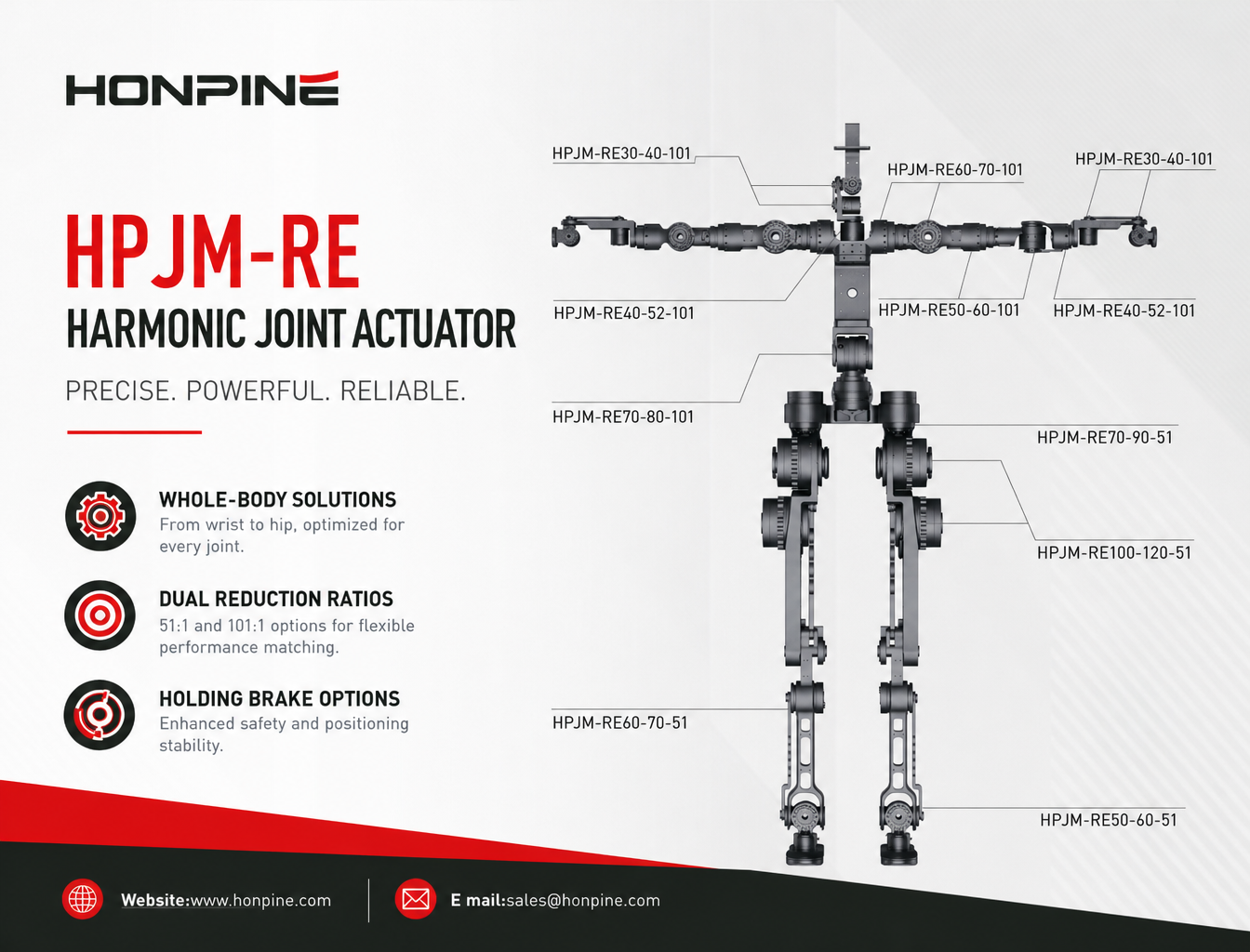
 The Complete Harmonic Joint Actuator Solution for Humanoid Robots: HPJM Series Selection GuideA complete guide to selecting harmonic joint actuators for humanoid robots. Explore HONPINE HPJM models for wrist, elbow, shoulder, waist, hip, knee, and ankle joints, with practical considerations for torque capacity, reduction ratios, dynamic response, and holding brake configurations.
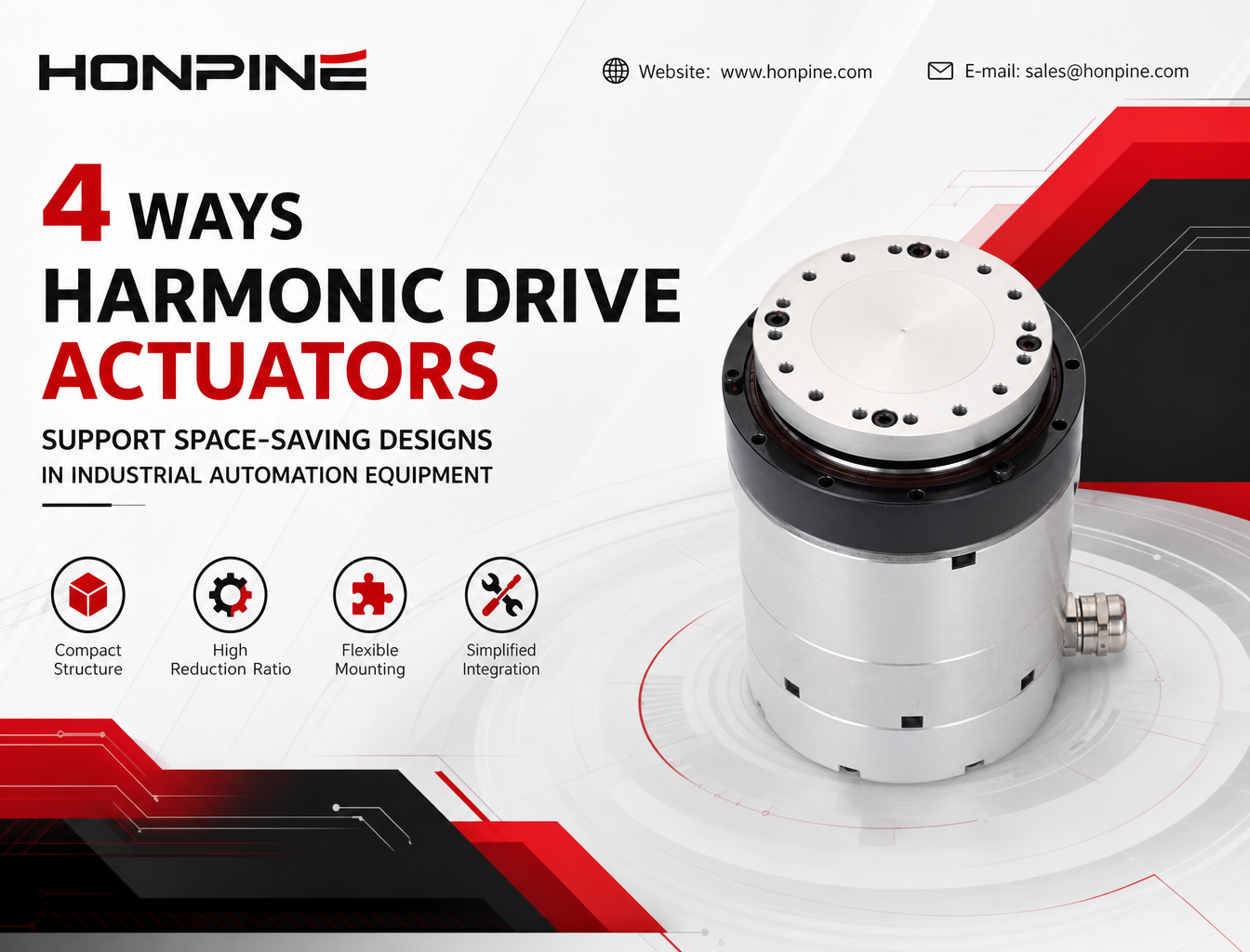
 Why Are Harmonic Drive Actuators Ideal for Space-Constrained Industrial Automation Equipment?In modern industrial automation, limited installation space often makes mechanical design more challenging. Harmonic drive actuators offer a compact motion-control solution by integrating key drive components into a single unit. Their high reduction ratios, streamlined mechanical structures, and flexible mounting options can help equipment manufacturers reduce space requirements, simplify assembly, and optimize internal layouts. This article explores four ways integrated harmonic drive actuators support space-saving designs in industrial automation equipment.
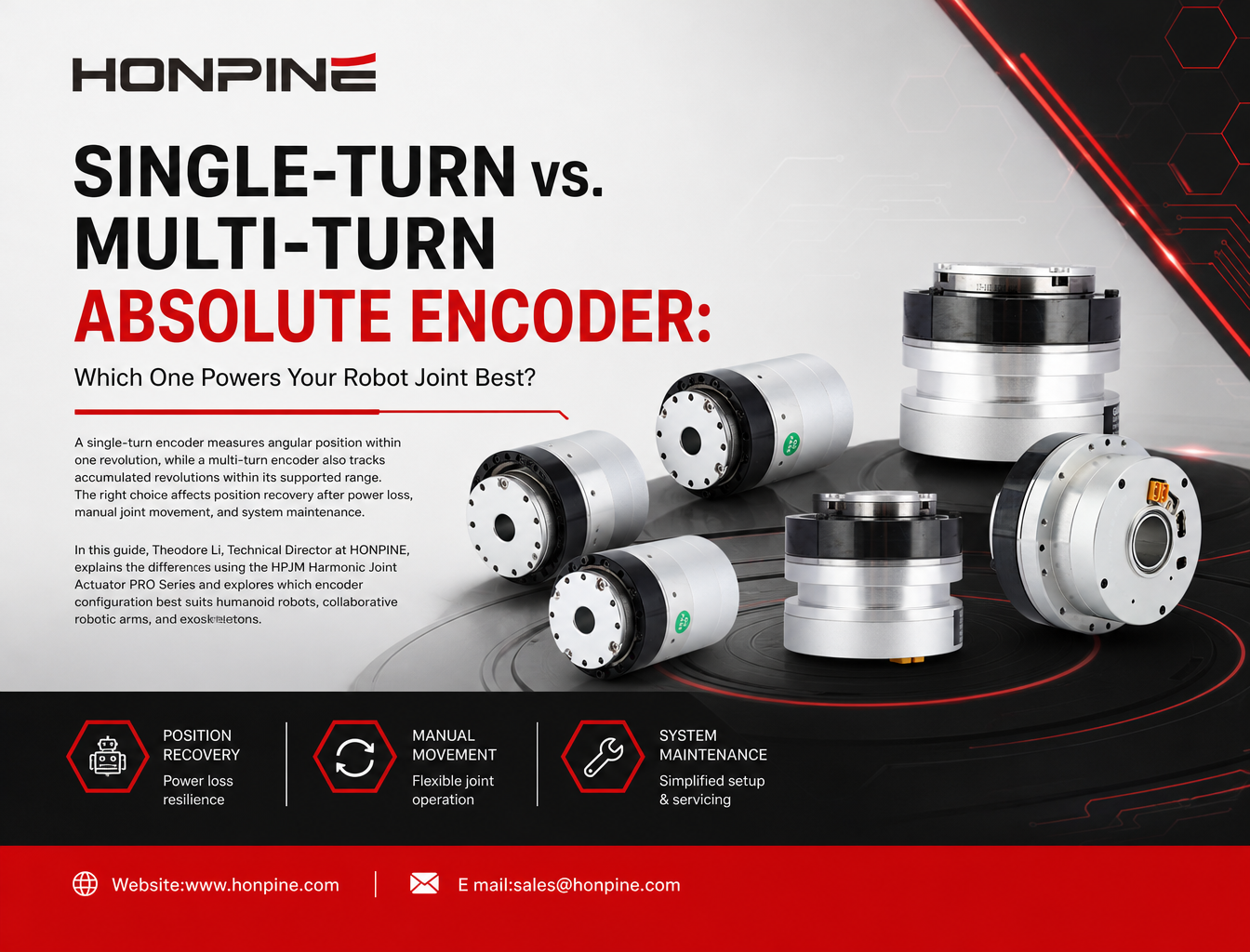
 Single-Turn vs. Multi-Turn Absolute Encoders for Robot Joint Modules: How to Choose?This guide compares single-turn and multi-turn absolute encoders for robot joint modules, explaining how they differ in position feedback, power-off position retention, and maintenance requirements. Learn how to select the right encoder configuration for humanoid robots, collaborative robotic arms, and exoskeletons using the HONPINE HPJM Harmonic Joint Actuator PRO Series as an example.
Double Click
We provide harmonic drive reducer,planetary reducer,robot joint motor,robot rotary actuators,RV gear reducer,robot end effector,dexterous robot hand
 What is robot joint actuator?How to Choose the Best Robot Rotary Joint Actuator?In core robot joint transmission solutions, planetary and harmonic rotary actuators each have their own strengths. Choosing the right type based on application requirements is essential to achieve the optimal balance between performance and cost.
 DD Motors VS Harmonic Rotary ActuatorsThis article provides an in-depth comparison between Direct Drive (DD) motors and harmonic rotary actuators, covering their transmission principles, advantages and disadvantages, and typical application fields.
 OMG Ultra Compact Harmonic Drive Joint Module with Built-in Torque SensorHONPINE TCHL series harmonic drive joint module is a game-changing product that achieves disruptive improvements in multiple aspects such as lightweight design, integration level, and connection convenience. This article will analyze its revolutionary enhancements with you.
 How Should Manufacturers Upgrade Harmonic Joint Modules for Robotic Arms and Embodied AI in 2026?For engineers planning a robotic system upgrade, the right joint module depends on more than a single specification. EtherCAT synchronization, output-side position feedback, real-time torque measurement, continuous torque capability, and integrated safety functions must work together to meet the demands of the application. By evaluating these factors as a complete electromechanical system, manufacturers can make more informed decisions about joint module selection, integration, and long-term performance.
 How Do Planetary Gearboxes Reduce Speed and Increase Torque in High-Precision Automation Equipment?How does a planetary gearbox reduce speed while increasing torque in high-precision automation equipment? By combining a sun gear, multiple planet gears, and an internal ring gear, a planetary gearbox delivers compact, efficient power transmission for applications that require controlled motion and reliable torque output. From industrial robots and CNC machinery to automated assembly systems, selecting the right gearbox involves more than choosing a reduction ratio. This guide explains how planetary gearboxes work, their key advantages, common applications, and practical selection considerations to help engineers identify a suitable transmission solution.
 Should You Choose a T-Type or Straight-Type Harmonic Joint Module for a Collaborative Robot?Choosing the right harmonic joint module is essential when designing a compact, high-performance collaborative robot. Should you use a TCHL straight-type or an HTS T-type harmonic joint module? Although both configurations can support precise robotic motion, their different output flange geometries affect installation space, link connections, cable routing, and mechanical integration. In this guide, Theodore Li, Technical Director at HONPINE, explains the key differences between the two designs, their advantages and limitations, and how to select the most suitable configuration for your collaborative robotic arm.
 The Complete Harmonic Joint Actuator Solution for Humanoid Robots: HPJM Series Selection GuideA complete guide to selecting harmonic joint actuators for humanoid robots. Explore HONPINE HPJM models for wrist, elbow, shoulder, waist, hip, knee, and ankle joints, with practical considerations for torque capacity, reduction ratios, dynamic response, and holding brake configurations.
 Why Are Harmonic Drive Actuators Ideal for Space-Constrained Industrial Automation Equipment?In modern industrial automation, limited installation space often makes mechanical design more challenging. Harmonic drive actuators offer a compact motion-control solution by integrating key drive components into a single unit. Their high reduction ratios, streamlined mechanical structures, and flexible mounting options can help equipment manufacturers reduce space requirements, simplify assembly, and optimize internal layouts. This article explores four ways integrated harmonic drive actuators support space-saving designs in industrial automation equipment.
 Single-Turn vs. Multi-Turn Absolute Encoders for Robot Joint Modules: How to Choose?This guide compares single-turn and multi-turn absolute encoders for robot joint modules, explaining how they differ in position feedback, power-off position retention, and maintenance requirements. Learn how to select the right encoder configuration for humanoid robots, collaborative robotic arms, and exoskeletons using the HONPINE HPJM Harmonic Joint Actuator PRO Series as an example.
 STO vs. Holding Brake in Robot Joint Modules: What Is the Difference for Robot Safe Control?STO (Safe Torque Off) and holding brakes play different roles in robot joint safety. While STO prevents a motor from generating driving torque, a holding brake mechanically resists joint movement and helps retain loads when the motor is disabled. Understanding the difference is essential when selecting a robot joint module for humanoid robots, collaborative robots, and industrial automation. In this article, Theodore Li, Technical Director at HONPINE, explains how these functions work, their limitations, and when both should be considered in a harmonic integrated joint actuator such as the HONPINE HAG series.
 AGV Robot Steering Drive Wheel: A Comprehensive Guide to Components, Applications, and SelectionAn AGV steering drive wheel integrates traction and active steering to support flexible movement in industrial mobile robots. This guide explains its main components, working principles, industrial applications, and key selection factors, including load capacity, traction torque, steering torque, wheel diameter, speed, and control interfaces. Discover how to choose a suitable steering drive module for AGVs, AMRs, autonomous forklifts, and heavy-duty material handling systems.
 How Does a Harmonic Joint Actuator with a Torque Sensor Improve Robot Force Control?Learn how the HONPINE TCHL harmonic joint actuator uses an integrated output torque sensor to support force feedback, collision detection, compliant assembly, rehabilitation robotics, and teleoperation.