

Why Bedside Physical Therapy Robots Need Force-Controlled Joint Modules?
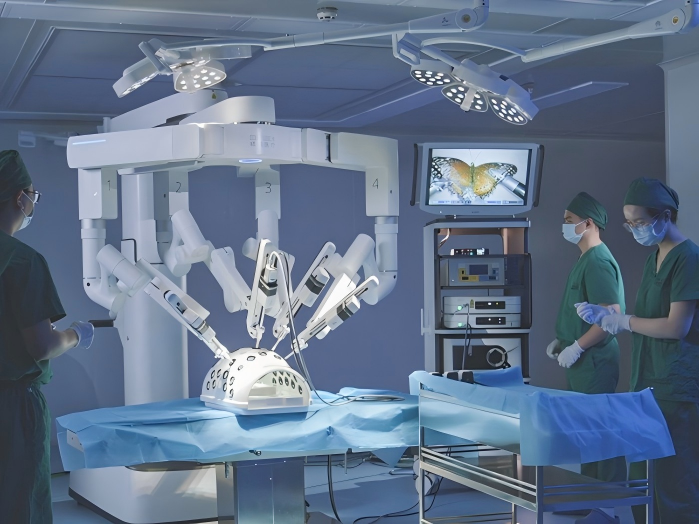
A therapy robot does not sell a robot arm; it sells a force applied to a human body. Pressure, rhythm and depth are the prescription, and position control cannot deliver them: soft tissue is compliant and time-varying, so one position command yields contact forces that differ several-fold between muscle and bone. Force-controlled harmonic joint modules turn contact force into a closed-loop variable - the only way to make dose repeatable, human contact safe and a therapist's technique teachable. Starting from one site photo of a bedside therapy robot, this article reads the configuration, sets out five reasons force control is unavoidable, settles HONPINE's TCHL-versus-HAG choice criterion by criterion, and gives the torque sensor resolution budget that picks the frame sizes.
1. Reading the Machine: What Kind of Robot Is This?
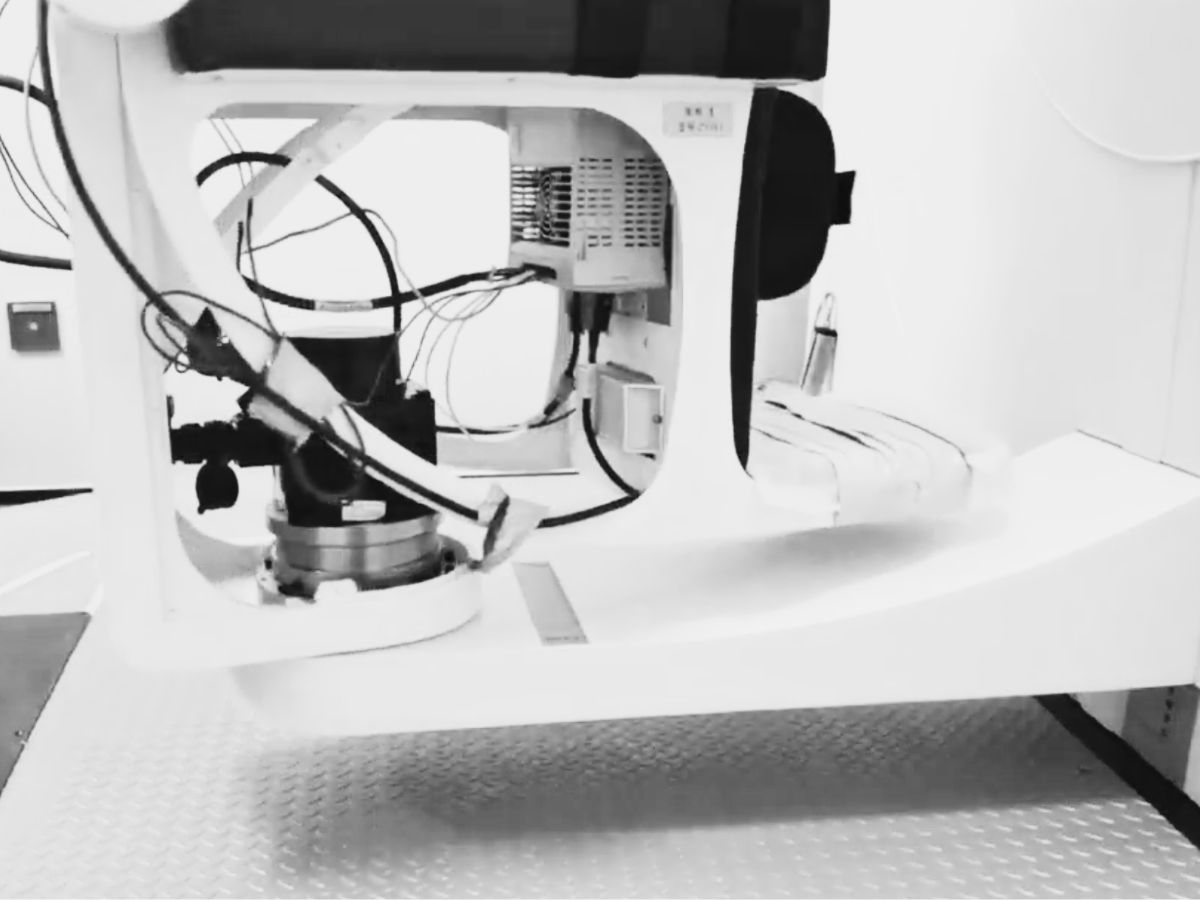
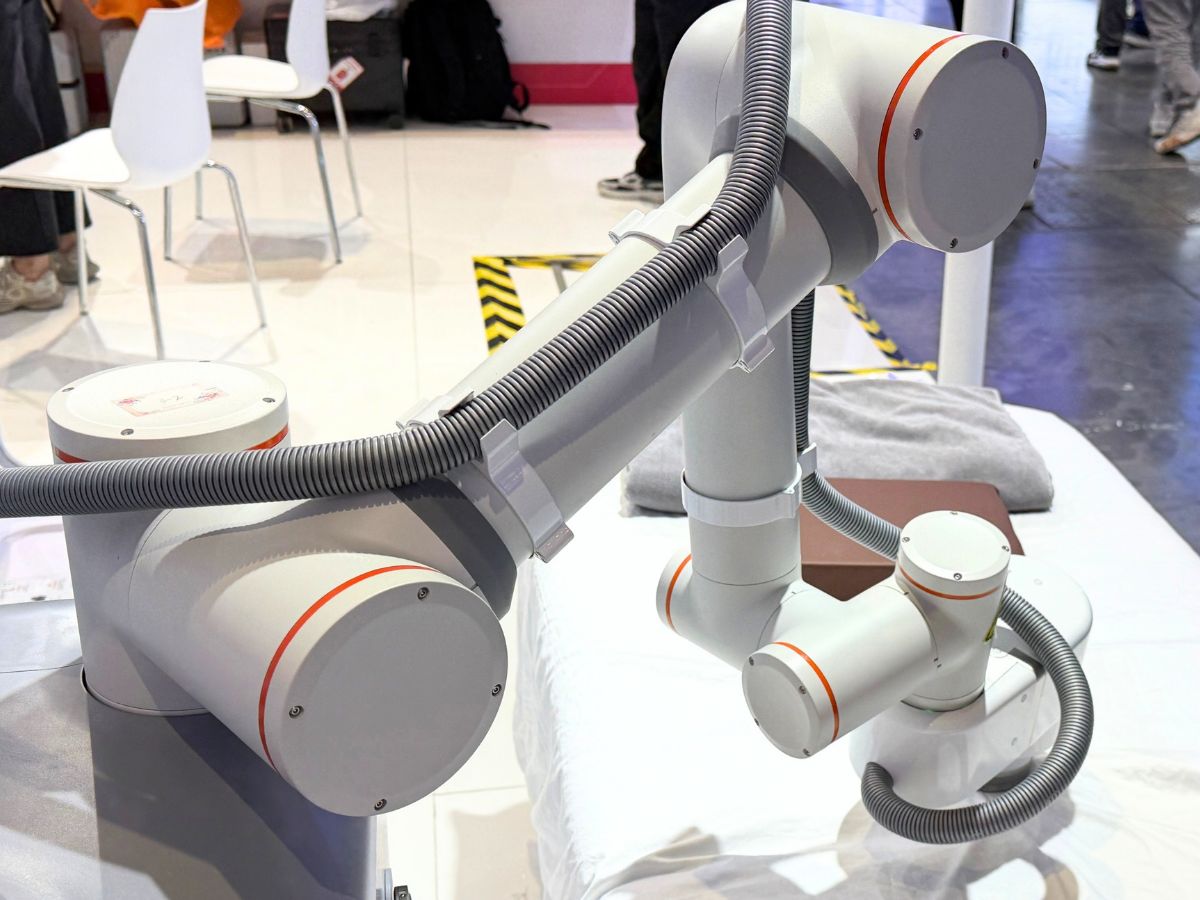
One site photograph already tells you most of what matters for selection. The machine is a 6-7 DOF vertical articulated arm working over a therapy bed, built from large-diameter one-piece joint modules. Nothing here is high dynamic: the duty cycle is low speed, sustained contact, long sessions. What the photo does show - external corrugated conduit running across several joints - is a real integration pain point, and it is the argument for a large hollow shaft. All readings below are visual estimates used to demonstrate a method, not the actual design parameters of that machine.
2. Five Reasons Force Control Is Non-Negotiable in Therapy Robots
2.1 The stiffness paradox: position control does not govern force on compliant tissue
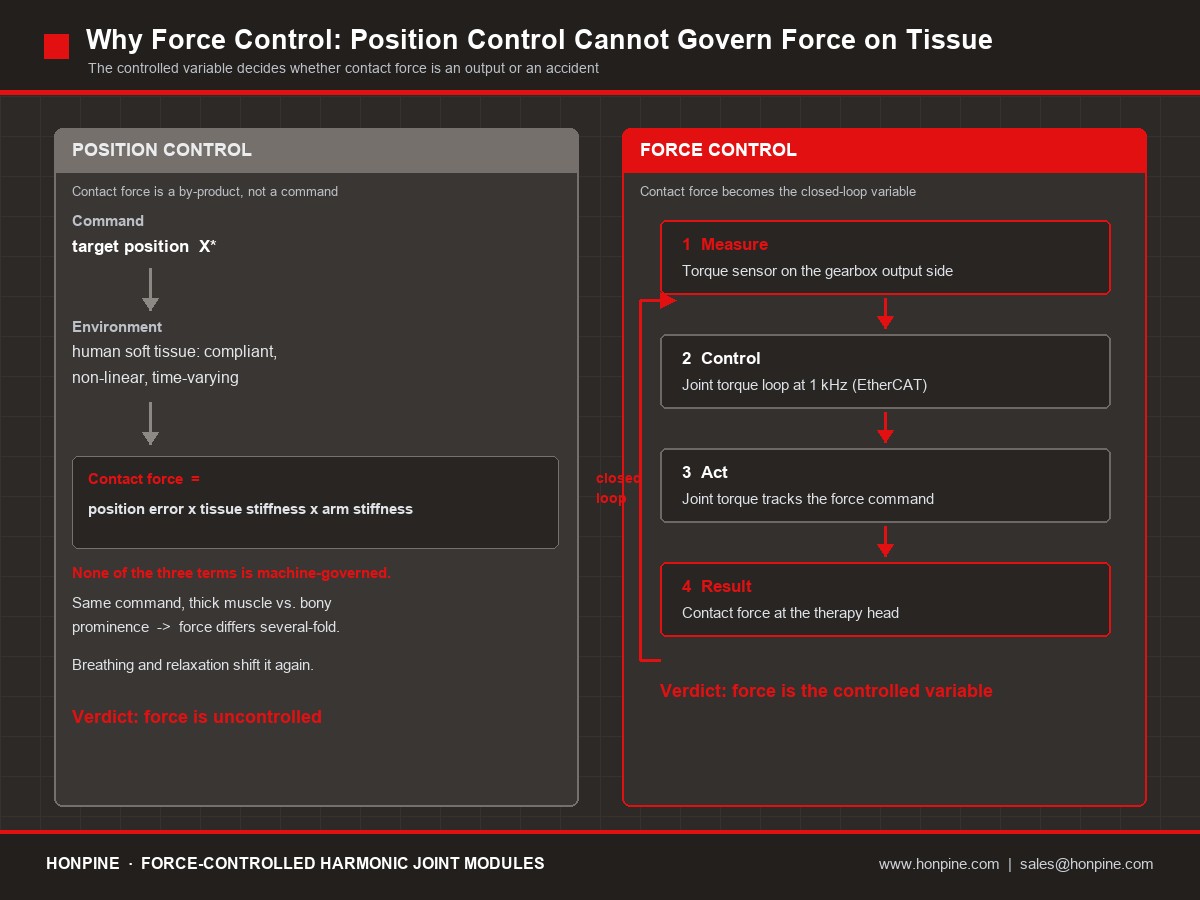
Position control assumes a rigid, compliant-free environment. Human soft tissue is the opposite: low stiffness, non-linear and time-varying. The same position command meets thick muscle and a bony prominence and produces contact forces that differ by a factor of several; breathing and how far the patient relaxes shift the force again at an unchanged position. Contact force under position control equals position error x environment stiffness x arm equivalent stiffness - and not one of those three terms is machine-governed.
Force control changes the controlled variable from position to force, so contact force becomes a closed-loop quantity. That is the only control architecture that can take responsibility for the force applied to a human body.
2.2 Therapy dosimetry: force is the prescription, and it must be repeatable
The clinical parameters of manual therapy are force (or pressure), frequency, duration and depth. The commercial promise of a therapy robot is standardised force and repeatable treatment - the same prescription should feel the same on the first session and the tenth, with this therapist or that one, in this clinic or that one. Without a force loop, "dose" is only a number in software, not a physical fact.
2.3 Human-contact safety: collision detection and safe stop are the compliance floor
Patients move, cough and turn over without warning. Torque-sensing joints give the whole arm collision detection through joint torque residual monitoring, and pair with STO (safe torque off) to turn an abnormal contact event into a safe torque-off stop. That is the compliance basis for entering any human-contact scenario: ISO 10218 and ISO/TS 15066 provide the collaborative reference, while a device classified as a medical device must be worked through IEC 60601 and ISO 14971 risk management. Certification conclusions rest with the notified body, not with this article.
2.4 Hand-guided teaching: the therapist's touch has to be transferable
Today the technique lives in the hands of experienced therapists, so the product route is fixed: the therapist guides the arm through the movement, the machine records trajectory and force, then replays it. Hand guiding requires the joints to run in zero-force or compliant mode - a direct application of torque closed loop. Without force control, guiding is either immovable or collides at the slightest push.
2.5 Compensation and unit-to-unit consistency
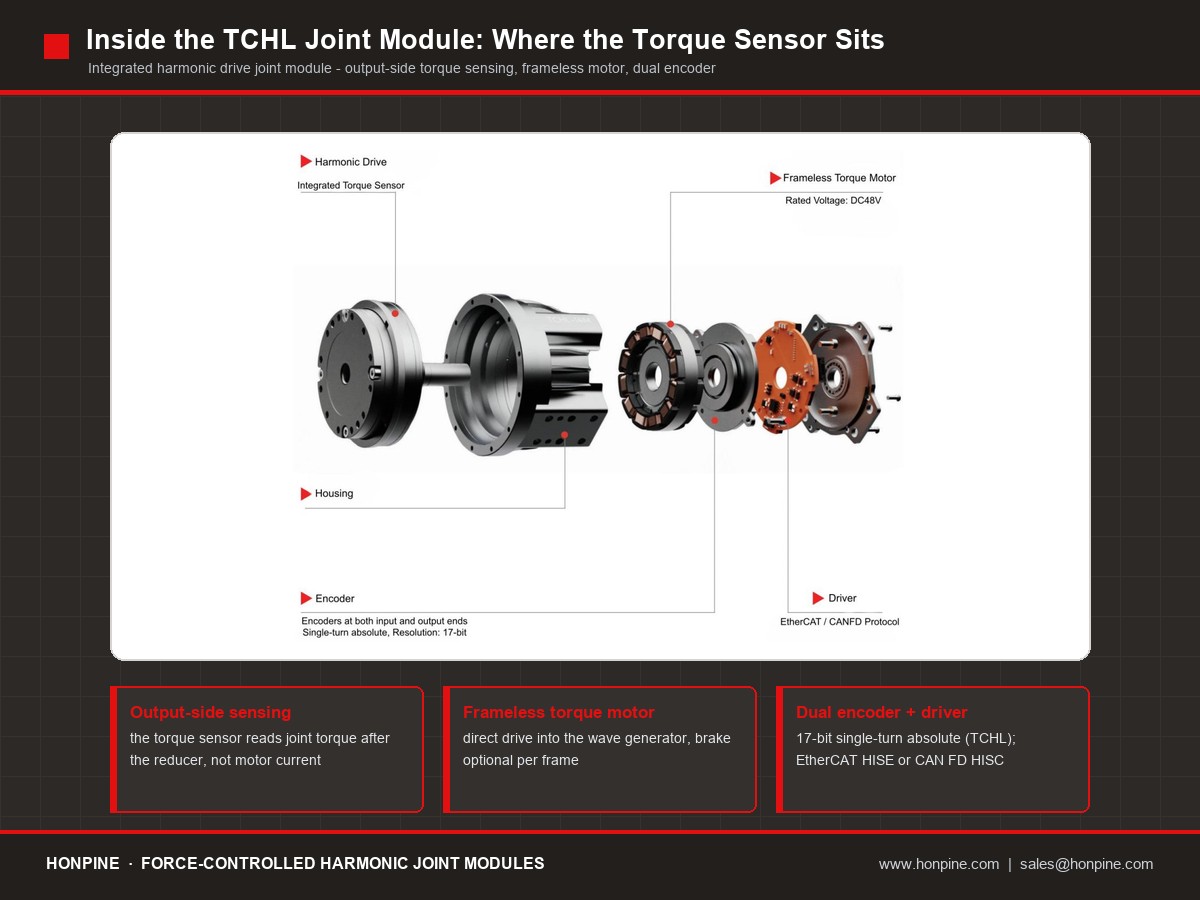
Harmonic joints carry friction and hysteresis, and every change of arm posture changes the gravity torque. Measured joint torque is the data source for gravity and friction feed-forward; compensate badly and the mechanical side pollutes tip force accuracy. Equally, the calibration record shipped with each module - stiffness and hysteresis curve - is what keeps "every robot feels the same" true across a batch.
3. Two Layers, Not Either-Or: Joint Torque Sensing and End-Effector Force Sensing
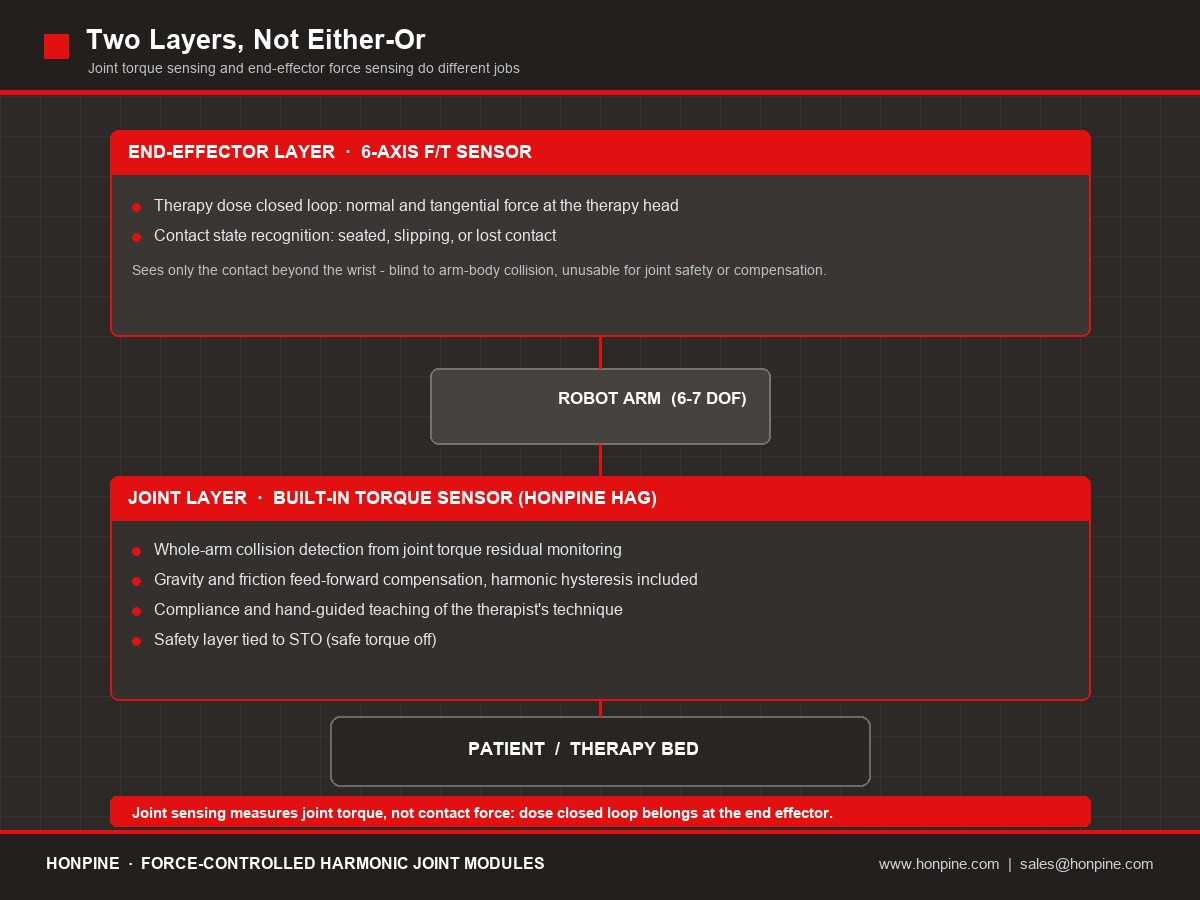
The most common specification error is to treat joint torque sensing and a wrist force/torque sensor as alternatives. They are two layers with different jobs, and a therapy robot needs both. The joint layer measures joint torque, not contact force: it has to be mapped through link length and posture, and it is contaminated by gravity, inertia and harmonic friction, so reading it directly as "massage force" carries real error. The end-effector layer sees only contact beyond the wrist - it cannot detect an arm-body collision and cannot serve joint safety or compensation.
4. TCHL vs HAG: Item-by-Item Verdict for Therapy Robots
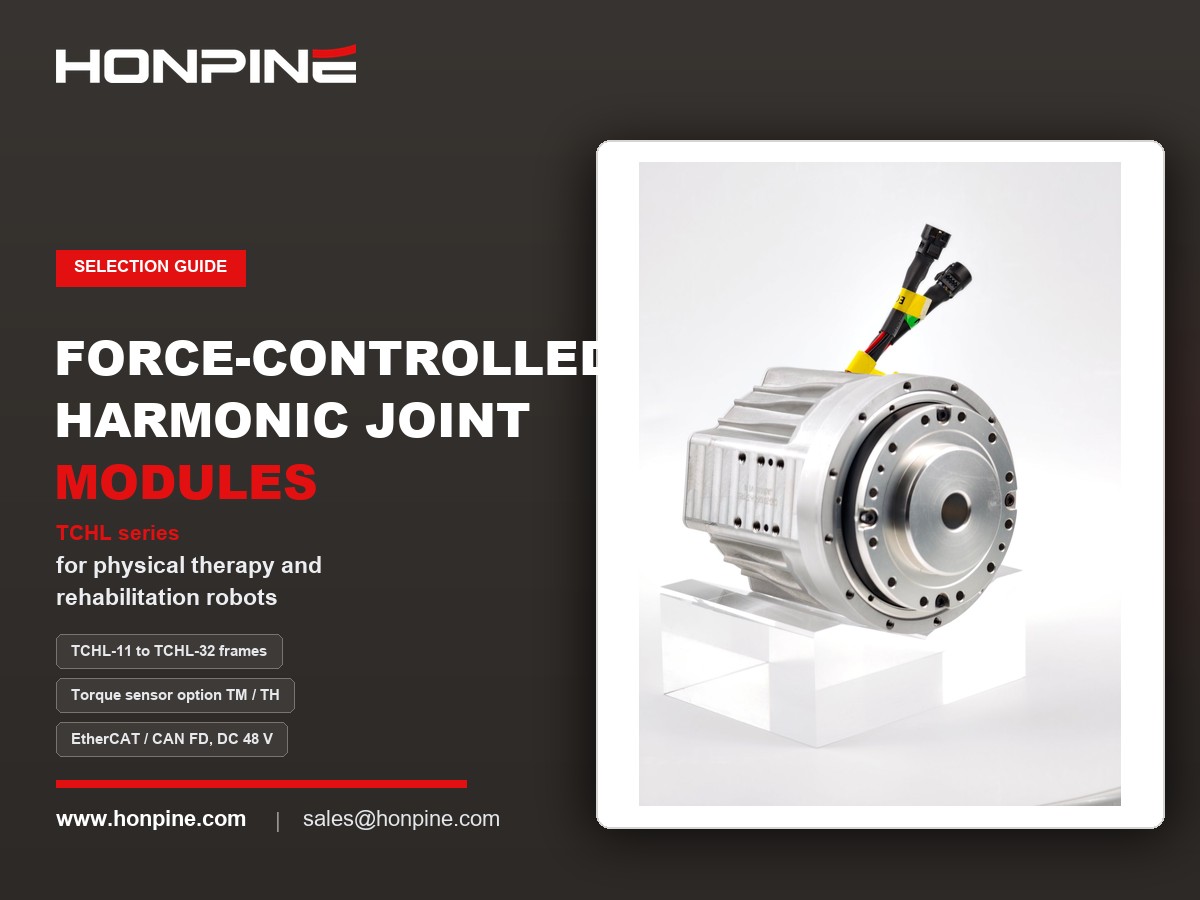
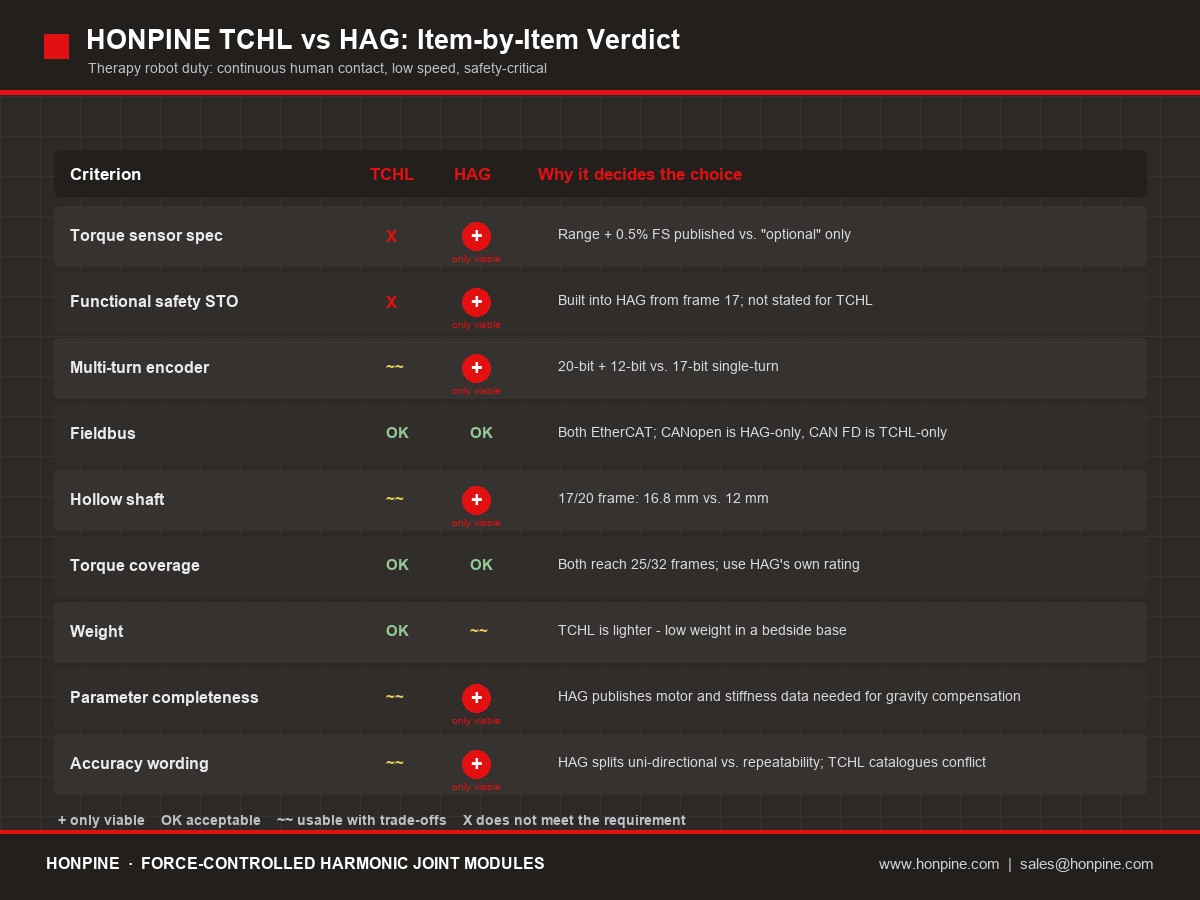
HONPINE's TCHL and HAG are two product definitions on one platform, not two generations. TCHL is the lightweight, compact series built for overseas channels; HAG is the highly integrated series with functional safety. Both offer an optional torque sensor, and that is where the verdict turns.
4.1 Where HAG wins outright
4.1.1 A published torque sensor specification you can promise
A force-controlled product has to answer one question in writing: what is the resolution? With HAG the answer is published - range per frame and 0.5% of full scale non-linearity - so a resolution figure can be quoted, calibrated and defended. TCHL publishes "optional" only. On a product whose entire value proposition is force, an unspecified sensor is a hard defect.
4.1.2 Integral STO as the functional-safety base
Physical human contact needs a safety floor that does not depend on software. HAG integrates STO from frame 17 upward, which is what turns collision detection into a safe torque-off. Confirm the safety level and certification status per frame in writing before you commit.
4.1.3 Multi-turn absolute encoder for patient positioning
After an e-stop or a power loss in a clinical session, the patient is still on the bed. A single-turn absolute encoder forces a re-homing routine with a human being under the arm; HAG's 12-bit multi-turn removes that step entirely.
4.2 Where TCHL still makes sense
TCHL remains the better answer where mass is the binding constraint - wearable or airborne structures, portable devices carried by an operator - and where the host controller speaks CAN FD. On a bedside therapy robot with a fixed or wheeled base, weight is not the binding constraint, so its main advantage simply does not apply.
5. Frame Matching and the Force-Control Resolution Budget
5.1 Published HAG sensor ranges and resolution
Resolution is range x 0.5% of full scale, because non-linearity is quoted against full scale. The practical rule follows directly: choose the range that sits close to the working torque. Oversizing costs resolution - a 500 N.m sensor resolves 2.5 N.m, twenty times coarser than a 25 N.m sensor.
5.1.1 Worked example: from tip force to joint torque
A manual therapy normal force of 10-50 N, taken through a wrist moment arm of roughly 0.10-0.20 m, becomes a 1-10 N.m wrist torque signal. Against the table above, HAG-17's 0.375 N.m resolution is about 2-4 N at the tip - workable but not generous for a prescription graded in 5 N steps, and the joint reading still carries gravity, inertia, and harmonic friction and hysteresis on top.
5.2 The boundary that has to be stated: joint sensing is not therapy-dose closed loop
A joint-level torque sensor does not by itself close the loop on therapy dose. The correct architecture is two layers: joint torque sensing for safety, collision detection and compensation, and end-effector force sensing for dose. Saying this out loud is what separates a credible specification from a marketing claim - and it is also the honest reason to keep a wrist F/T sensor in the bill of materials.
6. Getting HAG Right: Ordering and Validation Checklist
6.1 Before you order
1. STO per frame. Confirm the frame number in the model code HAG-XX T-XXX-DC1-02-B-E actually carries STO, and ask for the safety level (SIL/PL) and certification status. The HONPINE documentation contradicts itself on STO (HAU-14 "not included" versus HAG-14 "integrated"), so this has to be clarified in writing.
2. Measurement state of published figures. HAG ships in T (with sensor) and N (without) configurations, but the catalogue carries a single parameter table. Get written confirmation of whether rated and peak torque were measured with or without the torque sensor.
3. Sensor dynamic behaviour. Bandwidth, hysteresis and thermal drift. Therapy runs continuously for long sessions: drift decides whether minute 30 matches minute 1, and bandwidth caps the achievable compliance loop.
4. How torque readings reach the bus, and how often. Decide whether the force loop runs inside the drive or on the host. Under 1 kHz control the sensor reporting rate has to match - prefer the EtherCAT version.
6.2 Before you ship
5. Factory calibration record. Require a stiffness, hysteresis and zero-drift calibration report per module, and confirm the controller can read those parameters for compensation. This is the handle on "every machine feels the same" in volume delivery.
6. Bench validation items. Tip force step response and steady-state accuracy at room temperature and after warm-up; collision detection threshold and response time together with STO; hand-guiding feel; accuracy decay after one million cycles.
7. Compliance pathway. Where the device falls under medical device rules, run risk management against IEC 60601 and ISO 14971. This article is not a certification basis; the professional body's opinion governs.
7. One-Page Conclusion
Why force control. What a therapy robot delivers is a force on a human body, and a human body is a deformable contact object, so position control cannot govern force. Force control is the precondition, not the premium option: dose, safety and teachable technique all sit on it.
TCHL or HAG. HAG. Three decisive advantages land exactly on the pressure points of this scenario: a force specification that can be promised (published range and 0.5% non-linearity), an STO functional-safety base, and a multi-turn absolute encoder that recovers patient positioning. TCHL's lightweight advantage carries the least weight in a bedside machine, and an unpublished sensor specification is a hard defect on a force-control product.
How to use it. Take wrist HAG-17, elbow HAG-20 and shoulder HAG-25 as the baseline combination and check range margin joint by joint against working torque. Run two layers - joint torque sensing for safety and compliance, end-effector force sensing for dose - and close the seven items in section 6 before releasing an order.
Sources and confidence levels
Disclaimer
· Configuration readings (degrees of freedom, joint diameter, reach, torque tiers) are visual estimates, not the real design parameters of the machine photographed. They illustrate a selection method and must not be presented as a technical conclusion about that model.
· Manufacturer figures come from catalogues that contain several internal inconsistencies; this article does not silently pick one reading. Before any external commitment, work from the latest specification and a written confirmation from the manufacturer.
· Where a therapy device is classified as a medical device, safety and compliance (IEC 60601 series, ISO 14971 and related) rest with the professional certification body. This article is not a certification basis.
Read More
Learn more about the story of HONPINE and industry trends related to precision transmission.
 What is robot joint actuator?How to Choose the Best Robot Rotary Joint Actuator?In core robot joint transmission solutions, planetary and harmonic rotary actuators each have their own strengths. Choosing the right type based on application requirements is essential to achieve the optimal balance between performance and cost.
 DD Motors VS Harmonic Rotary ActuatorsThis article provides an in-depth comparison between Direct Drive (DD) motors and harmonic rotary actuators, covering their transmission principles, advantages and disadvantages, and typical application fields.
 OMG Ultra Compact Harmonic Drive Joint Module with Built-in Torque SensorHONPINE TCHL series harmonic drive joint module is a game-changing product that achieves disruptive improvements in multiple aspects such as lightweight design, integration level, and connection convenience. This article will analyze its revolutionary enhancements with you.
 The Role of Harmonic Drive Gears in Achieving 5–10 μm Accuracy in Dental Milling MachinesA dental milling machine is a CNC machining system used to directly process digital dental models into restorations such as crowns, bridges, veneers, inlays, and implant abutments. Dental milling machines require far higher operational accuracy and motion stability than ordinary equipment. This article explains how harmonic drive gear help dental milling machines achieve stable, continuous, and controllable operation.
 Why Are Harmonic Rotary Actuators Perfect for Medical Equipment?Harmonic rotary actuators (typically integrated systems consisting of a harmonic drive reducer, frameless torque motor, encoder, and optional brake) are regarded as key components in medical equipment. The core reason is that they simultaneously meet the most stringent medical requirements for precision, compact size, safety, and controllability. The following explanation is structured from three perspectives: technical characteristics, application scenarios, and medical value.
 High-Precision RV Reducers Perfectly Matched for Walking RobotsThe walking axis of a robot is a core component for power transmission and support. RV reducers provide extremely high rigidity, precision, and torque while maintaining a compact size and exceptional reliability, making them an ideal match for the demanding requirements of walking robot joints in terms of load capacity, impact resistance, and precision.
 Why Bedside Physical Therapy Robots Need Force-Controlled Joint Modules?A therapy robot does not sell a robot arm; it sells a force applied to a human body. Pressure, rhythm and depth are the prescription, and position control cannot deliver them: soft tissue is compliant and time-varying, so one position command yields contact forces that differ several-fold between muscle and bone. Force-controlled harmonic joint modules turn contact force into a closed-loop variable - the only way to make dose repeatable, human contact safe and a therapist's technique teachable. Starting from one site photo of a bedside therapy robot, this article reads the configuration, sets out five reasons force control is unavoidable, settles HONPINE's TCHL-versus-HAG choice criterion by criterion, and gives the torque sensor resolution budget that picks the frame sizes.
 NEMA 17 & NEMA 23 Harmonic Drive Matching Guide: Pairing Stepper Motors with Harmonic ReducersPairing a stepper motor with a harmonic drive is not a budget compromise. A stepper's weak points — the coarse step angle, torque collapse above roughly 400 rpm, and the lack of a precision transmission — are exactly what a harmonic drive fixes: it pulls the operating point into the low-speed, high-torque sweet spot, refines a 1.8° step angle into arc-second resolution, and delivers near-zero backlash. This guide explains what NEMA frame sizes mean at the mounting interface, which harmonic frames match NEMA 17 and NEMA 23, the eight checks to run in order — including the input-side no-load starting torque most often missed — and the pairing's real weakness: silent failure. Includes HONPINE SHD and CSF specifications.
 Harmonic vs. RV Reducers for Lithium Battery Robotic Arms: A Joint-by-Joint Selection GuideIn lithium battery plants, reducer selection for a robotic arm is not about finding one "best" gearbox — it is about dividing work by joint. RV reducers take the shoulder and elbow (J1–J3), where stiffness, shock resistance, and long life matter most; harmonic reducers take the wrist (J4–J6), where near-zero backlash, high torque density, and low weight decide positioning accuracy. Planetary gearboxes cover long-travel Cartesian transfer at lower cost. Lithium battery production then adds three stricter filters: extreme repeatability (±0.02–0.05 mm), 24/7 high-duty cycles, and zero tolerance for metal particle contamination. This guide explains the logic behind joint-by-joint selection, compares the three reducer types, and maps typical configurations for every station.
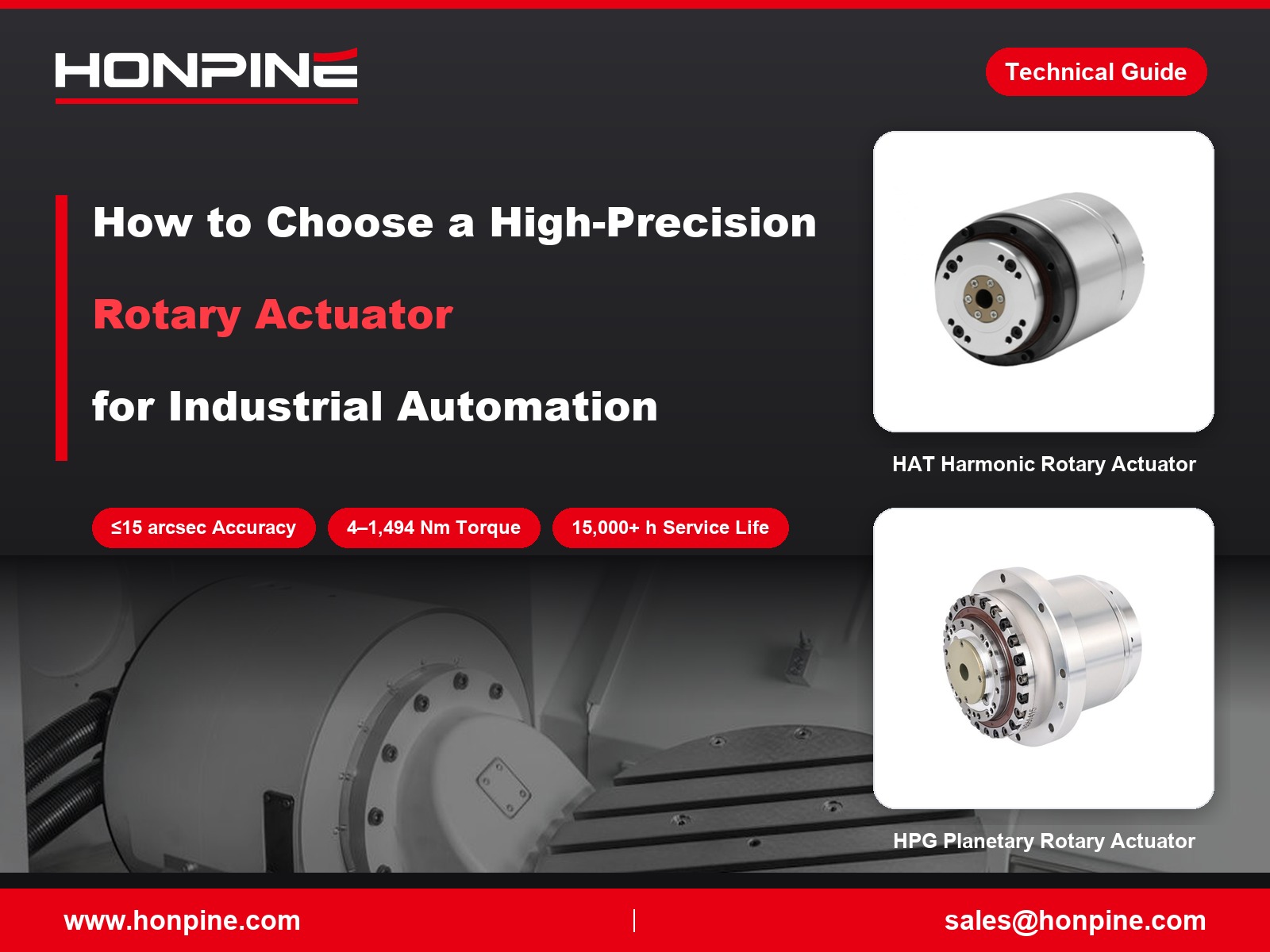
 How to Choose High-Precision Rotary Actuators for Industrial Automation?High-precision rotary actuators play an important role in industrial automation, where positioning accuracy, repeatability, durability and installation flexibility directly affect equipment performance. HONPINE offers four main series of precision rotary actuators, including HAT, HAM and HAS harmonic rotary actuators and HPG low-backlash planetary actuators. With torque ratings ranging from 4 to 1,494 Nm across the product range, these solutions are designed for applications in semiconductor manufacturing, 3C automation, laser processing and CNC machine tools. Learn how to identify the right rotary actuator based on operating conditions, precision requirements and mechanical integration needs.
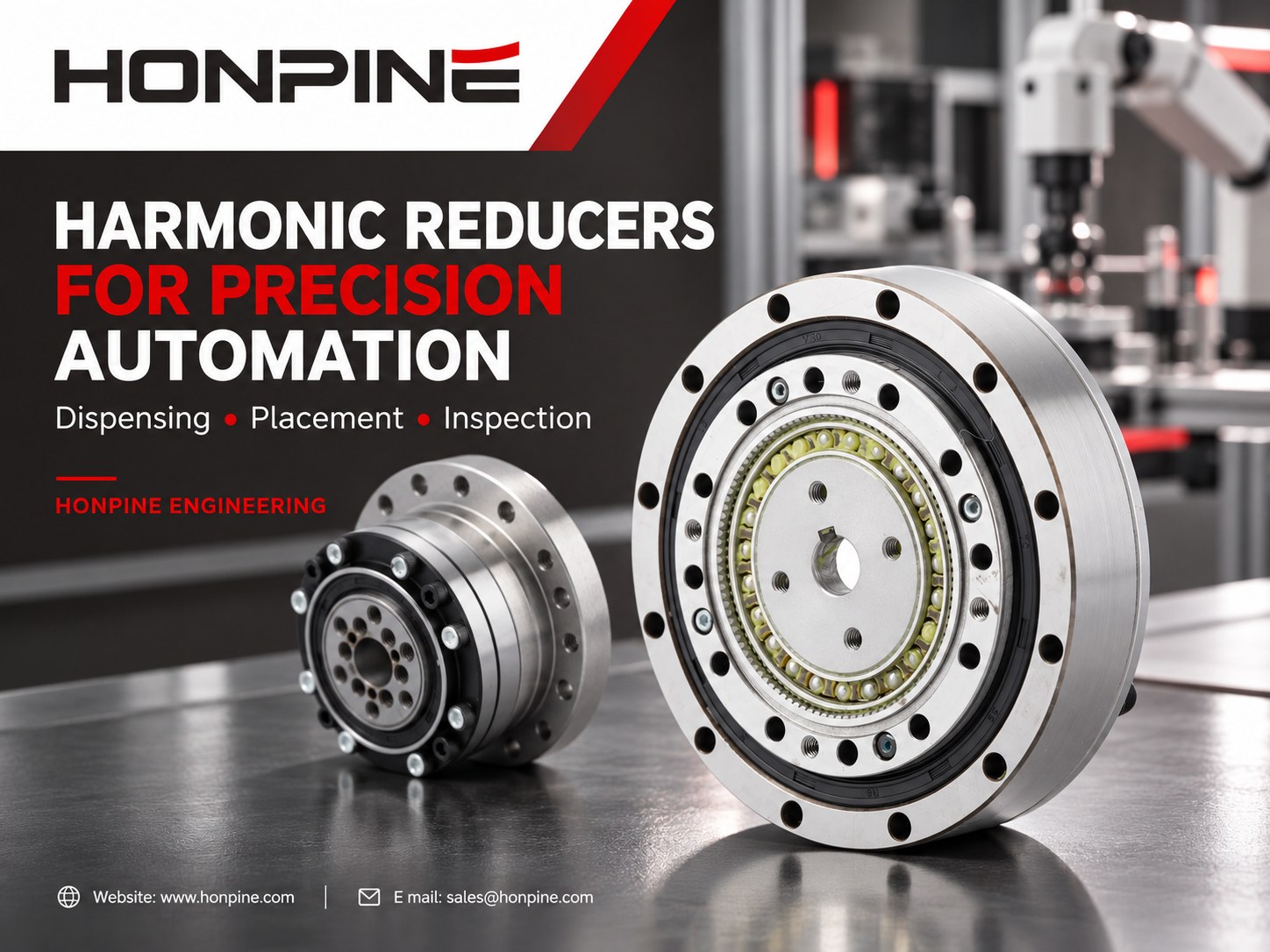
 Why Are Harmonic Reducers Suitable for High-Precision Automation Equipment?Precision automation equipment depends on consistent rotary motion, reliable positioning and compact transmission design. From dispensing head orientation and component angular alignment to automated inspection indexing, harmonic reducers offer a practical solution for applications requiring low backlash and high reduction ratios in limited installation space. This article explains how harmonic reducers support repeatable motion, compares key design configurations, and outlines how to select a suitable reduction ratio and reducer structure based on load, speed, accuracy and machine cycle-time requirements.
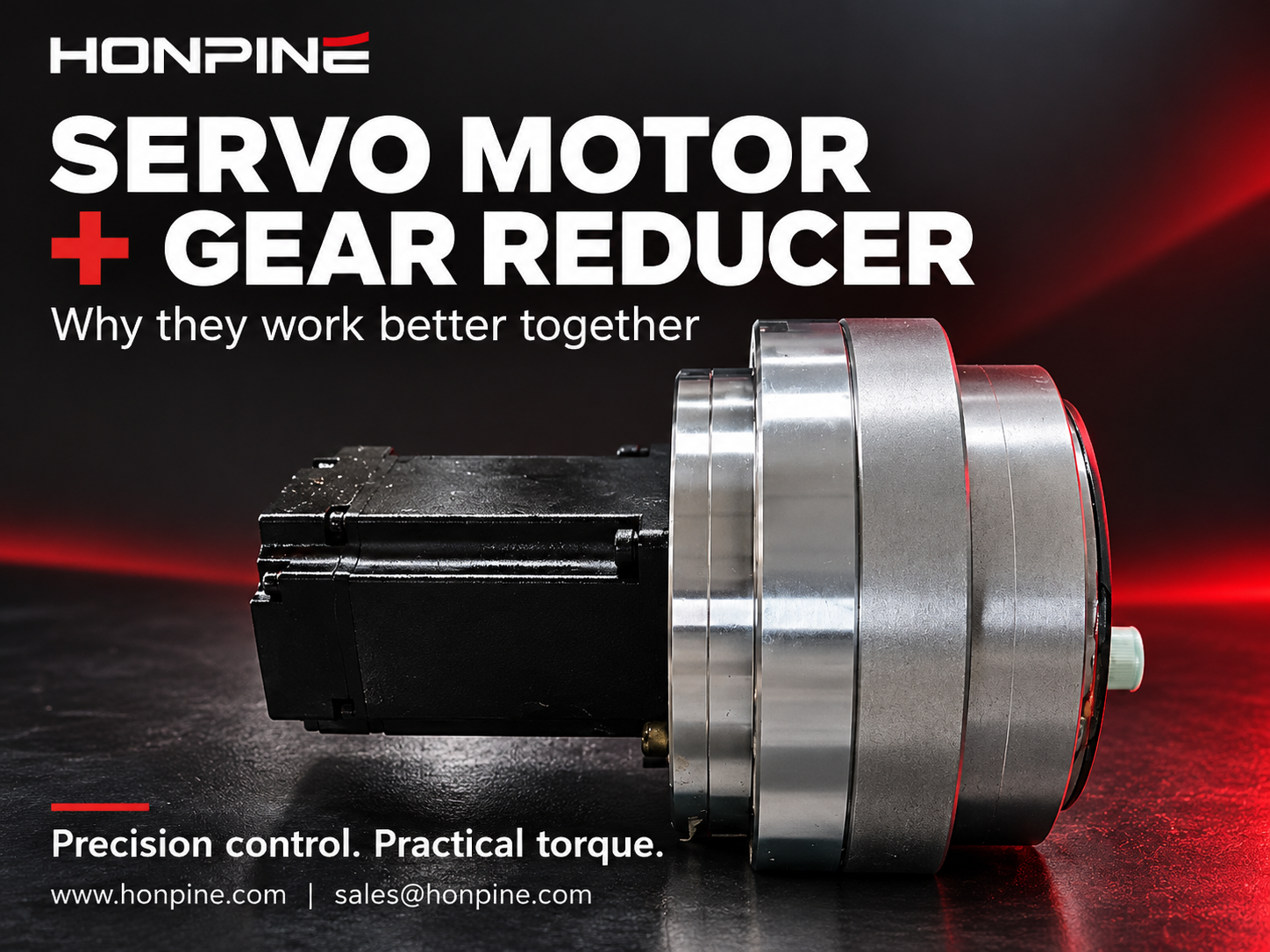
 Why Are Servo Motors and Gear Reducers an Ideal Match?Servo motors provide fast, precise motion control, while gear reducers adapt their speed and torque to the load. This guide explains how servo motors and gear reducers work together through torque multiplication, reflected inertia reduction and finer theoretical position resolution. Learn how inertia matching, backlash, torsional stiffness and reduction ratio influence performance in robotics and industrial automation.
Double Click
We provide harmonic drive reducer,planetary reducer,robot joint motor,robot rotary actuators,RV gear reducer,robot end effector,dexterous robot hand
 The Role of Harmonic Drive Gears in Achieving 5–10 μm Accuracy in Dental Milling MachinesA dental milling machine is a CNC machining system used to directly process digital dental models into restorations such as crowns, bridges, veneers, inlays, and implant abutments. Dental milling machines require far higher operational accuracy and motion stability than ordinary equipment. This article explains how harmonic drive gear help dental milling machines achieve stable, continuous, and controllable operation.
 Why Are Harmonic Rotary Actuators Perfect for Medical Equipment?Harmonic rotary actuators (typically integrated systems consisting of a harmonic drive reducer, frameless torque motor, encoder, and optional brake) are regarded as key components in medical equipment. The core reason is that they simultaneously meet the most stringent medical requirements for precision, compact size, safety, and controllability. The following explanation is structured from three perspectives: technical characteristics, application scenarios, and medical value.
 High-Precision RV Reducers Perfectly Matched for Walking RobotsThe walking axis of a robot is a core component for power transmission and support. RV reducers provide extremely high rigidity, precision, and torque while maintaining a compact size and exceptional reliability, making them an ideal match for the demanding requirements of walking robot joints in terms of load capacity, impact resistance, and precision.
 Why Bedside Physical Therapy Robots Need Force-Controlled Joint Modules?A therapy robot does not sell a robot arm; it sells a force applied to a human body. Pressure, rhythm and depth are the prescription, and position control cannot deliver them: soft tissue is compliant and time-varying, so one position command yields contact forces that differ several-fold between muscle and bone. Force-controlled harmonic joint modules turn contact force into a closed-loop variable - the only way to make dose repeatable, human contact safe and a therapist's technique teachable. Starting from one site photo of a bedside therapy robot, this article reads the configuration, sets out five reasons force control is unavoidable, settles HONPINE's TCHL-versus-HAG choice criterion by criterion, and gives the torque sensor resolution budget that picks the frame sizes.
 Harmonic Rotary Actuator for Lithium Battery Roller Press EquipmentLithium battery manufacturing equipment requires higher precision, stability, and integration efficiency as production processes continue to evolve. In roller press equipment, accurate roller positioning, pressure control, and dynamic response are critical for ensuring electrode quality and consistency.
HONPINE harmonic rotary actuators provide high precision, high rigidity, fast response, and compact integration for lithium battery roller press equipment. With near-zero backlash, high torque density, and reliable motion control performance, they help improve equipment accuracy and production stability. Harmonic Robot Joint Actuators for Pipeline Robots and Other Special-Purpose EquipmentPipeline robots operate in narrow and complex environments where limited installation space, high load requirements, cable routing, and precise motion control are critical challenges. A reliable joint actuator must provide high torque output, compact dimensions, and stable performance while adapting to demanding operating conditions. Harmonic robot joint actuators integrate precision transmission, motor drive, and sensing capabilities into a compact motion unit, making them suitable for pipeline robots and other special-purpose robotic systems. This article explores the key design requirements of pipeline robots and explains how HONPINE HPJM harmonic robot joint modules help achieve compact, high-performance, and reliable robotic solutions.
 Harmonic Actuator for Lift Equipment: Precision, Torque Density and Compact Motion Control IntroductionModern lifting equipment requires more than simply moving a load vertically. Robotic lift axes, AGV and AMR lift modules, semiconductor equipment, inspection platforms, and specialized winches increasingly demand high torque density, precise positioning, low backlash, high rigidity, and compact motion control. A harmonic actuator integrates a harmonic drive with a motor and, depending on the configuration, encoders, brakes, servo drives, and communication interfaces into a compact motion module. This article explores how harmonic actuators can be applied to different lifting systems and why their combination of precision, torque density, rigidity, and integration makes them suitable for automated lifting and positioning applications.
 Harmonic Rotary Actuators for Semiconductor Equipment: Precision Motion, Hollow-Shaft Design and FOC ControlHello everyone, I’m Theodore Li, Technical Director at HONPINE. In semiconductor manufacturing equipment, rotary motion is not simply about making a mechanism rotate. Limited installation space, cable and tube routing, low-speed stability, precise positioning and continuously adjustable motion profiles can all influence the performance of the machine. This is why harmonic rotary actuators are becoming an important motion solution for semiconductor equipment. In this article, I will discuss how harmonic transmission, FOC-based motor control, encoder feedback, large hollow-shaft design and flexible mechanical interfaces work together to meet practical semiconductor motion requirements, based on our experience with developing equipment, overhead transport, wafer handling, cleaning and crystal-growth applications.
 Miniature Harmonic Drive for Minimally Invasive Surgical RobotsMinimally invasive surgical robots require highly compact transmission systems that can deliver precise motion within extremely limited mechanical spaces. As robotic instruments become smaller and more dexterous, conventional transmission architectures can face challenges related to size, tendon elasticity, friction, hysteresis, and mechanical integration. A miniature harmonic drive offers one potential approach by providing high-ratio precision transmission, low backlash, and compact dimensions in a small mechanical envelope. In this article, I will explain why miniature harmonic transmission is relevant to surgical robotics, compare external tendon-driven and distal transmission architectures, and discuss the key engineering considerations behind HONPINE’s CSF-mini miniature harmonic reducer for compact robotic joints, flexible robotic instruments, and other precision mechanisms.
 Why Laser Wobble Welding Systems Need a High-Precision Harmonic Rotary Actuator?Laser wobble welding is increasingly used in battery manufacturing, busbar welding, electronics, medical devices, robotic welding, and other precision manufacturing applications where beam movement must remain accurate and repeatable. In mechanical wobble welding systems, however, weld quality depends not only on laser parameters but also on the precision of the rotary motion mechanism driving the wobble head. Backlash, insufficient torsional rigidity, limited torque density, and positioning errors can directly affect the actual beam trajectory and molten pool stability. This is why a high-precision rotary motion solution is becoming an important part of modern laser wobble welding equipment. A Harmonic Rotary Actuator combines precision transmission, high rigidity, low backlash, and compact integration, making it well suited for mechanical wobble heads that require controlled rotary motion under dynamic loads.
 When Does Outboard Motor Steering Require a Harmonic Rotary Actuator?Electric outboard motor steering is evolving from a simple mechanical function into a precision motion-control application. This article explains when a Harmonic Rotary Actuator becomes a suitable solution and examines the role of precision transmission, low backlash, high torque density, encoder feedback, and compact mechanical integration. It also explores applications in electric boats, autonomous surface vessels, unmanned boats, marine robotics, and electric marine propulsion, helping engineers understand how to select the right rotary actuator according to steering torque, speed, positioning accuracy, operating conditions, and installation requirements.
 How to Choose the Right Robot Joint Actuator for Specialized Robotic Applications?Choosing the right robot joint actuator is no longer simply a matter of comparing torque specifications or selecting a motor and gearbox separately. As humanoid robots, collaborative robots, industrial robotic arms, medical robots, mobile manipulators, and specialized robotic systems become more diverse, robot manufacturers must balance torque, speed, precision, stiffness, weight, installation space, feedback, communication, and safety at the same time. This article explains how engineers can select the right harmonic joint actuator or robot joint motor by starting with the actual application problem and building a joint-level solution that matches the mechanical structure and control requirements of the complete robot.