


• Planetary Joint Module Solutions for Quadruped Robots

    What Are the Key Challenges in Quadruped Robot Joint Transmission?

    Are your quadruped robots experiencing joint stuttering, abnormal noise, walking deviations, or even single-leg failures?

    As quadruped robots move beyond demonstrations and enter real-world applications, many robot manufacturers encounter challenges in one of the most fundamental components: the joint module. Joint performance directly affects locomotion stability, dynamic response, payload capacity, and long-term reliability.

    So, what type of joint module is best suited for quadruped robot motion control? And how can robot manufacturers identify a reliable joint module supplier?

    Here are five common challenges to consider when selecting planetary joint modules for quadruped robots, along with how HONPINE addresses them.

    1. Inflated Specifications and Unverified Performance

    Some joint module suppliers advertise torque, speed, and positioning accuracy figures that differ significantly from actual operating performance. Without supporting test data, these specifications make it difficult for robot manufacturers to evaluate real capabilities. The result can be frequent joint stuttering, abnormal operation, and unexpected failures after integration.

    HONPINE's Solution: Transparent Specifications and Verified Test Data

    HONPINE maintains strict standards for product specifications and accurately labels the performance parameters of its joint modules. Relevant performance figures are supported by factory testing and documented test reports, giving robot manufacturers a more reliable basis for component selection and system integration.

    2. Excessive Weight in Pursuit of Higher Torque

    Some joint modules achieve higher torque ratings at the expense of weight and overall size. Low torque density increases the weight of the robot's limbs and body, potentially reducing battery endurance, dynamic responsiveness, and payload capacity.

    For quadruped robots, balancing output torque, structural weight, and power consumption is essential to improving overall mobility and performance.

    HONPINE's Solution: High Torque Density Through Integrated Design

    HONPINE develops high-torque-density joint modules through in-house capabilities covering structural design, motor integration, and drive control algorithms. By optimizing the entire transmission and drive system, HONPINE aims to deliver higher torque output within a compact and lightweight structure, helping quadruped robots achieve a better balance between payload capacity, mobility, and energy efficiency.

    3. Overlooking Thermal Management Under Continuous Operation

    Joint modules generate heat during continuous operation. Without effective thermal management, excessive temperature rise can cause motor demagnetization, encoder accuracy drift, and lubricant degradation, eventually reducing joint performance and system reliability.

    This is particularly important for quadruped robots that require repeated acceleration, deceleration, and high-dynamic movements.

    HONPINE's Solution: Reducing Heat Generation at the Source

    HONPINE addresses thermal management at the joint module design stage by optimizing the reducer, motor, and integrated drive system. The design focuses on reducing electromagnetic losses, mechanical friction losses, and power device switching losses, helping suppress temperature rise at the source and maintain stable performance during operation.

    4. Insufficient Long-Term Reliability and Service Life

    Joint modules operating under repeated cyclic loads may experience component wear, positioning accuracy drift, and performance degradation over time. These problems can shorten service life and increase maintenance requirements.

    For quadruped robots, which frequently perform repetitive walking, running, jumping, and load-bearing movements, joint durability and positioning consistency are critical.

    HONPINE's Solution: Dual Absolute Inductive Encoders and Robust Mechanical Design

    HONPINE combines hardware optimization with control algorithm improvements to achieve high-precision motion control. Unlike some conventional magnetic encoder solutions, HONPINE adopts a dual absolute inductive encoder architecture, achieving positioning accuracy of up to 40 arcsec.

    The joint modules also use high-strength, wear-resistant, and fatigue-resistant materials, together with high-rigidity bearings and quality sealing components. This combination helps improve service life, mechanical reliability, and operational stability under demanding working conditions.

    5. Unreliable Production Capacity and Batch Consistency

    Prototype performance does not necessarily translate into reliable mass production. Some joint module suppliers struggle with production delays, inconsistent precision, and variations in product quality between batches.

    For quadruped robot manufacturers moving from R&D to commercial production, stable delivery capacity and consistent product performance are essential.

    HONPINE's Solution: In-House Manufacturing and Full-Process Quality Control

    HONPINE operates its own manufacturing facilities equipped with automated production lines. From component machining to final assembly and factory inspection, the entire manufacturing process is subject to quality control.

    This integrated production capability helps maintain product consistency across batches, improve delivery reliability, and support the transition from prototype development to mass production.

Quadruped Robot Joint Module Solutions for Different Robot Sizes and Applications

HONPINE provides customized planetary joint module solutions for quadruped robots of different sizes, including large, medium, and small quadruped robots, as well as explosion-proof robotic dogs. By combining high-torque-density leg joints with high-speed wheel-leg modules, HONPINE helps robot manufacturers balance payload capacity, mobility, structural weight, and dynamic performance across different applications.
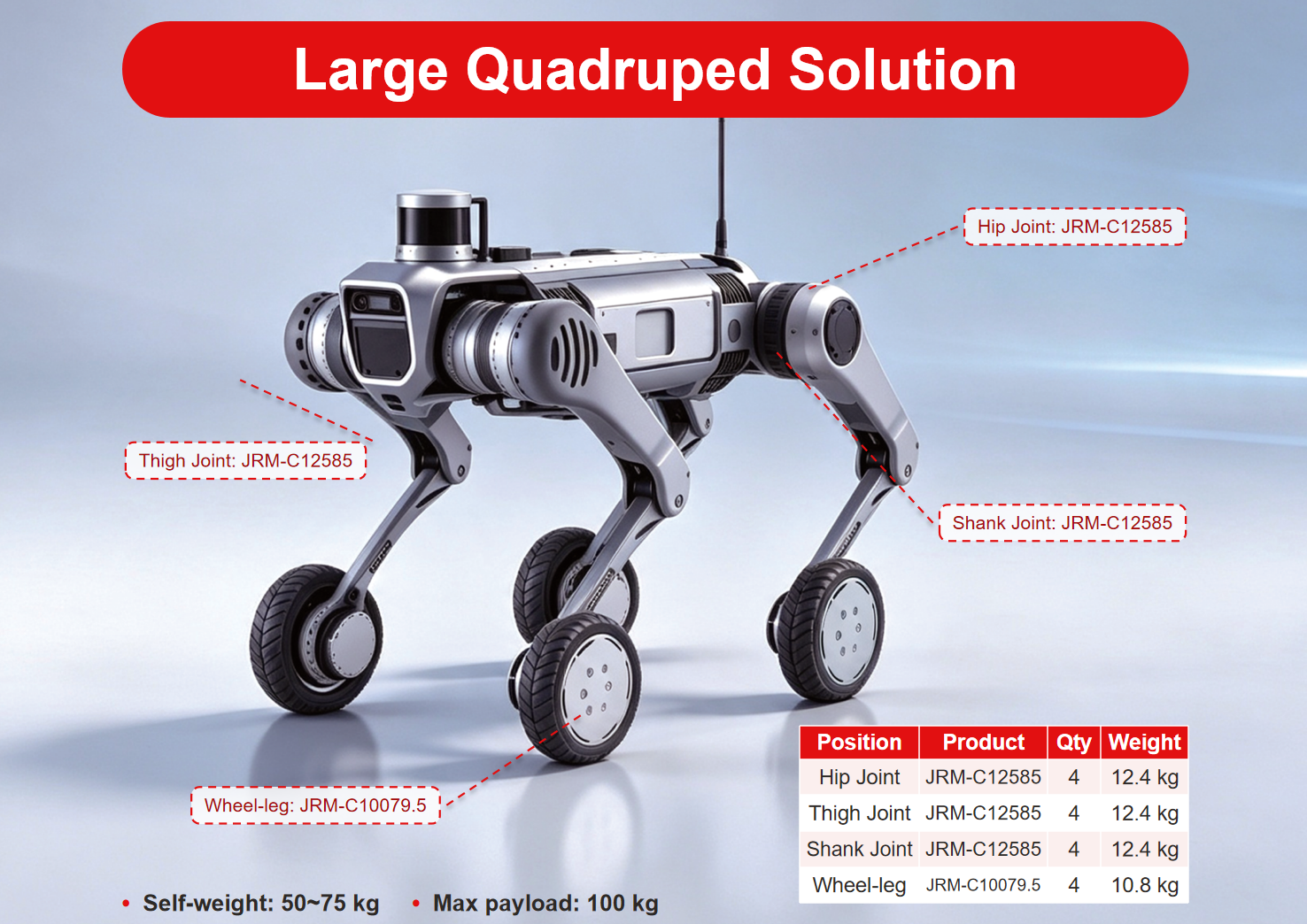
Large Quadruped Robot Joint Solution

Joint Module Solution for Large Quadruped Robots

Designed for large quadruped robots weighing 50–75 kg, with a maximum payload capacity of 100 kg, this solution combines the JRM-C12585 planetary joint module for hip, thigh, and lower-leg joints with the JRM-C10079.5 wheel-integrated module for wheel-leg joints.

The JRM-C12585 weighs only 3.1 kg while delivering 500 Nm of peak torque, 76 Nm of continuous torque, and a rated speed of 136 rpm. Its 13 mm hollow shaft design provides convenient cable routing and simplifies joint integration. It is designed to deliver high torque output for load-bearing and obstacle-crossing movements.

For wheel-leg joints, the JRM-C10079.5 features an integrated wheel and weighs just 2.7 kg. With a low reduction ratio of 10:1 and a peak speed of up to 350 rpm, it supports lightweight construction and high-speed wheeled mobility.

Together, these two modules address the key engineering challenges of large quadruped robots, including structural weight, high torque output, cable routing, and thermal management, while supporting both legged locomotion and high-speed wheeled movement.
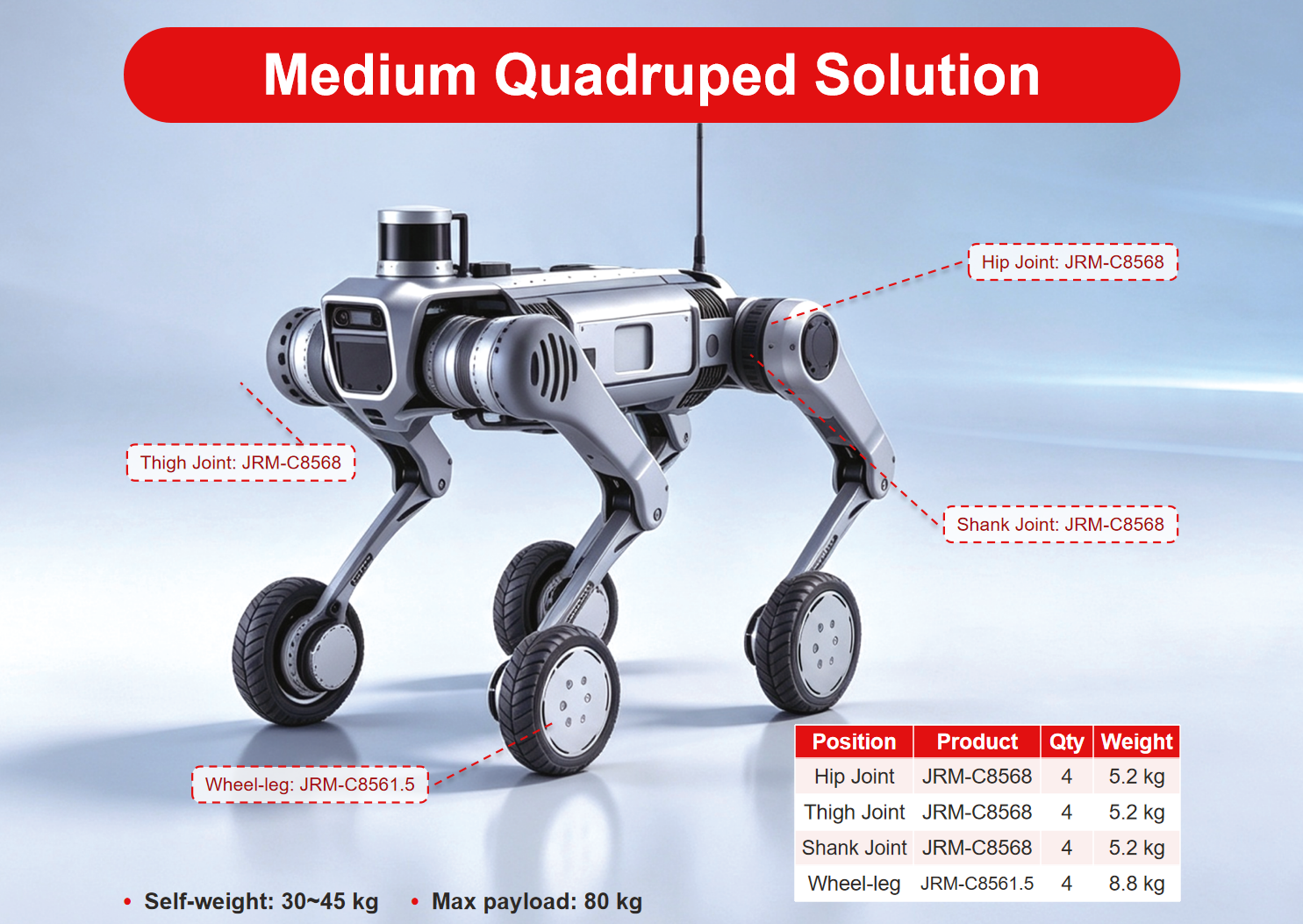
Medium Quadruped Robot Joint Solution

Joint Module Solution for Medium Quadruped Robots

Designed for medium-sized quadruped robots weighing 30–45 kg, with a maximum payload capacity of 80 kg, this configuration combines the JRM-C8568 planetary joint module for hip, thigh, and lower-leg joints with the JRM-C8561.5 wheel-integrated module for wheel-leg joints.

The JRM-C8568 weighs only 1.3 kg and delivers 160 Nm of intermittent peak torque, with 38 Nm of continuous torque and a reduction ratio of 32:1. Its high torque density provides the power required for load-bearing movements and obstacle negotiation without adding excessive weight to the robot.

The JRM-C8561.5 wheel-integrated module features a low reduction ratio of 6:1 and a peak speed of up to 410 rpm. With an integrated wheel weight of only 2.2 kg, it combines lightweight construction with high-speed wheeled mobility.

Both modules support a wide input voltage range of 48/72 VDC and CAN/CAN-FD communication. This configuration helps medium-sized quadruped robots balance overall weight, payload capacity, dynamic response, and seamless transitions between legged and wheeled locomotion.
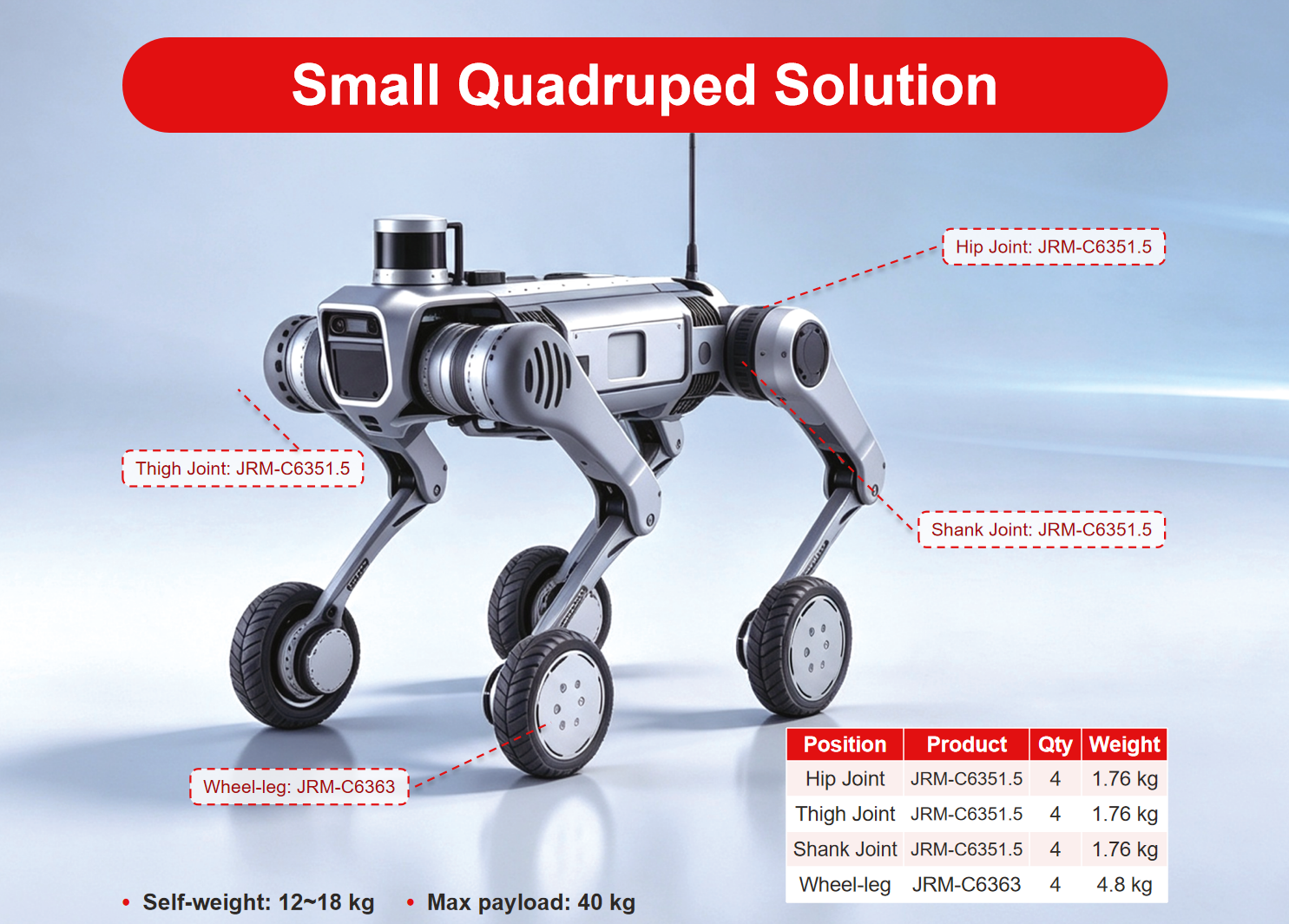
Small Quadruped Robot Joint Solution

Joint Module Solution for Small Quadruped Robots

Designed for small quadruped robots weighing 12–18 kg, with a maximum payload capacity of 40 kg, this solution combines the JRM-C6351.5 planetary joint module for hip, thigh, and lower-leg joints with the JRM-C6363 wheel-integrated module for wheel-leg joints.

The JRM-C6351.5 weighs only 0.44 kg while delivering 45 Nm of intermittent peak torque, 12 Nm of continuous torque, and a reduction ratio of 36:1. Its lightweight design and high torque density provide the load-bearing and obstacle-crossing capabilities required by compact quadruped robots under strict weight constraints.

For wheel-leg joints, the JRM-C6363 features a reduction ratio of 10:1 and a peak speed of up to 360 rpm. With an integrated wheel weight of approximately 1.2 kg, it supports lightweight design and high-speed wheeled movement.

Both modules operate on a 48 VDC power supply and support CAN/CAN-FD communication. This configuration helps small quadruped robots maintain a payload capacity of up to 40 kg while achieving responsive motion control and flexible transitions between legged and wheeled locomotion.
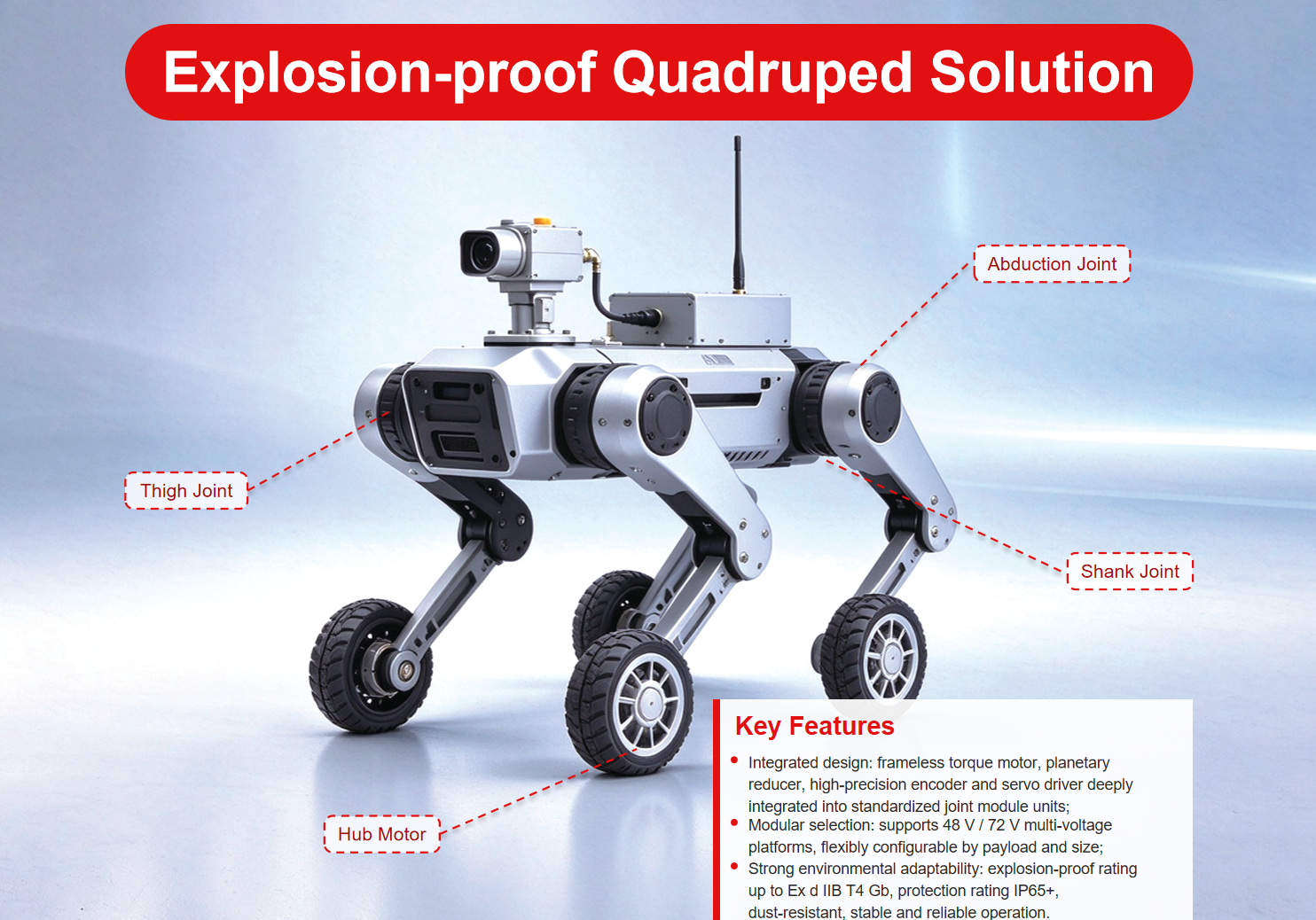
Explosion-proof Quadruped Robot Joint Solution

Joint Module Solution for Explosion-Proof Quadruped Robots

Designed for quadruped robots operating in hazardous and potentially explosive environments, this solution adopts highly integrated joint modules combining frameless torque motors, planetary reducers, high-precision encoders, and servo drives. The total joint module system weighs approximately 13 kg.

The solution consists of two joint configurations:

Hip / Swing / Abduction Joints

Designed for load-bearing and obstacle-crossing movements, these joints deliver 90–110 Nm of continuous torque and up to 450–500 Nm of intermittent peak torque, with reduction ratios ranging from 30:1 to 35:1.

Wheel-Leg Joints

Designed for high-speed wheeled movement, these modules provide 20 Nm of continuous torque, 60 Nm of peak torque, a reduction ratio of 10:1, and a peak speed of up to 350 rpm.

The entire series features a 72 VDC power supply, CAN-FD/CANMIT communication, and dual 17-bit encoders. It also supports Ex d IIB T4 explosion-proof certification, IP65/IP67 ingress protection, and a wide operating temperature range of -20°C to +60°C.

With modular voltage platforms and strong environmental adaptability, this solution addresses the demanding requirements of explosion-proof quadruped robots operating in hazardous environments, including high peak torque output, precise motion control, and reliable operation in potentially explosive atmospheres.