

Robot Joint Motor with Dual Encoders: How to Reduce Harmonic Reducer Backlash and Improve Position Accuracy
Introduction
A robot joint motor is not simply a motor combined with a gearbox. In a high-performance robotic joint, motor torque, reduction transmission, encoder feedback, mechanical stiffness, control algorithms, and output accuracy all work together to determine the final motion performance.
This becomes particularly important when a harmonic reducer is used inside the robot joint motor.
Harmonic reducers are widely adopted in robotic joints because they provide a high reduction ratio, compact dimensions, high torque density, and very low backlash. However, one technical statement is often misunderstood in the market: a harmonic reducer does not literally have zero backlash.
Many manufacturers describe harmonic reducers as having "zero backlash" for marketing purposes. From an engineering perspective, it is more accurate to describe them as having extremely low backlash or backlash approaching zero under specified operating conditions.
Even when mechanical backlash is extremely small, the actual output position of a robot joint can still be affected by transmission error, elastic deformation, torsional compliance, load variation, bearing deformation, assembly tolerance, and other factors.
This is where the feedback architecture of the robot joint motor becomes critical.
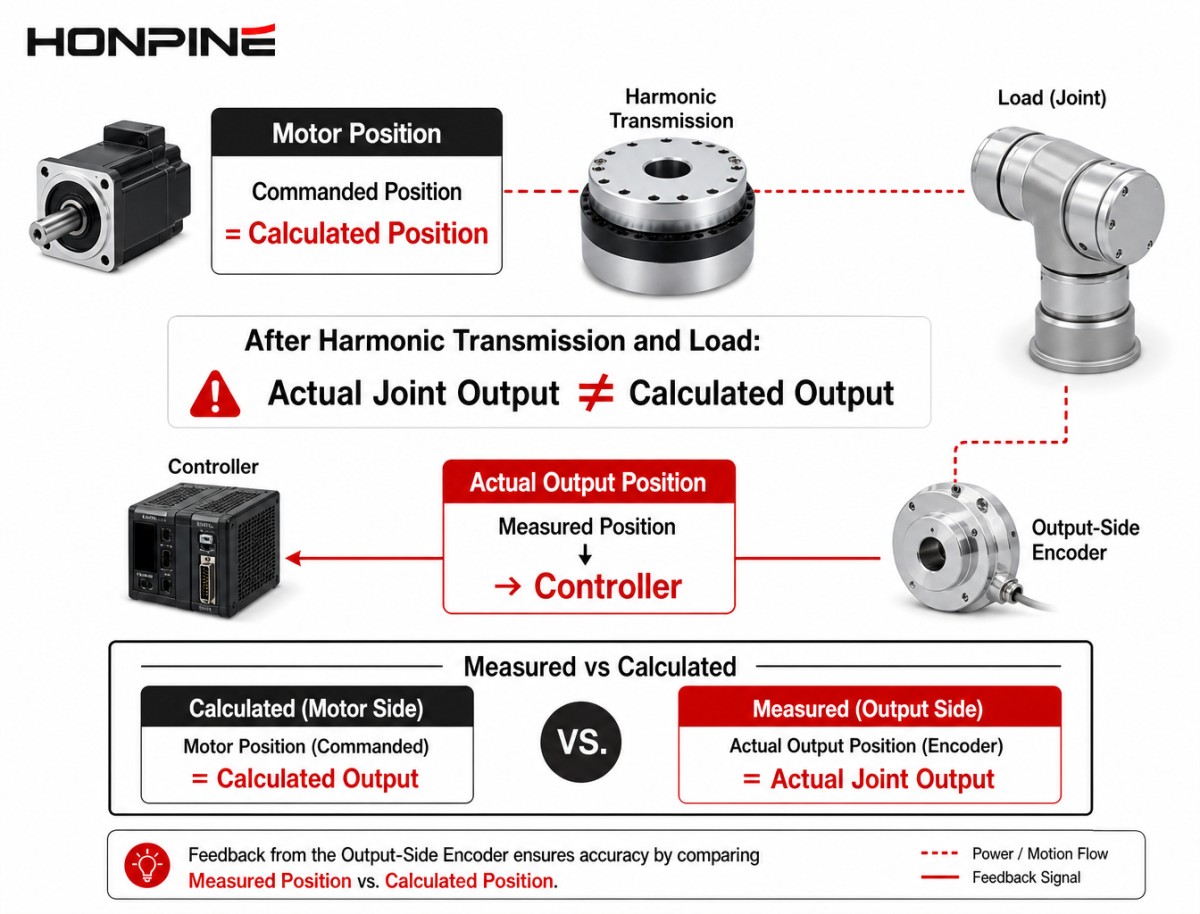
A single motor-side encoder tells the controller how the motor is rotating. A dual-encoder architecture adds an additional measurement point at the output side, allowing the controller to understand what is actually happening after the reduction mechanism.
For high-precision and high-dynamic robots, this difference can have a significant impact on positioning, trajectory tracking, force control, and motion stability.
Harmonic Reducer Backlash Is Extremely Low, But It Is Not Literally Zero
The popularity of harmonic reducers in robotics is closely related to their ability to achieve a very low backlash transmission structure within a compact package.
Unlike conventional gear reducers, harmonic transmission uses a flexible spline, circular spline, and wave generator to achieve high reduction ratios through controlled elastic deformation.
This architecture allows manufacturers to minimize mechanical clearance between the meshing components.
As a result, harmonic reducers can achieve backlash levels that are extremely small compared with many conventional reduction mechanisms.
However, extremely low backlash should not automatically be described as absolute zero backlash.
In real mechanical systems, several factors can contribute to output position deviation. These may include manufacturing tolerances, assembly conditions, preload, wear, temperature, load direction, elastic deformation, and changes in operating conditions.
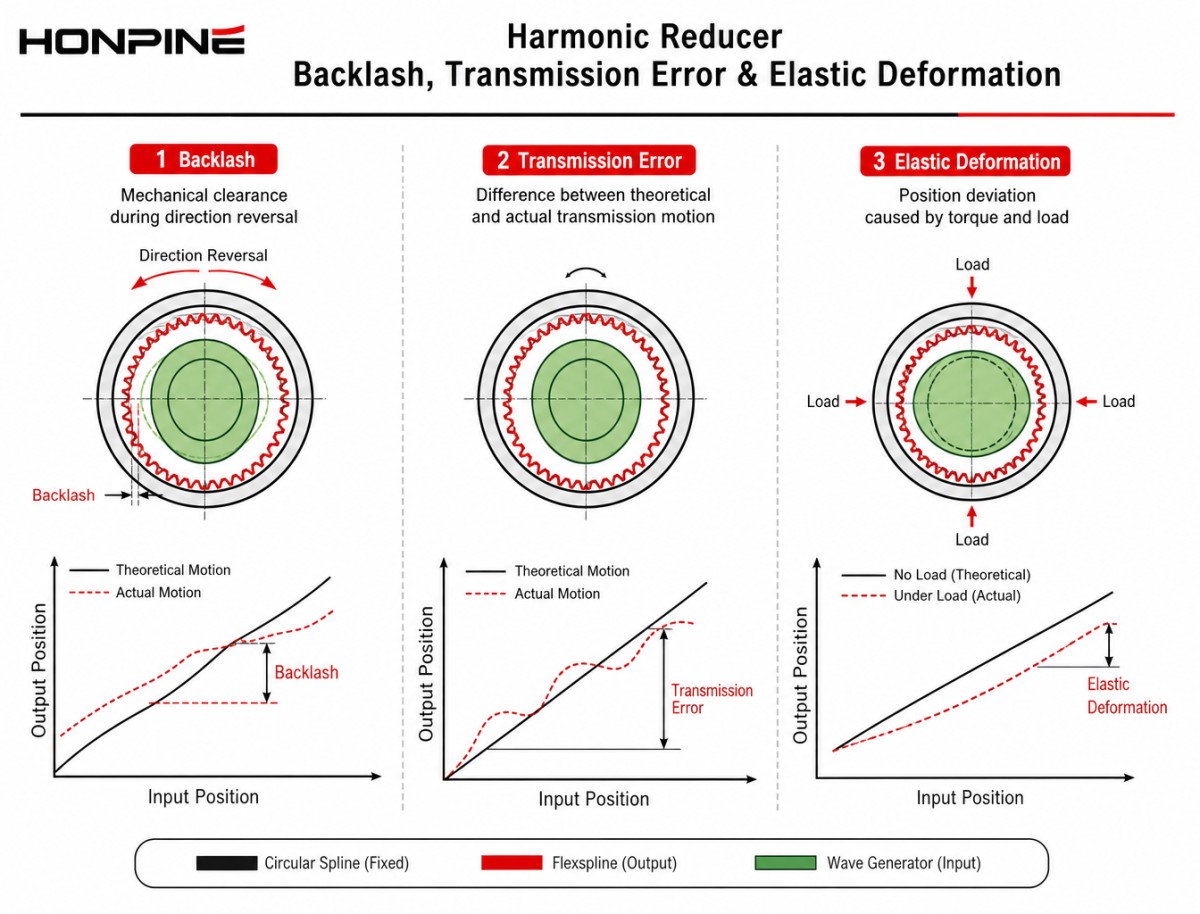
Therefore, engineers evaluating a robot joint motor should distinguish between three different concepts:
Backlash, which refers to mechanical clearance or lost motion associated with reversal of motion.
Transmission error, which describes the difference between theoretical and actual transmission behavior.
Elastic deformation, which occurs when the transmission and mechanical structure deform under torque and external load.
These effects are related, but they are not identical.
This distinction is particularly important when a robot must maintain high positioning accuracy while carrying a changing load.
Why Low Backlash Does Not Automatically Mean High Output Accuracy?
It is tempting to assume that a harmonic reducer with extremely low backlash will automatically produce an equally accurate robot joint.
In practice, the mechanical transmission is only one part of the complete motion chain.
Consider a robot joint motor consisting of a motor, harmonic reducer, and motor-side encoder.
The encoder measures the rotational position of the motor shaft. The controller can therefore determine whether the motor has reached the commanded position.
But the motor shaft is not the final output of the robot joint.
Between the motor and the robot link are the harmonic transmission, bearings, housing, output flange, and mechanical structure. Under changing loads, each component can contribute to the final output position.
For example, when the robot accelerates rapidly, stops suddenly, changes direction, or applies an external force, the torque transmitted through the joint changes significantly.
The motor-side encoder may indicate that the motor has reached the commanded position, while the output flange may experience a small but measurable difference caused by the transmission and mechanical structure.
This is why motor position feedback and output position feedback are not necessarily the same thing.
For demanding robotic applications, engineers increasingly need to consider the complete feedback chain rather than focusing only on motor encoder resolution.
What a Single Encoder Can and Cannot Tell You?
A conventional robot joint motor may use one encoder on the motor side.
This configuration has several advantages. It is relatively simple, compact, cost-effective, and sufficient for many applications.
The motor-side encoder provides the controller with important information about motor position and speed. It can support commutation, velocity control, position control, and other servo functions.
However, it does not directly measure the actual angular position of the output shaft.
This distinction becomes more important as the reduction ratio increases.
The controller may calculate the theoretical output position from the motor position and the reduction ratio, but the calculated position is still based on the assumption that the transmission behaves exactly as expected.
In real operating conditions, the transmission may experience elastic deformation or other position deviations.
For robots that only require moderate precision, this may not represent a significant limitation.
For high-precision robot arms, humanoid robots, medical robots, force-controlled manipulators, and other systems requiring highly responsive motion, however, the difference between calculated output position and actual output position becomes much more important.
How Dual Encoders Change the Feedback Architecture?
A dual encoder robot joint motor places one encoder on the motor side and another on the output side.
The two encoders observe different parts of the motion chain.
The motor-side encoder primarily provides information about motor position and speed.
The output-side encoder directly measures the position of the joint output.
The controller can then compare the two feedback signals to understand how the transmission is behaving.
This does not mean that the second encoder magically removes mechanical backlash.
Instead, it provides something that a single encoder cannot provide: direct information about the actual output position.
This additional feedback can help the control system identify and compensate for position differences caused by transmission characteristics and load-dependent deformation.
For a robot joint motor, this creates a more complete closed-loop control architecture.
Dual Encoders Help Separate Motor Motion from Actual Joint Motion
The key advantage of dual encoders is not simply "more resolution."
It is more complete feedback.
With only a motor-side encoder, the controller primarily knows:
How much the motor has rotated.
With an output-side encoder, the controller can also determine:
How much the robot joint output has actually rotated.
This distinction becomes valuable when the robot experiences dynamic loads.
During acceleration, deceleration, direction reversal, or external contact, the transmission system can behave differently from an ideal rigid mechanical model.
The difference between motor-side and output-side measurements provides useful information about this behavior.
For high-performance robot joint motors, this additional information can support more accurate position control and better compensation strategies.
It can also improve the system's ability to maintain trajectory accuracy when the joint load changes.
Why This Matters More for High-Dynamic Robots?
The requirement for output-side feedback becomes increasingly important as robot motion becomes faster and more dynamic.
A slow-moving robot performing relatively simple movements may tolerate small transmission deviations.
A high-speed robot performing continuous trajectory tracking has much less tolerance.
The same is true for robots that frequently change direction or interact with their environment.
Humanoid robots provide an especially good example.
Human-like robots continuously change joint loads while walking, balancing, reaching, manipulating objects, and interacting with the environment.
The knee, ankle, hip, shoulder, elbow, and wrist do not operate under constant loads.
The joint motor must respond to continuously changing torque and position requirements.
In such systems, relying exclusively on motor-side feedback may not provide sufficient information about the actual output state.
A dual-encoder architecture gives the controller another measurement point closer to the actual mechanical output.
Dual Encoders Are Particularly Valuable When Precision and Load Change at the Same Time
Position accuracy becomes more challenging when the robot must maintain precision under changing loads.
Imagine a robotic arm moving from an unloaded state to holding a heavy component.
The commanded joint position may remain unchanged, but the torque applied to the transmission changes substantially.
The mechanical system responds to this torque.
Even if the harmonic reducer has extremely low backlash, the transmission and structural components are not infinitely rigid.
Small elastic deformation can therefore influence the actual output position.
A motor-side encoder alone cannot directly observe this output-side deviation.
A dual-encoder system can.
This makes dual feedback particularly valuable for applications such as precision assembly, robotic polishing, medical manipulation, advanced research robots, and high-performance collaborative robots.
Why Encoder Resolution Is Not the Same as Robot Joint Accuracy?
Another common misconception in robot joint motor selection is that a higher encoder bit count automatically produces a more accurate robot joint.
It does not.
Encoder resolution describes how finely the encoder can divide rotational position.
Actual system accuracy depends on a much larger combination of factors.
These include encoder accuracy, installation tolerance, eccentricity, temperature variation, mechanical transmission error, structural stiffness, calibration, control algorithms, and load conditions.
For example, increasing the encoder resolution on the motor side does not necessarily eliminate output-side deformation.
This is why simply replacing a 17-bit encoder with a higher-resolution encoder may not produce the expected improvement in actual robot joint accuracy.
For demanding applications, engineers should evaluate the complete feedback architecture rather than focusing on encoder resolution alone.
Absolute Encoders and Dual Encoders Solve Different Problems
Absolute encoders and dual encoders are sometimes discussed as if they were competing technologies.
They actually solve different problems.
An absolute encoder determines the absolute angular position of the shaft.
A dual-encoder architecture determines the position of two different points within the mechanical transmission.
A robot joint motor can therefore use absolute encoders and dual feedback at the same time.
For example, an absolute motor-side encoder can provide accurate motor position information after power-up, while an output-side encoder provides direct feedback from the robot joint output.
This combination can reduce the need for mechanical homing while also improving the completeness of the position feedback system.
For humanoid and collaborative robots, where frequent mechanical homing can be inconvenient or undesirable, this architecture can be particularly useful.
When Should a Robot Joint Motor Use Dual Encoders?
Not every robot joint requires dual encoders.
The decision should be based on the actual performance requirements of the robot.
If the application is relatively low speed, low load, and tolerant of moderate positioning error, a single motor-side encoder may provide an appropriate balance between performance, complexity, and cost.
However, dual encoders become increasingly attractive when the robot requires high positioning accuracy under dynamic loads.
They are especially relevant when the joint must support precise trajectory tracking, frequent direction changes, variable loads, force interaction, or advanced closed-loop control.
The important question is therefore not:
"Does every robot need dual encoders?"
The better question is:
"Does this robot need direct feedback from the actual joint output?"
If the answer is yes, a dual-encoder robot joint motor deserves serious consideration.
The Role of Integrated Robot Joint Motors
The encoder architecture is only one part of a modern robot joint.
Traditional robot designs often combine a servo motor, separate harmonic reducer, external encoder, external driver, brake, and multiple cables.
This approach provides flexibility, but it can also increase the size, weight, wiring complexity, and integration workload of the complete joint.
An integrated robot joint motor combines several of these components into a single compact module.
Depending on the architecture, the module can integrate the motor, harmonic reducer, encoder system, driver, brake, torque sensor, and communication interfaces.
This changes the engineering task from designing every joint component separately to selecting an appropriate integrated joint architecture for the robot.
For robot manufacturers developing specialized robotic arms, humanoid robots, collaborative robots, medical equipment, and precision automation systems, this can significantly simplify mechanical and electrical integration.
How HONPINE Approaches Dual-Encoder Robot Joint Motor Design?
HONPINE develops integrated robot joint modules for applications where motor performance, transmission, feedback, mechanical integration, and control need to work as one system.
Rather than treating the harmonic reducer as an isolated transmission component, HONPINE integrates the reducer with motor, encoder, drive, and other functional elements according to the requirements of different robot architectures.
The TCHL series focuses on highly compact robot joints where weight, installation space, output feedback, and torque sensing are particularly important. Its integrated torque sensor and flexible connection architecture make it suitable for applications requiring compact force-aware joints.
The HAG series provides a broader range of torque and configuration options, with high-resolution absolute encoders, optional dual-encoder feedback, torque sensing, braking, and industrial communication options. This makes it suitable for applications ranging from collaborative robots and humanoid joints to industrial robotic arms and precision automation.
The HPJM-PRO series is designed for higher-performance robot and automation applications that require high torque density, integrated drive electronics, precise feedback, and compact mechanical integration.
The important point is that these platforms are not intended to force every robot into the same joint architecture.
Different robotic systems have different requirements for torque, speed, weight, accuracy, sensing, braking, communication, and installation.
The appropriate joint motor architecture should therefore be selected according to the actual mechanical and control requirements of the robot.
From Low Backlash to Complete Output Feedback
The development of robot joint technology is moving beyond the simple question of whether a reducer has low backlash.
For the next generation of robotic systems, engineers need to consider the entire motion chain.
A harmonic reducer can provide extremely low backlash and high reduction ratios.
A high-resolution encoder can provide precise angular measurement.
A powerful motor can generate high torque and dynamic acceleration.
But these components only reach their full potential when the mechanical transmission, feedback system, control architecture, and structural design are properly matched.
This is why dual-encoder robot joint motors are becoming an important solution for applications where actual output position matters as much as motor position.
The goal is not to claim that a dual encoder "eliminates" harmonic reducer backlash.
The goal is to measure the actual joint output more accurately and give the controller the information required to compensate for transmission-related errors and load-dependent deformation.
That is a much more meaningful engineering advantage.
Choosing the Right Robot Joint Motor Architecture
When selecting a robot joint motor, engineers should evaluate more than rated torque and reduction ratio.
The feedback architecture should be considered at the same time as the mechanical transmission.
For applications requiring compact dimensions and low weight, an integrated joint motor can reduce the space occupied by separate motor, reducer, driver, and wiring components.
For applications requiring high positioning accuracy, output-side feedback may be more important than simply increasing motor encoder resolution.
For applications involving physical contact, force-controlled assembly, polishing, or human-robot interaction, integrated torque sensing can provide another important layer of feedback.
For vertical joints, an integrated brake can improve safety during power loss.
For distributed robot architectures, integrated EtherCAT, CANopen, or other communication interfaces can simplify system-level integration.
The best robot joint motor is therefore not necessarily the one with the highest specification in one category.
It is the one whose mechanical transmission, feedback architecture, sensing capability, drive system, and physical dimensions match the robot's actual requirements.
Conclusion
Harmonic reducers remain one of the most important transmission technologies for high-performance robot joints because they combine compact dimensions, high reduction ratios, high torque density, and extremely low backlash.
However, extremely low backlash should not be confused with literal zero backlash.
More importantly, low mechanical backlash alone does not guarantee perfect output positioning under dynamic loads.
As robots become faster, lighter, more compliant, and more interactive, the relationship between motor position and actual joint output becomes increasingly important.
A single encoder measures the motor side.
A dual-encoder architecture adds direct feedback from the output side.
This additional information allows the control system to better understand transmission behavior and compensate for position deviations caused by mechanical characteristics and changing loads.
For this reason, robot joint motors with dual encoders are particularly valuable in high-precision and high-dynamic robotic applications.
HONPINE provides multiple integrated robot joint motor platforms, including TCHL, HAG, and HPJM-PRO, allowing robot manufacturers to select different combinations of motor performance, harmonic transmission, encoder feedback, torque sensing, drive integration, braking, and communication according to their application requirements.
The future of robot joint design is not simply about achieving "zero backlash" on a specification sheet.
It is about building a measurable, controllable, and integrated motion system that delivers the required output performance under real operating conditions.
Read More
Learn more about the story of HONPINE and industry trends related to precision transmission.
 What is robot joint actuator?How to Choose the Best Robot Rotary Joint Actuator?In core robot joint transmission solutions, planetary and harmonic rotary actuators each have their own strengths. Choosing the right type based on application requirements is essential to achieve the optimal balance between performance and cost.
 DD Motors VS Harmonic Rotary ActuatorsThis article provides an in-depth comparison between Direct Drive (DD) motors and harmonic rotary actuators, covering their transmission principles, advantages and disadvantages, and typical application fields.
 OMG Ultra Compact Harmonic Drive Joint Module with Built-in Torque SensorHONPINE TCHL series harmonic drive joint module is a game-changing product that achieves disruptive improvements in multiple aspects such as lightweight design, integration level, and connection convenience. This article will analyze its revolutionary enhancements with you.
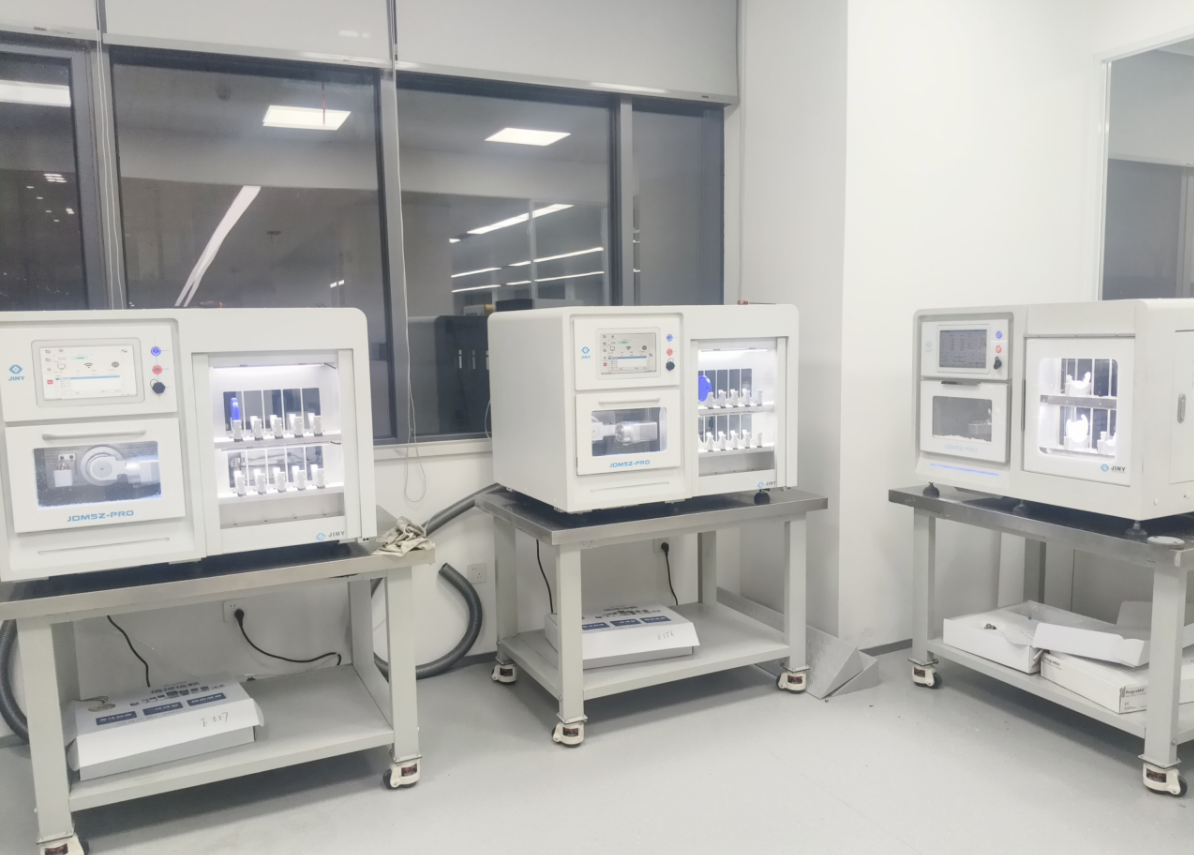
 The Role of Harmonic Drive Gears in Achieving 5–10 μm Accuracy in Dental Milling MachinesA dental milling machine is a CNC machining system used to directly process digital dental models into restorations such as crowns, bridges, veneers, inlays, and implant abutments. Dental milling machines require far higher operational accuracy and motion stability than ordinary equipment. This article explains how harmonic drive gear help dental milling machines achieve stable, continuous, and controllable operation.
 Why Are Harmonic Rotary Actuators Perfect for Medical Equipment?Harmonic rotary actuators (typically integrated systems consisting of a harmonic drive reducer, frameless torque motor, encoder, and optional brake) are regarded as key components in medical equipment. The core reason is that they simultaneously meet the most stringent medical requirements for precision, compact size, safety, and controllability. The following explanation is structured from three perspectives: technical characteristics, application scenarios, and medical value.
 High-Precision RV Reducers Perfectly Matched for Walking RobotsThe walking axis of a robot is a core component for power transmission and support. RV reducers provide extremely high rigidity, precision, and torque while maintaining a compact size and exceptional reliability, making them an ideal match for the demanding requirements of walking robot joints in terms of load capacity, impact resistance, and precision.
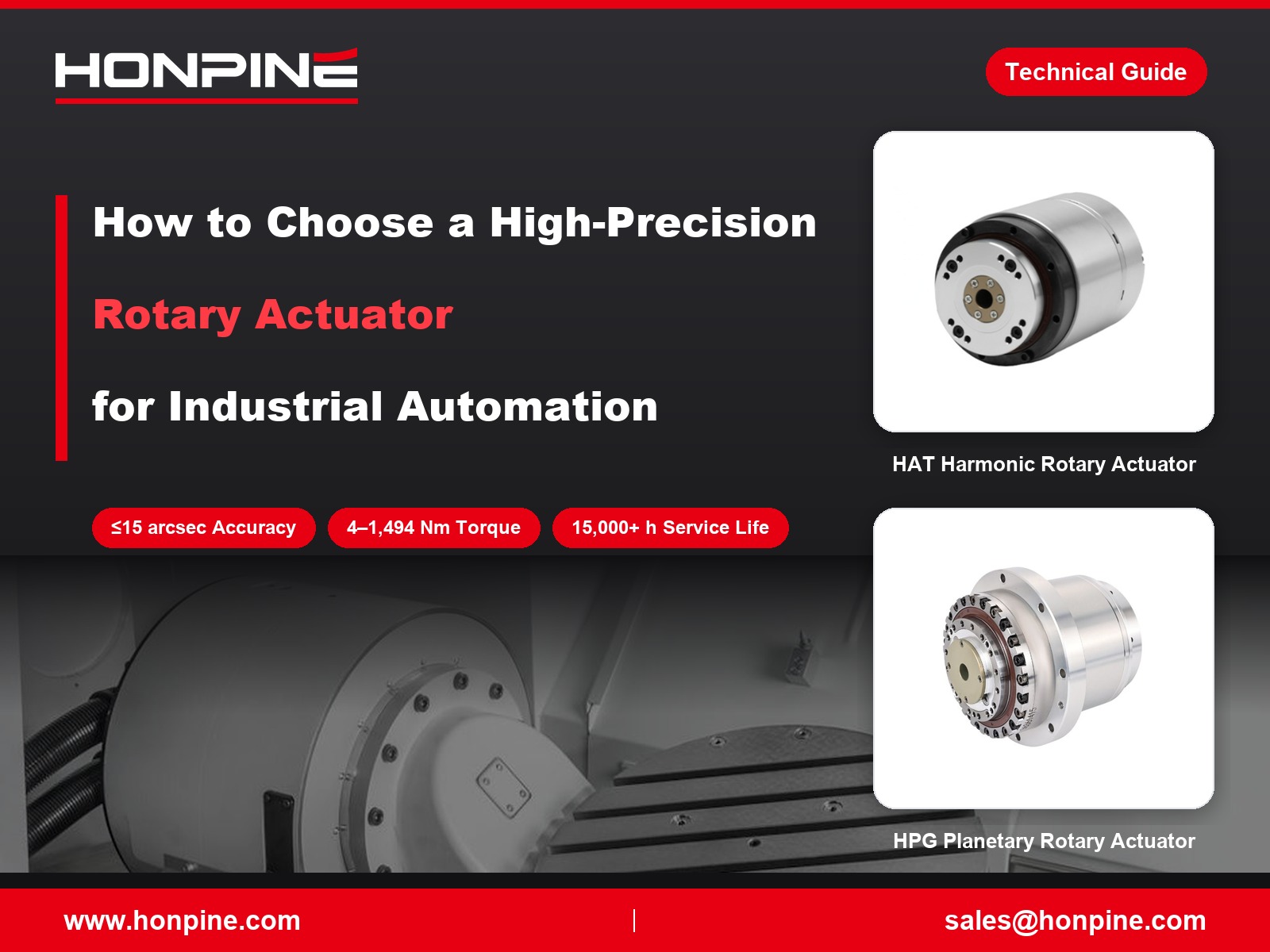
 How to Choose High-Precision Rotary Actuators for Industrial Automation?High-precision rotary actuators play an important role in industrial automation, where positioning accuracy, repeatability, durability and installation flexibility directly affect equipment performance. HONPINE offers four main series of precision rotary actuators, including HAT, HAM and HAS harmonic rotary actuators and HPG low-backlash planetary actuators. With torque ratings ranging from 4 to 1,494 Nm across the product range, these solutions are designed for applications in semiconductor manufacturing, 3C automation, laser processing and CNC machine tools. Learn how to identify the right rotary actuator based on operating conditions, precision requirements and mechanical integration needs.
 Why Are Harmonic Reducers Suitable for High-Precision Automation Equipment?Precision automation equipment depends on consistent rotary motion, reliable positioning and compact transmission design. From dispensing head orientation and component angular alignment to automated inspection indexing, harmonic reducers offer a practical solution for applications requiring low backlash and high reduction ratios in limited installation space. This article explains how harmonic reducers support repeatable motion, compares key design configurations, and outlines how to select a suitable reduction ratio and reducer structure based on load, speed, accuracy and machine cycle-time requirements.
 Why Are Servo Motors and Gear Reducers an Ideal Match?Servo motors provide fast, precise motion control, while gear reducers adapt their speed and torque to the load. This guide explains how servo motors and gear reducers work together through torque multiplication, reflected inertia reduction and finer theoretical position resolution. Learn how inertia matching, backlash, torsional stiffness and reduction ratio influence performance in robotics and industrial automation.
 How to Select and Use Robotic Joint Modules?How do you take robotic joint modules from selection to controlled motion? Using the HONPINE HPJM harmonic joint module as an example, Technical Director Theodore Li explains the key steps in mechanical installation, electrical wiring, CAN and EtherCAT configuration, and control commissioning. Learn what to confirm before integration and how to approach setup so each joint can respond correctly to your controller.
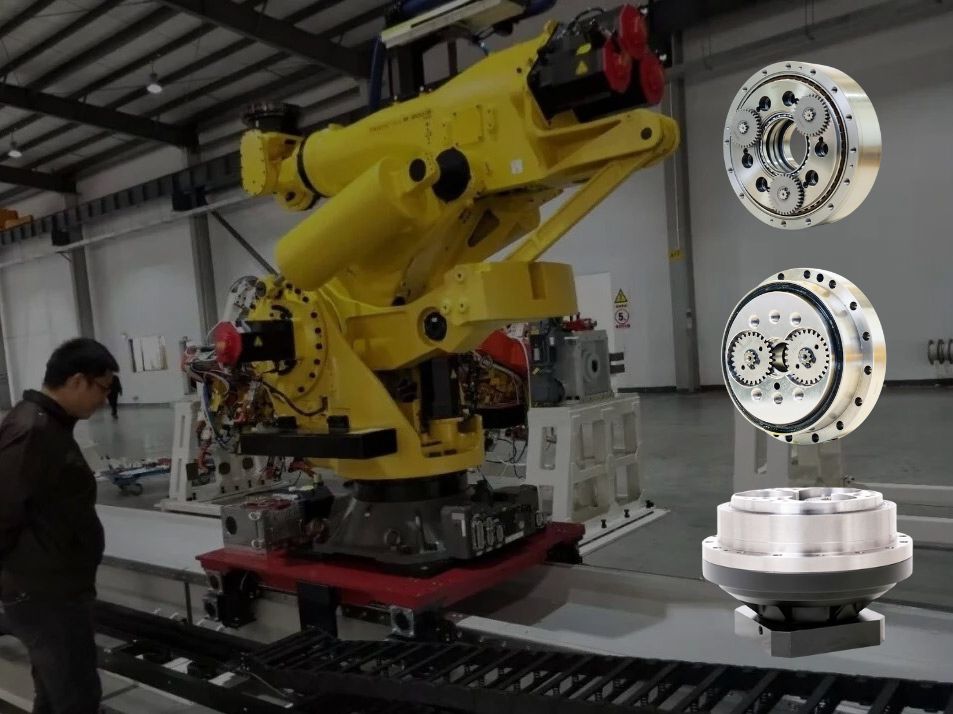
 How to Select Harmonic and RV Reducers for Each Axis of a Six-Axis Robot?What determines whether a six-axis robot joint needs a harmonic reducer or an RV reducer? The answer depends on torque, inertia, impact loads, bearing loads and installation space. This guide explains how to evaluate harmonic and RV reducers for the base, shoulder, elbow and wrist, with practical checks for stiffness, backlash and service life. Use the requirements of each axis to select a suitable reducer configuration.
 Top 7 RV Reducer Gearbox Manufacturers: Why Does Nabtesco Still Dominate?What sets RV reducer gearbox manufacturers apart, and why does Nabtesco remain a benchmark in this market? RV reducer production demands precise component machining, careful assembly and extensive engineering know-how. This article introduces seven manufacturers across RV reducers and related transmission technologies, examines the strengths behind Nabtesco's position, and explores HONPINE's development capabilities to help you understand the supplier landscape.
Double Click
We provide harmonic drive reducer,planetary reducer,robot joint motor,robot rotary actuators,RV gear reducer,robot end effector,dexterous robot hand
 What is robot joint actuator?How to Choose the Best Robot Rotary Joint Actuator?In core robot joint transmission solutions, planetary and harmonic rotary actuators each have their own strengths. Choosing the right type based on application requirements is essential to achieve the optimal balance between performance and cost.
 DD Motors VS Harmonic Rotary ActuatorsThis article provides an in-depth comparison between Direct Drive (DD) motors and harmonic rotary actuators, covering their transmission principles, advantages and disadvantages, and typical application fields.
 OMG Ultra Compact Harmonic Drive Joint Module with Built-in Torque SensorHONPINE TCHL series harmonic drive joint module is a game-changing product that achieves disruptive improvements in multiple aspects such as lightweight design, integration level, and connection convenience. This article will analyze its revolutionary enhancements with you.
 How to Choose High-Precision Rotary Actuators for Industrial Automation?High-precision rotary actuators play an important role in industrial automation, where positioning accuracy, repeatability, durability and installation flexibility directly affect equipment performance. HONPINE offers four main series of precision rotary actuators, including HAT, HAM and HAS harmonic rotary actuators and HPG low-backlash planetary actuators. With torque ratings ranging from 4 to 1,494 Nm across the product range, these solutions are designed for applications in semiconductor manufacturing, 3C automation, laser processing and CNC machine tools. Learn how to identify the right rotary actuator based on operating conditions, precision requirements and mechanical integration needs.
 Why Are Harmonic Reducers Suitable for High-Precision Automation Equipment?Precision automation equipment depends on consistent rotary motion, reliable positioning and compact transmission design. From dispensing head orientation and component angular alignment to automated inspection indexing, harmonic reducers offer a practical solution for applications requiring low backlash and high reduction ratios in limited installation space. This article explains how harmonic reducers support repeatable motion, compares key design configurations, and outlines how to select a suitable reduction ratio and reducer structure based on load, speed, accuracy and machine cycle-time requirements.
 Why Are Servo Motors and Gear Reducers an Ideal Match?Servo motors provide fast, precise motion control, while gear reducers adapt their speed and torque to the load. This guide explains how servo motors and gear reducers work together through torque multiplication, reflected inertia reduction and finer theoretical position resolution. Learn how inertia matching, backlash, torsional stiffness and reduction ratio influence performance in robotics and industrial automation.
 How to Select and Use Robotic Joint Modules?How do you take robotic joint modules from selection to controlled motion? Using the HONPINE HPJM harmonic joint module as an example, Technical Director Theodore Li explains the key steps in mechanical installation, electrical wiring, CAN and EtherCAT configuration, and control commissioning. Learn what to confirm before integration and how to approach setup so each joint can respond correctly to your controller.
 How to Select Harmonic and RV Reducers for Each Axis of a Six-Axis Robot?What determines whether a six-axis robot joint needs a harmonic reducer or an RV reducer? The answer depends on torque, inertia, impact loads, bearing loads and installation space. This guide explains how to evaluate harmonic and RV reducers for the base, shoulder, elbow and wrist, with practical checks for stiffness, backlash and service life. Use the requirements of each axis to select a suitable reducer configuration.
 Top 7 RV Reducer Gearbox Manufacturers: Why Does Nabtesco Still Dominate?What sets RV reducer gearbox manufacturers apart, and why does Nabtesco remain a benchmark in this market? RV reducer production demands precise component machining, careful assembly and extensive engineering know-how. This article introduces seven manufacturers across RV reducers and related transmission technologies, examines the strengths behind Nabtesco's position, and explores HONPINE's development capabilities to help you understand the supplier landscape.
 How to Calculate Torque for a Harmonic Rotary Actuator in a Flipping Mechanism?How much torque does a harmonic rotary actuator need to flip a 10 kg load through 180 degrees? The answer depends on more than weight. Center-of-gravity offset, load inertia, acceleration and operating frequency all affect actuator selection. In this guide, Theodore Li, Technical Director at HONPINE, explains the calculation process using a horizontal-axis flipping example and outlines the checks needed for peak torque, continuous operation, output speed and bearing loads.
 Why Are Harmonic Reducers Suitable for CNC Machine Tool Rotary Tables?Why choose harmonic reducers for CNC rotary tables? Accurate indexing depends on more than the motor: backlash, torsional stiffness and torque capacity all affect how reliably a rotary table holds its position during machining. This guide explains the key transmission requirements of fourth and fifth axis rotary tables, explores common machine tool applications, and introduces HONPINE harmonic reducer configurations for different installation and load requirements.
 What’s the Difference Between Single and Dual Encoder Robot Joint Modules?Does your robot need a dual encoder joint module, or is a single encoder enough? The answer depends on positioning requirements, transmission behavior, force control strategy and budget. This guide compares motor-side and output-side feedback, explains where dual encoders can improve control, and examines their costs and limitations. Learn when a single encoder can meet your needs and when additional output feedback is worth considering.