








What Is the Revolving Joint of a Robot?Structure, Components, and Working Principles Explained?
This article will provide you with a comprehensive analysis of a robot's rotary joint, including its integrated components, the role of each component, and how precise control is achieved.
What Is the Revolving Joint of a Robot?
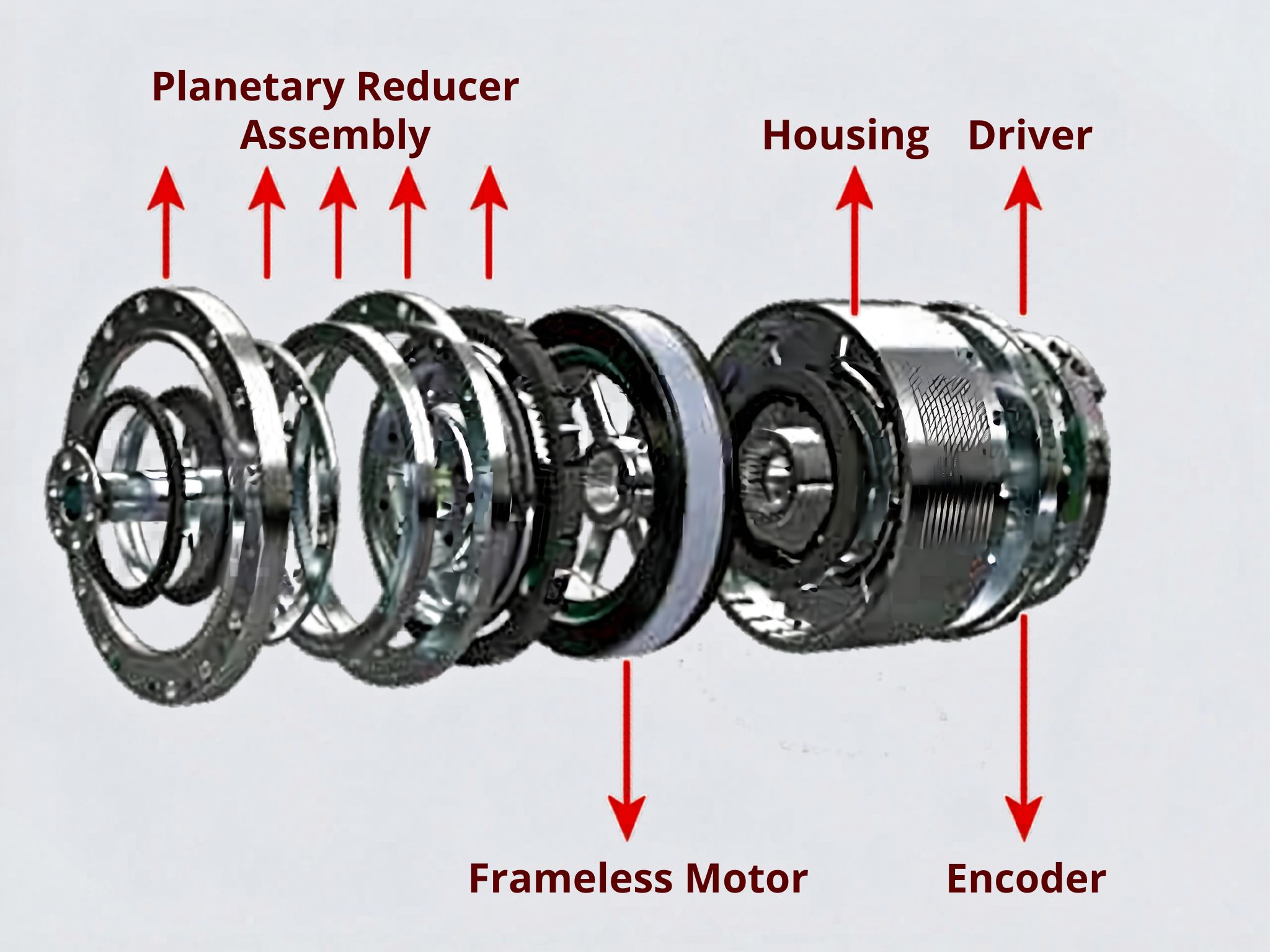
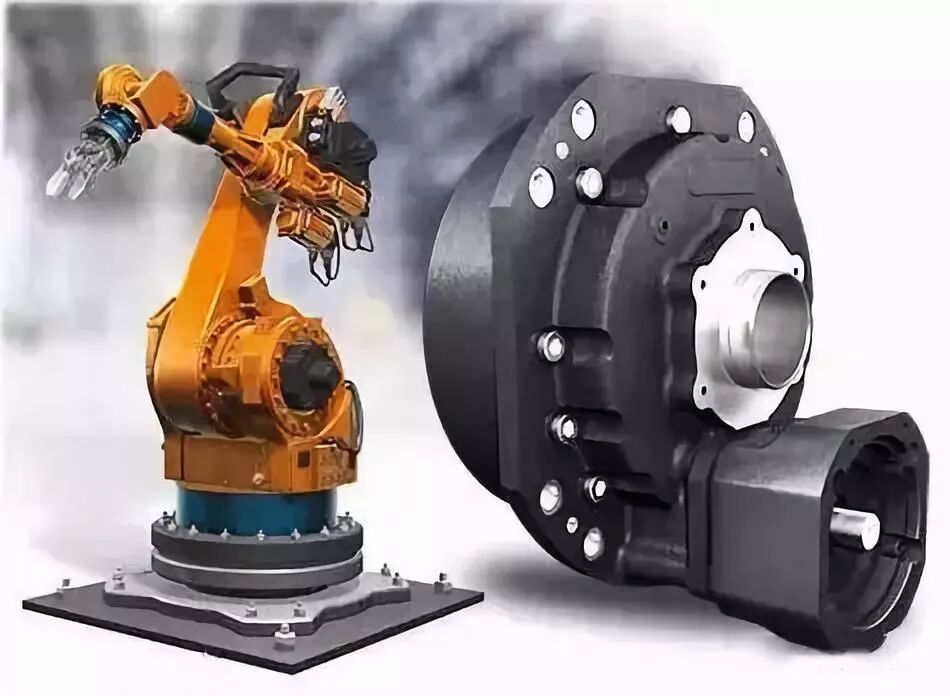
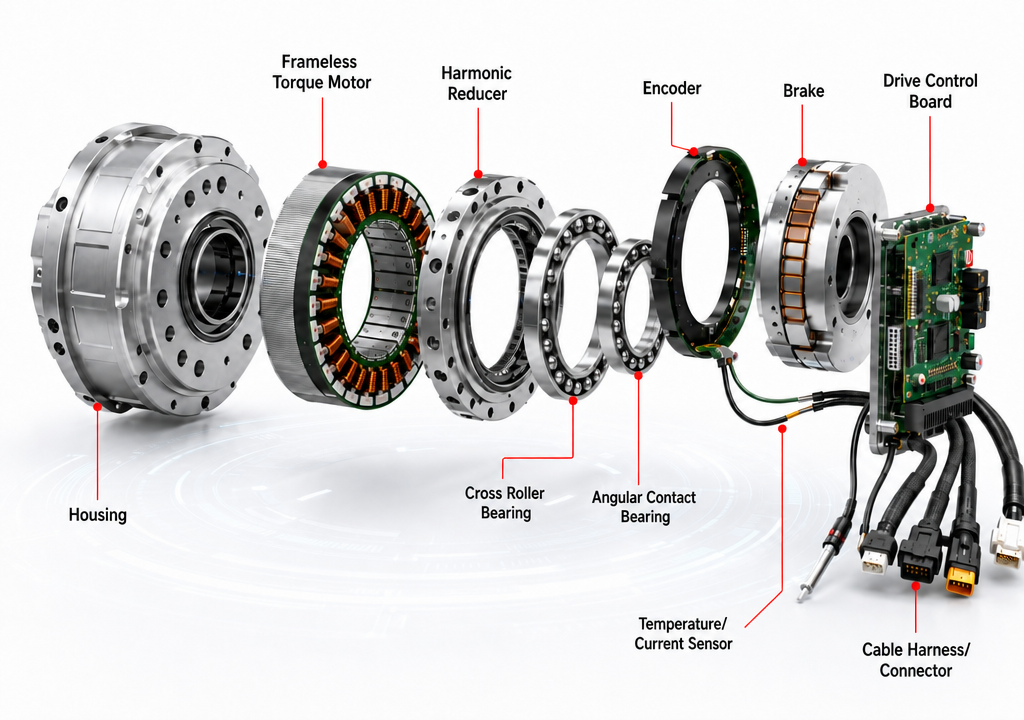
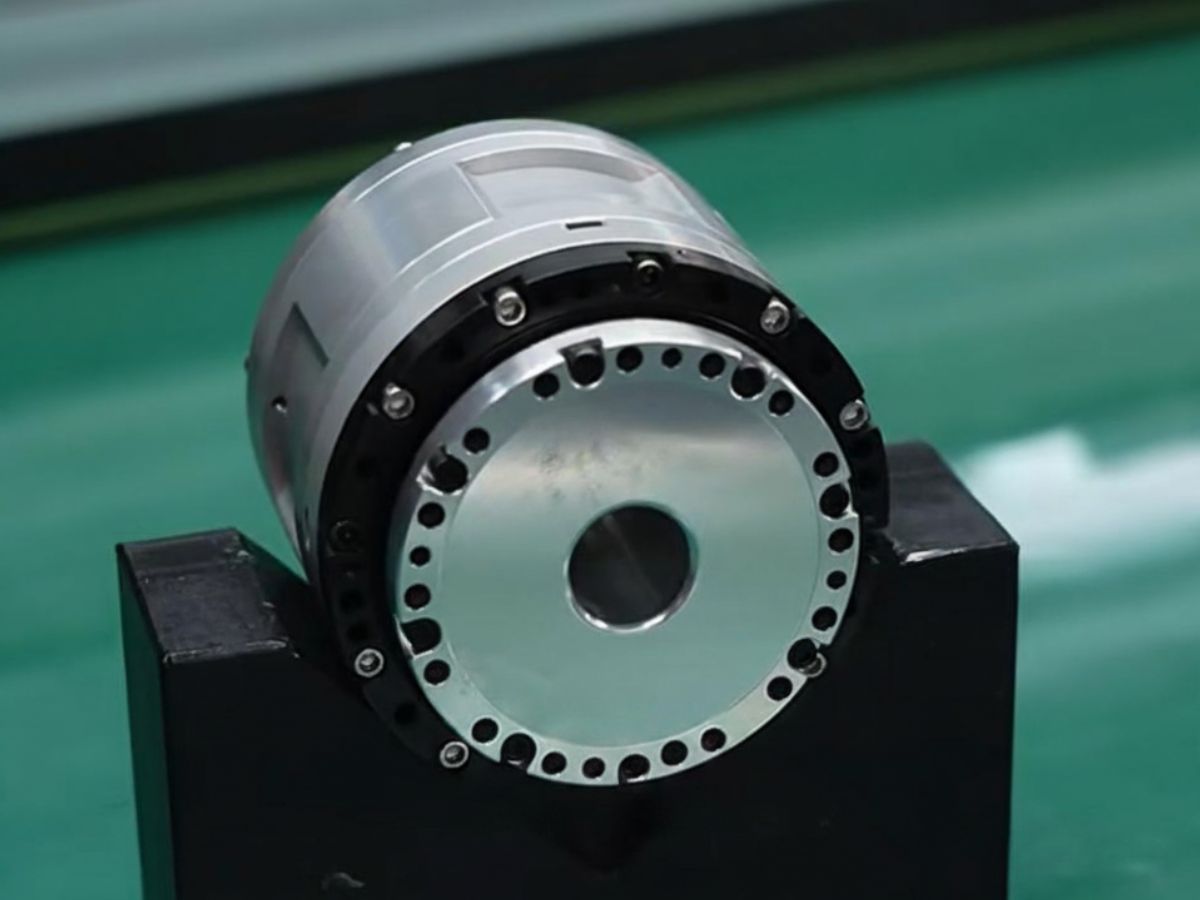
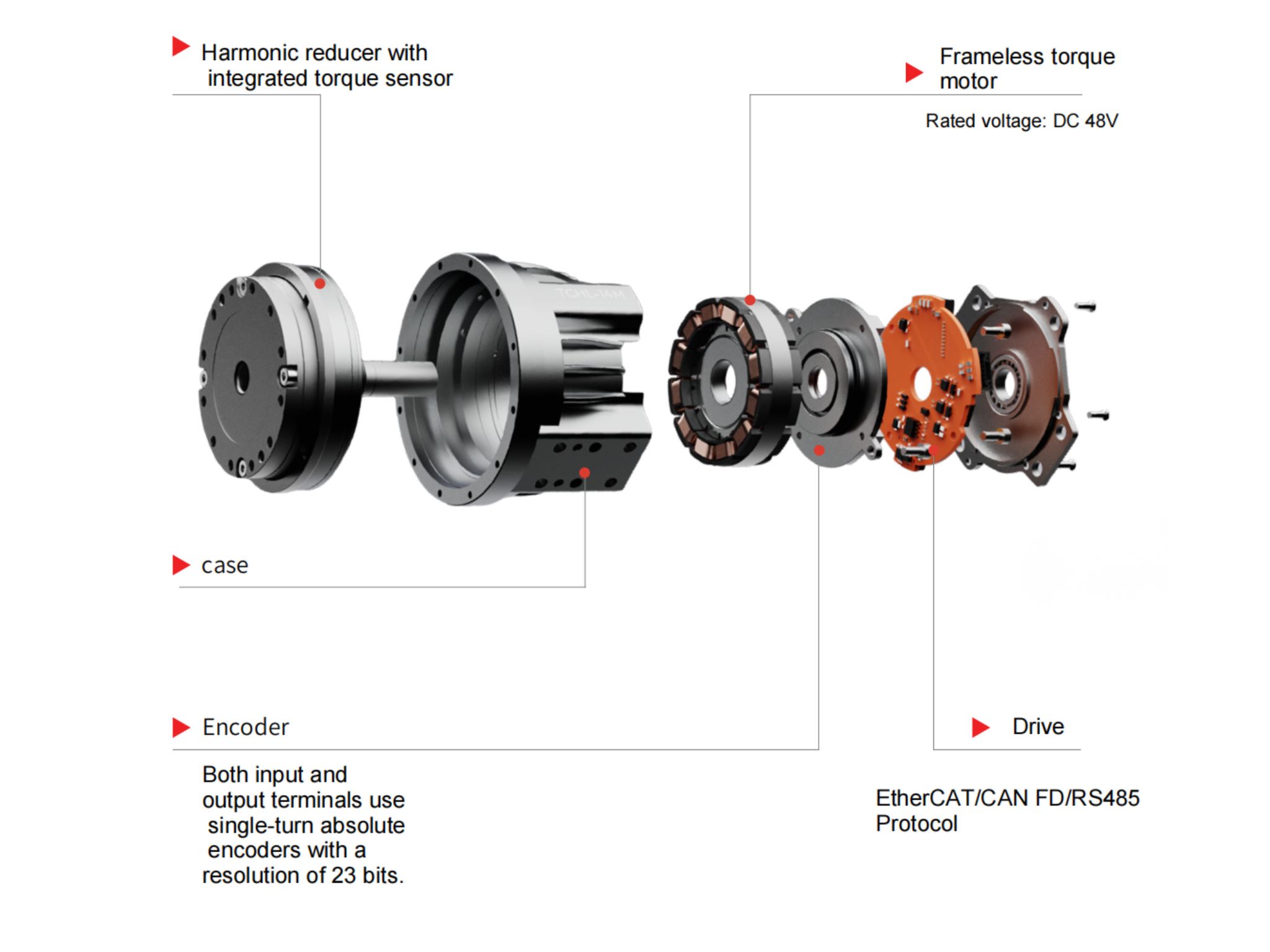
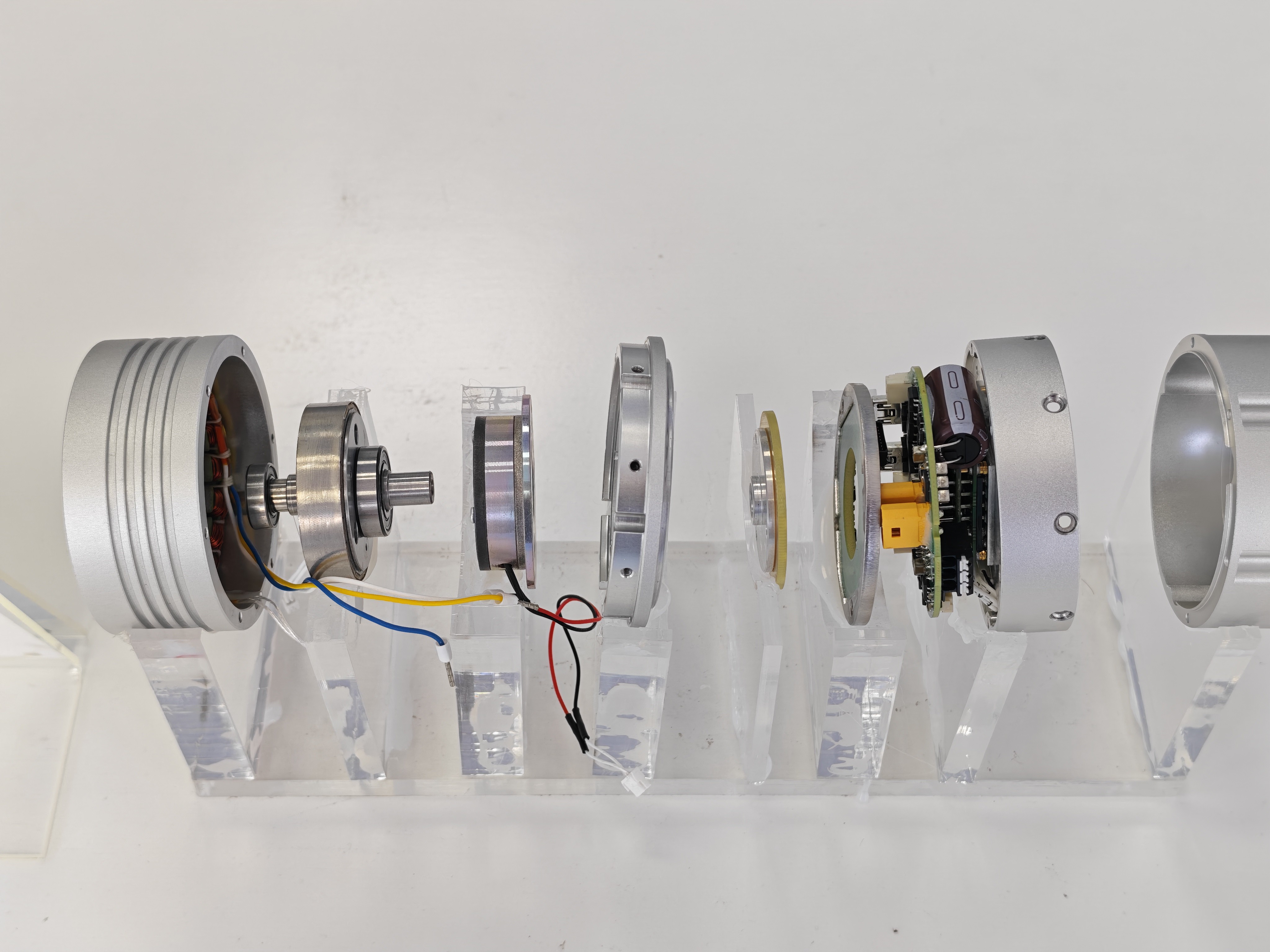
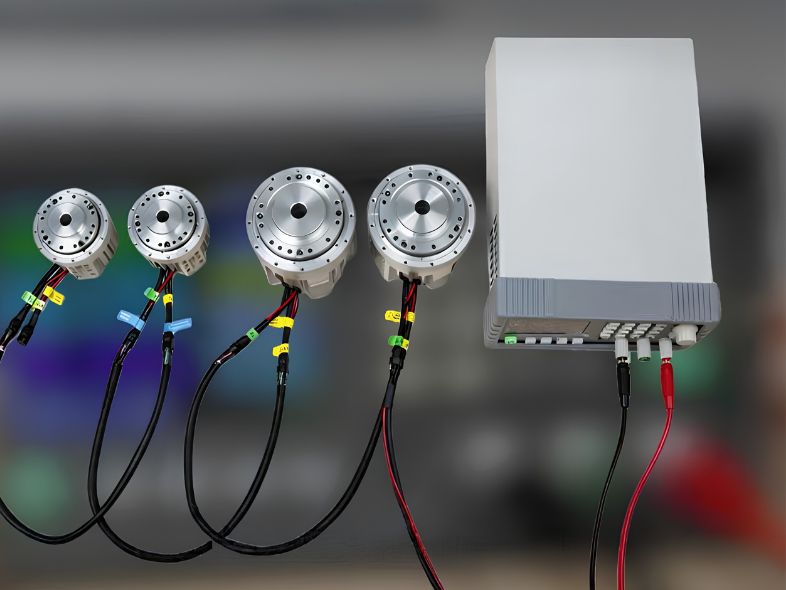
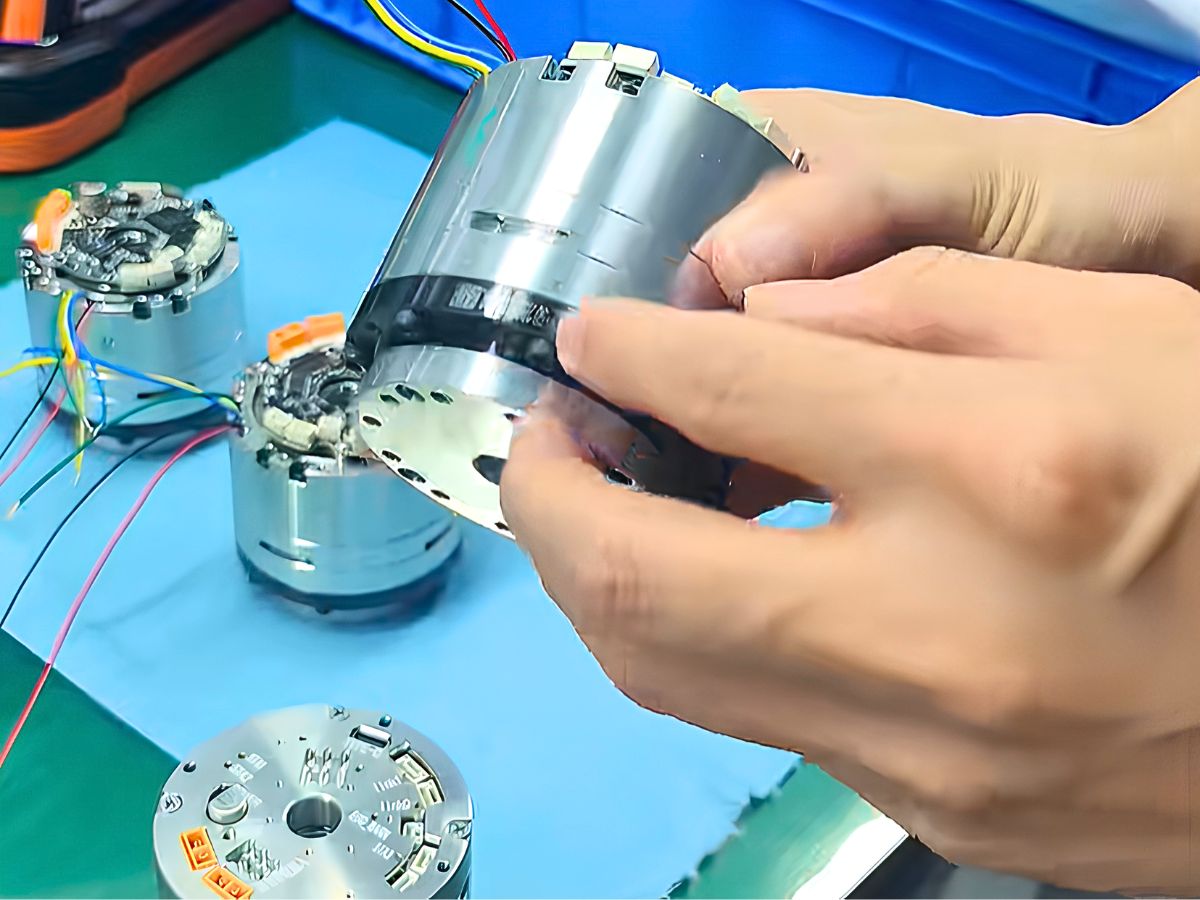
A robot’s revolving joint cannot simply be understood as a motor. It is more like a compact powertrain integrated inside the robot’s body. A typical joint module usually contains a motor, reducer, encoder, driver, brake, bearings, sensors, housing, wiring harnesses, and control boards.
Within a very limited space, the joint must deliver power, provide feedback, brake safely, dissipate heat, and withstand falls, impacts, power loss, and long-term wear. Making it rotate is not the hardest part — the real challenge is ensuring it operates consistently every day under nearly identical conditions.
Why Do Revolving Joints Limit Robot Deployment?
When a robot raises its arm, the shoulder, elbow, and wrist joints all work together. When it takes a step, the hip, knee, and ankle joints must continuously adjust posture within milliseconds.
Each joint must know:
how far it has rotated,
how much torque it is outputting,
whether the temperature is rising,
and whether it has experienced external impact.
If even one joint responds slightly slower, has excessive backlash, or cannot control temperature rise effectively, the robot’s movements become unstable and unnatural. In severe cases, the robot may even fall.
From an engineering perspective, a humanoid robot is not judged by performing one beautiful movement once. The real challenge is whether the motion remains stable after tens or hundreds of repeated cycles:
Does the posture drift?
Does thermal degradation occur?
Do wiring harnesses loosen over time?
Algorithms can calculate the next movement, but the joint module is responsible for reliably transferring that movement to the real world.
What Does a Robot Revolving Joint Contain?
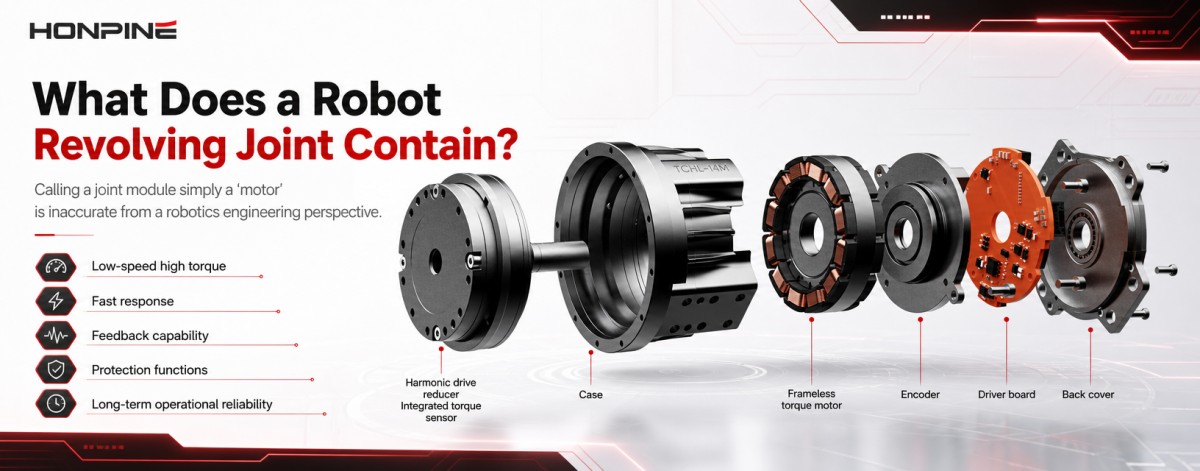
Calling a joint module simply a “motor” is inaccurate from a robotics engineering perspective.
A motor only converts electrical energy into rotational motion. Robot joints require:
low-speed high torque,
fast response,
feedback capability,
protection functions,
and long-term operational reliability.
A standalone motor cannot simultaneously satisfy requirements for torque, size, precision, and safety.
A typical revolving joint module usually includes:
the motor for power generation,
the reducer for speed reduction and torque amplification,
the encoder for position and speed feedback,
the driver for current and motion control,
the brake for maintaining safe posture during power loss,
bearings for load support,
structural components and housing for fixation, load-bearing, and heat dissipation,
and wiring harnesses/connectors for power and communication.
Only after integrating all these components together can it become a functional robotic actuator module.
In practical debugging, joint problems rarely originate from a single component alone. For example:
motor overheating may be related to reducer efficiency, housing heat dissipation, or driver current strategy;
joint vibration may involve encoder resolution, control parameters, transmission backlash, or structural rigidity.
The difficulty of designing joint modules lies in the strong interaction between all these subsystems. Components that look excellent individually on specification sheets may not necessarily create a high-performance joint when assembled together.
What Roles Do the Motor and Reducer Play in a Revolving Joint?
The first thing engineers usually evaluate in a joint module is the combination of the motor and reducer.
The motor rotates at high speed, while the reducer lowers speed and amplifies torque. Robot joints do not require fan-like high-speed rotation. Instead, they must deliver stable force output at relatively low speeds and stop precisely according to control commands.
Frameless torque motors are commonly used in humanoid robot joints. These motors essentially retain only the stator and rotor, while the robot structure itself shares functions traditionally handled by the motor housing, end caps, and bearings.
This design allows the joint to become significantly more compact. Public materials from companies such as Kollmorgen and maxon show that frameless servo motors are widely used in robotic joints, high torque density systems, and highly integrated actuator applications.
Reducers directly affect:
output torque,
positioning accuracy,
backlash,
and service life.
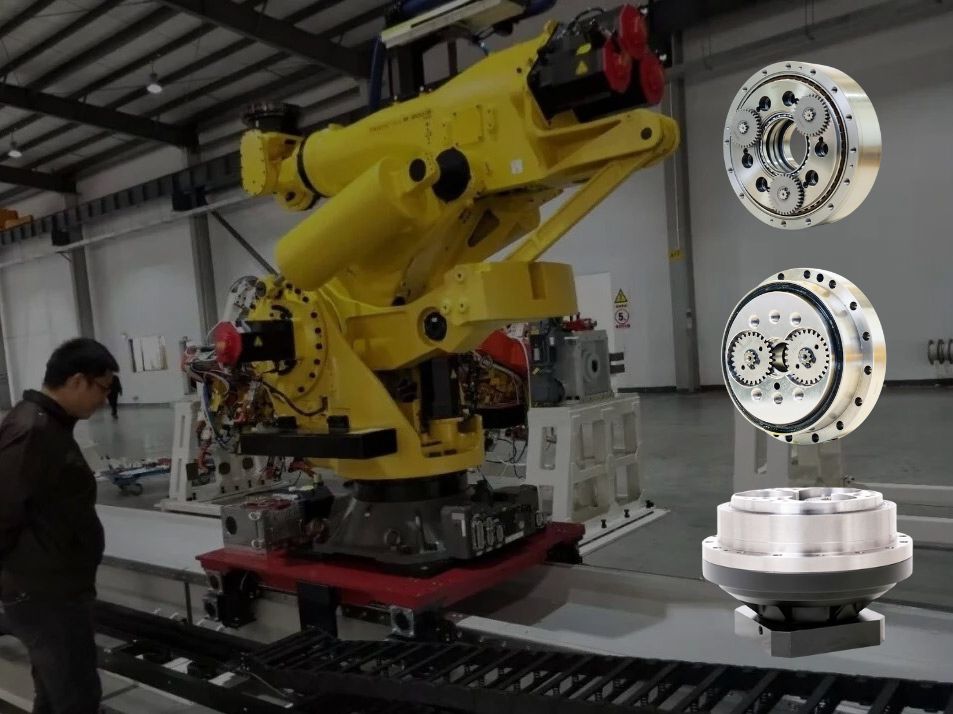
Harmonic reducers are compact, highly precise, and feature low backlash, making them ideal for space-constrained joints. RV or cycloidal reducers emphasize rigidity, load capacity, and durability, and are more common in heavy-duty industrial robot joints.
Humanoid robots rarely use only one reducer type throughout the body. Different joints have different requirements:
hips and knees prioritize high load capacity,
shoulders and elbows require balanced performance,
wrists and fingers focus on lightweight and compactness.
In real-world selection, engineers care about more than maximum torque alone:
How long can continuous torque be maintained?
How does efficiency behave under typical operating conditions?
How does backlash change over the product lifetime?
Can precision still be maintained after impact loads?
If the motor and reducer are not properly matched, a “high-performance” joint on paper may ultimately become a source of heat, noise, and control error in the final robot.
How Do Revolving Joint Modules Achieve Precise Control?
Power alone is not enough — the system must also know exactly where the joint is moving.
For example, when the controller commands the elbow joint to rotate 30 degrees, the system continuously monitors position and speed feedback:
if the joint only reaches 27 degrees, compensation is needed;
if it exceeds 31 degrees, correction is required;
if external force is applied, the system must detect the disturbance immediately.
Without feedback, the control system is essentially guessing.
Encoders provide position and speed feedback, while temperature sensors, current sensing, torque-related sensors, and vibration monitoring provide operating condition data.
More advanced joint modules send this information back to the driver or upper-level control system for:
motion control,
electrical protection,
fault diagnosis,
and lifetime prediction.
A robot merely being able to move is one thing; maintaining motion quality and safety boundaries depends entirely on reliable feedback.
Wiring harnesses and connectors are often underestimated. Humanoid robots contain numerous power, communication, and signal cables throughout the body. As joints move, the wiring must repeatedly bend, twist, and stretch.
A prototype may complete a short demonstration successfully, but after weeks of continuous operation, problems such as:
looseness,
wear,
poor shielding,
and unstable electrical contact
can become extremely difficult field failures.
Many real engineering challenges are hidden within these small but critical connection details.
What Role Does the Driver Play in the Joint Module?
The driver is far more than a simple power supply board.
It converts control commands into precise current and voltage regulation that the motor can execute. Typical control functions include:
current control,
speed control,
position control,
and torque control.
It must also handle protections such as:
overcurrent,
overvoltage,
and overheating.
No matter how powerful the motor is, poor driver control will still result in:
vibration,
noise,
excessive heat,
slow response,
frequent protection shutdowns.
Humanoid robots place especially demanding requirements on drivers. Dozens of joints operate simultaneously with rapidly changing loads, strong posture coupling, and constant external disturbances.
The driver must:
respond quickly,
avoid excessive sensitivity,
deliver sufficient current,
maintain thermal stability.
Joints must remain flexible during normal operation while instantly entering safe states during abnormalities.
Brakes serve another critical function: joints must not only move, but also stop safely.
During power loss:
arms must not suddenly drop,
heavy loads must not slowly slide downward,
standing postures must remain stable.
This is especially important for high-load joints such as shoulders, hips, and knees. Brakes and protection logic are not only related to motion quality, but also determine whether robots can safely operate in factories, warehouses, shopping centers, or homes.
How Should Revolving Joint Modules Be Evaluated and Selected?
When evaluating a joint module, peak torque is only the first specification to consider.
Peak torque reflects short-term burst capability, while continuous torque better represents daily operating performance.
Peak torque may be used during:
standing up,
impact resistance,
or lifting heavy loads.
However, continuous walking, posture holding, and repetitive tasks depend much more on sustained output and thermal management.
Torque density measures how much torque can be delivered per unit weight.
Lighter joints reduce overall robot inertia.
Higher torque within the same size enables heavier tasks in compact spaces.
This is especially important for:
arm end effectors,
lower legs,
ankles,
where weight changes are amplified through the motion chain.
Backlash, precision, and rigidity directly affect motion quality. Backlash can be understood as “lost motion” inside the transmission system, creating discrepancies between control commands and actual movement.
Tasks such as:
grasping,
assembly,
tool operation
require extremely high end-effector precision. Even tiny joint errors can accumulate along the robotic arm or leg structure, eventually causing inaccurate grasping, unstable standing, or drifting motion.
Efficiency and heat generation determine how long a robot can operate continuously. When dozens of joints work simultaneously, even small losses in each joint affect overall thermal management and battery endurance.
As temperature rises:
drivers may reduce power,
motor performance may change,
lubrication and material lifespan may degrade.
For commercial robots, a five-minute demonstration and several hours of stable operation represent completely different product levels.
Finally, lifespan, reliability, and cost all directly affect large-scale deployment.
Problems such as:
reducer wear,
motor overheating,
bearing fatigue,
loose wiring,
driver failure
can stop the entire robot system.
Humanoid robots often contain dozens of joints. A slightly higher cost per module significantly increases total robot cost, while a slightly higher failure rate greatly increases maintenance and after-sales pressure.
Contact HONPINE to learn more about complete harmonic joint modulesolutions.
Read More
Learn more about the story of HONPINE and industry trends related to precision transmission.
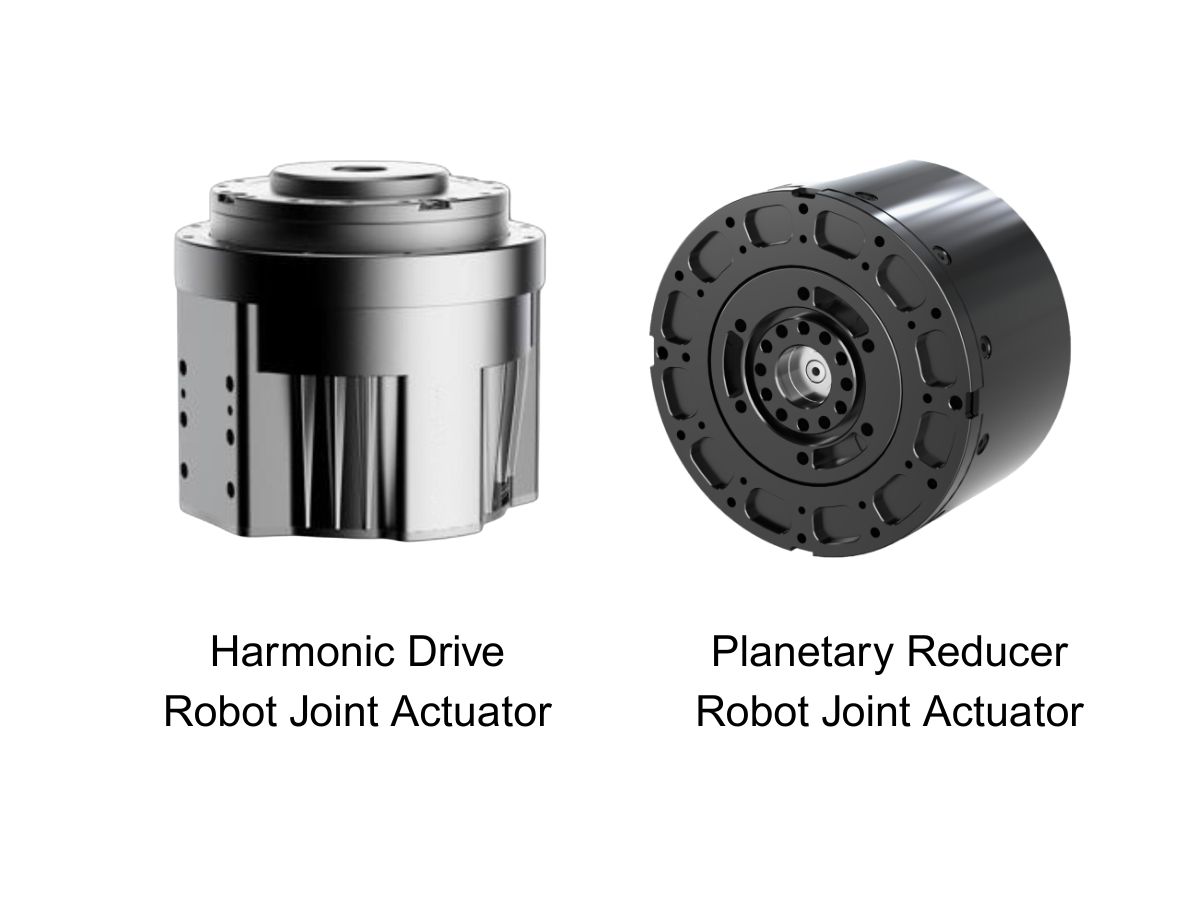
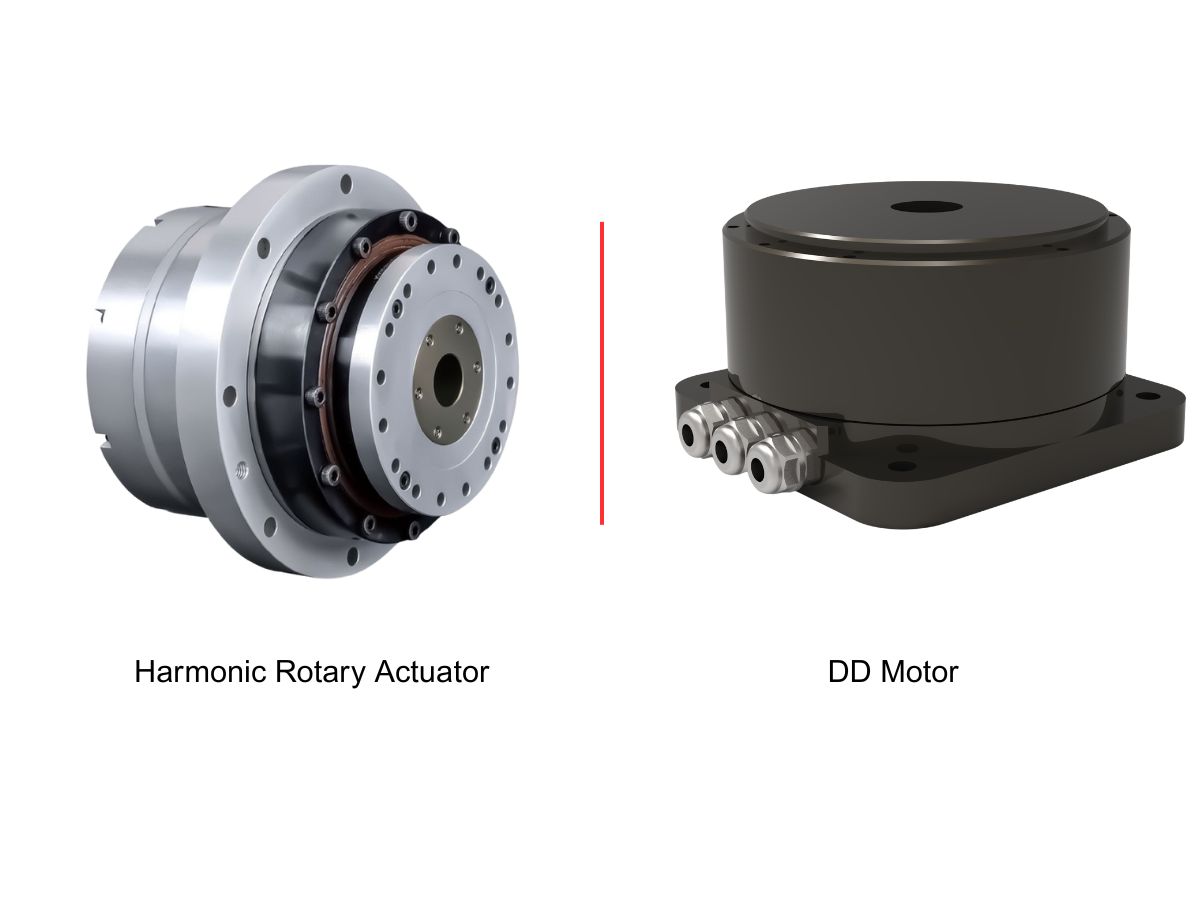
 What is robot joint actuator?How to Choose the Best Robot Rotary Joint Actuator?In core robot joint transmission solutions, planetary and harmonic rotary actuators each have their own strengths. Choosing the right type based on application requirements is essential to achieve the optimal balance between performance and cost.
 DD Motors VS Harmonic Rotary ActuatorsThis article provides an in-depth comparison between Direct Drive (DD) motors and harmonic rotary actuators, covering their transmission principles, advantages and disadvantages, and typical application fields.
 OMG Ultra Compact Harmonic Drive Joint Module with Built-in Torque SensorHONPINE TCHL series harmonic drive joint module is a game-changing product that achieves disruptive improvements in multiple aspects such as lightweight design, integration level, and connection convenience. This article will analyze its revolutionary enhancements with you.
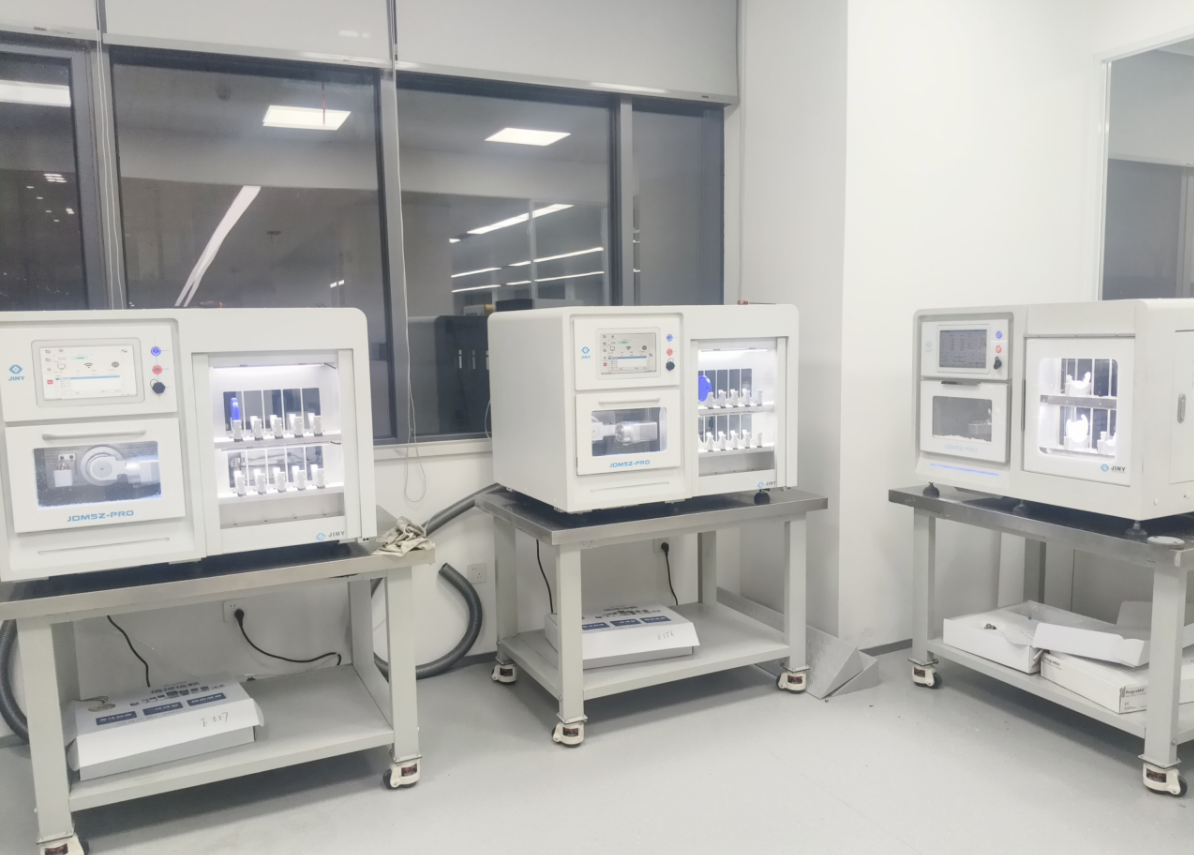
 The Role of Harmonic Drive Gears in Achieving 5–10 μm Accuracy in Dental Milling MachinesA dental milling machine is a CNC machining system used to directly process digital dental models into restorations such as crowns, bridges, veneers, inlays, and implant abutments. Dental milling machines require far higher operational accuracy and motion stability than ordinary equipment. This article explains how harmonic drive gear help dental milling machines achieve stable, continuous, and controllable operation.
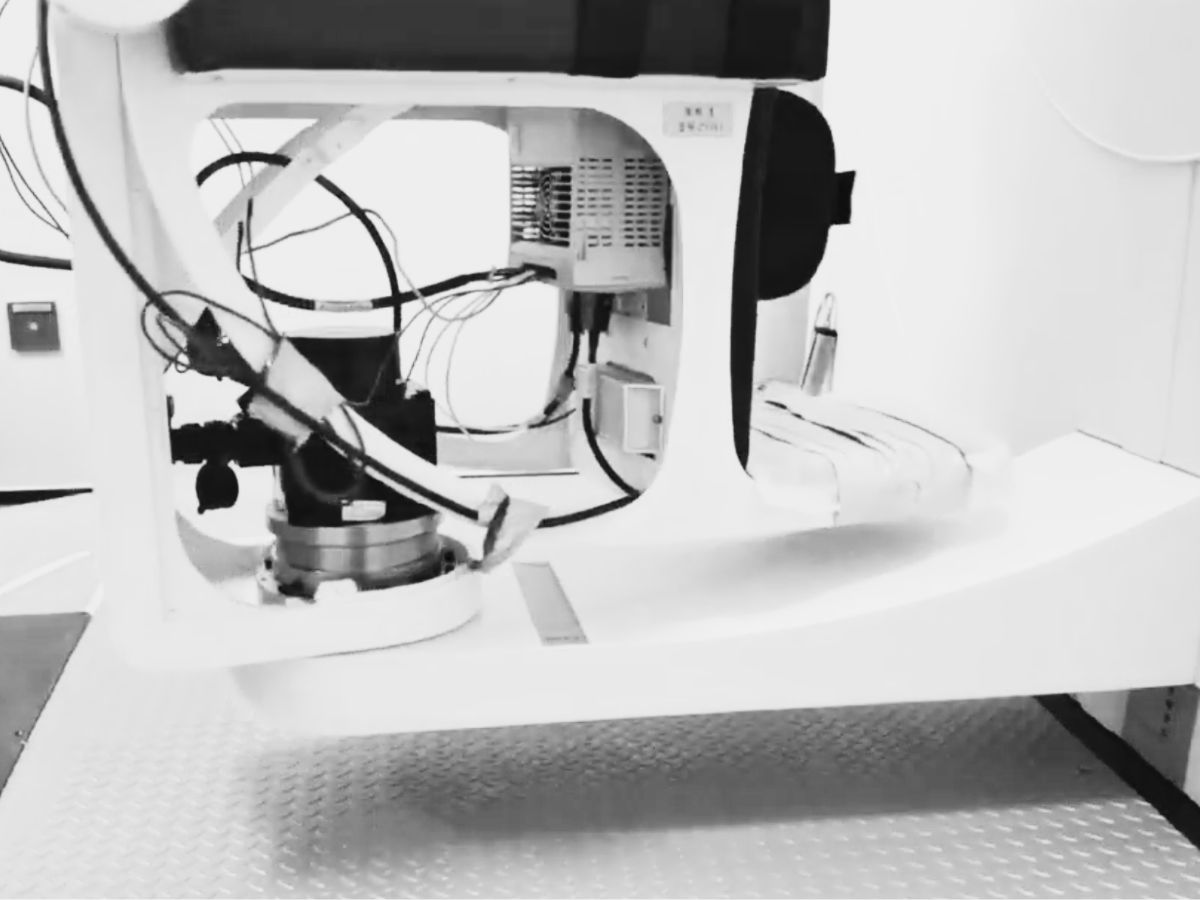
 Why Are Harmonic Rotary Actuators Perfect for Medical Equipment?Harmonic rotary actuators (typically integrated systems consisting of a harmonic drive reducer, frameless torque motor, encoder, and optional brake) are regarded as key components in medical equipment. The core reason is that they simultaneously meet the most stringent medical requirements for precision, compact size, safety, and controllability. The following explanation is structured from three perspectives: technical characteristics, application scenarios, and medical value.
 High-Precision RV Reducers Perfectly Matched for Walking RobotsThe walking axis of a robot is a core component for power transmission and support. RV reducers provide extremely high rigidity, precision, and torque while maintaining a compact size and exceptional reliability, making them an ideal match for the demanding requirements of walking robot joints in terms of load capacity, impact resistance, and precision.
 How Does the HONPINE JRM Planetary Robot Joint Module Address Temperature Rise in Continuous Operation?HONPINE JRM planetary robot joint modules are designed for long-duration and high-load robotic operation. This article examines how motor electromagnetic optimization, high-efficiency planetary transmission, GaN-based drive technology, and system-level low-loss design help control temperature rise. Using the C6345 planetary robot joint module as a test example, HONPINE also presents full-load thermal validation under continuous operation, including motor efficiency up to 92%, planetary gearbox efficiency up to 97%, and a final equilibrium temperature of 61.42°C at a 25°C ambient temperature.
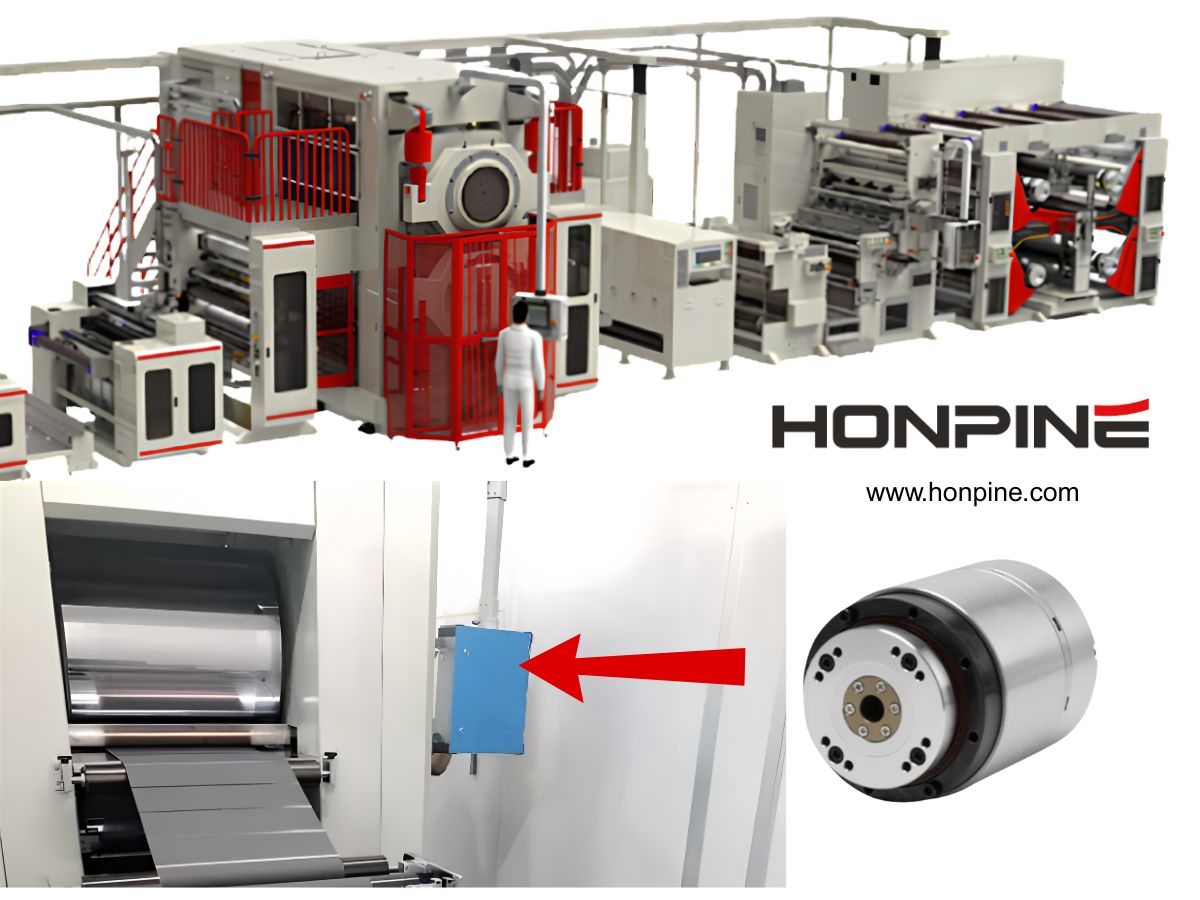
 Harmonic Rotary Actuator for Lithium Battery Roller Press EquipmentLithium battery manufacturing equipment requires higher precision, stability, and integration efficiency as production processes continue to evolve. In roller press equipment, accurate roller positioning, pressure control, and dynamic response are critical for ensuring electrode quality and consistency.
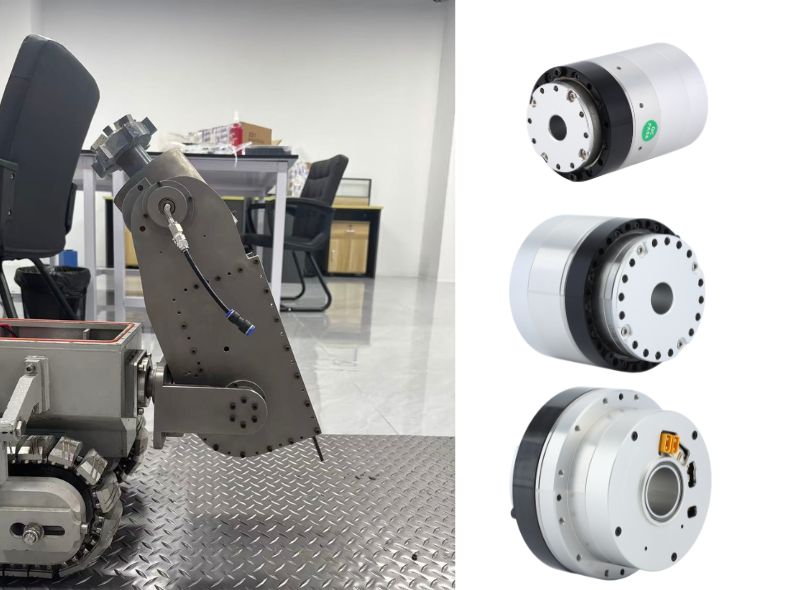
HONPINE harmonic rotary actuators provide high precision, high rigidity, fast response, and compact integration for lithium battery roller press equipment. With near-zero backlash, high torque density, and reliable motion control performance, they help improve equipment accuracy and production stability. Harmonic Robot Joint Actuators for Pipeline Robots and Other Special-Purpose EquipmentPipeline robots operate in narrow and complex environments where limited installation space, high load requirements, cable routing, and precise motion control are critical challenges. A reliable joint actuator must provide high torque output, compact dimensions, and stable performance while adapting to demanding operating conditions. Harmonic robot joint actuators integrate precision transmission, motor drive, and sensing capabilities into a compact motion unit, making them suitable for pipeline robots and other special-purpose robotic systems. This article explores the key design requirements of pipeline robots and explains how HONPINE HPJM harmonic robot joint modules help achieve compact, high-performance, and reliable robotic solutions.
 How Integrated Robot Joint Modules Are Reshaping Robot Wiring and Control Architecture?Integrated robot joint modules are changing how robots are designed by combining the motor, reducer, drive, encoder, and sensing components into a compact motion unit. Compared with traditional distributed architectures, this integrated approach can reduce cable complexity, simplify power and communication connections, and support more compact robot structures. As humanoid robots demand higher levels of motion coordination, response speed, precision, and integration, robot joint modules are becoming an increasingly important interface between intelligent control systems and physical movement. This article explains how integrated robot joint modules reshape robot wiring and control architecture, using the HONPINE TCHL harmonic drive robot joint module as an example.
 Harmonic Actuator for Lift Equipment: Precision, Torque Density and Compact Motion Control IntroductionModern lifting equipment requires more than simply moving a load vertically. Robotic lift axes, AGV and AMR lift modules, semiconductor equipment, inspection platforms, and specialized winches increasingly demand high torque density, precise positioning, low backlash, high rigidity, and compact motion control. A harmonic actuator integrates a harmonic drive with a motor and, depending on the configuration, encoders, brakes, servo drives, and communication interfaces into a compact motion module. This article explores how harmonic actuators can be applied to different lifting systems and why their combination of precision, torque density, rigidity, and integration makes them suitable for automated lifting and positioning applications.
 Force-Controlled Harmonic Joint Modules: A Key Solution for Robot CommercializationAs robots move from precise positioning toward physical interaction, joint-level torque feedback is becoming increasingly important. A force-controlled robot joint module allows the robot to sense changes in output torque and respond more appropriately to external loads, supporting compliant motion, contact detection, and force-controlled applications. HONPINE HAG and HAU harmonic joint modules integrate torque sensing directly into the joint, enabling torque closed-loop control, 360° continuous output rotation, less than 1% torque control accuracy, and a 50 Hz torque bandwidth. This integrated design also maintains consistent dimensions between force-controlled and non-force-controlled configurations, providing a flexible joint platform for robot manufacturers.
Double Click
We provide harmonic drive reducer,planetary reducer,robot joint motor,robot rotary actuators,RV gear reducer,robot end effector,dexterous robot hand
 What is robot joint actuator?How to Choose the Best Robot Rotary Joint Actuator?In core robot joint transmission solutions, planetary and harmonic rotary actuators each have their own strengths. Choosing the right type based on application requirements is essential to achieve the optimal balance between performance and cost.
 Harmonic Rotary Actuators for Semiconductor Equipment: Precision Motion, Hollow-Shaft Design and FOC ControlHello everyone, I’m Theodore Li, Technical Director at HONPINE. In semiconductor manufacturing equipment, rotary motion is not simply about making a mechanism rotate. Limited installation space, cable and tube routing, low-speed stability, precise positioning and continuously adjustable motion profiles can all influence the performance of the machine. This is why harmonic rotary actuators are becoming an important motion solution for semiconductor equipment. In this article, I will discuss how harmonic transmission, FOC-based motor control, encoder feedback, large hollow-shaft design and flexible mechanical interfaces work together to meet practical semiconductor motion requirements, based on our experience with developing equipment, overhead transport, wafer handling, cleaning and crystal-growth applications.
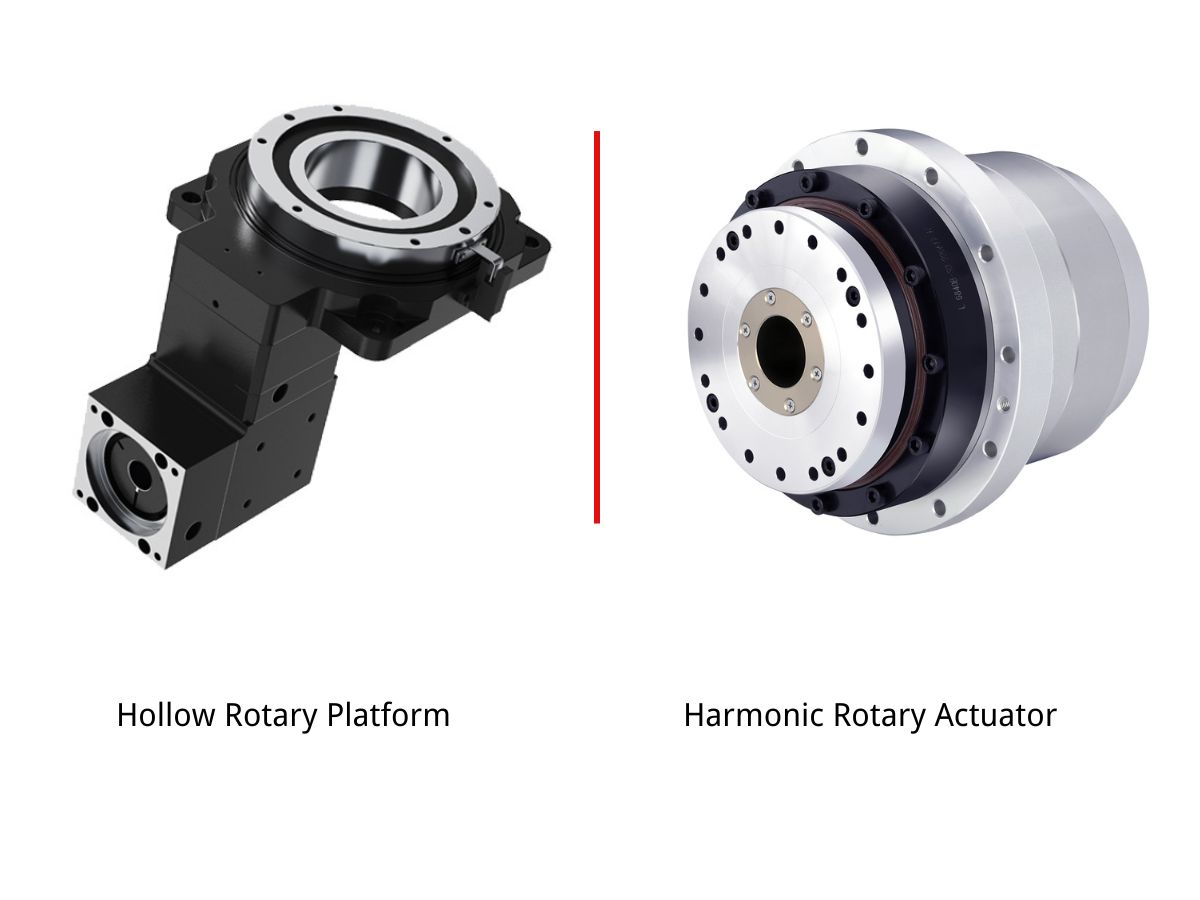
 Hollow Rotary Platform vs. Harmonic Rotary Actuator: Application Comparison and InterchangeabilityHello everyone, I’m Theodore Li, Technical Director at HONPINE. For engineers designing precision rotary stations for industrial automation, one question often comes up: when a machine requires high-precision rotation, indexing, or rotary positioning, should you choose a hollow rotary platform or a harmonic rotary actuator? Can they be used interchangeably? Although both are precision rotary motion solutions, their mechanical structures and application characteristics are quite different. In actual equipment, choosing the wrong solution can lead to insufficient load capacity, inadequate rigidity, vibration, speed limitations, or reduced service life. In this article, I’ll compare their application characteristics and explain where they can be used interchangeably, where one is more suitable than the other, and what engineers should check before making a replacement.
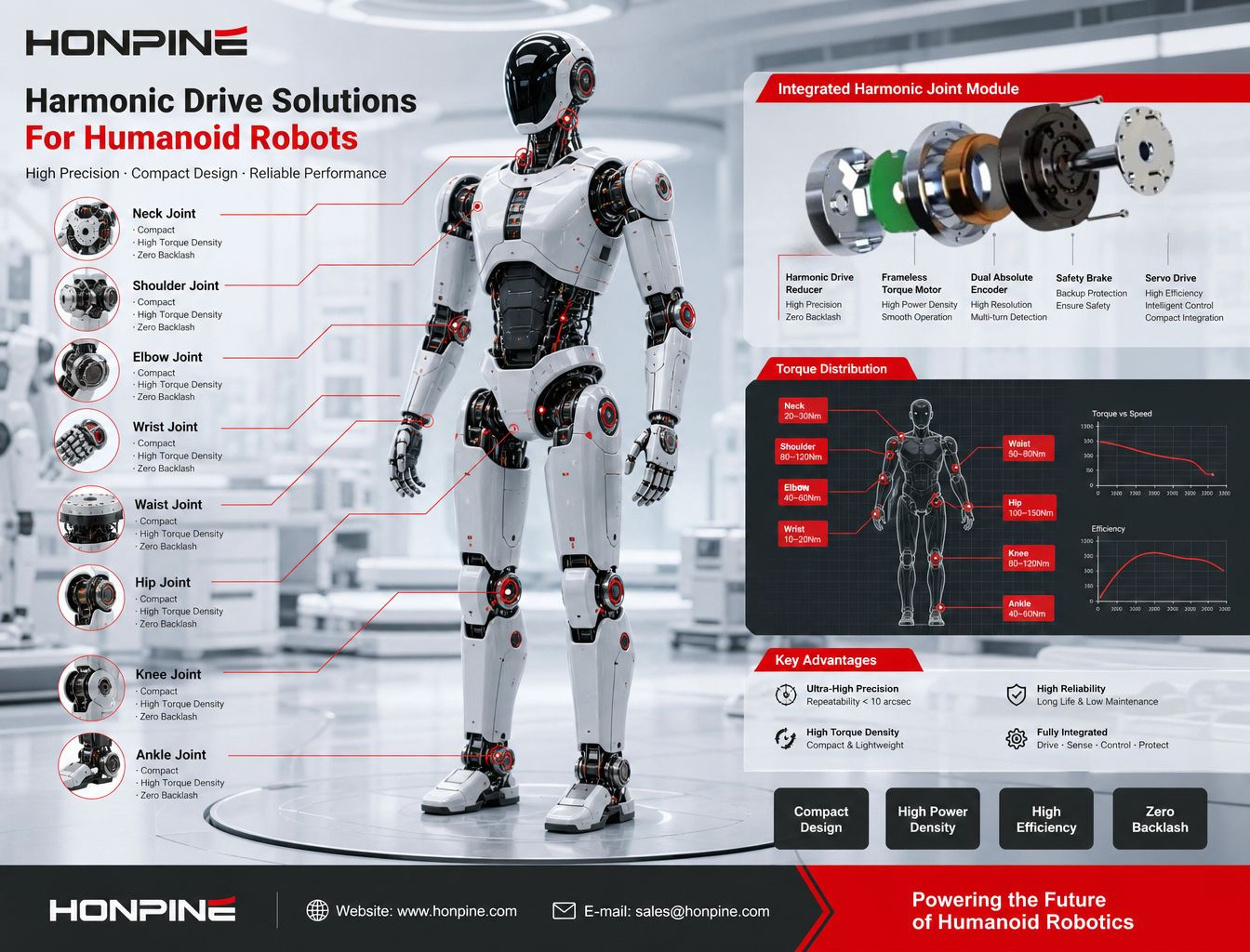
 Humanoid Robot Joint Module Selection Guide: Choosing the Right Harmonic Joint Module for Every Robot JointSelecting the right joint module is one of the most important decisions in humanoid robot design.
Different robot joints require different levels of torque, speed, stiffness, and payload capacity. Using the same actuator throughout the robot often increases weight, reduces efficiency, and limits motion performance.
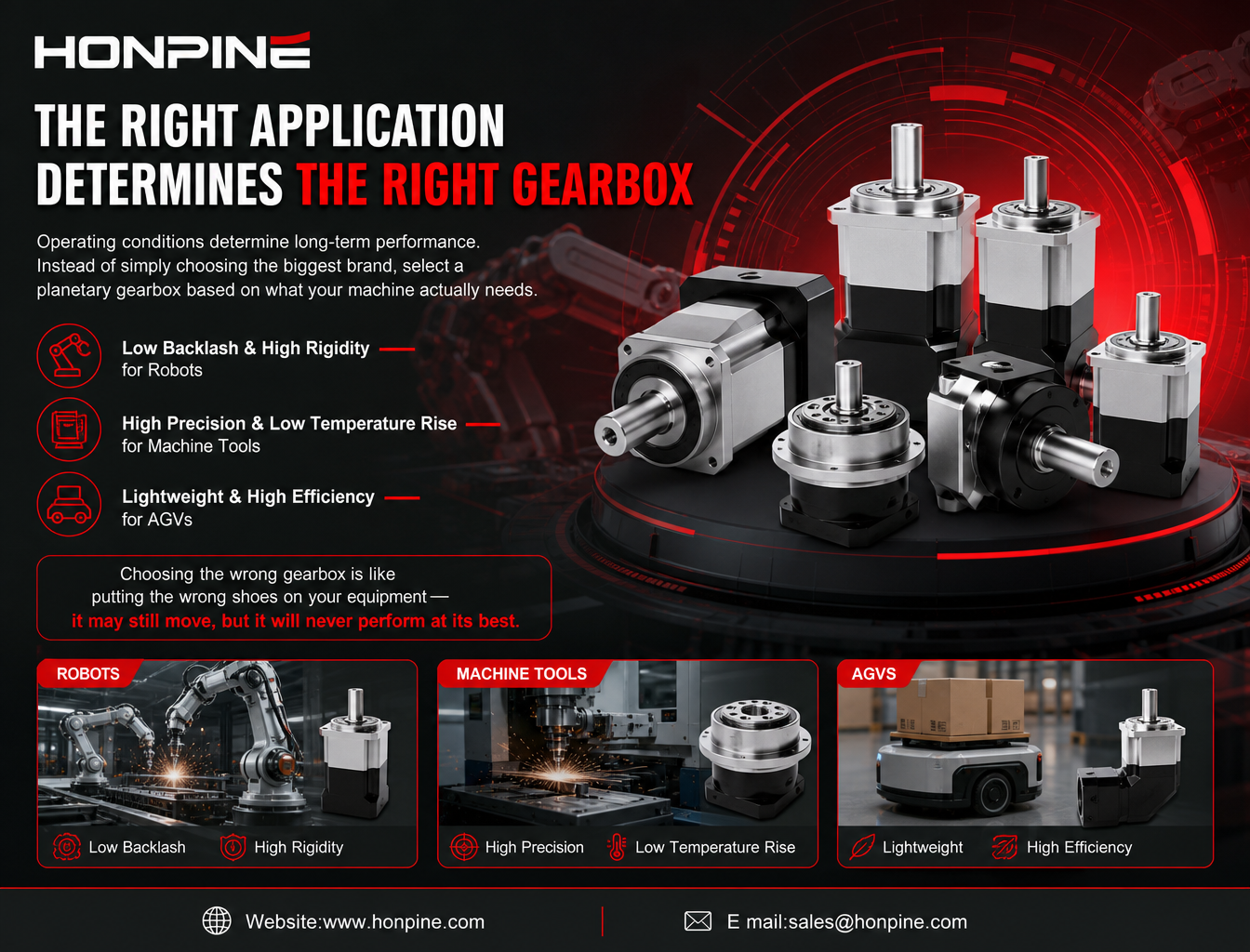
The Honpine HPJM-PRO Series Harmonic Joint Modules provide a complete range of integrated joint actuators for humanoid robots, enabling engineers to optimize every joint from the head to the lower body. Honpine Planetary Gearbox Selection Guide: How to Choose the Right Gearbox for Robots, CNC Machines, and AGVsThe right application determines the right gearbox. Operating conditions determine long-term performance. Instead of simply choosing the biggest brand, select a planetary gearbox based on what your machine actually needs: low backlash and high rigidity for robots, high precision and low temperature rise for machine tools, and lightweight, high-efficiency designs for AGVs. Choosing the wrong gearbox is like putting the wrong shoes on your equipment—it may still move, but it will never perform at its best.
 How the HONPINE JRM Planetary Joint Module Improves Robot Motion Performance?The JRM-C Planetary Joint Module is a lightweight, high-torque actuator module specially designed for humanoid robots, wheeled robots, quadruped robots, and other intelligent robotic systems.
 Why Do Most People Choose Nabtesco as Their RV Reducer Gearbox Supplier?The article explains Nabtesco’s dominance in RV reducers due to its high precision and reliability, while noting that the industry has few suppliers because of extreme manufacturing difficulty. It also briefly mentions competitors like Sumitomo, Spinea, and HONPINE offering cost and delivery advantages.
 What Is the Revolving Joint of a Robot?Structure, Components, and Working Principles Explained?This article will provide you with a comprehensive analysis of a robot's rotary joint, including its integrated components, the role of each component, and how precise control is achieved.
 Which Manufacturers Are Capable of Providing Integrated Frameless Torque Motor and Hollow Rotary Servo Actuator Solutions?A traditional servo rotary actuator consists of a rotor, stator, housing, bearings, end caps, and feedback components. A frameless motor removes all redundant mechanical structures and retains only the electromagnetic conversion core. The rotor becomes a direct part of the load shaft, while the stator is integrated into the machine structure through bonding, locking, or potting.
 Why Are Crossed Roller Bearing Harmonic Reducers Ideal for Robot Joints?In robotic harmonic reducers, crossed roller bearings are the key components that ensure motion accuracy and structural rigidity. Their performance directly affects the robot’s repeat positioning accuracy, load capacity, and service life.
 How HONPINE HAG Harmonic Drive Robot Joint Modules Improve Precision, Torque Control, and ReliabilityHONPINE HAG robot joint module is a game-changing innovation developed to meet the emerging demands of the robotics industry. It is a fully closed-loop harmonic robotic joint module.
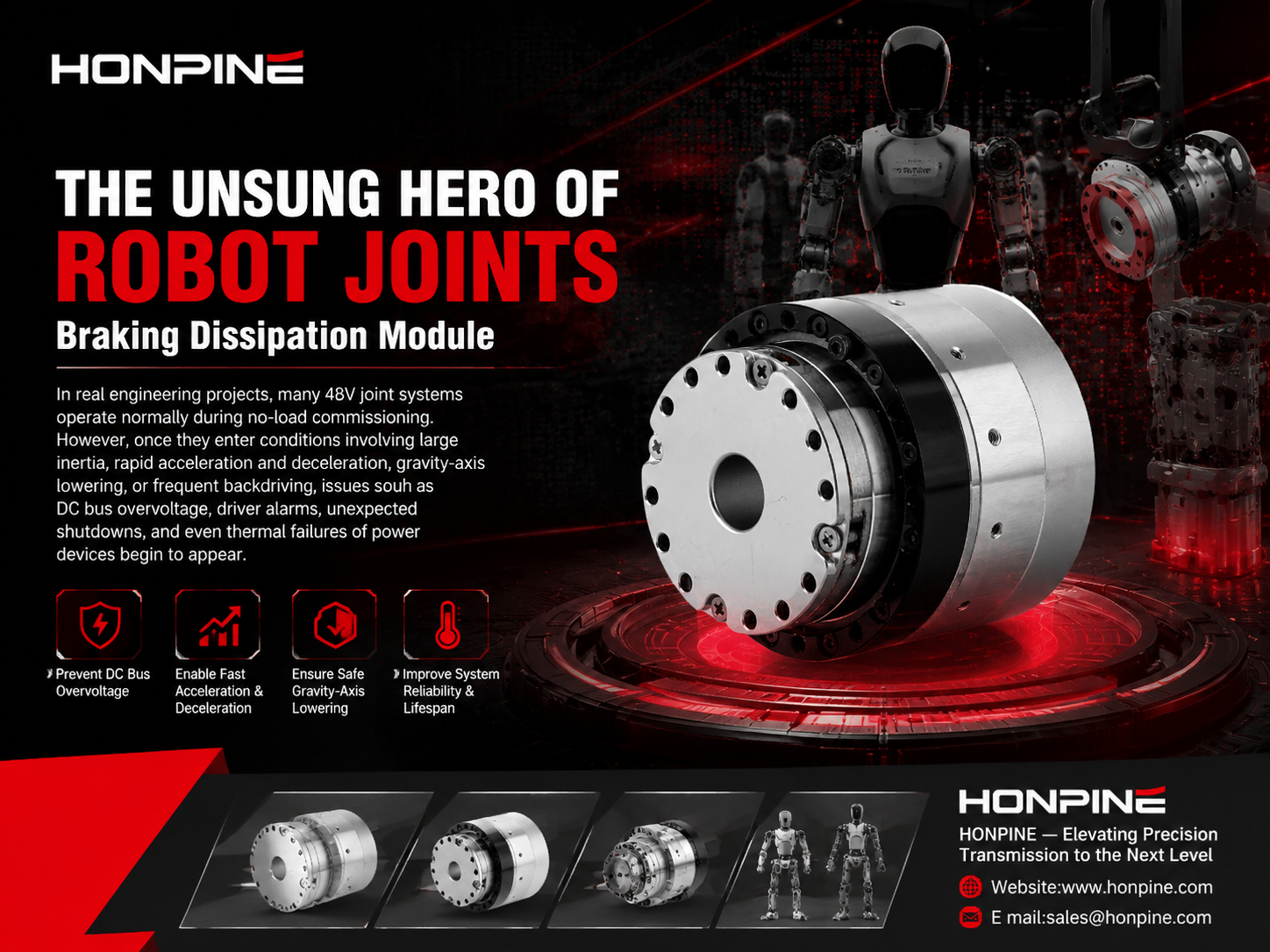
 Comprehensive Analysis of Braking Dissipation Modules for Robotic Harmonic Joint ActuatorsIn discussions about robotic joint actuator modules, the motor, gearbox, encoder, brake, and driver usually receive the most attention, while the braking dissipation module is often underestimated. In real engineering projects, many 48V joint systems operate normally during no-load commissioning. However, once they enter conditions involving large inertia, rapid acceleration and deceleration, gravity-axis lowering, or frequent backdriving, issues such as DC bus overvoltage, driver alarms, unexpected shutdowns, and even thermal failures of power devices begin to appear.