








Comprehensive Analysis of Braking Dissipation Modules for Robotic Harmonic Joint Actuators
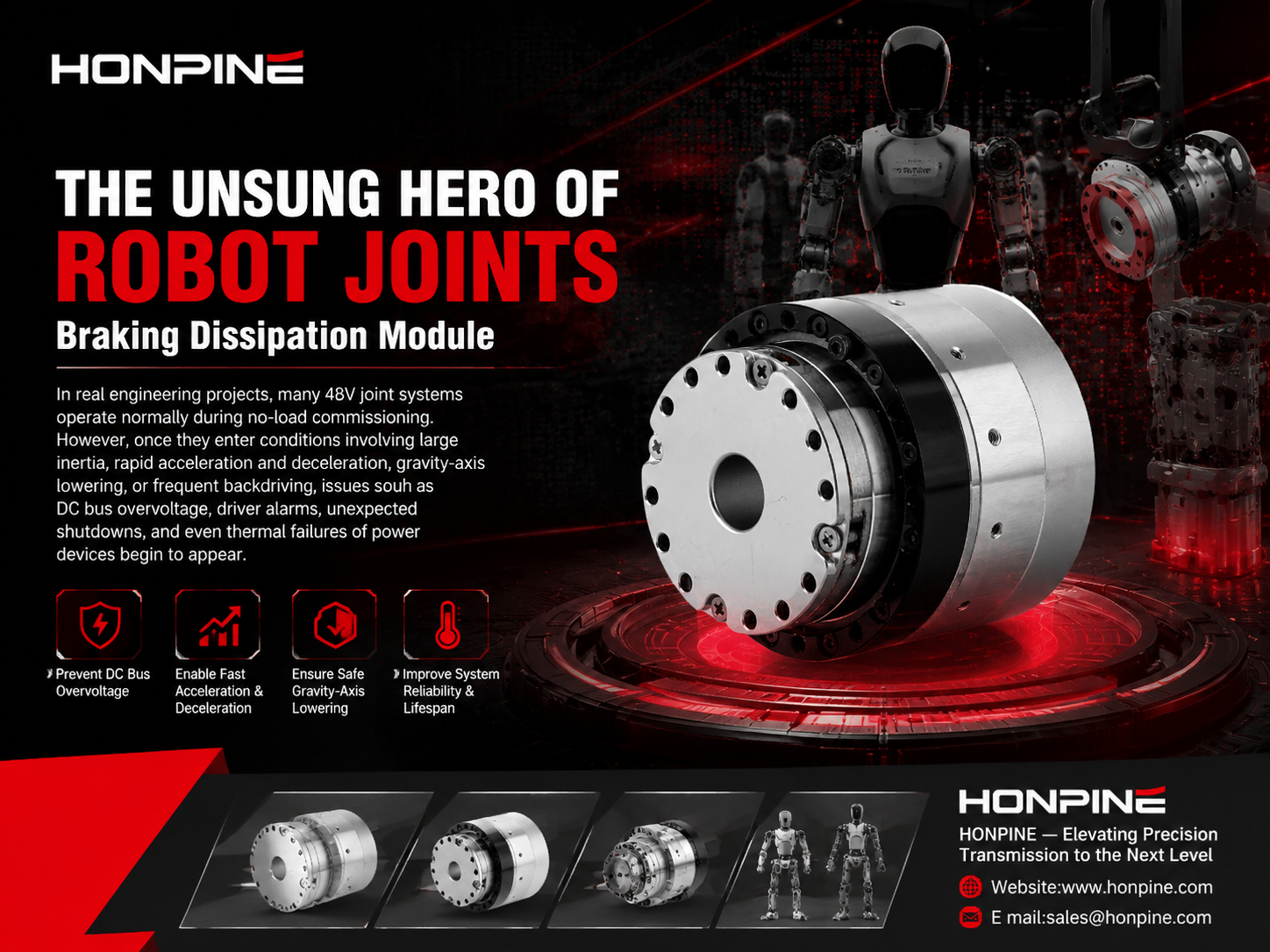
In discussions about robotic joint actuator modules, the motor, gearbox, encoder, brake, and driver usually receive the most attention, while the braking dissipation module is often underestimated. In real engineering projects, many 48V joint systems operate normally during no-load commissioning. However, once they enter conditions involving large inertia, rapid acceleration and deceleration, gravity-axis lowering, or frequent backdriving, issues such as DC bus overvoltage, driver alarms, unexpected shutdowns, and even thermal failures of power devices begin to appear.
In many cases, the root cause is not the servo control algorithm itself, but the fact that the regenerative energy handling chain has not been properly closed.
From an engineering perspective, a braking dissipation module used in robotic joint actuators is essentially a DC bus regenerative energy absorption unit. Its purpose is not to “release joint motion” or “replace a brake,” but to safely redirect excess regenerative energy into a braking resistor when the motor enters generator mode, dissipating that energy as heat and preventing the DC bus voltage from rising into a dangerous range for the driver or power supply.
What Is the Principle of Braking Dissipation?
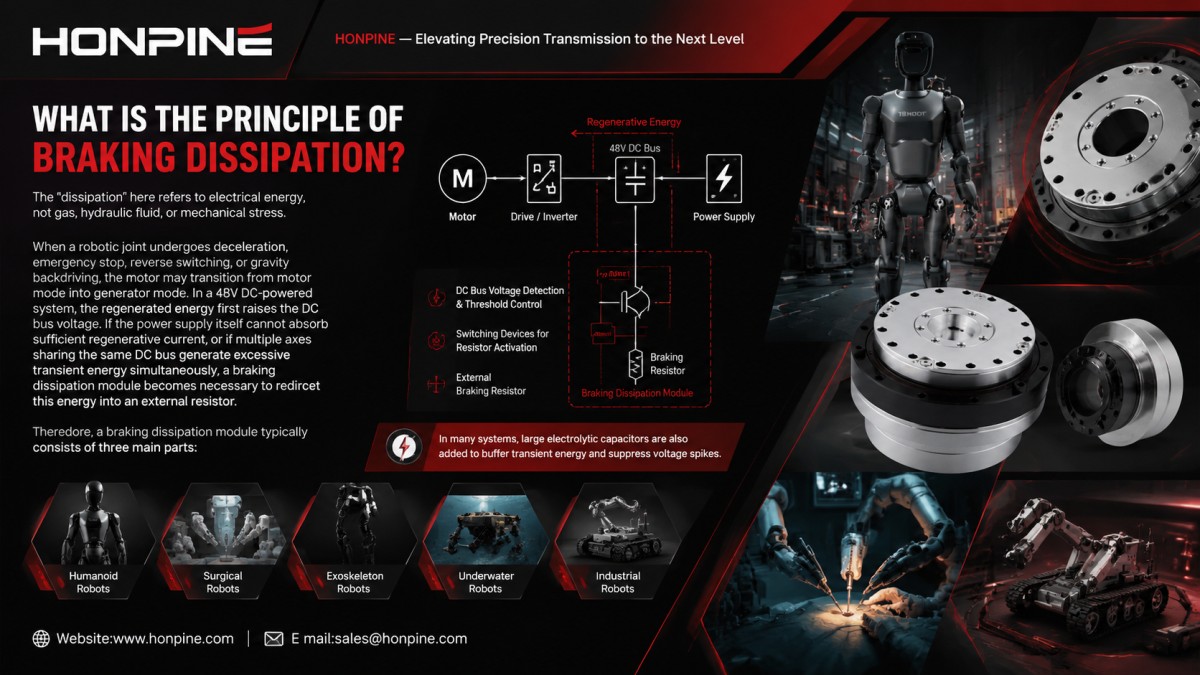
The “dissipation” here refers to electrical energy, not gas, hydraulic fluid, or mechanical stress.
When a robotic joint undergoes deceleration, emergency stop, reverse switching, or gravity backdriving, the motor may transition from motor mode into generator mode. In a 48V DC-powered system, the regenerated energy first raises the DC bus voltage. If the power supply itself cannot absorb sufficient regenerative current, or if multiple axes sharing the same DC bus generate excessive transient energy simultaneously, a braking dissipation module becomes necessary to redirect this energy into an external resistor.
Therefore, a braking dissipation module typically consists of three main parts:
DC bus voltage detection and threshold control
Switching devices for resistor activation
External braking resistor
In many systems, large electrolytic capacitors are also added to buffer transient energy and suppress voltage spikes.
Why Do Robotic Joint Actuators Particularly Need It?
Robotic joint modules operate under highly dynamic conditions, unlike ordinary constant-speed conveyor axes. Harmonic drive joints and torque motors frequently accelerate and decelerate, while robotic arms continuously exchange gravitational potential energy through posture changes.
Regenerative energy becomes especially significant in the following scenarios:
High-Inertia Rapid Deceleration
When the end load is heavy and deceleration time is short, rotational kinetic energy is rapidly fed back into the DC bus.
Gravity-Axis Lowering or Backdriving
During the lowering motion of vertical joints, elbows, or shoulder axes, gravitational potential energy is directly converted into electrical energy, causing the DC bus voltage to rise rapidly.
Multi-Axis Simultaneous Regeneration
During complex robotic arm trajectories, multiple axes may simultaneously enter deceleration or gravity-backdrive states. In shared DC bus architectures, this often leads to cumulative regenerative energy.
Switching Power Supplies Cannot Absorb Regenerative Energy
Many industrial 48V switching power supplies are designed to provide energy efficiently, but not to absorb reverse energy flow. When regenerative energy has nowhere to go, overvoltage becomes the system’s primary failure mode.
Some publicly available joint actuator documentation clearly states that braking dissipation modules are required under high-speed and high-load operating conditions to handle regenerative braking energy and prevent DC bus overvoltage shutdowns.
A typical control strategy is:
l Disconnect the braking resistor when bus voltage is below approximately 50V
l Connect the braking resistor when bus voltage exceeds approximately 51V
Additional safety margins are usually implemented for maximum allowable bus voltage.
Understanding Braking Dissipation Modules from an Engineering Perspective
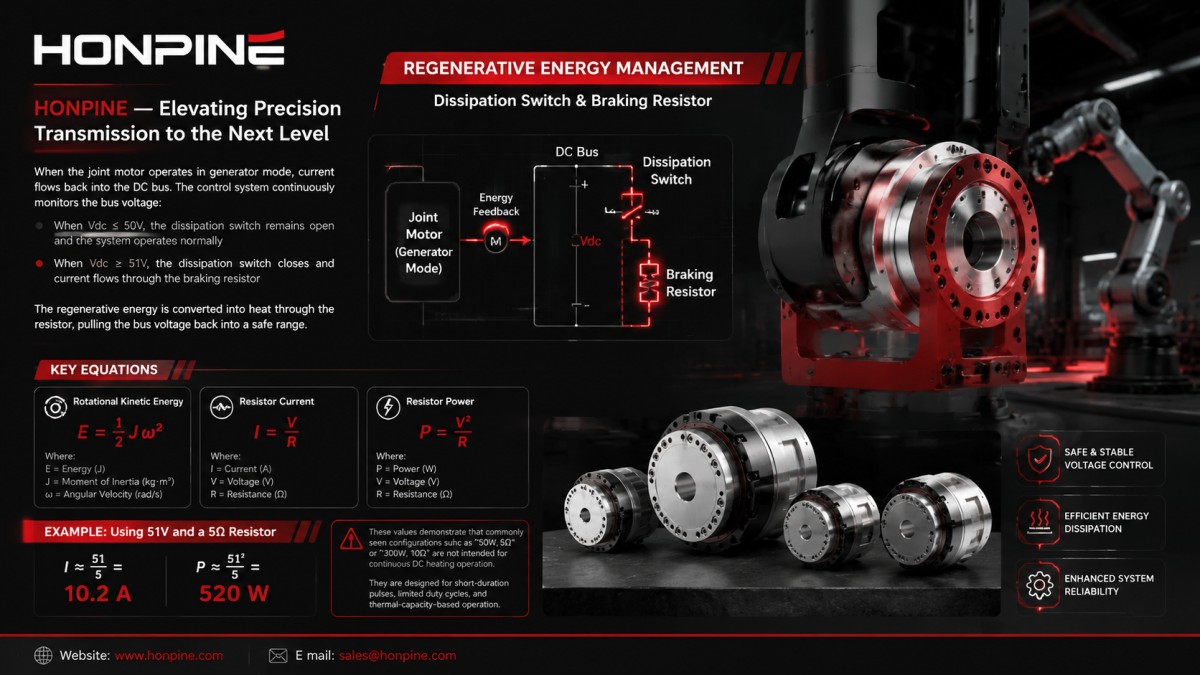
When the joint motor operates in generator mode, current flows back into the DC bus. The control system continuously monitors the bus voltage:
When Vdc ≤ 50V, the dissipation switch remains open and the system operates normally
When Vdc ≥ 51V, the dissipation switch closes and current flows through the braking resistor
The regenerative energy is converted into heat through the resistor, pulling the bus voltage back into a safe range.
Several common equations help illustrate the scale involved:
Rotational kinetic energy:
E = 1/2 × J × ω²
Resistor current:
I = V / R
Resistor power:
P = V² / R
For example, using 51V and a 5Ω resistor:
I ≈ 51 ÷ 5 = 10.2 A
P ≈ 51² ÷ 5 = 520 W
These values are extremely important from an engineering standpoint. They demonstrate that commonly seen configurations such as “50W, 5Ω” or “300W, 10Ω” are not intended for continuous DC heating operation. Instead, they are designed for short-duration pulses, limited duty cycles, and thermal-capacity-based operation.
For this reason, thermal design, installation location, and ventilation are often just as important as the electrical specifications themselves.
Key Considerations When Selecting Braking Dissipation Modules
Many engineers simply ask: “What resistor value and wattage should I use?” In reality, reliable selection requires consideration of at least six parameters.
Bus Voltage and Trigger Threshold
A 48V joint system should not be assumed to operate at a constant 48V. Power supply tolerances, regenerative spikes, and capacitor charging/discharging create dynamic voltage fluctuations.
If the threshold is too low, the resistor activates too early and generates excessive heat.
If the threshold is too high, overvoltage suppression may react too late.
Regenerative Energy Peak and Duration
Short transient spikes and repeated high thermal loads must be distinguished.
A single emergency stop may not generate much energy, but repetitive high-cycle operation can rapidly increase average thermal load.
Braking Resistor Value and Power Rating
Resistance determines dissipation current capability, while power rating determines thermal handling capability.
Lower resistance provides stronger dissipation but also increases stress on switching devices, resistors, and wiring.
DC Bus Capacitor Capacity
Capacitors do not replace braking dissipation modules. They mainly smooth voltage spikes and buffer transient energy.
Small capacitors can slow voltage rise but cannot fundamentally eliminate regenerative energy.
For large joints or multi-axis shared-bus systems, capacitor capacity often becomes a critical stability factor.
Load Type and Axis Orientation
The same joint model behaves very differently on horizontal and vertical axes.
Systems with insufficient gravity compensation, rapid lowering speed, or frequent backdriving should adopt more conservative braking module sizing.
Thermal Path Design
Correct electrical wiring alone is insufficient.
If the module is installed in a sealed enclosure, on plastic surfaces, or in poorly ventilated environments, heat dissipation becomes inadequate.
In such cases, the final failure mode is often not overvoltage, but resistor degradation, solder fatigue, or thermal damage to power devices.
How Are Braking Dissipation Modules Configured in Real Systems?
Publicly available documentation shows that many 48V joint systems set braking thresholds around 50V to 51V and pair them with braking resistors and bus capacitors of varying sizes.
Typical examples include:
Small joints: 50W, 5Ω resistor with approximately 12,000μF bus capacitance
Larger joints: 300W-class resistors with up to 96,000μF bus capacitance
The difference is not simply because “larger models are more advanced,” but because the recoverable kinetic energy and thermal loads are significantly higher.
For integrated actuators, another important detail is that some product manuals explicitly require external regenerative energy absorption modules. This means the driver and power supply are not expected to handle all regenerative energy internally.
As a result, the braking dissipation circuit must be included during the system design phase, including:
BOM planning
Wiring layout
Thermal management design
rather than being added later during debugging.
Important Installation and Commissioning Considerations
Incorrect Module Placement
The braking dissipation module should be located close to the DC bus to minimize high-current loop length.
Long wiring increases parasitic inductance and cable heating.
Focusing Only on Rated Wattage
Many resistors appear sufficient on paper but exceed temperature limits during continuous operation.
This happens because datasheet ratings do not necessarily match real-world duty cycles.
Ignoring Switching Device and Terminal Heating
Failures may occur not only in the resistor itself, but also in:
MOSFETs
Busbars
Connectors
Terminal blocks
Relays
Mistaking Braking Dissipation for Functional Safety
Braking dissipation modules regulate voltage, not hazardous motion.
Vertical-axis anti-fall protection, collaborative robot safe stop, and maintenance lockout functions cannot rely on the dissipation module alone.
Estimating Only Single-Axis Conditions
A single axis may appear safe, while multi-axis simultaneous regeneration triggers frequent overvoltage alarms.
This is typically caused by unaccounted cumulative regenerative energy in shared DC bus systems.
When Should External Braking Dissipation Modules Be Prioritized?
External braking dissipation modules should generally be treated as mandatory rather than optional in the following cases:
48V DC systems where the power supply lacks regenerative absorption capability
Large inertia loads or rapid deceleration conditions
Vertical axes, elbows, or shoulder joints with significant gravity backdrive
Multi-axis shared DC bus systems
Existing overvoltage alarms, unstable braking, or power supply protection trips during commissioning
High-cycle equipment with frequent start-stop operation and elevated temperatures
Frequently Asked Questions from Customers
Which Axis Generates the Largest Regenerative Energy?
Not all axes carry equal risk. Gravity axes and high-inertia axes are usually the most critical.
What Is the Actual DC Bus Protection Threshold?
Do not rely only on the nominal “48V” label. The true voltage limits of the driver, capacitors, and power supply must be verified.
Is the Resistor Sized by Peak Power or Average Thermal Load?
Both must be considered. Otherwise, the system may survive short-term testing but fail during long-term operation.
Is the Thermal Path Adequate?
Mounting surfaces, airflow, nearby heat sources, and cabinet temperature rise should all be evaluated.
Are Functional Safety and Energy Management Properly Layered?
The roles of brakes, STO, braking dissipation modules, and emergency stop logic must be clearly defined within the system architecture.
A braking dissipation module for robotic joint actuators is fundamentally an interface device that converts excess mechanical-side energy into controlled thermal dissipation.
Although it may appear to be a minor accessory, it has a major impact on the stability, tunability, and reliability of 48V robotic joint systems under demanding operating conditions.
From practical engineering experience, any robotic actuator system that emphasizes dynamic performance will eventually need to address regenerative energy recovery and dissipation.
The ability of a driver to control torque is one layer of capability. The ability of the DC bus to survive regenerative energy is another.
Only when both capabilities are properly addressed can a robotic joint actuator truly achieve the engineering maturity required for mass production and complex real-world applications.

About Author
Theodore Li serves as the Technical Director at HONPINE, overseeing the R&D strategy for replication products, guiding team selection, and managing both pre-sales and after-sales operations.

Read More
Learn more about the story of HONPINE and industry trends related to precision transmission.
 What is robot joint actuator?How to Choose the Best Robot Rotary Joint Actuator?In core robot joint transmission solutions, planetary and harmonic rotary actuators each have their own strengths. Choosing the right type based on application requirements is essential to achieve the optimal balance between performance and cost.
 DD Motors VS Harmonic Rotary ActuatorsThis article provides an in-depth comparison between Direct Drive (DD) motors and harmonic rotary actuators, covering their transmission principles, advantages and disadvantages, and typical application fields.
 OMG Ultra Compact Harmonic Drive Joint Module with Built-in Torque SensorHONPINE TCHL series harmonic drive joint module is a game-changing product that achieves disruptive improvements in multiple aspects such as lightweight design, integration level, and connection convenience. This article will analyze its revolutionary enhancements with you.
 The Role of Harmonic Drive Gears in Achieving 5–10 μm Accuracy in Dental Milling MachinesA dental milling machine is a CNC machining system used to directly process digital dental models into restorations such as crowns, bridges, veneers, inlays, and implant abutments. Dental milling machines require far higher operational accuracy and motion stability than ordinary equipment. This article explains how harmonic drive gear help dental milling machines achieve stable, continuous, and controllable operation.
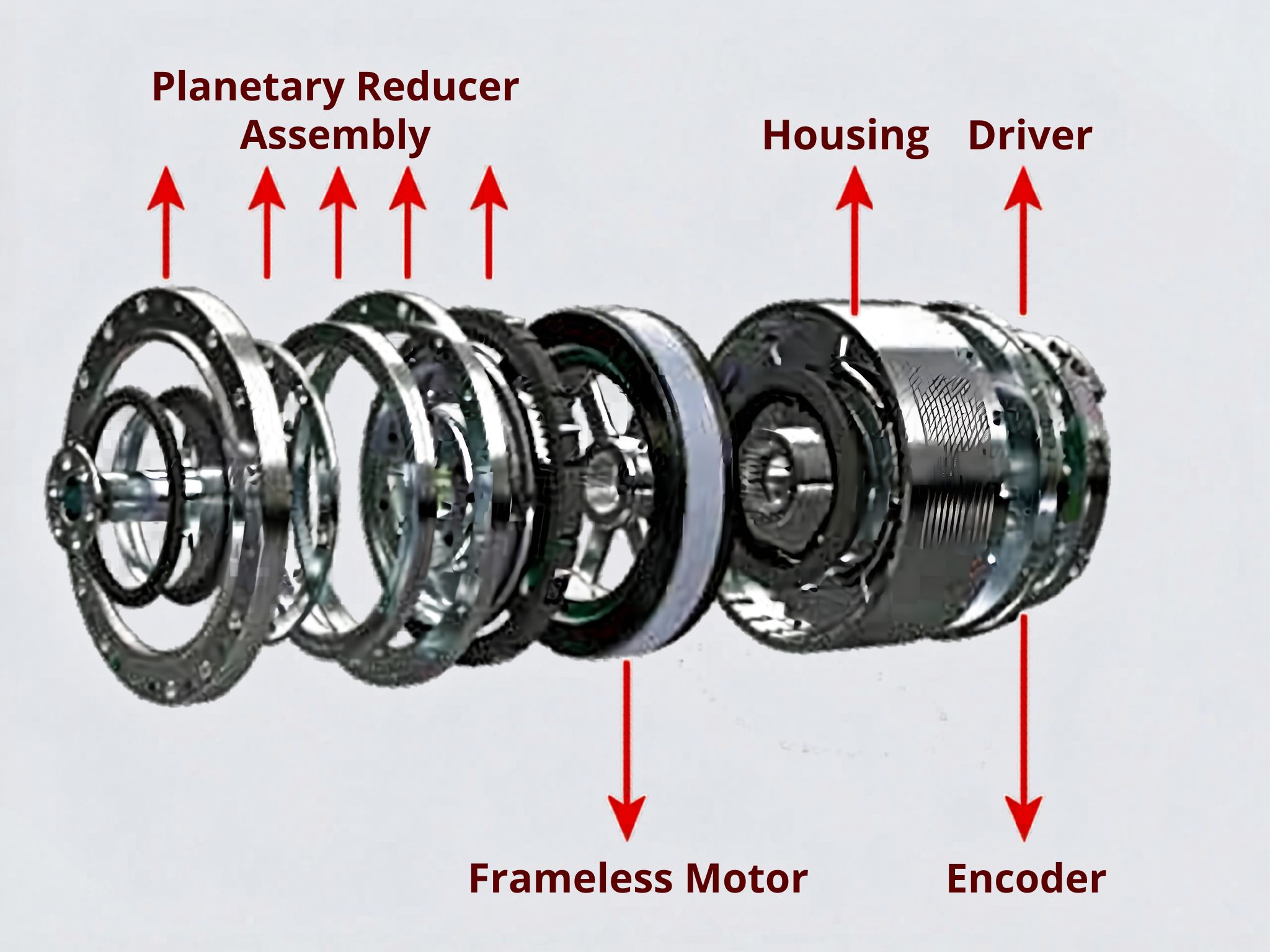
 Why Are Harmonic Rotary Actuators Perfect for Medical Equipment?Harmonic rotary actuators (typically integrated systems consisting of a harmonic drive reducer, frameless torque motor, encoder, and optional brake) are regarded as key components in medical equipment. The core reason is that they simultaneously meet the most stringent medical requirements for precision, compact size, safety, and controllability. The following explanation is structured from three perspectives: technical characteristics, application scenarios, and medical value.
 High-Precision RV Reducers Perfectly Matched for Walking RobotsThe walking axis of a robot is a core component for power transmission and support. RV reducers provide extremely high rigidity, precision, and torque while maintaining a compact size and exceptional reliability, making them an ideal match for the demanding requirements of walking robot joints in terms of load capacity, impact resistance, and precision.
 Why Does an RV Reducer Need Profile Modification? How to Further Reduce Backlash and Transmission Error?An RV Reducer is designed to deliver high torque, high stiffness, and precise motion for demanding applications such as robotic joints, industrial rotary tables, and precision machinery. However, achieving low backlash and stable transmission accuracy requires more than high-precision machining. Cycloidal profile modification must also account for manufacturing tolerances, assembly errors, load-induced deformation, thermal expansion, and lubrication conditions. In this article, we examine why RV reducers require profile modification, how different modification methods affect meshing, and how engineers can further control backlash and transmission error through profile design, error budgeting, structural analysis, precision manufacturing, and validation testing.
 Hollow Robot Joint Module: Why Cable Routing Matters in Robotic Joints?A hollow robot joint module provides an internal passage for power cables, signal lines, pneumatic tubes, and other end-effector connections. Compared with external cable routing, a hollow joint module can help reduce cable exposure, improve system integration, and create a cleaner motion path for robotic arms. This article explains why internal cable routing matters in robotic joints and what to consider when selecting a hollow joint module for robotic applications.
 Large-Bore Harmonic Joint Actuator for Humanoid Robot Waist Joints: A Practical Selection GuideThe humanoid robot waist joint is one of the most demanding motion joints in a humanoid robot. Unlike conventional robotic arm joints, it supports the upper body while handling bending, twisting, posture transitions, and continuously changing dynamic loads. At the same time, the limited internal space must accommodate power cables, signal lines, sensors, and structural components. These requirements make a large-bore harmonic joint actuator an important option for humanoid robot waist joints. This article explains how to select a suitable harmonic joint actuator by considering hollow bore size, dynamic torque, reduction ratio, mechanical rigidity, integration, and service life.
 Nabtesco RV vs Harmonic Drive vs WITTENSTEIN: Why Backlash-Free Planetary Actuators Are EmergingNabtesco RV, Harmonic Drive, and WITTENSTEIN have each established proven transmission solutions for robotics, machine tools, automation, and precision motion control. However, applications requiring both arc-second-level positioning and high mechanical rigidity can expose different trade-offs between backlash, torsional stiffness, load capacity, and transmission accuracy. This has created growing interest in a backlash-free planetary actuator that combines the rigidity and torque density of planetary transmission with advanced backlash compensation. In this article, we compare the characteristics of Nabtesco RV, Harmonic Drive, and WITTENSTEIN precision planetary gearboxes, and examine where a backlash-free planetary actuator can provide an alternative solution.
 Robot Joint Actuator Selection: From Inertia Matching to System-Level OptimizationSelecting a robot joint actuator is not simply a matter of matching motor torque or achieving a suitable inertia ratio. In a real robotic system, reduction ratio, load spectrum, thermal performance, mechanical stiffness, transmission nonlinearity, encoder architecture, control bandwidth, and service life all interact to determine the final result. A joint may meet its peak torque requirement and still experience vibration, overheating, positioning errors, or premature wear in real operation. This article examines the engineering logic behind robot joint actuator selection and explains why moving from single-parameter matching to system-level optimization can lead to more reliable and predictable robotic joint performance.
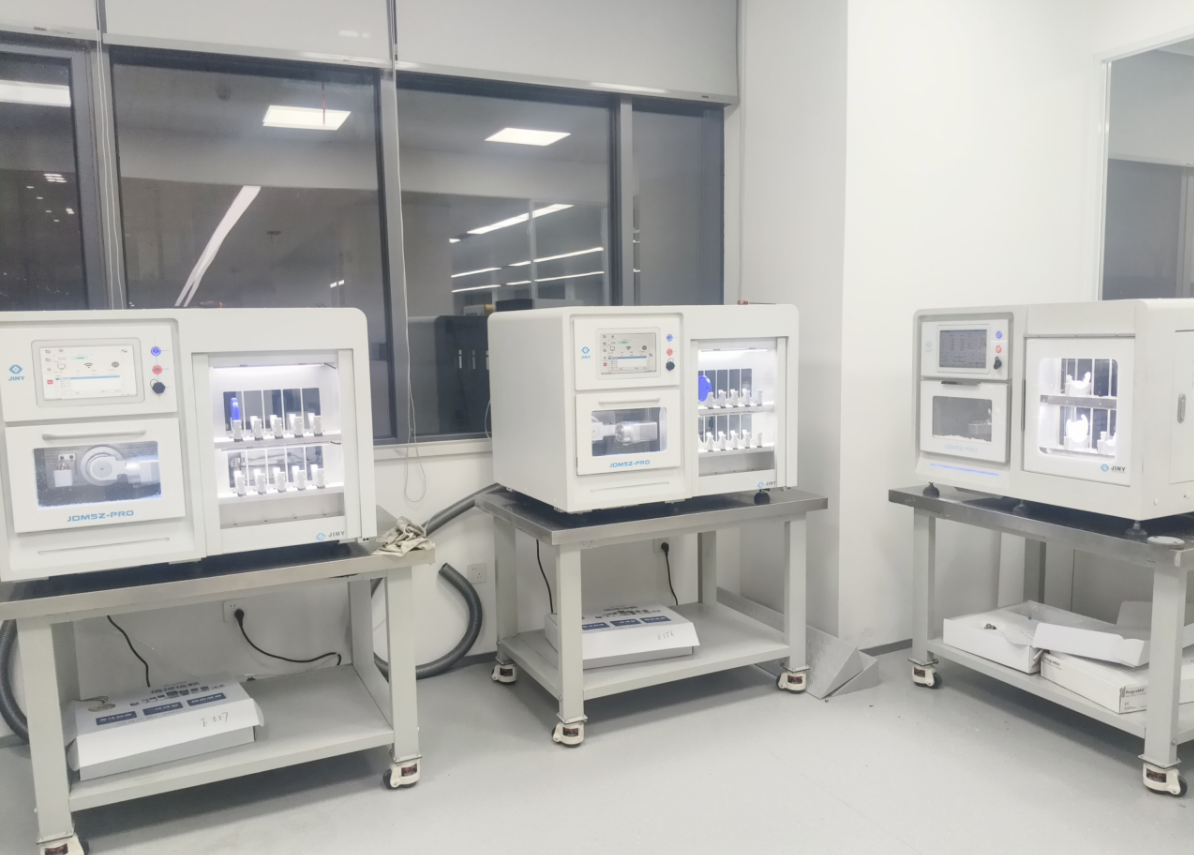
 HONPINE HAG Robot Joint Module Undergoing Pre-Shipment InspectionThe HONPINE HAG Robot Joint Module is currently undergoing pre-shipment inspection before delivery.
Double Click
We provide harmonic drive reducer,planetary reducer,robot joint motor,robot rotary actuators,RV gear reducer,robot end effector,dexterous robot hand
 What is robot joint actuator?How to Choose the Best Robot Rotary Joint Actuator?In core robot joint transmission solutions, planetary and harmonic rotary actuators each have their own strengths. Choosing the right type based on application requirements is essential to achieve the optimal balance between performance and cost.
 Harmonic Rotary Actuators for Semiconductor Equipment: Precision Motion, Hollow-Shaft Design and FOC ControlHello everyone, I’m Theodore Li, Technical Director at HONPINE. In semiconductor manufacturing equipment, rotary motion is not simply about making a mechanism rotate. Limited installation space, cable and tube routing, low-speed stability, precise positioning and continuously adjustable motion profiles can all influence the performance of the machine. This is why harmonic rotary actuators are becoming an important motion solution for semiconductor equipment. In this article, I will discuss how harmonic transmission, FOC-based motor control, encoder feedback, large hollow-shaft design and flexible mechanical interfaces work together to meet practical semiconductor motion requirements, based on our experience with developing equipment, overhead transport, wafer handling, cleaning and crystal-growth applications.
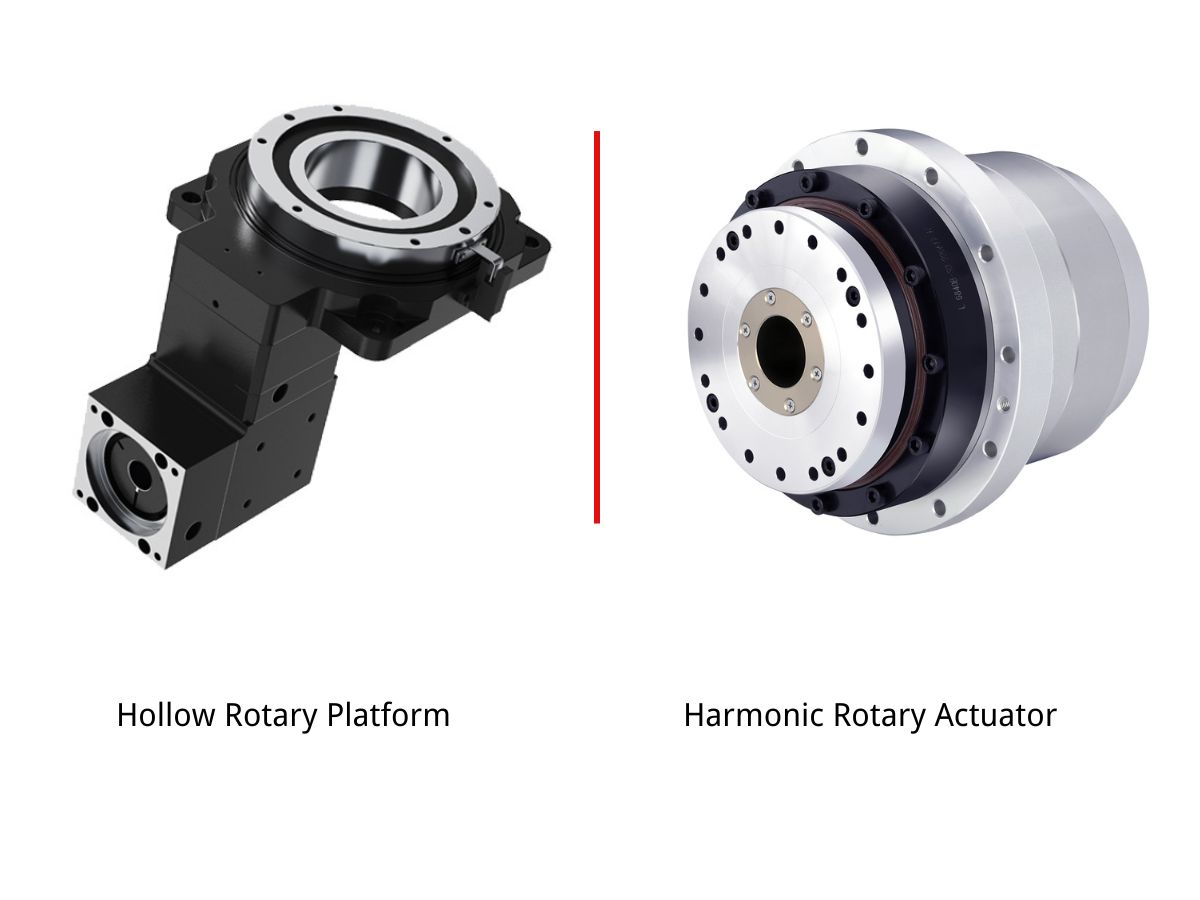
 Hollow Rotary Platform vs. Harmonic Rotary Actuator: Application Comparison and InterchangeabilityHello everyone, I’m Theodore Li, Technical Director at HONPINE. For engineers designing precision rotary stations for industrial automation, one question often comes up: when a machine requires high-precision rotation, indexing, or rotary positioning, should you choose a hollow rotary platform or a harmonic rotary actuator? Can they be used interchangeably? Although both are precision rotary motion solutions, their mechanical structures and application characteristics are quite different. In actual equipment, choosing the wrong solution can lead to insufficient load capacity, inadequate rigidity, vibration, speed limitations, or reduced service life. In this article, I’ll compare their application characteristics and explain where they can be used interchangeably, where one is more suitable than the other, and what engineers should check before making a replacement.
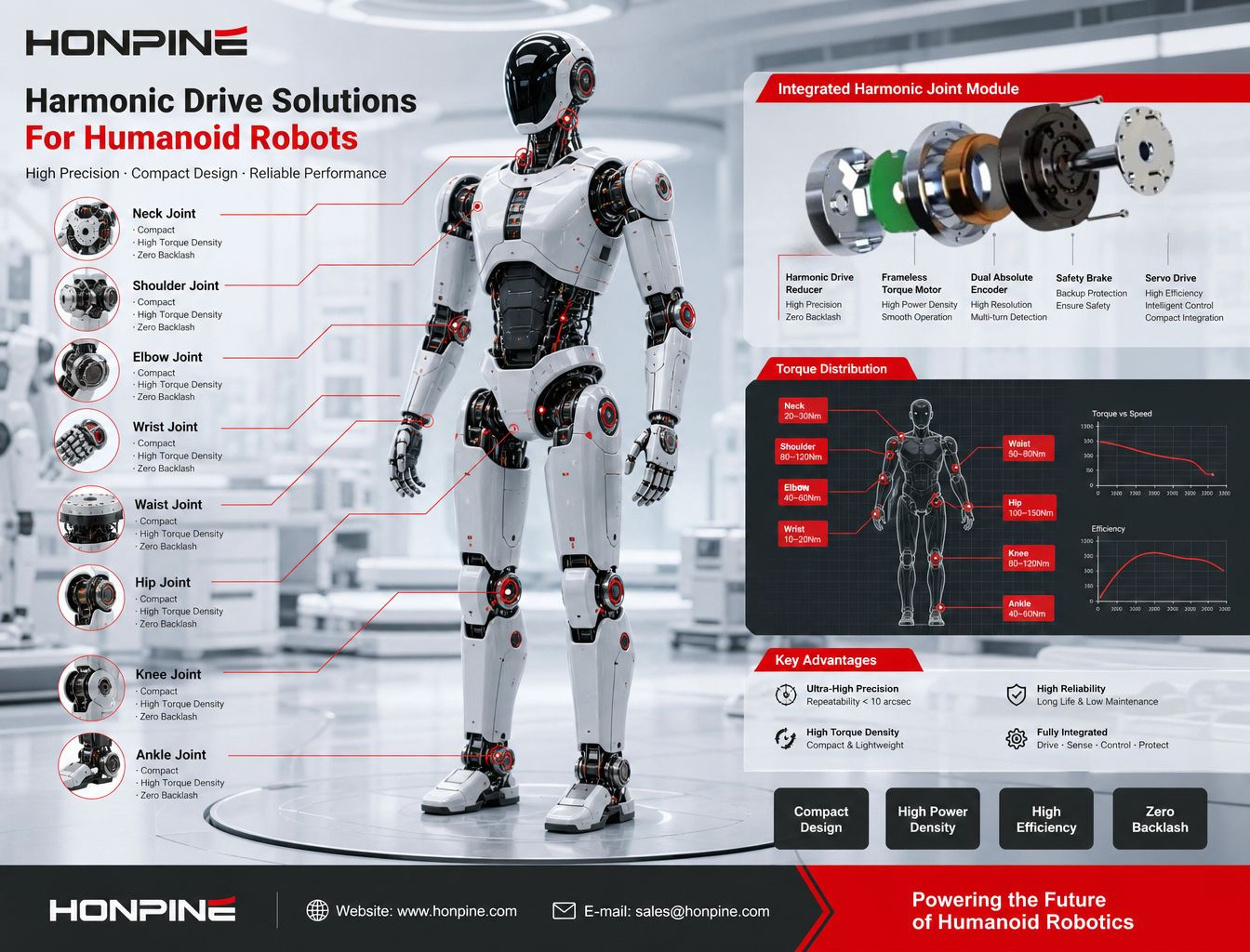
 Humanoid Robot Joint Module Selection Guide: Choosing the Right Harmonic Joint Module for Every Robot JointSelecting the right joint module is one of the most important decisions in humanoid robot design.
Different robot joints require different levels of torque, speed, stiffness, and payload capacity. Using the same actuator throughout the robot often increases weight, reduces efficiency, and limits motion performance.
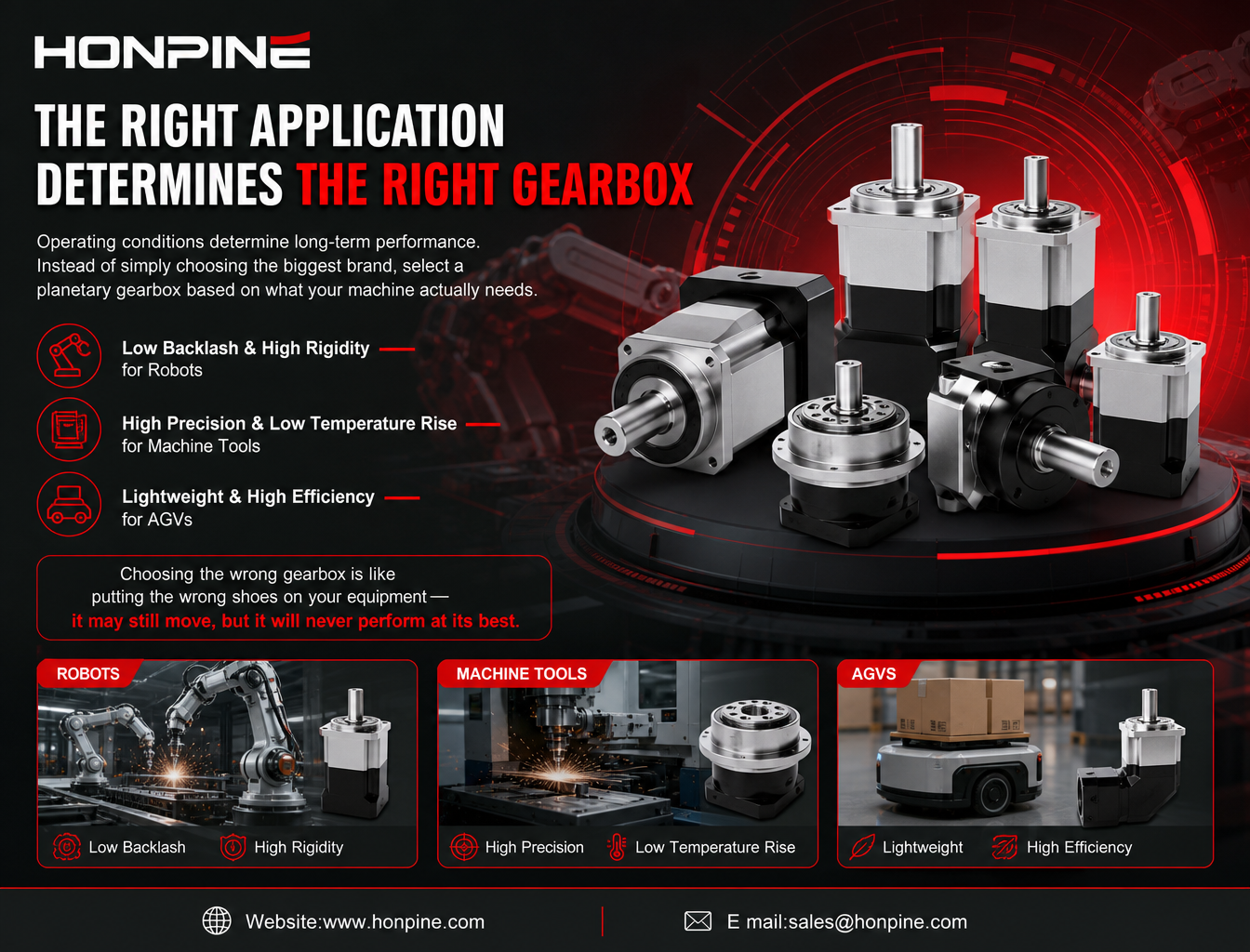
The Honpine HPJM-PRO Series Harmonic Joint Modules provide a complete range of integrated joint actuators for humanoid robots, enabling engineers to optimize every joint from the head to the lower body. Honpine Planetary Gearbox Selection Guide: How to Choose the Right Gearbox for Robots, CNC Machines, and AGVsThe right application determines the right gearbox. Operating conditions determine long-term performance. Instead of simply choosing the biggest brand, select a planetary gearbox based on what your machine actually needs: low backlash and high rigidity for robots, high precision and low temperature rise for machine tools, and lightweight, high-efficiency designs for AGVs. Choosing the wrong gearbox is like putting the wrong shoes on your equipment—it may still move, but it will never perform at its best.
 How the HONPINE JRM Planetary Joint Module Improves Robot Motion Performance?The JRM-C Planetary Joint Module is a lightweight, high-torque actuator module specially designed for humanoid robots, wheeled robots, quadruped robots, and other intelligent robotic systems.
 Why Do Most People Choose Nabtesco as Their RV Reducer Gearbox Supplier?The article explains Nabtesco’s dominance in RV reducers due to its high precision and reliability, while noting that the industry has few suppliers because of extreme manufacturing difficulty. It also briefly mentions competitors like Sumitomo, Spinea, and HONPINE offering cost and delivery advantages.
 What Is the Revolving Joint of a Robot?Structure, Components, and Working Principles Explained?This article will provide you with a comprehensive analysis of a robot's rotary joint, including its integrated components, the role of each component, and how precise control is achieved.
 Which Manufacturers Are Capable of Providing Integrated Frameless Torque Motor and Hollow Rotary Servo Actuator Solutions?A traditional servo rotary actuator consists of a rotor, stator, housing, bearings, end caps, and feedback components. A frameless motor removes all redundant mechanical structures and retains only the electromagnetic conversion core. The rotor becomes a direct part of the load shaft, while the stator is integrated into the machine structure through bonding, locking, or potting.
 Why Are Crossed Roller Bearing Harmonic Reducers Ideal for Robot Joints?In robotic harmonic reducers, crossed roller bearings are the key components that ensure motion accuracy and structural rigidity. Their performance directly affects the robot’s repeat positioning accuracy, load capacity, and service life.
 How HONPINE HAG Harmonic Drive Robot Joint Modules Improve Precision, Torque Control, and ReliabilityHONPINE HAG robot joint module is a game-changing innovation developed to meet the emerging demands of the robotics industry. It is a fully closed-loop harmonic robotic joint module.
 Comprehensive Analysis of Braking Dissipation Modules for Robotic Harmonic Joint ActuatorsIn discussions about robotic joint actuator modules, the motor, gearbox, encoder, brake, and driver usually receive the most attention, while the braking dissipation module is often underestimated. In real engineering projects, many 48V joint systems operate normally during no-load commissioning. However, once they enter conditions involving large inertia, rapid acceleration and deceleration, gravity-axis lowering, or frequent backdriving, issues such as DC bus overvoltage, driver alarms, unexpected shutdowns, and even thermal failures of power devices begin to appear.