






Planetary Drive Actuator for AGV Wheel Hub Motors: Solving Torque, Turning Radius and Drive Integration Challenges
Hello everyone, I’m Theodore Li, Technical Director at HONPINE. Today, I’d like to introduce how planetary drive actuators can be used in AGV wheel hub motor systems and, more importantly, what practical engineering problems they can solve.
As AGVs and AMRs are increasingly used in smart factories, warehouses, logistics centers, and automated production lines, the requirements for their wheel drive systems are becoming more demanding. An AGV needs sufficient wheel torque to start with a heavy payload, climb ramps, accelerate smoothly, and operate reliably through frequent stopping and reversing. At the same time, the complete drive system has to remain compact because the available space inside an AGV chassis is often very limited.
From my experience in precision transmission and motion control, one of the most important challenges is the mismatch between the operating characteristics of an electric motor and the actual requirements of an AGV wheel. The motor may operate efficiently at a relatively high speed, while the wheel requires much lower speed and significantly higher torque.
This is where a planetary drive actuator becomes particularly useful. By combining a motor with a planetary reduction mechanism and, depending on the system architecture, feedback, braking, and other drive components, the actuator can convert high-speed motor output into the low-speed, high-torque motion required at the wheel.
In this article, I will explain the engineering relationship between the planetary drive actuator and AGV wheel hub motor, including wheel torque, gear ratio, climbing ability, turning radius, direct-drive systems, and harmonic drive actuators.
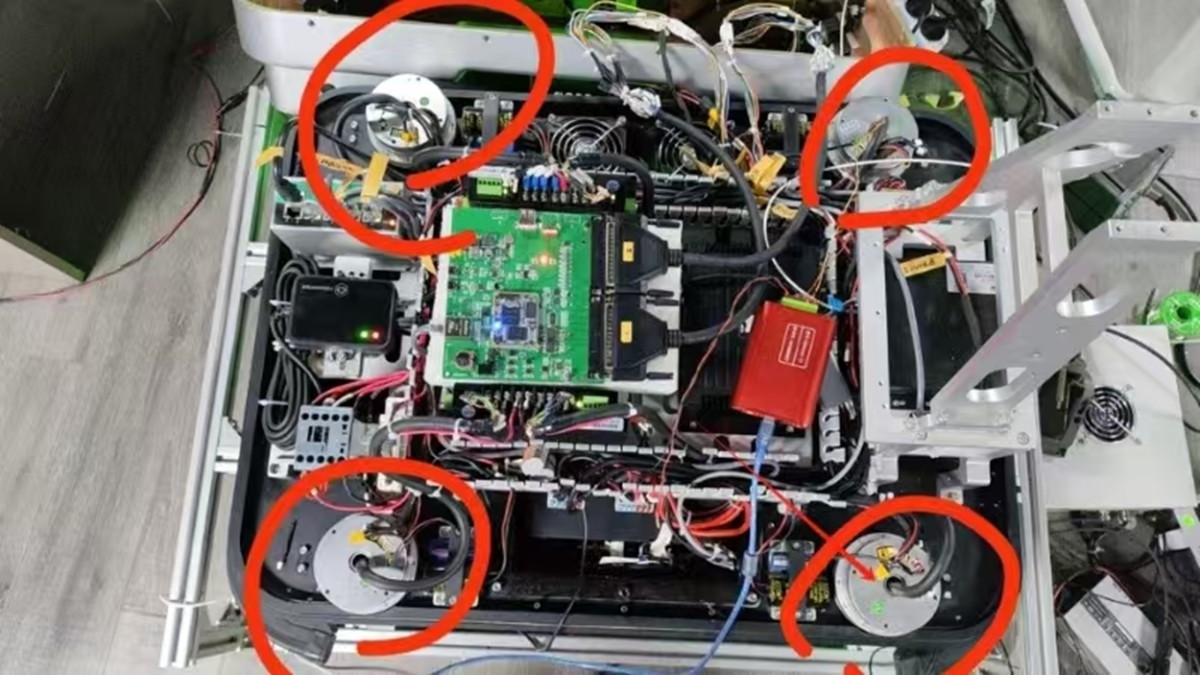
What Is an AGV Wheel Hub Motor?
An AGV wheel hub motor is a drive system in which the motor is positioned close to the driving wheel and provides the mechanical power required to move the vehicle. Depending on the vehicle architecture, the motor may be installed directly inside the wheel or connected to the wheel through a reduction gearbox.
At first glance, the principle seems straightforward. However, when we design a real AGV drive system, many requirements have to be considered simultaneously. The motor must generate enough torque to accelerate the AGV, overcome rolling resistance, climb slopes, and carry the required payload. At the same time, it needs to operate efficiently over a wide speed range while remaining compact enough to fit within the vehicle chassis.
This creates a fundamental engineering problem: the optimum operating speed of the motor is usually much higher than the required speed of the AGV wheel.
For example, an electric motor may operate efficiently at several thousand revolutions per minute, while the AGV wheel may only need a few hundred revolutions per minute. If we connect the motor directly to the wheel, the motor has to generate a relatively high torque at low speed. In many cases, this results in a larger motor, higher current demand, greater thermal load, and increased installation space.
A planetary drive actuator provides another approach by placing a reduction transmission between the motor and the wheel.
Why Does an AGV Wheel Hub Motor Need a Planetary Drive Actuator?
Matching Motor Speed with Wheel Speed
The first problem we need to solve is the difference between motor speed and wheel speed.
The relationship can be expressed as:
n_w = n_m / i
where n_w is the wheel speed, n_m is the motor speed, and i is the planetary gearbox reduction ratio.
When we select an appropriate reduction ratio, the motor can operate closer to its efficient speed range while the wheel rotates at the lower speed required by the AGV.
This is especially important for AGV traction systems because the vehicle normally requires relatively low wheel speed but high wheel torque. Instead of asking the motor to generate all of the required wheel torque directly, we can use the planetary transmission to convert high-speed, lower-torque motor output into lower-speed, higher-torque wheel output.
From an engineering perspective, this gives us more freedom when selecting the motor. We can optimize the motor and gearbox as a complete power transmission system rather than trying to make the motor itself satisfy every wheel-end requirement.
Increasing Wheel-End Torque Without Simply Increasing Motor Size
Wheel torque is one of the most important parameters in an AGV drive system.
A simplified relationship is:
T_w = T_m × i × η
where T_w is wheel torque, T_m is motor torque, i is the reduction ratio, and η is the transmission efficiency.
The planetary gearbox therefore provides mechanical torque multiplication. This allows a relatively compact motor to generate substantially higher torque at the wheel.
The advantage becomes more obvious when an AGV needs to carry a heavy payload. During starting, acceleration, climbing, or overcoming temporary increases in rolling resistance, the wheel may require considerably more torque than the motor can efficiently provide by itself.
In this situation, the planetary drive actuator can help us achieve the required wheel-end torque without simply increasing the motor diameter and weight.
How Wheel Diameter Affects AGV Drive Torque
When I discuss AGV wheel drive systems with engineers, wheel diameter is another parameter that deserves careful attention.
The traction force generated at the ground can be approximately calculated as:
F_t = T_w / r
where F_t is the available traction force, T_w is wheel torque, and r is the effective wheel radius.
This means that a larger wheel has several advantages, including improved ground clearance and better ability to pass over small floor irregularities. However, a larger wheel also requires greater wheel torque to generate the same traction force.
For example, if an AGV requires a certain traction force, increasing the wheel radius increases the required wheel torque proportionally.
This is why I recommend considering wheel diameter, payload, slope, acceleration, motor characteristics, and gearbox ratio together rather than selecting the wheel motor independently.
A properly selected planetary drive actuator allows us to match the motor characteristics to the actual wheel diameter and vehicle operating requirements.
Solving Heavy-Load Starting Problems
Starting is often more demanding than steady-state driving.
When an AGV starts from rest, the drive system needs to overcome rolling resistance and acceleration force. If the vehicle is operating on a slope, it must also overcome the gravitational component acting against the vehicle.
The required traction force can be estimated as:
F_required = mg sinθ + C_rr mg cosθ + ma
where m is the total AGV mass including payload, g is gravitational acceleration, θ is the slope angle, C_rr is the rolling resistance coefficient, and a is acceleration.
The corresponding wheel torque is:
T_w,required = F_required × r
This calculation explains an issue we often see in practical AGV applications. A drive system may perform well when the vehicle is empty, but its starting performance can change significantly when the AGV is carrying its maximum payload.
A planetary drive actuator provides torque multiplication at the wheel, making it easier to achieve the required starting torque without using an excessively large motor.
For this reason, when we evaluate an AGV wheel drive system, I would not recommend looking only at the motor's rated power. Peak wheel torque, starting torque, acceleration requirements, and the actual load conditions are equally important.
Improving AGV Climbing Ability
AGVs operating in factories and logistics facilities may encounter ramps, loading platforms, thresholds, or uneven floors. When the vehicle climbs a slope, part of its driving force must overcome gravity.
The steeper the slope and the heavier the vehicle, the greater the required wheel torque.
A planetary drive actuator helps by increasing the available wheel-end torque while maintaining a relatively compact motor package. This makes the architecture particularly attractive when an AGV needs both high payload capacity and limited chassis space.
However, I would not recommend simply choosing the highest possible reduction ratio.
An excessively high reduction ratio can reduce the maximum wheel speed and may also affect the dynamic response of the vehicle. The reduction ratio should therefore be selected according to motor speed, wheel diameter, maximum vehicle speed, continuous torque, peak torque, acceleration, and duty cycle.
The objective is to find the correct balance between wheel torque and wheel speed.
The Relationship Between Planetary Drive Actuator and AGV Turning Radius
Turning performance is another important consideration in AGV design.
For a differential-drive AGV, the vehicle changes direction by controlling the speeds of the left and right driving wheels independently. A simplified relationship for the turning radius is:
R = L × (v_L + v_R) / [2(v_R − v_L)]
where R is the turning radius, L is the distance between the left and right wheel contact paths, and v_L and v_R are the respective wheel speeds.
When the two wheels rotate at different speeds, the AGV follows a curved path. If the left and right wheels rotate at equal speeds in opposite directions, the theoretical turning radius can approach zero.
There is an important point here that is sometimes misunderstood: the planetary drive actuator itself does not determine the AGV's turning radius.
The actual turning radius is primarily determined by the AGV's mechanical architecture, wheel arrangement, wheelbase or track width, steering angle, and control strategy. The planetary drive actuator affects the wheel's available torque and speed, which determines whether the drive system can accurately and reliably achieve the required wheel-speed difference.
For AGVs that require a small turning radius, zero-radius turning, or frequent forward and reverse operation, the drive actuator also needs to withstand repeated torque reversals and dynamic load changes.
Therefore, when we discuss an AGV's turning radius, we should consider the complete drive system rather than looking at the gearbox alone.
Planetary Drive Actuator vs Direct-Drive Wheel Motor
A direct-drive wheel motor eliminates the mechanical reduction stage. The motor directly drives the wheel, so there is no gearbox backlash and no additional mechanical transmission stage.
This architecture has clear advantages. The mechanical structure can be relatively simple, and the absence of a gearbox eliminates gear wear and transmission backlash.
However, the motor must generate the required wheel torque directly.
Because AGV wheels typically require relatively high torque at low speed, a direct-drive system may require a larger motor with greater continuous torque capability. The motor may also need a larger electromagnetic structure and greater thermal capacity.
This creates a common design conflict between motor size and available chassis space.
A planetary drive actuator takes a different approach. Instead of requiring the motor itself to generate all of the wheel torque, the planetary gearbox increases the output torque while reducing the motor speed to a suitable wheel speed.
For AGV traction applications, I generally see the planetary architecture as a practical balance between torque density, efficiency, mechanical size, durability, and system cost.
Direct drive can still be an excellent solution when extremely high efficiency, simple mechanics, or specific low-speed motor characteristics are the main priorities. The correct choice depends on the actual AGV design.
Planetary Drive Actuator vs Harmonic Drive Actuator
Planetary and harmonic transmissions have different mechanical characteristics, so we should select between them according to the function of the actuator.
A harmonic drive actuator is well known for very low backlash, high reduction ratios, compact construction, and high positioning accuracy. These characteristics make harmonic transmission highly attractive for robotic joints, precision rotary axes, camera platforms, and other applications where angular positioning accuracy is a primary requirement.
An AGV traction wheel operates under a different set of conditions.
The wheel drive may experience repeated acceleration and deceleration, sudden changes in wheel load, floor impacts, wheel slip, and frequent torque reversals. The transmission therefore needs to provide high torque capacity while maintaining stable operation over a large number of repeated cycles.
For this type of traction application, a planetary gearbox is often a more practical choice because of its high torque density, efficient transmission, load distribution through multiple planetary gears, and ability to handle high output torque within a compact package.
This does not mean that a planetary transmission is universally better than a harmonic transmission. They are designed to solve different problems.
In an AGV, I would normally consider planetary transmission for the traction axis, while harmonic transmission can be considered for a precision steering axis when the steering mechanism requires very low backlash and accurate angular positioning.
Why Planetary Transmission Works Well for AGV Traction
High Torque Density
The planetary gear structure distributes transmitted load through multiple planet gears. This allows a relatively compact gearbox to handle significant torque.
For AGV wheel drives, where installation space is limited but wheel torque requirements can be high, this is one of the main advantages of planetary transmission.
From a mechanical design perspective, the ability to obtain high output torque from a compact package is particularly valuable when the gearbox has to be installed close to the wheel.
Compact Installation
An AGV chassis often contains batteries, controllers, sensors, safety equipment, communication systems, and mechanical structures in addition to the drive system.
This means that every millimeter of installation space can become important.
An integrated planetary drive actuator can bring several drive components together into a more compact assembly instead of requiring the motor, gearbox, encoder, brake, and mounting structures to be designed as completely independent units.
This can give AGV manufacturers greater freedom when designing the chassis and wheel assembly.
High Transmission Efficiency
Planetary gearboxes can provide high transmission efficiency when they are properly designed and matched with the motor and operating conditions.
For AGVs that operate for long periods, transmission efficiency directly affects energy consumption and battery utilization.
A highly efficient drive system can reduce unnecessary energy losses and help the vehicle make better use of its available battery capacity.
Handling Repeated Load Changes
AGV drive wheels frequently accelerate, decelerate, stop, reverse, and change direction.
The transmission therefore needs to handle repeated torque variations rather than only a constant load.
The planetary architecture is well suited to applications that require a combination of continuous torque capability and short-duration peak torque.
Why an Integrated Planetary Drive Actuator Can Be Better Than a Separate Gearbox
A traditional AGV drive system may use a motor, separate planetary gearbox, encoder, brake, mounting bracket, and other components.
This approach provides flexibility, but it also creates multiple mechanical and electrical interfaces.
An integrated planetary drive actuator can bring several of these components together into one engineered motion assembly. This can simplify mechanical integration and reduce the amount of individual component matching required during vehicle development.
The value of integration becomes particularly clear when an AGV manufacturer is developing a compact wheel-drive platform and needs to coordinate the overall dimensions, mounting interface, cable routing, encoder position, brake configuration, and wheel connection.
Instead of treating the motor and gearbox as separate products, the actuator becomes part of the vehicle's overall motion architecture.
This approach can also make it easier to develop different AGV platforms around a common drive architecture.
How to Select a Planetary Drive Actuator for an AGV
When I select a planetary drive actuator for an AGV application, I would not recommend starting with the gearbox ratio alone.
The first step is to determine the total moving mass, including the AGV itself and the maximum payload. We then need to consider the required maximum speed, acceleration, slope angle, wheel diameter, number of driven wheels, rolling resistance, and operating duty cycle.
The wheel torque requirement should be calculated from the actual traction force instead of selecting the gearbox only according to nominal motor power.
The relationship between the main parameters can be summarized as follows:
These parameters should always be considered together.
A gearbox with a high reduction ratio may provide excellent output torque but limit the maximum wheel speed. A larger wheel may improve ground clearance but increase the required wheel torque. A larger motor may provide more torque but consume valuable installation space.
For this reason, the planetary drive actuator should be selected as part of the complete AGV wheel drive system rather than as an isolated gearbox.
Example: Estimating Wheel Torque for an AGV
Let us consider a simplified example.
Assume an AGV has a total mass of 1,000 kg, including payload. The vehicle uses four driven wheels, each with an effective wheel radius of 0.1 m. Suppose the AGV needs to climb a 5% grade while accelerating.
The required traction force can be estimated by considering gravitational resistance, rolling resistance, and acceleration force:
F_required = mg sinθ + C_rr mg cosθ + ma
For example, if we assume a rolling resistance coefficient of 0.015 and an acceleration of 0.3 m/s², the total traction force is approximately 935 N under these simplified conditions.
With four equally loaded driven wheels, the average traction requirement per wheel would be approximately:
935 / 4 ≈ 234 N
The corresponding wheel torque would be:
T_w = 234 × 0.1 ≈ 23.4 N·m
This is the wheel torque before applying an engineering safety factor or considering dynamic load transfer, tire friction, drivetrain losses, and other real-world conditions.
If the planetary gearbox has a reduction ratio of 20:1 and an assumed transmission efficiency of 90%, the corresponding motor torque required to generate this wheel torque would be approximately:
T_m = 23.4 / (20 × 0.9) ≈ 1.3 N·m
This simple example demonstrates the basic reason for using a planetary drive actuator. Instead of requiring the motor to produce more than 23 N·m directly at low speed, the planetary reduction allows a much smaller motor torque to be converted into the required wheel torque.
In an actual AGV design, we would also need to consider safety factors, tire-road friction, wheel load distribution, battery voltage, motor thermal limits, gearbox peak torque, acceleration profile, and transient impact loads.
Planetary Traction and Harmonic Steering: A Practical AGV Architecture
For some advanced AGVs and AMRs, I do not think we need to choose one transmission technology for every axis.
A more practical architecture can be to use a planetary drive actuator for the traction wheel and a harmonic drive actuator for the steering mechanism.
The planetary actuator handles the high-torque wheel-drive function, including acceleration, climbing, and continuous traction. The harmonic actuator can be used on the steering axis when accurate angular positioning and low backlash are required.
This allows each transmission technology to perform the function for which it is mechanically well suited.
For example, a four-wheel steering AGV may require the steering axis to accurately control the wheel orientation while the traction axis requires high torque and efficient continuous operation.
In such a system, the planetary traction actuator and harmonic steering actuator can complement each other rather than compete with each other.
Planetary Drive Actuator for AGV and AMR Applications
The same engineering principles apply to AMRs.
An AMR drive wheel needs to provide sufficient torque for acceleration, payload transportation, ramp climbing, and frequent direction changes. At the same time, the drive system must fit inside a compact mobile platform.
This makes planetary drive actuators suitable for a variety of mobile robot architectures, including differential-drive AMRs, autonomous forklifts, warehouse transport robots, mobile platforms, and other automated material-handling equipment.
The specific actuator design depends on whether the vehicle uses differential drive, steering drive, omnidirectional drive, Mecanum wheels, or another wheel configuration.
For each architecture, the motor, planetary reduction ratio, wheel diameter, output torque, wheel speed, and control strategy need to be evaluated as one system.
What Problems Does a Planetary Drive Actuator Actually Solve?
When I look at a planetary drive actuator from the perspective of AGV engineering, its value is not simply that it adds a gearbox to a wheel motor.
The more important point is that it solves several system-level problems at the same time.
It addresses the mismatch between high motor speed and low wheel speed. It increases wheel-end torque when the AGV needs to start with a heavy payload or climb a slope. It helps resolve the conflict between motor size and limited chassis space. It provides a transmission architecture capable of handling repeated acceleration, deceleration, reversing, and variable wheel loads. It can also help integrate the motor, planetary transmission, feedback, brake, and mechanical interfaces into a compact drive assembly.
In other words, the planetary drive actuator is not simply a transmission component. When properly designed, it becomes an important part of the AGV's overall motion system.
HONPINE's Approach to Planetary Drive Actuator Development
At HONPINE, we focus on precision transmission and motion solutions for industrial automation and mobile robot applications.
When developing a planetary drive actuator for an AGV or AMR, I believe the most important point is to start with the actual vehicle requirements rather than selecting a gearbox first.
The motor characteristics, reduction ratio, output torque, wheel speed, wheel diameter, encoder configuration, brake requirements, installation dimensions, and mechanical interface all need to be considered together.
Our objective is not simply to increase gearbox torque. The more important goal is to match the motor, planetary transmission, feedback system, and wheel-end requirements so that the complete drive system operates efficiently and reliably.
For AGV manufacturers that need high wheel torque in a compact installation space, a planetary drive actuator can provide a practical solution between a conventional separate motor-and-gearbox architecture and a larger direct-drive motor.
Conclusion
From my perspective as a motion-system engineer, designing an AGV wheel drive system is not simply a matter of selecting a motor with sufficient power.
Wheel torque, wheel diameter, vehicle speed, acceleration, payload, climbing ability, turning radius, installation space, thermal performance, and operating duty cycle are closely connected.
A direct-drive wheel motor can provide a simple mechanical architecture and eliminate gearbox backlash, but it may require a larger motor when high torque is needed at low wheel speed.
A harmonic drive actuator provides excellent positioning accuracy and very low backlash, making it attractive for precision steering and robotic joint applications. However, it is not necessarily the first choice for a traction wheel that experiences repeated impact and high torque reversals.
A planetary drive actuator provides a balanced solution for many AGV and AMR traction applications. By matching high motor speed with lower wheel speed and multiplying motor torque at the wheel, it can help achieve high torque density, compact installation, efficient transmission, and reliable starting and climbing performance.
For AGV manufacturers, the key question is therefore not simply whether to use a planetary gearbox. The more important question is whether the motor, planetary transmission, encoder, brake, wheel interface, and control requirements have been engineered as one complete drive system.
When properly matched to the AGV's payload, wheel diameter, speed, torque, and duty cycle, a planetary drive actuator can become an important part of a compact, efficient, and reliable AGV wheel drive architecture.
Thank you for reading. I hope this technical discussion gives you a clearer understanding of why planetary drive actuators are increasingly being considered for AGV and AMR wheel-drive applications.
Read More
Learn more about the story of HONPINE and industry trends related to precision transmission.
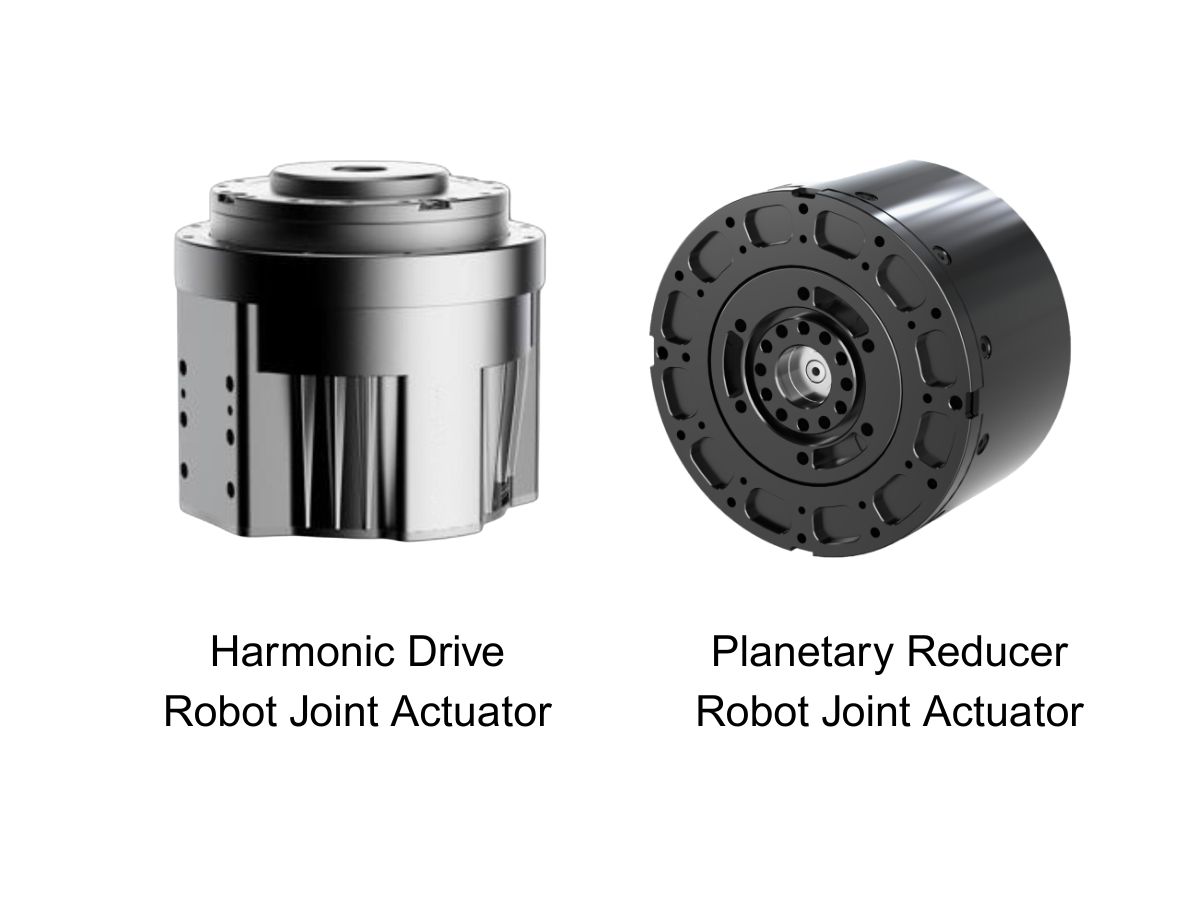
 What is robot joint actuator?How to Choose the Best Robot Rotary Joint Actuator?In core robot joint transmission solutions, planetary and harmonic rotary actuators each have their own strengths. Choosing the right type based on application requirements is essential to achieve the optimal balance between performance and cost.
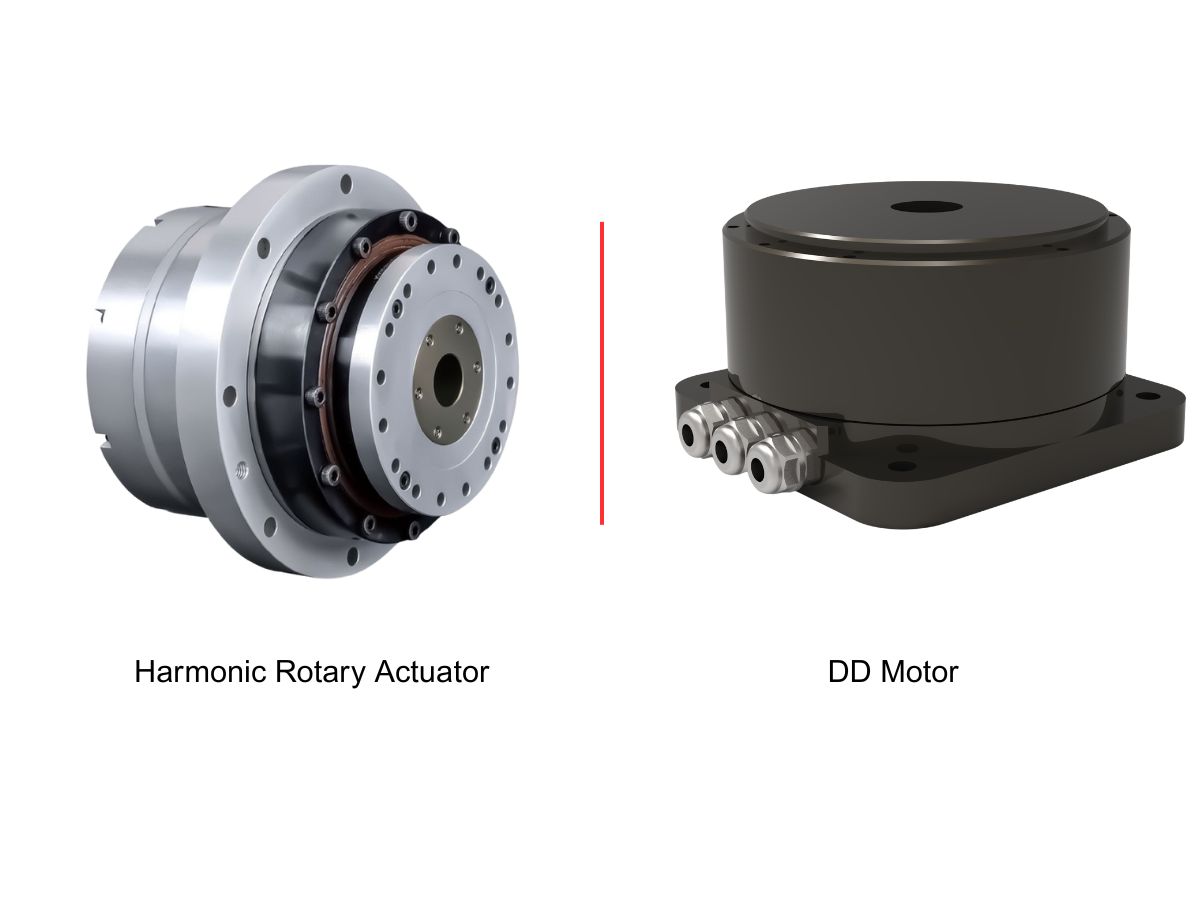
 DD Motors VS Harmonic Rotary ActuatorsThis article provides an in-depth comparison between Direct Drive (DD) motors and harmonic rotary actuators, covering their transmission principles, advantages and disadvantages, and typical application fields.
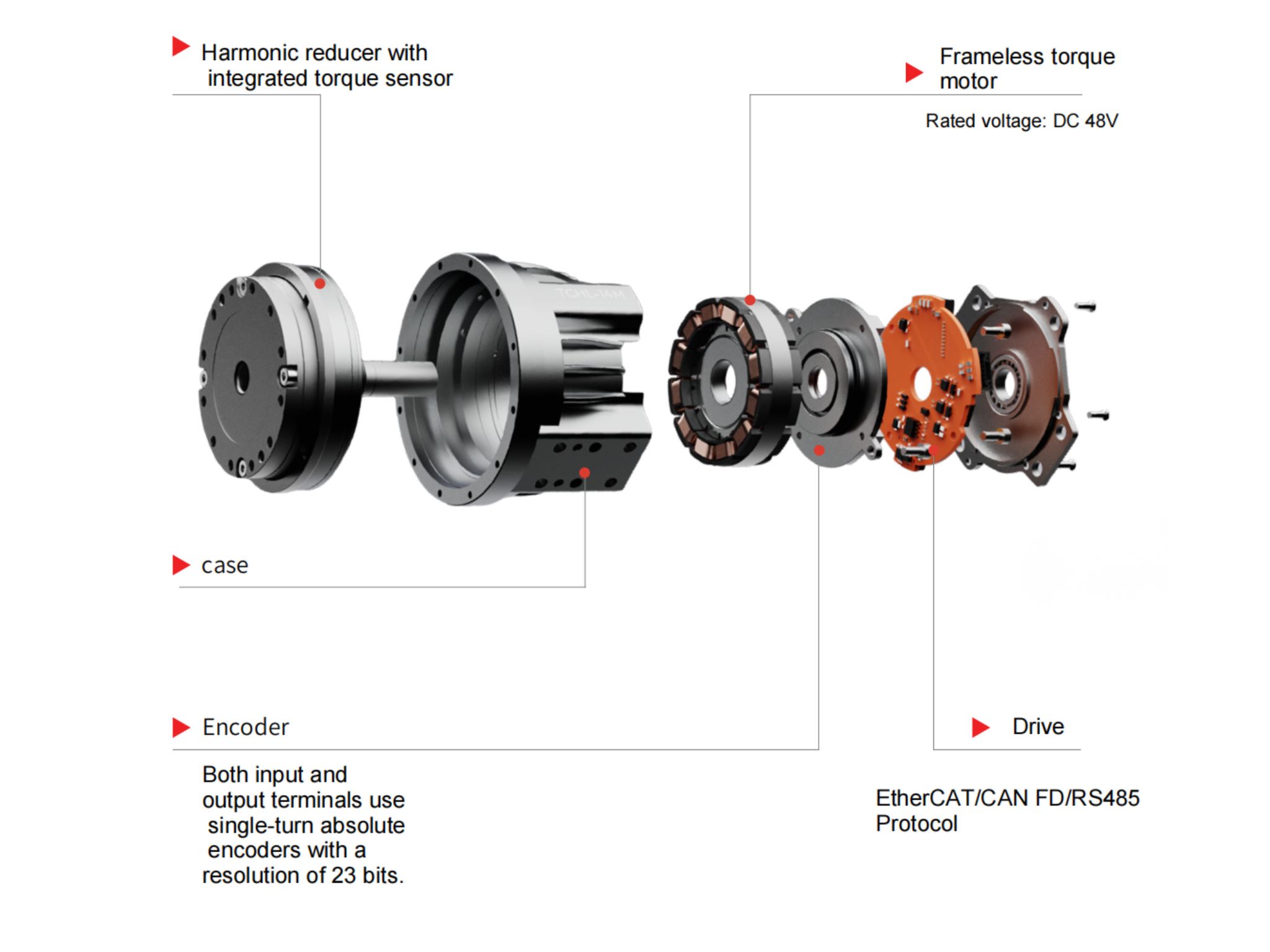
 OMG Ultra Compact Harmonic Drive Joint Module with Built-in Torque SensorHONPINE TCHL series harmonic drive joint module is a game-changing product that achieves disruptive improvements in multiple aspects such as lightweight design, integration level, and connection convenience. This article will analyze its revolutionary enhancements with you.
 The Role of Harmonic Drive Gears in Achieving 5–10 μm Accuracy in Dental Milling MachinesA dental milling machine is a CNC machining system used to directly process digital dental models into restorations such as crowns, bridges, veneers, inlays, and implant abutments. Dental milling machines require far higher operational accuracy and motion stability than ordinary equipment. This article explains how harmonic drive gear help dental milling machines achieve stable, continuous, and controllable operation.
 Why Are Harmonic Rotary Actuators Perfect for Medical Equipment?Harmonic rotary actuators (typically integrated systems consisting of a harmonic drive reducer, frameless torque motor, encoder, and optional brake) are regarded as key components in medical equipment. The core reason is that they simultaneously meet the most stringent medical requirements for precision, compact size, safety, and controllability. The following explanation is structured from three perspectives: technical characteristics, application scenarios, and medical value.
 High-Precision RV Reducers Perfectly Matched for Walking RobotsThe walking axis of a robot is a core component for power transmission and support. RV reducers provide extremely high rigidity, precision, and torque while maintaining a compact size and exceptional reliability, making them an ideal match for the demanding requirements of walking robot joints in terms of load capacity, impact resistance, and precision.
 Planetary Drive Actuator for AGV Wheel Hub Motors: Solving Torque, Turning Radius and Drive Integration ChallengesHello everyone, I’m Theodore Li, Technical Director at HONPINE. Today, I’d like to discuss how a planetary drive actuator can solve practical challenges in AGV wheel hub motor systems. AGVs and AMRs require sufficient wheel torque for heavy-load starting, acceleration, slope climbing, and frequent reversing, while the drive system must remain compact enough for limited chassis space. A planetary drive actuator combines a motor with a planetary reduction mechanism to convert high-speed motor output into the lower-speed, higher-torque motion required at the wheel. In this article, I will examine the relationship between planetary drive actuators and AGV wheel hub motors, including torque, gear ratio, wheel diameter, climbing ability, turning radius, direct-drive systems, and harmonic drive actuators.
 How to Choose a Reliable Robot Joint Motor Manufacturer for Humanoid Robots?Choosing a reliable robot joint motor manufacturer is a critical step when developing humanoid robots and other advanced robotic systems. A robotic joint must balance torque, speed, precision, torque density, thermal performance, feedback, mechanical stiffness, and long-term reliability within a compact structure. For B2B robotics companies, supplier evaluation should therefore go beyond a product datasheet and consider engineering capability, manufacturing capacity, joint integration, testing, and production scalability. In this article, Allen Li, Founder of HONPINE, explains the key factors to consider when selecting a robot joint motor manufacturer and how integrated harmonic robot joint technology can support humanoid robot development.
 Lightweight Humanoid Robots Start with Precision TransmissionAs humanoid robots move from experimental prototypes toward practical applications, lightweight design, energy efficiency, motion performance, and long-term reliability are becoming increasingly important. At the center of these challenges is precision transmission. From harmonic reducers and lightweight robot joints to integrated development kits, the design of each core component directly affects the overall performance of a humanoid robot. In this article, Allen Li, Founder of HONPINE, shares his perspective on how precision transmission technology can support the development of lightweight humanoid robots and how HONPINE is extending its expertise from harmonic reducers toward lightweight robot joints and integrated robotics solutions.
 Hollow-Shaft Direct Drive Motor for Heavy-Duty Precision Positioning and Industrial AutomationIn heavy-duty automation, precision positioning depends not only on the motor but also on the mechanical transmission between the motor and the load. A hollow shaft direct drive motor delivers torque directly to the load while providing a central passage for cables, pneumatic lines and other components. This makes it a practical solution for CNC machining, photovoltaic, lithium battery, optical inspection and semiconductor equipment.
 Harmonic Rotary Actuators for Semiconductor Equipment: Precision Motion, Hollow-Shaft Design and FOC ControlHello everyone, I’m Theodore Li, Technical Director at HONPINE. In semiconductor manufacturing equipment, rotary motion is not simply about making a mechanism rotate. Limited installation space, cable and tube routing, low-speed stability, precise positioning and continuously adjustable motion profiles can all influence the performance of the machine. This is why harmonic rotary actuators are becoming an important motion solution for semiconductor equipment. In this article, I will discuss how harmonic transmission, FOC-based motor control, encoder feedback, large hollow-shaft design and flexible mechanical interfaces work together to meet practical semiconductor motion requirements, based on our experience with developing equipment, overhead transport, wafer handling, cleaning and crystal-growth applications.
 Miniature Harmonic Drive for Minimally Invasive Surgical RobotsMinimally invasive surgical robots require highly compact transmission systems that can deliver precise motion within extremely limited mechanical spaces. As robotic instruments become smaller and more dexterous, conventional transmission architectures can face challenges related to size, tendon elasticity, friction, hysteresis, and mechanical integration. A miniature harmonic drive offers one potential approach by providing high-ratio precision transmission, low backlash, and compact dimensions in a small mechanical envelope. In this article, I will explain why miniature harmonic transmission is relevant to surgical robotics, compare external tendon-driven and distal transmission architectures, and discuss the key engineering considerations behind HONPINE’s CSF-mini miniature harmonic reducer for compact robotic joints, flexible robotic instruments, and other precision mechanisms.


Double Click
We provide harmonic drive reducer,planetary reducer,robot joint motor,robot rotary actuators,RV gear reducer,robot end effector,dexterous robot hand
 What is robot joint actuator?How to Choose the Best Robot Rotary Joint Actuator?In core robot joint transmission solutions, planetary and harmonic rotary actuators each have their own strengths. Choosing the right type based on application requirements is essential to achieve the optimal balance between performance and cost.
 DD Motors VS Harmonic Rotary ActuatorsThis article provides an in-depth comparison between Direct Drive (DD) motors and harmonic rotary actuators, covering their transmission principles, advantages and disadvantages, and typical application fields.
 OMG Ultra Compact Harmonic Drive Joint Module with Built-in Torque SensorHONPINE TCHL series harmonic drive joint module is a game-changing product that achieves disruptive improvements in multiple aspects such as lightweight design, integration level, and connection convenience. This article will analyze its revolutionary enhancements with you.
 Planetary Drive Actuator for AGV Wheel Hub Motors: Solving Torque, Turning Radius and Drive Integration ChallengesHello everyone, I’m Theodore Li, Technical Director at HONPINE. Today, I’d like to discuss how a planetary drive actuator can solve practical challenges in AGV wheel hub motor systems. AGVs and AMRs require sufficient wheel torque for heavy-load starting, acceleration, slope climbing, and frequent reversing, while the drive system must remain compact enough for limited chassis space. A planetary drive actuator combines a motor with a planetary reduction mechanism to convert high-speed motor output into the lower-speed, higher-torque motion required at the wheel. In this article, I will examine the relationship between planetary drive actuators and AGV wheel hub motors, including torque, gear ratio, wheel diameter, climbing ability, turning radius, direct-drive systems, and harmonic drive actuators.
 How to Choose a Reliable Robot Joint Motor Manufacturer for Humanoid Robots?Choosing a reliable robot joint motor manufacturer is a critical step when developing humanoid robots and other advanced robotic systems. A robotic joint must balance torque, speed, precision, torque density, thermal performance, feedback, mechanical stiffness, and long-term reliability within a compact structure. For B2B robotics companies, supplier evaluation should therefore go beyond a product datasheet and consider engineering capability, manufacturing capacity, joint integration, testing, and production scalability. In this article, Allen Li, Founder of HONPINE, explains the key factors to consider when selecting a robot joint motor manufacturer and how integrated harmonic robot joint technology can support humanoid robot development.
 Lightweight Humanoid Robots Start with Precision TransmissionAs humanoid robots move from experimental prototypes toward practical applications, lightweight design, energy efficiency, motion performance, and long-term reliability are becoming increasingly important. At the center of these challenges is precision transmission. From harmonic reducers and lightweight robot joints to integrated development kits, the design of each core component directly affects the overall performance of a humanoid robot. In this article, Allen Li, Founder of HONPINE, shares his perspective on how precision transmission technology can support the development of lightweight humanoid robots and how HONPINE is extending its expertise from harmonic reducers toward lightweight robot joints and integrated robotics solutions.
 Hollow-Shaft Direct Drive Motor for Heavy-Duty Precision Positioning and Industrial AutomationIn heavy-duty automation, precision positioning depends not only on the motor but also on the mechanical transmission between the motor and the load. A hollow shaft direct drive motor delivers torque directly to the load while providing a central passage for cables, pneumatic lines and other components. This makes it a practical solution for CNC machining, photovoltaic, lithium battery, optical inspection and semiconductor equipment.
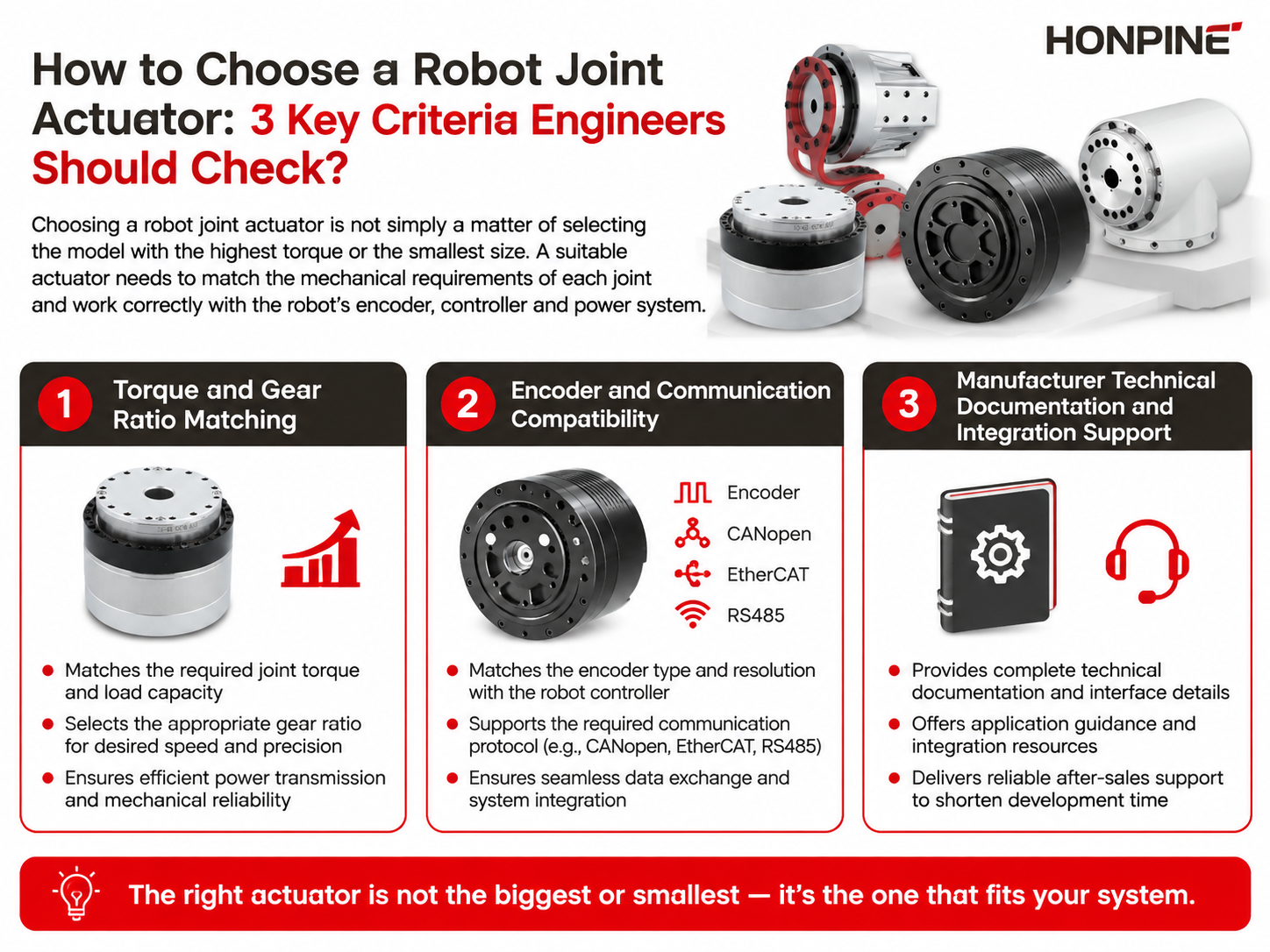
 How to Choose a Robot Joint Actuator: 3 Key Criteria Engineers Should Check?Choosing a robot joint actuator is an engineering decision that affects not only torque and motion performance, but also control stability, mechanical integration, and development time. For industrial robots, collaborative robots, humanoid robots, and other robotic systems, the right actuator must match the actual requirements of each joint while remaining compatible with the robot’s motor, encoder, controller, communication network, and power architecture. In this article, I will explain three key criteria engineers should evaluate when selecting a robot joint actuator: torque and gear ratio matching, encoder and communication compatibility, and the manufacturer’s technical documentation and engineering support.
 Outdoor Robot Joint Solution: Harmonic Joint Module with Built-in Torque SensorHello everyone, I’m Theodore Li, Technical Director at HONPINE. As robots move beyond controlled factory environments, outdoor robotic applications are creating new requirements for robot joint design. Rain, dust, humidity, temperature fluctuations, low-temperature conditions, and unpredictable external loads can all affect how a robotic joint performs in the field. In these environments, a joint needs to provide more than precise rotation. It also needs reliable torque feedback, suitable environmental protection, stable operation under changing temperatures, and practical mechanical integration. In this article, I will explain the key engineering considerations behind our outdoor robot joint solution, including the harmonic joint module, built-in torque sensor, IP65 protection, low-temperature lubrication, cable outlet protection, and mechanical integration, based on our experience with outdoor robotic applications such as solar panel installation, construction, and cleaning robots.
 RV Reducer for Welding Positioners: Selection and Torque Calculation for Heavy-Duty Welding ApplicationsSelecting the right RV reducer for a welding positioner requires more than simply matching the reducer to the workpiece weight. A heavy-duty welding positioner must provide sufficient output torque, high torsional rigidity, stable low-speed rotation, accurate positioning, and reliable performance during acceleration, deceleration, and reversing. In this article, we explain how to select an RV reducer and servo motor for a welding positioner by calculating output speed, reduction ratio, workpiece inertia, gravity load torque, acceleration torque, motor torque, and peak torque. A practical 500 kg welding positioner example is also used to show how these parameters affect RV reducer selection.
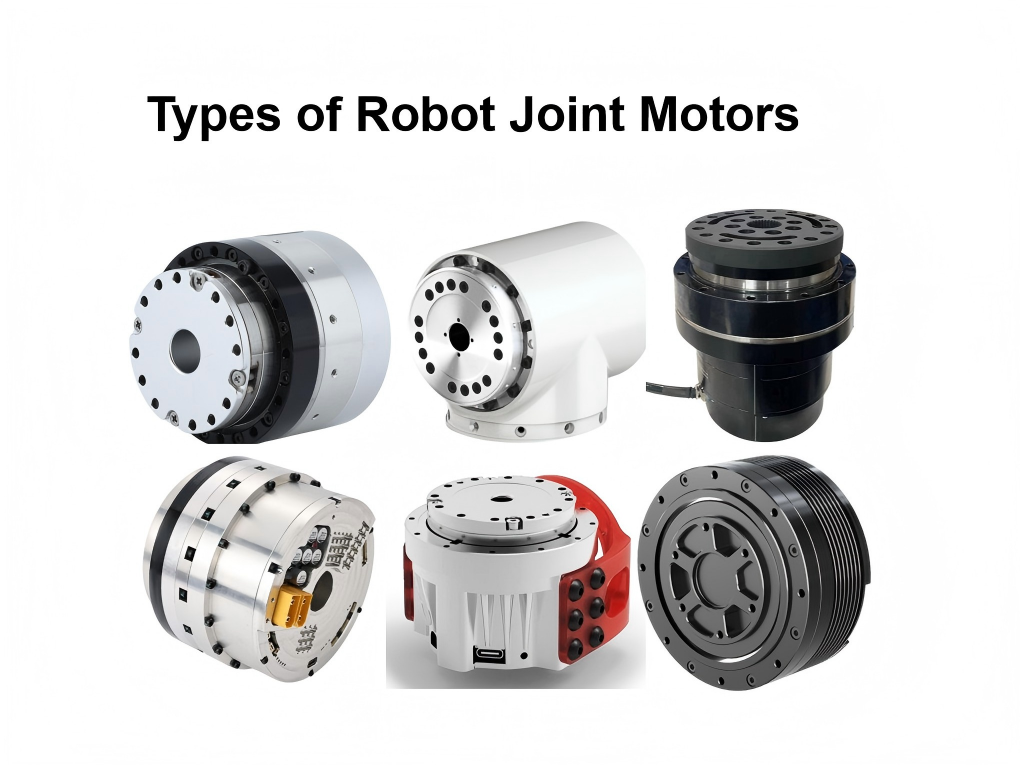
 Types of Robot Joint Motors: Model Selection, Advantages and DisadvantagesRobot joint motors are one of the key components that determine the performance, precision, efficiency, and load capacity of a robot. Depending on the application, robot joints can use electric, hydraulic, pneumatic, or other drive technologies. Among them, electric-drive solutions have become the mainstream choice for modern robots, especially humanoid robots, industrial robots, collaborative robots, and mobile robots. Electric robot joint motors can be further divided according to their transmission methods, including harmonic drive, planetary reducer, cycloidal reducer, ball screw, and direct drive solutions. Each type has its own advantages and disadvantages in terms of precision, torque density, efficiency, impact resistance, size, cost, and backdrivability. Understanding these differences is essential for selecting the right robot joint motor for a specific application.
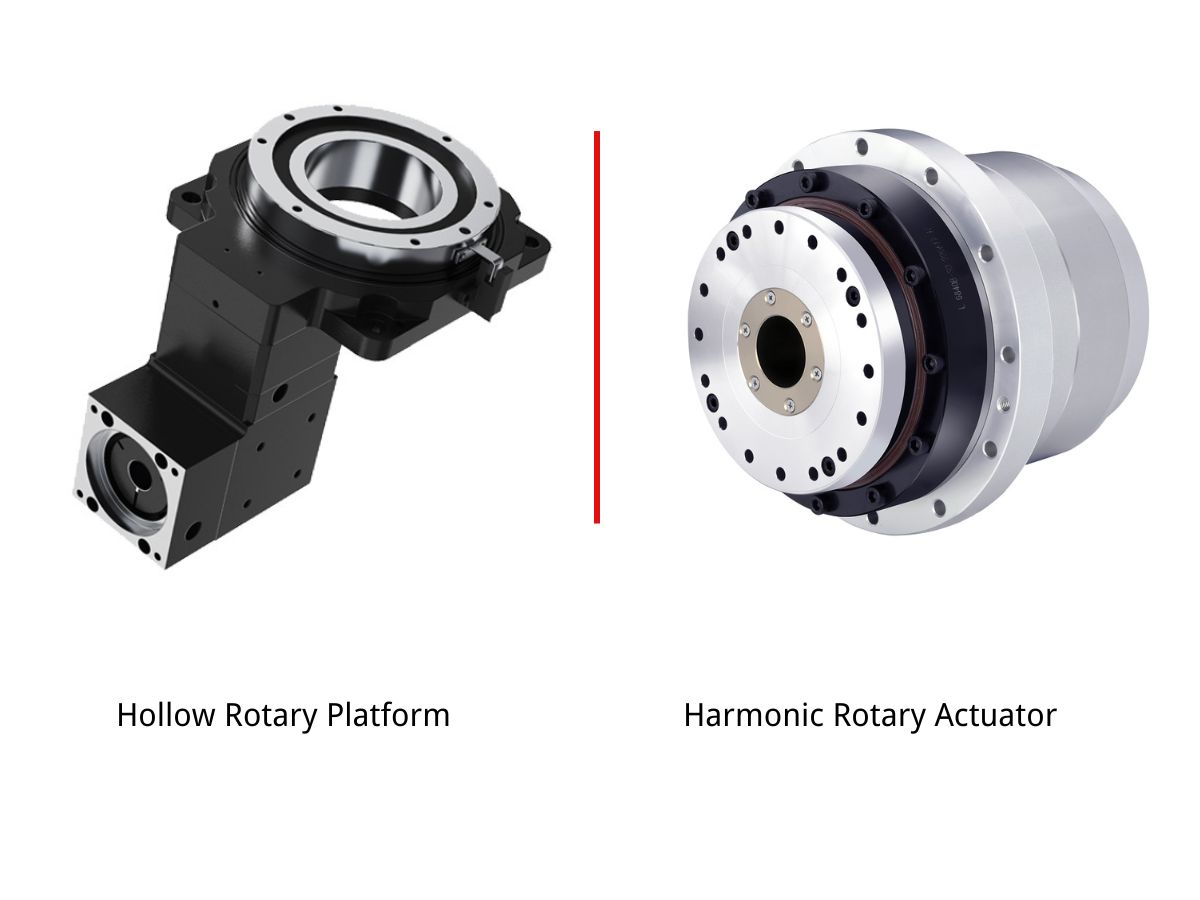
 Hollow Rotary Platform vs. Harmonic Rotary Actuator: Application Comparison and InterchangeabilityHello everyone, I’m Theodore Li, Technical Director at HONPINE. For engineers designing precision rotary stations for industrial automation, one question often comes up: when a machine requires high-precision rotation, indexing, or rotary positioning, should you choose a hollow rotary platform or a harmonic rotary actuator? Can they be used interchangeably? Although both are precision rotary motion solutions, their mechanical structures and application characteristics are quite different. In actual equipment, choosing the wrong solution can lead to insufficient load capacity, inadequate rigidity, vibration, speed limitations, or reduced service life. In this article, I’ll compare their application characteristics and explain where they can be used interchangeably, where one is more suitable than the other, and what engineers should check before making a replacement.
- harmonic drive
- harmonic transmission
- planetary gearbox
- planetary gearboxes
- harmonic actuator
- honpine
- precision transmission
- harmonic drive actuators
- harmonic drive actuator
- harmonic
- small
- planetary gear
- planetary
- 90
- torque motor
- robotic joint
- actuator
- agv wheel
- agv wheel drive
- planetary actuator
- hub motor
- planetary drive actuator