








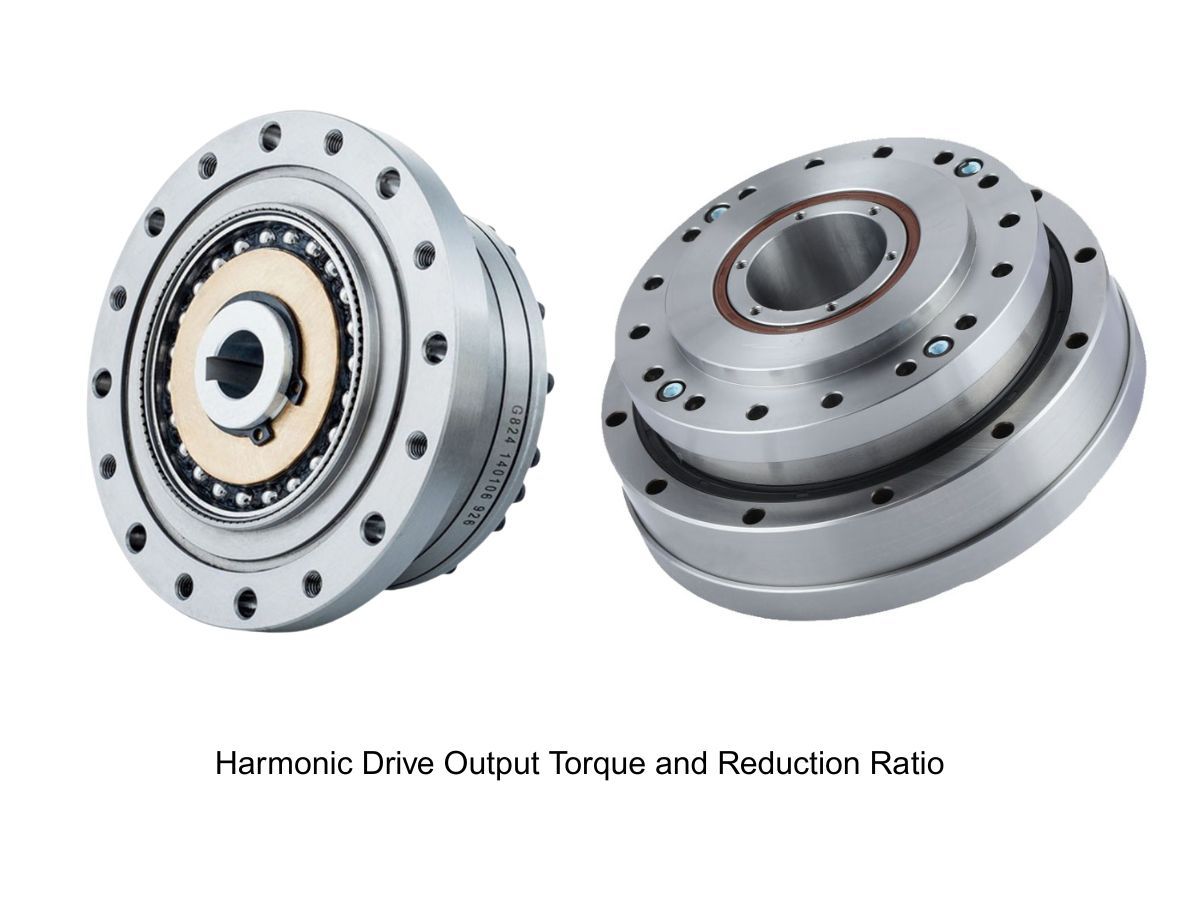
The output torque of a harmonic drive does not continue to increase indefinitely as the reduction ratio increases
Harmonic drives, with their compact structure, low backlash, and high rigidity, have become core components in high-end equipment such as robots and aerospace systems. However, many engineers encounter a common phenomenon: when the reduction ratio increases beyond a certain level (for example, above 100), the growth of output torque gradually slows down or even levels off—clearly contradicting the derived assumption that “torque is proportional to the reduction ratio.”
I had not paid much attention to this issue before, but a recent discussion with a friend prompted me to look into it more deeply. After reviewing relevant materials, I organized my findings into this article, hoping it can help engineers who may be confused by this topic.
1. Ideal vs. Reality: The “Theoretical Upper Limit” of Torque Amplification
We know that the output torque of a reducer follows the formula:
T_out = T_in × i × η
where T_in is the input torque, i is the reduction ratio, and η is the transmission efficiency. According to this logic, increasing the reduction ratio should result in a proportional increase in output torque—this is the theoretical basis of “speed reduction and torque amplification.”
However, the real-world performance of harmonic drives breaks this ideal expectation. Once the reduction ratio reaches a certain threshold (typically above 100 or 120), the increase in output torque—especially rated output torque and the maximum allowable average load—narrows rapidly and eventually enters a “saturation zone.” Even if the reduction ratio continues to increase, the torque no longer rises significantly.
This phenomenon is not a product defect, but an inevitable result of the combined effects of material properties, structural design, and transmission characteristics.
2. In-Depth Analysis: Three Core Causes of Torque Saturation at High Reduction Ratios
The stagnation of torque growth in harmonic drives is essentially a process in which theoretical torque amplification is gradually offset by real-world engineering constraints. These constraints can be summarized into three key factors, each closely tied to the drive’s structure and transmission principles.
2.1 Material and Structural Load Limits: The “Ceiling” of the Flexspline and Gears
The core transmission mechanism of a harmonic drive relies on the periodic elastic deformation of the flexspline. The flexspline is continuously subjected to alternating stresses, and its load-bearing capability is strictly limited by the fatigue strength of the material. No matter how high the reduction ratio becomes, the material properties and geometric dimensions of the flexspline do not improve accordingly—there is a clear upper limit to the stress it can withstand.
At the same time, torque transmission fundamentally depends on gear meshing. Load capacity is determined by key factors such as tooth contact area and tooth root strength. Increasing the reduction ratio does not change these physical parameters. When the theoretical output torque approaches the structural load limit, torque growth naturally stalls. This is the most fundamental physical constraint.
2.2 Transmission Efficiency Decline: “Energy Loss” Behind High Reduction Ratios
The transmission efficiency of harmonic drives is not constant; it decreases as the reduction ratio increases. Higher reduction ratios mean more gear teeth engaged in meshing, leading to increased losses from tooth surface friction and flexspline deformation. A significant portion of the input power is converted into heat rather than useful output power.
This efficiency degradation directly offsets the torque gain expected from a higher reduction ratio. Although theoretically T_out should increase with i, the reduction in η significantly weakens the actual output torque, ultimately resulting in sluggish torque growth.
2.3 Nonlinear Effects of Elastic Deformation: “Hidden Losses” from Reduced Meshing Accuracy
As an elastic component, the flexspline exhibits nonlinear torsional stiffness. Under high load torque, noticeable elastic deformation occurs in the flexspline and wave generator. This deformation causes gear meshing to deviate from the ideal trajectory, affecting not only transmission smoothness but also generating additional losses.
Under high reduction ratio conditions, these nonlinear effects are amplified. Increased meshing deviation and energy loss further limit effective torque output, making torque saturation more pronounced.
Ideal vs. Actual Transmission Characteristics
3. Engineering Significance: Why Pursue High Reduction Ratios Anyway?
If high reduction ratios cannot continuously increase torque, why do engineers still prefer high-ratio harmonic drives in robots, precision machine tools, and similar applications?
The key reason is that the selection logic shifts from “torque amplification” to “performance enhancement.” The true value of high reduction ratios lies in improving transmission precision and overall system performance.
3.1 Improved Motion Control Accuracy and Positioning Resolution
The pulse count per revolution of a servo motor is fixed. A high reduction ratio effectively magnifies angular resolution—after reduction, each motor pulse corresponds to a much smaller output shaft rotation. This significantly improves positioning resolution, which is a fundamental requirement for high-precision control.
3.2 Better Load Matching and Improved Dynamic Response
According to the reflected inertia formula:
J_reflected = J_load / i²
the load inertia reflected to the motor shaft decreases with the square of the reduction ratio. A high reduction ratio greatly reduces reflected inertia, making it easier to match the motor to the load. This results in faster response, improved stability, and reduced vibration and error.
3.3 Compact Structure and Low-Backlash Transmission
One of the core advantages of harmonic drives is their ability to achieve high reduction ratios in a single stage, eliminating the need for multi-stage gear trains. This simplifies the transmission structure, reduces size, and suits compact installation spaces such as robot joints.
Additionally, harmonic drives feature multi-tooth engagement—up to 30% of the total teeth can be engaged simultaneously—enabling near-zero backlash transmission and significantly improving repeatability, a critical performance metric for high-end equipment.
4. Practical Selection Tips: Avoiding High Reduction Ratio Pitfalls
Based on these characteristics, engineers should abandon the assumption that “higher reduction ratio equals higher torque” and instead focus on real application needs. Three key points deserve particular attention:
4.1 Prioritize Rated Output Torque
Rather than relying excessively on theoretical calculations, engineers should primarily refer to manufacturer datasheets and focus on rated output torque and peak torque. These values already account for material strength, efficiency loss, and other real-world factors, making them far more representative of actual operating conditions.
4.2 Match Reduction Ratio to Application Priorities
If high torque is the primary requirement, choosing a larger or higher-capacity model is more effective than simply increasing the reduction ratio. If high precision and resolution are the main goals, then a high reduction ratio model can be selected to fully leverage its accuracy advantages.
4.3 Pay Attention to Installation and Maintenance Details
Proper lubrication and effective heat dissipation help mitigate efficiency loss and material fatigue, extending service life. Precise alignment during installation reduces flexspline deformation and meshing deviation, avoiding unnecessary losses. These details have a direct impact on real-world performance and torque stability.
The lack of significant torque increase at high reduction ratios in harmonic drives is the result of combined effects from material load limits, transmission efficiency decline, and elastic deformation—not a flaw in the transmission principle itself. The true value of harmonic drives has long gone beyond simple “torque amplification,” shifting toward precision enhancement, load matching, and structural optimization, making them a core enabler of precise control in high-accuracy equipment.
Read More
Learn more about the story of HONPINE and industry trends related to precision transmission.
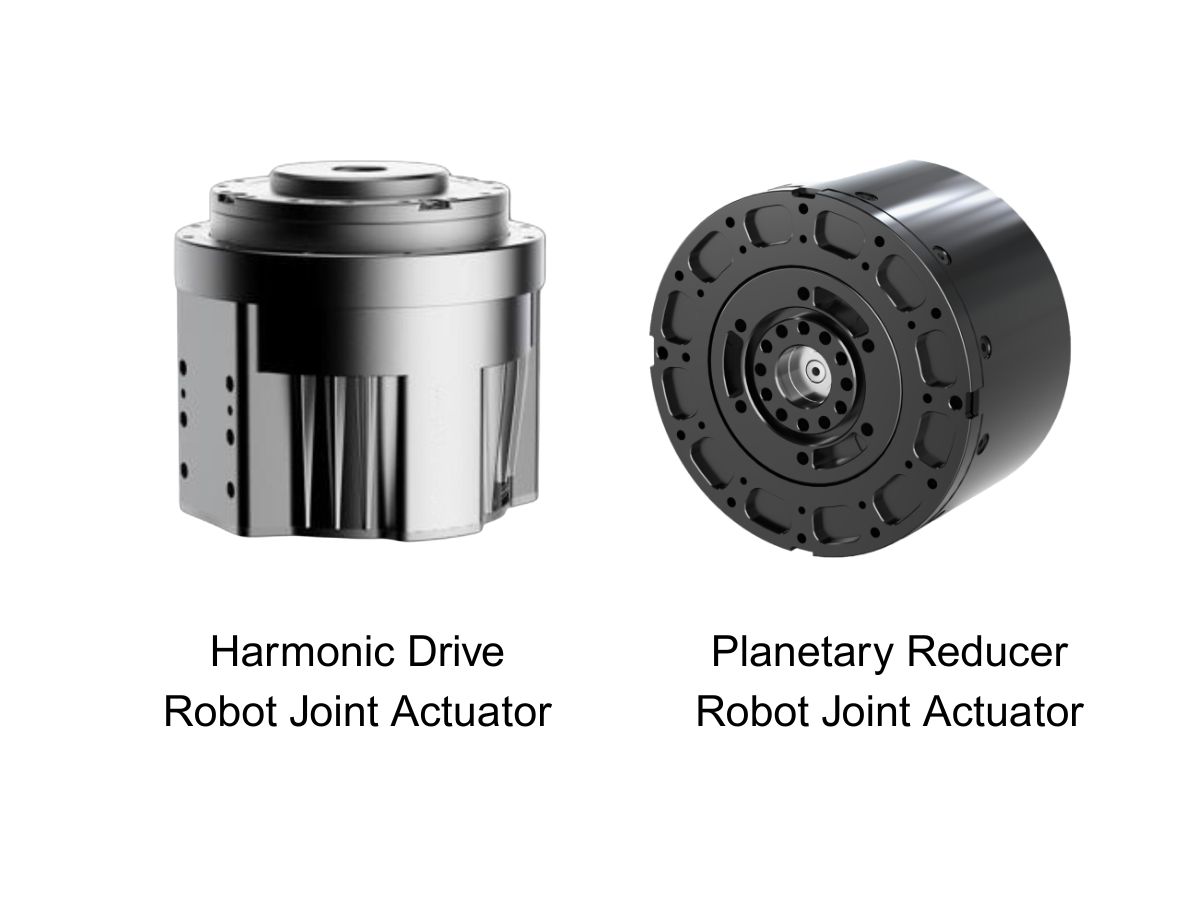
 What is robot joint actuator?How to Choose the Best Robot Rotary Joint Actuator?In core robot joint transmission solutions, planetary and harmonic rotary actuators each have their own strengths. Choosing the right type based on application requirements is essential to achieve the optimal balance between performance and cost.
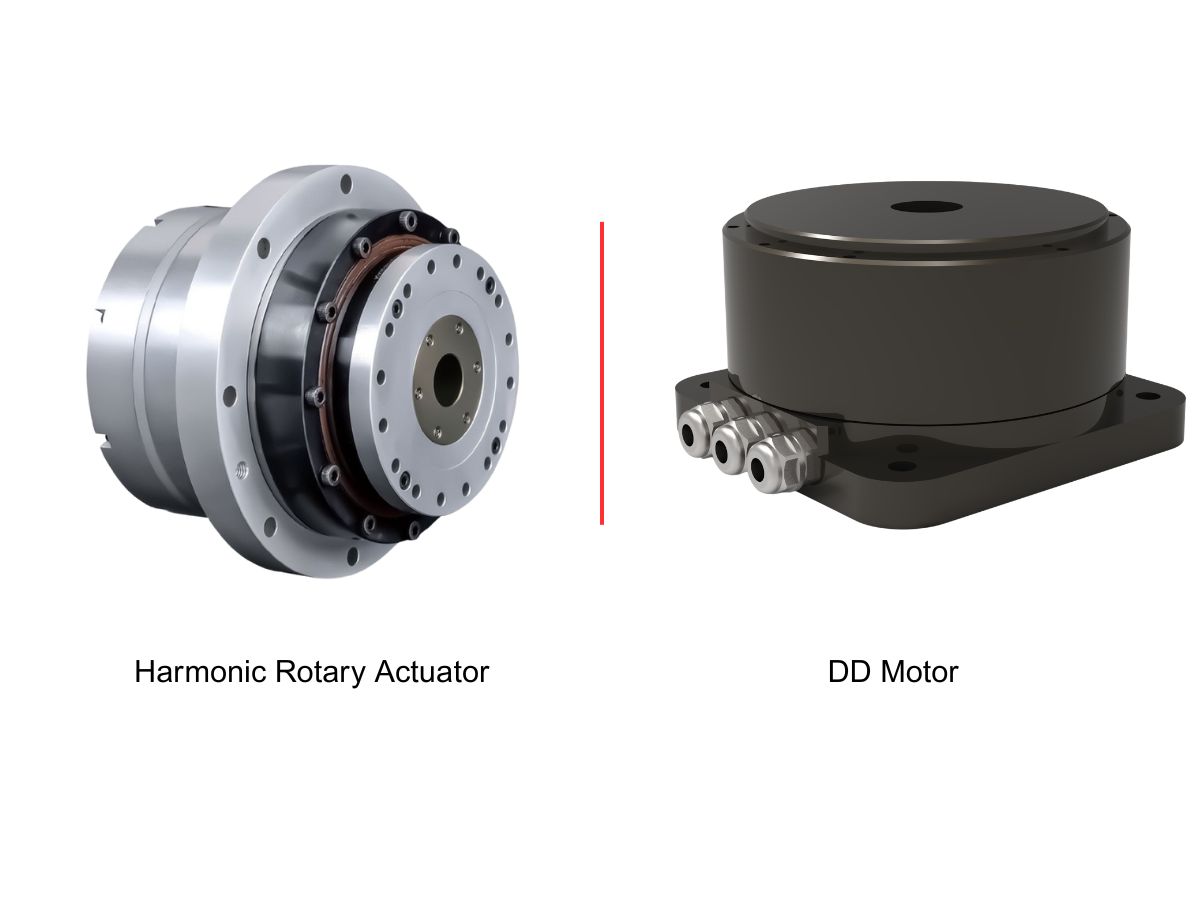
 DD Motors VS Harmonic Rotary ActuatorsThis article provides an in-depth comparison between Direct Drive (DD) motors and harmonic rotary actuators, covering their transmission principles, advantages and disadvantages, and typical application fields.
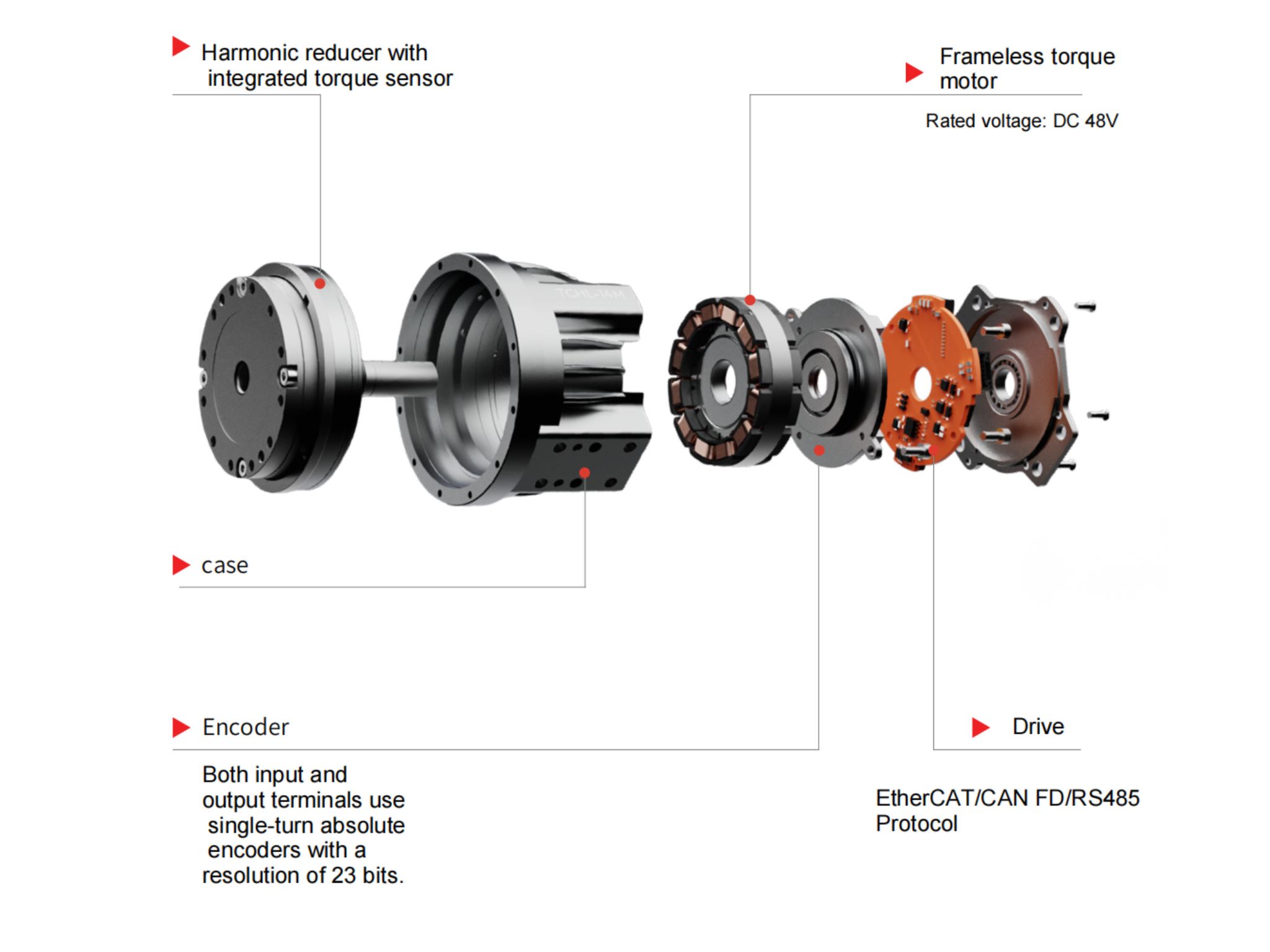
 OMG Ultra Compact Harmonic Drive Joint Module with Built-in Torque SensorHONPINE TCHL series harmonic drive joint module is a game-changing product that achieves disruptive improvements in multiple aspects such as lightweight design, integration level, and connection convenience. This article will analyze its revolutionary enhancements with you.
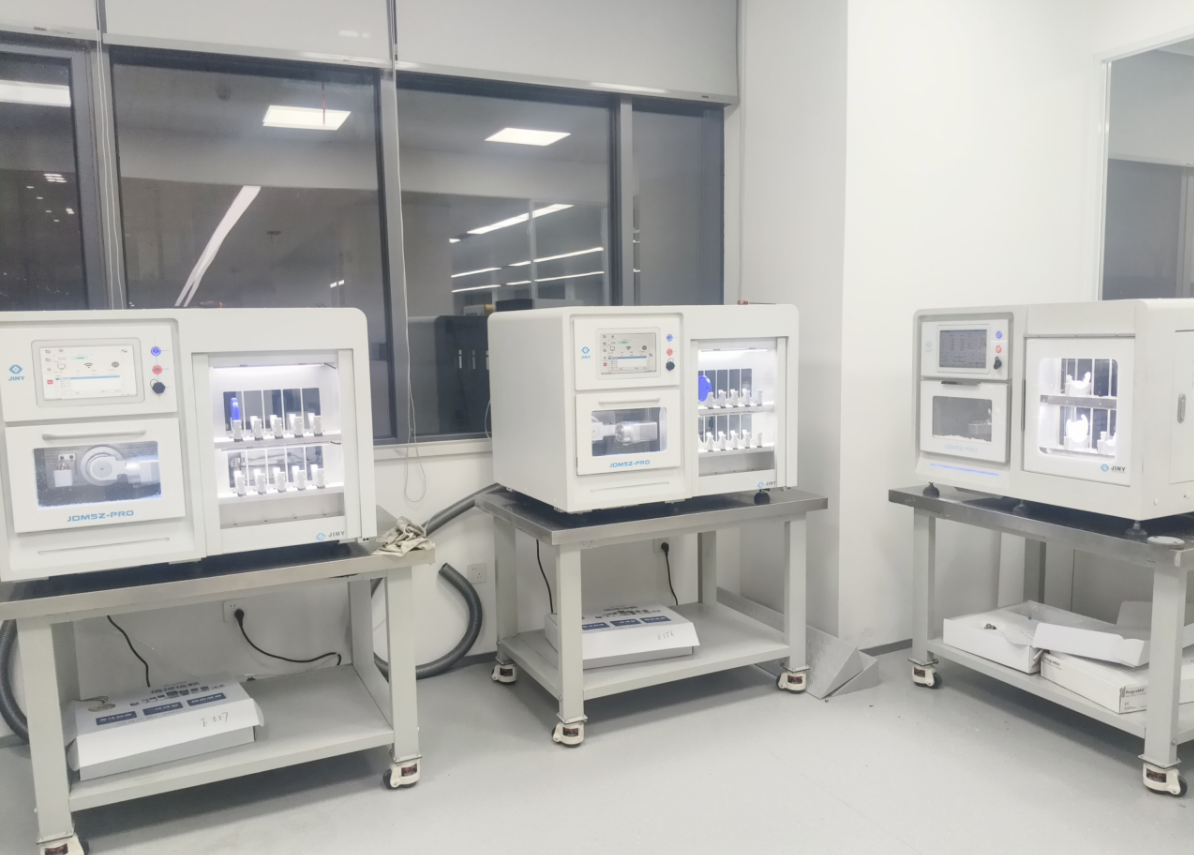
 The Role of Harmonic Drive Gears in Achieving 5–10 μm Accuracy in Dental Milling MachinesA dental milling machine is a CNC machining system used to directly process digital dental models into restorations such as crowns, bridges, veneers, inlays, and implant abutments. Dental milling machines require far higher operational accuracy and motion stability than ordinary equipment. This article explains how harmonic drive gear help dental milling machines achieve stable, continuous, and controllable operation.
 Why Are Harmonic Rotary Actuators Perfect for Medical Equipment?Harmonic rotary actuators (typically integrated systems consisting of a harmonic drive reducer, frameless torque motor, encoder, and optional brake) are regarded as key components in medical equipment. The core reason is that they simultaneously meet the most stringent medical requirements for precision, compact size, safety, and controllability. The following explanation is structured from three perspectives: technical characteristics, application scenarios, and medical value.
 High-Precision RV Reducers Perfectly Matched for Walking RobotsThe walking axis of a robot is a core component for power transmission and support. RV reducers provide extremely high rigidity, precision, and torque while maintaining a compact size and exceptional reliability, making them an ideal match for the demanding requirements of walking robot joints in terms of load capacity, impact resistance, and precision.
 DD Motor Servo System: How to Understand Mechanical Resonance and Solve Machine Vibration?This article explains the relationship between DD motor servo tuning, mechanical resonance, and servo bandwidth in direct drive motion systems. It examines why vibration and instability can occur even after repeated servo parameter adjustments, and explains how mechanical stiffness, moving mass, bearing conditions, load distribution, and structural geometry affect resonance frequency. The article also compares approaches for high- and low-frequency resonance, explains when digital notch filtering can be effective, and provides a practical tuning strategy for engineers working with DD motors, direct drive torque motors, and linear motors.
 High Precision Harmonic Drive Robot Joint Actuator Solution for Robotic ElbowsThe robotic elbow joint plays a critical role in arm flexion, posture adjustment, and end-effector positioning. As humanoid robots, collaborative robots, and robotic arms become more capable, elbow actuators need to deliver high torque and precise motion within increasingly limited installation spaces. A high precision harmonic drive robot joint actuator integrates the harmonic reducer, motor, encoder, brake, and drive system into a compact unit, providing low backlash, high stiffness, high torque density, and accurate motion control. In this article, HONPINE introduces three joint actuator series suitable for robotic elbow applications, covering different requirements for size, torque, speed, precision, and integration.
 Explosion-Proof Robot Joint Solution for Chemical Inspection Quadruped Robots: Planetary Joint Actuator with Up to 500 N·m Peak TorqueIn petrochemical, mining, power, and other hazardous environments, inspection robots are moving beyond simple monitoring toward practical operations such as tool handling, equipment inspection, and emergency response. This shift places higher demands on robot joint actuators, particularly in explosion protection, torque output, thermal management, environmental resistance, and mobility. HONPINE's explosion-proof robot joint actuator is designed for quadruped inspection robots and other hazardous-environment robotic platforms, integrating high-load planetary transmission with explosion-proof design and reliable motion performance. With up to 500 N·m peak torque per joint, optional IP67 protection, and Ex db IIB T4 Gb certification, the solution is designed to support demanding robotic applications in high-risk industrial environments.
 Planetary Drive Actuator for AGV Wheel Hub Motors: Solving Torque, Turning Radius and Drive Integration ChallengesHello everyone, I’m Theodore Li, Technical Director at HONPINE. Today, I’d like to discuss how a planetary drive actuator can solve practical challenges in AGV wheel hub motor systems. AGVs and AMRs require sufficient wheel torque for heavy-load starting, acceleration, slope climbing, and frequent reversing, while the drive system must remain compact enough for limited chassis space. A planetary drive actuator combines a motor with a planetary reduction mechanism to convert high-speed motor output into the lower-speed, higher-torque motion required at the wheel. In this article, I will examine the relationship between planetary drive actuators and AGV wheel hub motors, including torque, gear ratio, wheel diameter, climbing ability, turning radius, direct-drive systems, and harmonic drive actuators.
 How to Choose a Reliable Robot Joint Motor Manufacturer for Humanoid Robots?Choosing a reliable robot joint motor manufacturer is a critical step when developing humanoid robots and other advanced robotic systems. A robotic joint must balance torque, speed, precision, torque density, thermal performance, feedback, mechanical stiffness, and long-term reliability within a compact structure. For B2B robotics companies, supplier evaluation should therefore go beyond a product datasheet and consider engineering capability, manufacturing capacity, joint integration, testing, and production scalability. In this article, Allen Li, Founder of HONPINE, explains the key factors to consider when selecting a robot joint motor manufacturer and how integrated harmonic robot joint technology can support humanoid robot development.
 Lightweight Humanoid Robots Start with Precision TransmissionAs humanoid robots move from experimental prototypes toward practical applications, lightweight design, energy efficiency, motion performance, and long-term reliability are becoming increasingly important. At the center of these challenges is precision transmission. From harmonic reducers and lightweight robot joints to integrated development kits, the design of each core component directly affects the overall performance of a humanoid robot. In this article, Allen Li, Founder of HONPINE, shares his perspective on how precision transmission technology can support the development of lightweight humanoid robots and how HONPINE is extending its expertise from harmonic reducers toward lightweight robot joints and integrated robotics solutions.
Double Click
We provide harmonic drive reducer,planetary reducer,robot joint motor,robot rotary actuators,RV gear reducer,robot end effector,dexterous robot hand
 The Role of Harmonic Drive Gears in Achieving 5–10 μm Accuracy in Dental Milling MachinesA dental milling machine is a CNC machining system used to directly process digital dental models into restorations such as crowns, bridges, veneers, inlays, and implant abutments. Dental milling machines require far higher operational accuracy and motion stability than ordinary equipment. This article explains how harmonic drive gear help dental milling machines achieve stable, continuous, and controllable operation.
 How HONPINE Manufactures Precision Harmonic Reducers: Technology, Quality and Manufacturing Challenges?A precision harmonic reducer is more than a compact high-ratio transmission component. Its actual performance depends on how accurately every critical component is designed, manufactured, assembled, and tested. Tooth profile accuracy, flexspline material, heat treatment, machining tolerances, wave generator geometry, assembly precision, and production consistency can all influence backlash, torsional stiffness, efficiency, durability, and positioning accuracy. For robotics, CNC equipment, semiconductor manufacturing, optical inspection, and other precision automation applications, these factors become even more important. This article explores how HONPINE manufactures precision harmonic reducers, the key technologies and manufacturing challenges involved, and why stable production capability is essential for achieving reliable transmission performance at scale.
 Cup Type vs. Hat Type vs. Pancake Harmonic Reducer: How to Choose the Right Strain Wave Gear IntroductionAs industrial automation equipment becomes more compact and precise, the structural design of a harmonic reducer has become an important factor in motion system selection. Cup type, hat type, and pancake harmonic reducers use the same basic strain wave gearing principle, but their different flexspline structures result in different characteristics in axial size, torque capacity, rigidity, hollow space, and mechanical integration. For applications such as 3C automation, semiconductor equipment, CNC machinery, and precision inspection systems, choosing the right configuration requires more than simply comparing reduction ratios or dimensions. This article compares the three major harmonic reducer configurations and explains how to select the most suitable solution based on the actual requirements of an industrial motion system.
 Mini Harmonic Reducer for Small Robot Arms and Desktop 6-Axis Robots
 Harmonic Gear Reducer Technology: Working Principle, Manufacturing Barriers, and Industry InsightsGlobally, only a limited number of manufacturers are capable of producing high-precision harmonic gear reducer systems. This article explains how these precision transmission systems work, why they are difficult to manufacture, and HONPINE’s perspective on the global supply chain.
 Why Are Harmonic Drive Reducers the Core Component of Modern Robots?As the core transmission component inside robotic joints, the design, manufacturing quality, and selection of a harmonic drive reducer directly determine a robot's motion accuracy, reliability, and service life. Whether in industrial robots, collaborative robots, or next-generation humanoid robots, harmonic drives have become one of the most critical enabling technologies for high-performance motion control.
 How to Choose a Reliable Harmonic Drive Manufacturer in ChinaHow to Choose a Reliable Harmonic Drive Manufacturer in China: learn how machine tool buyers can assess precision, quality control, customization, and delivery reliability before sourcing.
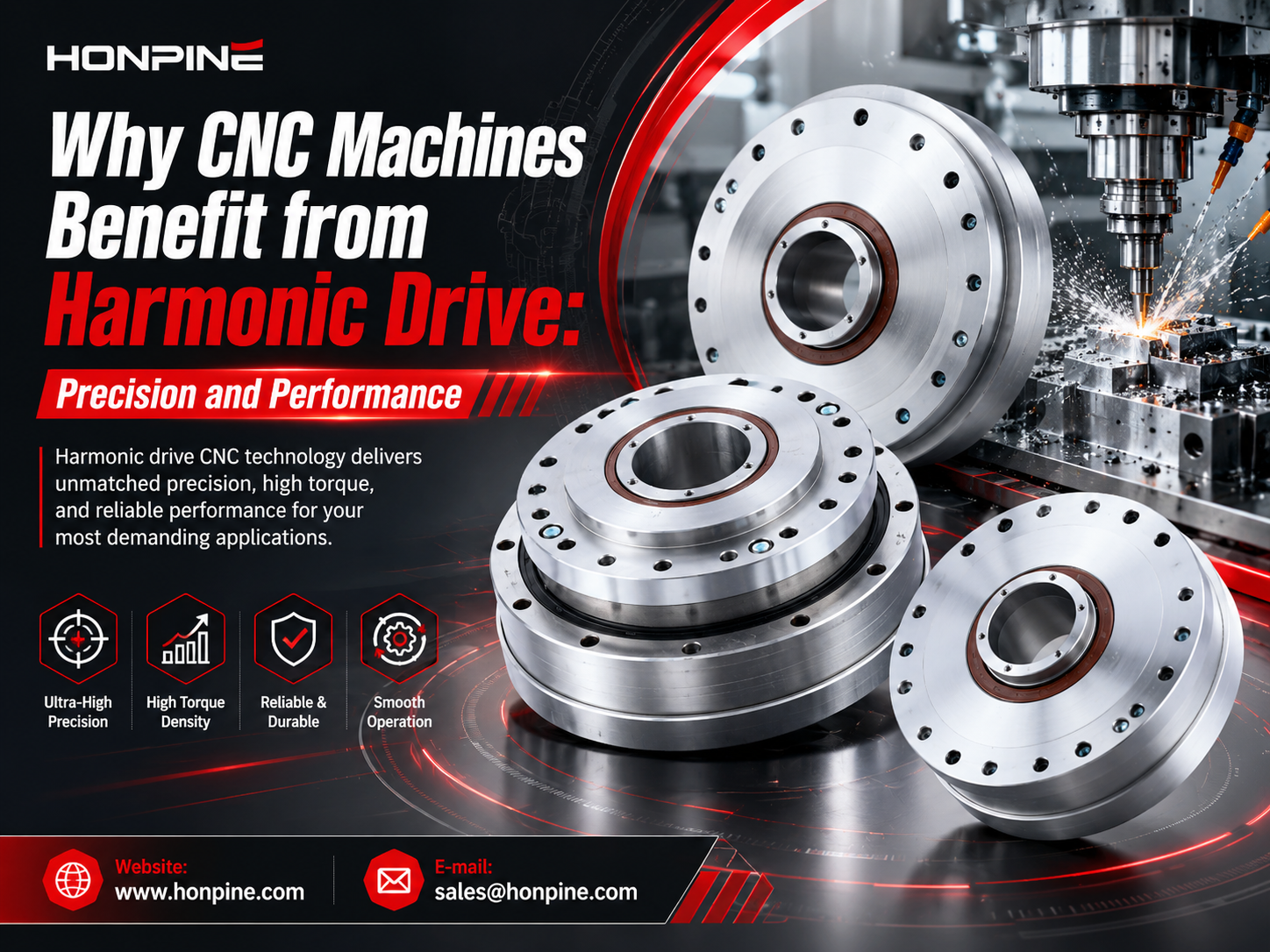
 Why CNC Machines Benefit from Harmonic Drive: Precision and Performance?In modern manufacturing, CNC machines are widely used for turning, taper turning, drilling, tapping, contouring with linear and circular interpolation, and threading (both parallel and tapered). While these machines excel at traditional operations, performing milling tasks on standard CNC turning centers presents significant challenges. This is where harmonic drive CNC technology comes into play, offering a solution that addresses these limitations effectively.
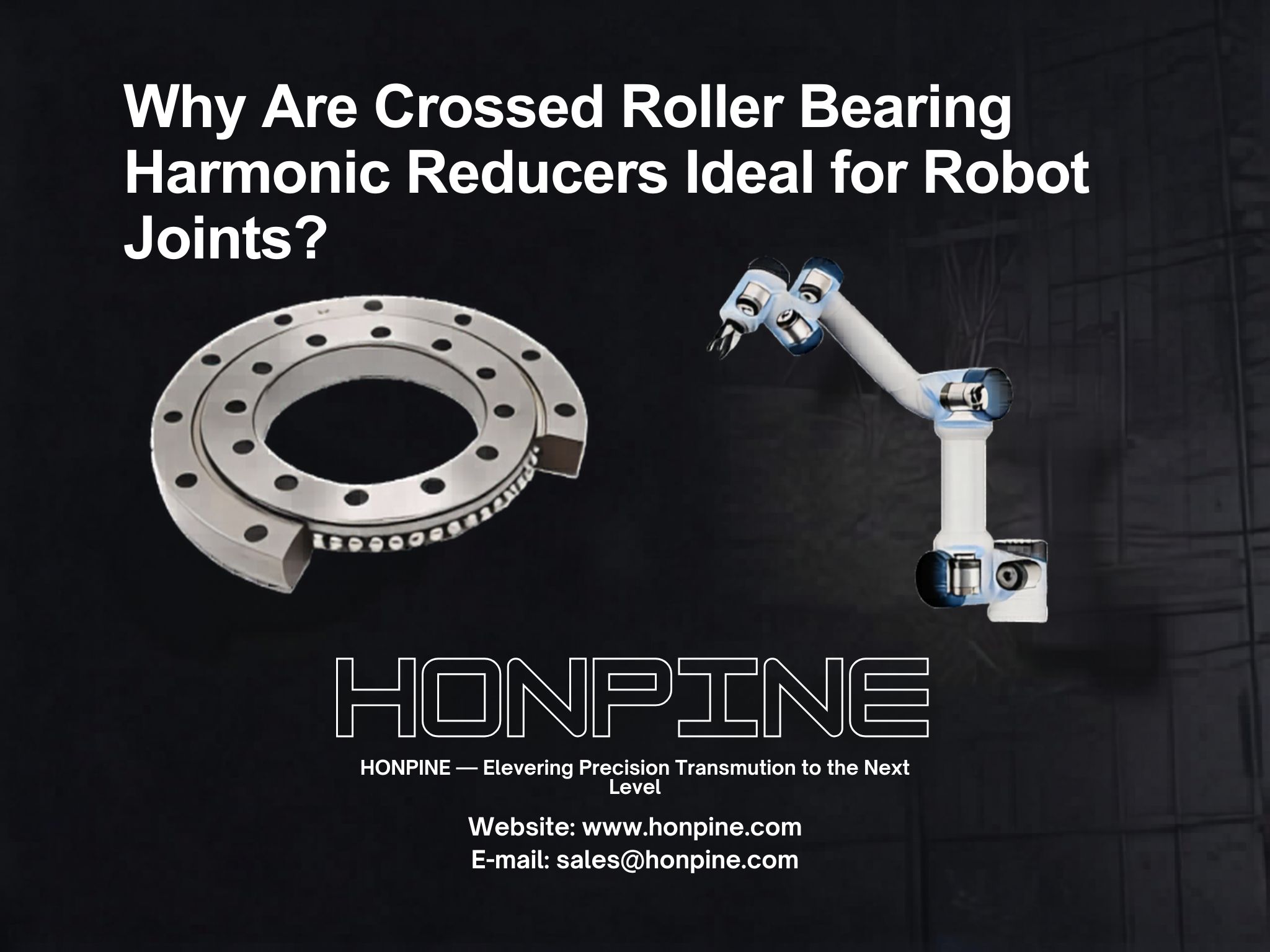
 Why Are Crossed Roller Bearing Harmonic Reducers Ideal for Robot Joints?In robotic harmonic reducers, crossed roller bearings are the key components that ensure motion accuracy and structural rigidity. Their performance directly affects the robot’s repeat positioning accuracy, load capacity, and service life.
 How to Selection Harmonic Reduction Gear?This article explains how to select harmonic reduction gears based on specific equipment, covering aspects such as average load torque, input speed, start-stop peak torque, comparison of impact torque, permissible number of impact torque cycles, and service life. It concludes with a mention of Honpine's star products, harmonic reduction gears.
 Top 7 Harmonic Drive Reducer ManufacturersThis article introduces seven manufacturers of harmonic drive reducers, primarily companies from China and Japan.
 Why Harmonic Drive Gear Systems Are Ideal for Missile Guidance and Precision Control Applications?Harmonic drive gear systems and harmonic drive actuator systems are highly suitable for applications such as turret rotation, missile fin control, and stabilized sensor gimbal systems.
This is mainly because they offer unique advantages in precision, compact size, fast response, and reliability, making them ideal for high-precision electromechanical systems.