






How to Choose a Robot Joint Actuator: 3 Key Criteria Engineers Should Check?
Choosing a robot joint actuator is not simply a matter of selecting the model with the highest torque or the smallest size. For industrial robots, collaborative robots, humanoid robots, and other robotic systems, actuator selection directly affects joint performance, control stability, mechanical integration, and development time.
A suitable robot joint actuator needs to match the mechanical requirements of each joint while also working correctly with the robot's encoder, controller, communication network, and power architecture.
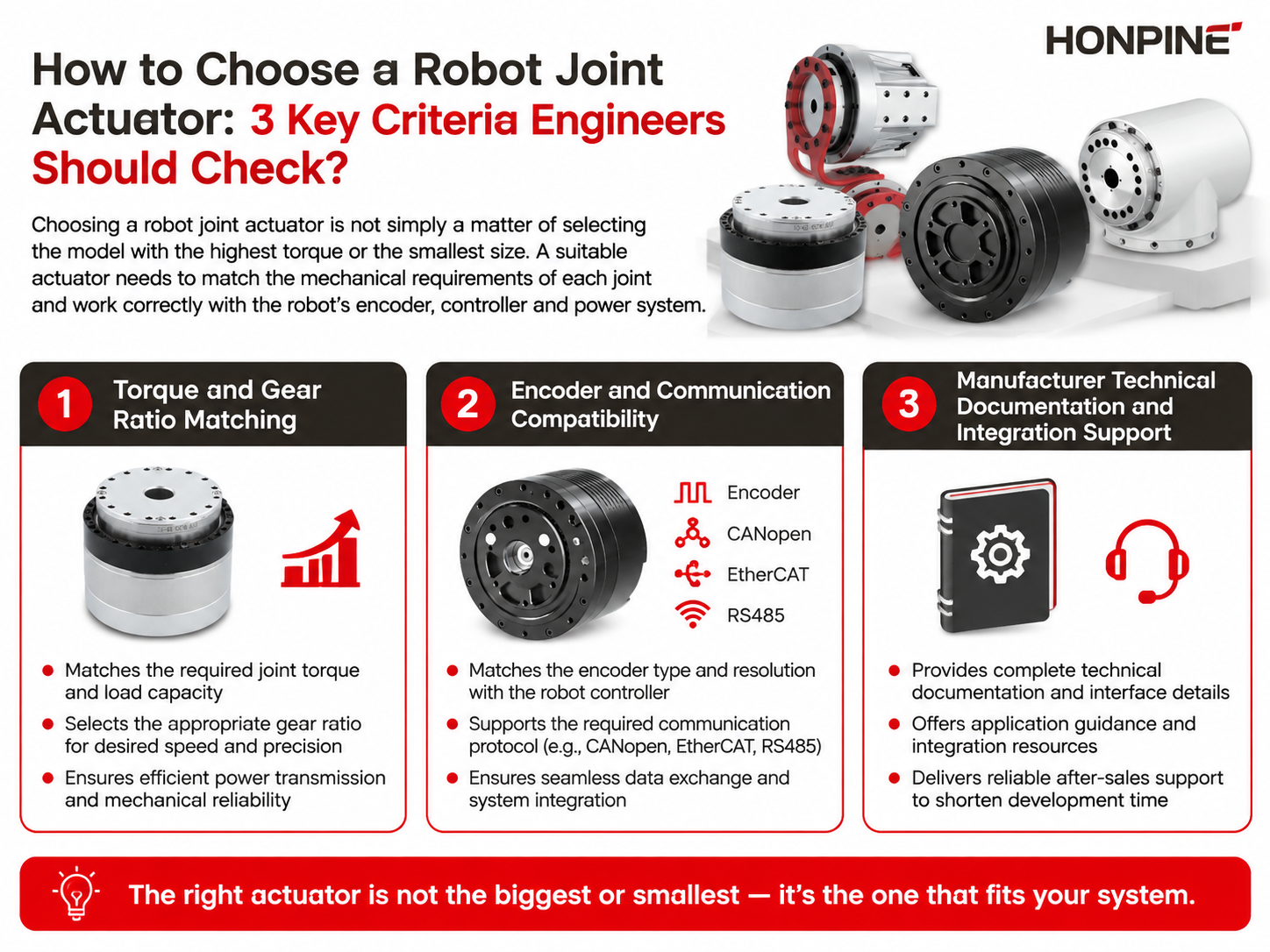
For engineers developing a robotic arm or humanoid robot, three criteria deserve particular attention before comparing actuator specifications: torque and gear ratio matching, encoder and communication compatibility, and the manufacturer's technical documentation and integration support.
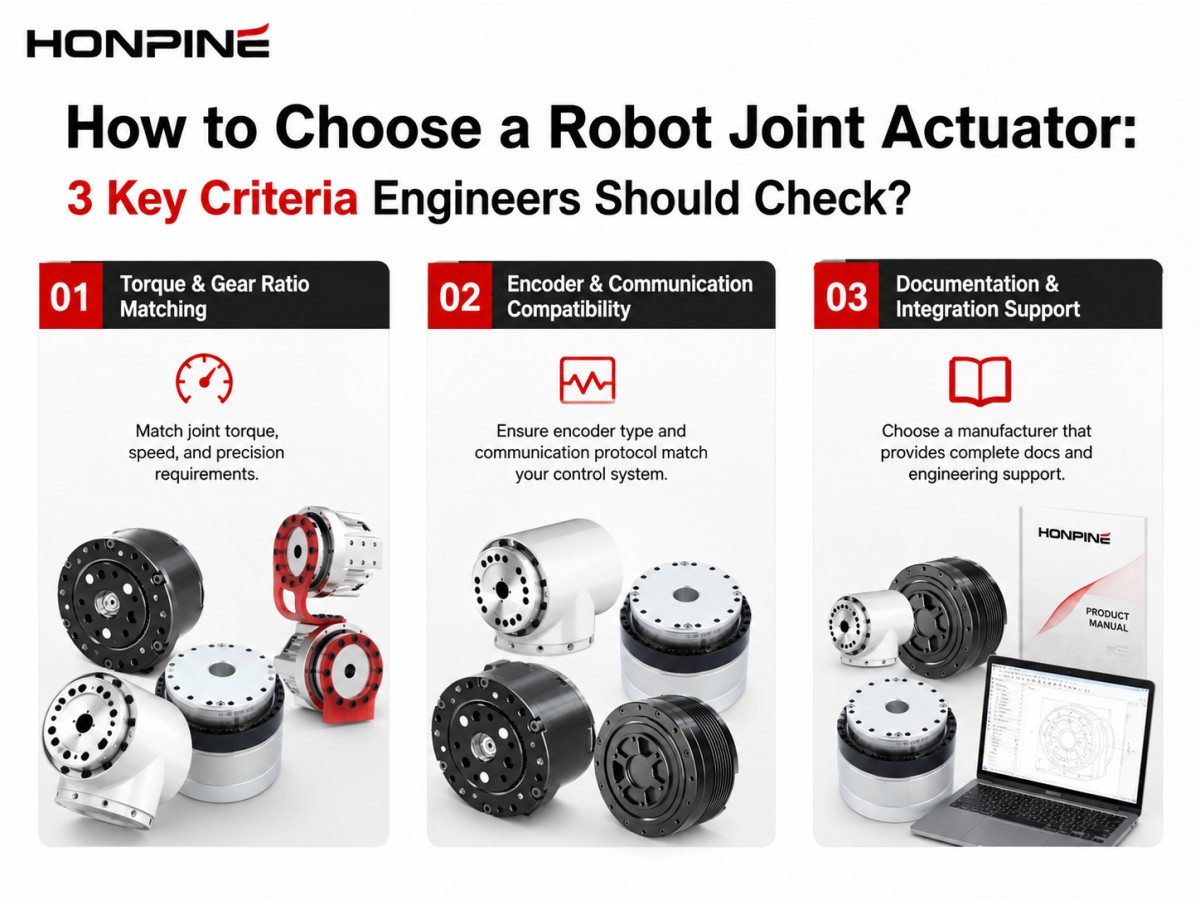
1. Calculate Torque and Gear Ratio Before Comparing Robot Joint Actuators
The first step in selecting a robot joint actuator is to calculate the actual load requirements of each joint.
A robot does not require the same actuator at every joint. Shoulder, elbow, hip, knee, wrist, and other joints can have significantly different torque requirements because their loads, lever arms, motion profiles, and required acceleration are different.
Instead of starting with a product catalog, engineers should first define the required continuous torque, peak torque, speed, reduction ratio, and duty cycle for each joint.
Continuous Torque and Peak Torque Must Be Considered Separately
Continuous torque represents the torque that the actuator can deliver during normal operation, while peak torque is associated with short-duration acceleration, deceleration, external loads, or dynamic motion.
Using only peak torque as the selection criterion can result in an actuator that appears powerful enough on paper but is not suitable for continuous operation.
For robotic joints, the selection process should therefore consider:
Continuous or rated torque
Peak torque
Joint speed
Required acceleration
Reduction ratio
Duty cycle
External radial and axial loads
Operating temperature
Available installation space
The actual torque requirement should be calculated according to the robot's mechanical structure and motion profile rather than estimated from the actuator's maximum specification.
Gear Ratio Directly Influences Robot Joint Performance
The reduction ratio is another important parameter when selecting a robotic joint actuator.
A higher reduction ratio can increase output torque and improve positioning resolution, but it may also influence output speed, reflected inertia, efficiency, and backdrivability.
For this reason, the reduction ratio should be selected together with the motor characteristics and joint requirements.
For example, a high-load shoulder or hip joint may prioritize high output torque and torque density, while a wrist joint may place greater emphasis on compact dimensions, low inertia, and dynamic response.
This is one reason why a robot may use different actuator sizes and reduction ratios across different joints instead of using one actuator model throughout the entire robot.
Match the Actuator Architecture to the Joint
Different transmission technologies can also affect the final joint design.
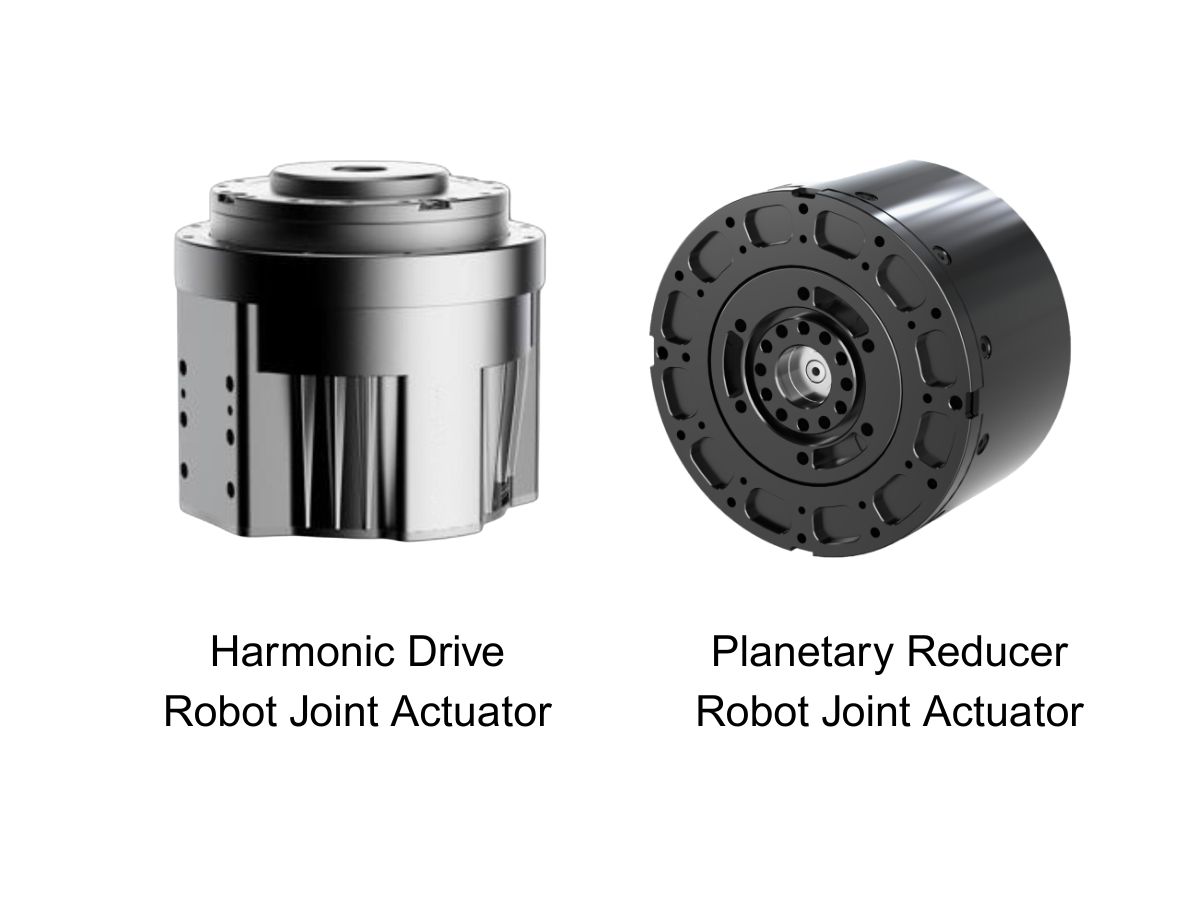
A harmonic actuator can be attractive for robotic joints that require high reduction ratios, compact dimensions, low backlash, and high positioning accuracy. Planetary-based actuators can provide another option where torque density, efficiency, speed, or mechanical architecture are prioritized.
The important point is that the transmission type should be selected according to the joint's actual mechanical requirements rather than simply choosing the technology that has the highest advertised torque.
For a robot manufacturer, a useful approach is to create a joint-by-joint requirement table before contacting suppliers. This allows the actuator size, reduction ratio, motor rating, and encoder configuration to be evaluated against the same engineering criteria.
2. Encoder and Communication Configuration Can Determine Integration Time
Torque and mechanical dimensions determine whether an actuator can physically drive a joint. However, encoder and communication configuration determine how easily the actuator can be integrated into the robot control system.
This is often underestimated during the early stages of robot development.
A robot joint actuator may have excellent mechanical performance but still create significant integration work if its encoder interface, communication protocol, wiring, or control architecture does not match the robot's existing system.
Single Encoder or Dual Encoder?
Encoder configuration should be evaluated according to the control architecture of the robot.
A single encoder may provide sufficient feedback for some joint control systems. More demanding robotic joints may benefit from dual-encoder architectures, where feedback from the motor side and output side can be used for more advanced motion control.
The two feedback positions can provide different information about the transmission and joint motion.
For example, motor-side feedback can be important for motor commutation and high-speed control, while output-side feedback can provide more direct information about the actual joint position.
For applications requiring high positioning accuracy, compliance control, force control, or advanced transmission compensation, engineers should evaluate whether a single encoder architecture is sufficient.
Encoder resolution should also be considered. Higher encoder resolution can provide finer position feedback, but the practical improvement depends on the entire control system, mechanical stiffness, transmission characteristics, and servo tuning.
CAN, CANopen, EtherCAT or Other Interfaces?
Communication protocol is another important consideration when selecting a robot joint actuator.
CAN and CANopen are commonly used in distributed motion systems because of their relatively simple architecture and suitability for multi-axis communication.
EtherCAT can be advantageous when the robot requires high-speed synchronized communication between multiple joints and the central controller.
The correct choice depends on the robot's overall control architecture.
Before purchasing actuators, engineers should confirm:
Supported communication protocols
Communication cycle requirements
Node or axis configuration
Wiring and connector definitions
CANopen object dictionary or equivalent communication documentation
EtherCAT configuration files when applicable
Error codes and diagnostic information
Parameter configuration methods
Firmware and software compatibility
The actuator should not be evaluated as an isolated motor. It should be evaluated as part of the complete robot control system.
Documentation Can Save More Time Than a Higher-Rated Actuator
One of the most common integration problems is not necessarily a hardware failure. It is simply a lack of technical information.
If the manufacturer provides only a basic specification table, engineers may still need to determine connector pinouts, communication parameters, encoder settings, control commands, fault codes, and commissioning procedures themselves.
A supplier that provides complete technical documentation can significantly reduce this uncertainty.
For a robot joint actuator, useful documentation should include the product datasheet, wiring diagram, communication protocol, parameter list, control instructions, mechanical drawing, and troubleshooting information.
These documents should ideally be available before the purchasing decision rather than after the actuators arrive.
3. Evaluate the Manufacturer's Technical Documentation and Engineering Support
The third criterion is often overlooked because it does not appear in a conventional actuator specification table.
However, for robot manufacturers and system integrators, supplier engineering support can directly affect development time.
The actuator is only one component of a robotic joint. Engineers still need to integrate it into the mechanical structure, electrical system, communication network, and motion-control software.
A technically capable actuator supplier should therefore provide more than a product catalog.
Check the Technical Documentation Before You Place an Order
Before selecting a robot joint actuator, ask the supplier for the complete technical package.
At minimum, engineers should check whether the manufacturer can provide:
Mechanical documentation: 3D models, dimensional drawings, mounting information, shaft specifications, allowable loads, and installation requirements.
Electrical documentation: connector definitions, wiring diagrams, voltage requirements, current ratings, brake wiring, and encoder interfaces.
Control documentation: communication protocol, control parameters, operating modes, error codes, and commissioning instructions.
Performance documentation: rated torque, peak torque, speed, reduction ratio, efficiency, backlash, repeatability, encoder resolution, and operating conditions.
Troubleshooting documentation: over-temperature protection, overload behavior, brake operation, communication faults, encoder errors, and other common problems.
The quality of these documents is a practical way to evaluate whether a supplier has real engineering experience with robotic applications.
Mechanical Integration Matters as Much as Rated Torque
A robot joint actuator may satisfy the torque requirement but still be unsuitable because of its mechanical envelope.
Engineers should therefore evaluate the complete actuator package, including:
Overall diameter
Axial length
Weight
Mounting interface
Output shaft or flange
Cable routing
Hollow-shaft requirements
Brake configuration
Encoder position
Cooling requirements
This becomes particularly important in humanoid robots and compact robotic arms, where every gram and millimeter can affect the overall mechanical design.
A compact actuator with high torque density can help reduce joint size and robot mass, but only if the actuator's mounting and cable architecture are compatible with the robot.
Environmental Conditions Should Be Confirmed Early
The actuator's rated torque and speed are normally specified under defined operating conditions.
Temperature, humidity, vibration, installation orientation, duty cycle, and cooling conditions can all affect actual performance.
For example, operating at elevated temperatures may trigger thermal protection or require torque derating. Low-temperature operation can also change lubrication and friction characteristics.
Therefore, if a robotic system will operate close to the actuator's environmental limits, engineers should request the manufacturer's recommended derating conditions before finalizing the actuator model.
Harmonic Actuator vs. Other Robot Joint Actuator Architectures
For precision robotic joints, one of the key decisions is whether to use a harmonic actuator, planetary actuator, or another integrated transmission architecture.
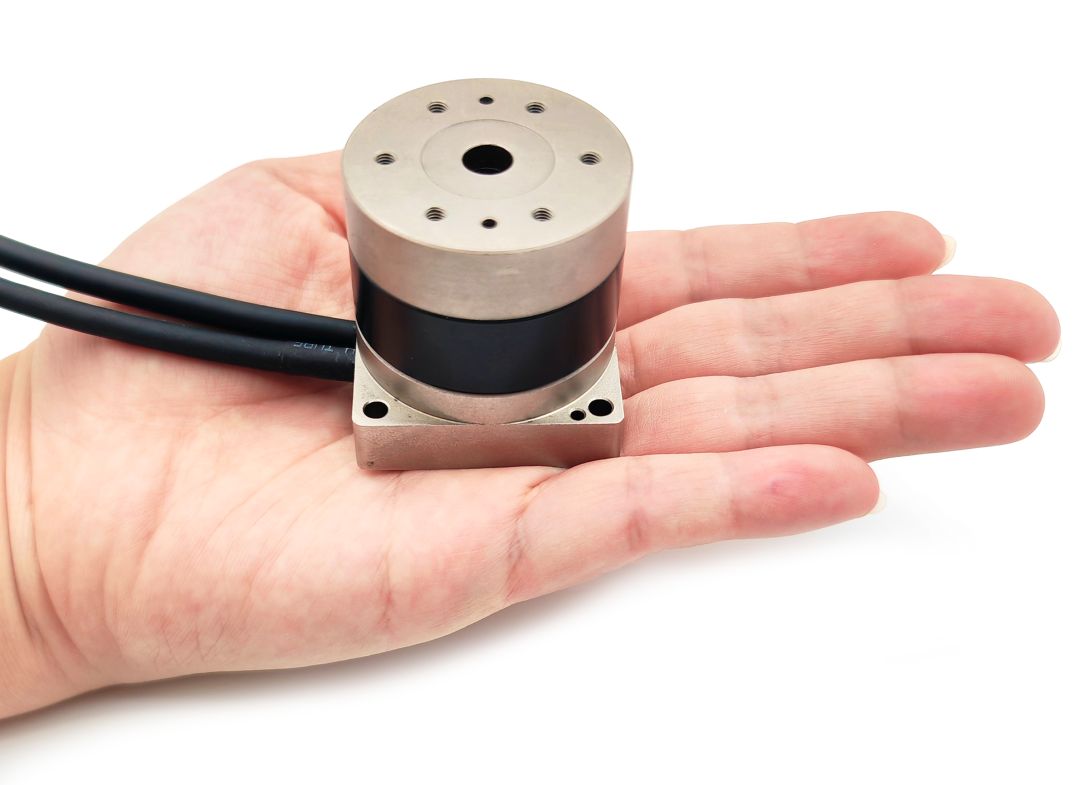
A harmonic actuator combines a motor with a harmonic reduction mechanism and can provide a high reduction ratio within a relatively compact package. This makes the architecture particularly relevant to robotic joints where space, weight, positioning accuracy, and backlash are important.
However, harmonic transmission is not automatically the best choice for every joint.
The selection should consider the complete set of requirements, including torque, speed, efficiency, backlash, stiffness, backdrivability, weight, dimensions, duty cycle, and control requirements.
For example, a high-precision robot wrist may place greater emphasis on compactness and positioning performance, while a heavy-load joint may prioritize torque density and thermal capacity.
The right question is therefore not “Which actuator has the highest torque?”, but rather “Which actuator architecture provides the required joint performance within the available mechanical and electrical constraints?”
A Practical Robot Joint Actuator Selection Process
A practical selection process can be divided into three stages.
First, calculate the mechanical requirements of every joint. Define continuous torque, peak torque, speed, acceleration, reduction ratio, duty cycle, allowable joint size, and maximum weight.
Second, define the electrical and control architecture. Confirm motor voltage, encoder configuration, communication protocol, controller compatibility, brake requirements, wiring, and feedback architecture.
Third, evaluate the supplier's technical support. Request mechanical drawings, 3D models, wiring diagrams, communication documentation, parameter definitions, troubleshooting information, and sample commissioning procedures.
This process helps prevent a common mistake in robotics development: selecting an actuator based on a few headline specifications and discovering integration problems only after the prototype has already been assembled.
Why Torque Density Matters in Robot Joint Actuator Selection?
For modern robotic systems, torque density deserves special attention.
A robot joint has to generate sufficient torque while contributing as little additional mass and volume as possible. This is particularly important for humanoid robots and lightweight robotic arms.
A heavier actuator installed at a distal joint can also increase the load that upstream joints must carry, potentially creating a cascading effect throughout the robot's mechanical structure.
For this reason, engineers should evaluate torque together with actuator weight and dimensions rather than considering torque as an independent specification.
A useful engineering metric is the relationship between output torque, actuator mass, and installation volume.
This is where compact harmonic actuators and integrated robot joint actuators can become particularly valuable for applications that require high torque density.
Questions to Ask a Robot Joint Actuator Manufacturer
Before placing an order, a robot manufacturer should be able to obtain clear answers to several practical questions.
Can the actuator provide the required continuous and peak torque under the actual duty cycle?
What reduction ratio is available for the required joint speed?
What encoder configuration is supported?
Is the actuator compatible with CAN, CANopen, EtherCAT, or the robot's existing communication architecture?
Are mechanical drawings and 3D models available?
Are complete wiring diagrams and connector definitions provided?
Can the manufacturer provide communication documentation and commissioning support?
What happens during overload or over-temperature conditions?
Is a brake available if the joint needs to hold its position after power loss?
Can the supplier support customized mechanical, electrical, or communication requirements?
These questions often reveal more about the suitability of a supplier than a conventional product brochure.
Conclusion: Choose the Robot Joint Actuator as a Complete System
Selecting a robot joint actuator in 2026 should not start with a simple comparison of torque numbers.
A better approach is to follow the actual engineering decision sequence: first match torque, speed, and reduction ratio to the mechanical requirements; then verify encoder and communication compatibility; finally evaluate the manufacturer's documentation and engineering support.
For robotic systems, actuator performance is determined not only by the motor and reducer but by the interaction between the transmission, encoder, controller, mechanical structure, and control software.
For manufacturers developing industrial robots, collaborative robots, humanoid robots, and other precision robotic systems, this system-level approach can reduce integration risk and shorten the path from actuator selection to a working robotic joint.
HONPINE develops integrated motion solutions including harmonic servo actuators, harmonic robot joint modules, DC Drive Wheel Module, and precision transmission components for robotic and industrial automation applications. By evaluating actuator torque, transmission architecture, feedback configuration, mechanical integration, and control compatibility together, engineers can select a robot joint actuator that is not only powerful on paper, but also practical to integrate into the final robot.
Read More
Learn more about the story of HONPINE and industry trends related to precision transmission.
 What is robot joint actuator?How to Choose the Best Robot Rotary Joint Actuator?In core robot joint transmission solutions, planetary and harmonic rotary actuators each have their own strengths. Choosing the right type based on application requirements is essential to achieve the optimal balance between performance and cost.
 DD Motors VS Harmonic Rotary ActuatorsThis article provides an in-depth comparison between Direct Drive (DD) motors and harmonic rotary actuators, covering their transmission principles, advantages and disadvantages, and typical application fields.
 OMG Ultra Compact Harmonic Drive Joint Module with Built-in Torque SensorHONPINE TCHL series harmonic drive joint module is a game-changing product that achieves disruptive improvements in multiple aspects such as lightweight design, integration level, and connection convenience. This article will analyze its revolutionary enhancements with you.
 The Role of Harmonic Drive Gears in Achieving 5–10 μm Accuracy in Dental Milling MachinesA dental milling machine is a CNC machining system used to directly process digital dental models into restorations such as crowns, bridges, veneers, inlays, and implant abutments. Dental milling machines require far higher operational accuracy and motion stability than ordinary equipment. This article explains how harmonic drive gear help dental milling machines achieve stable, continuous, and controllable operation.
 Why Are Harmonic Rotary Actuators Perfect for Medical Equipment?Harmonic rotary actuators (typically integrated systems consisting of a harmonic drive reducer, frameless torque motor, encoder, and optional brake) are regarded as key components in medical equipment. The core reason is that they simultaneously meet the most stringent medical requirements for precision, compact size, safety, and controllability. The following explanation is structured from three perspectives: technical characteristics, application scenarios, and medical value.
 High-Precision RV Reducers Perfectly Matched for Walking RobotsThe walking axis of a robot is a core component for power transmission and support. RV reducers provide extremely high rigidity, precision, and torque while maintaining a compact size and exceptional reliability, making them an ideal match for the demanding requirements of walking robot joints in terms of load capacity, impact resistance, and precision.
 Lightweight Humanoid Robots Start with Precision TransmissionAs humanoid robots move from experimental prototypes toward practical applications, lightweight design, energy efficiency, motion performance, and long-term reliability are becoming increasingly important. At the center of these challenges is precision transmission. From harmonic reducers and lightweight robot joints to integrated development kits, the design of each core component directly affects the overall performance of a humanoid robot. In this article, Allen Li, Founder of HONPINE, shares his perspective on how precision transmission technology can support the development of lightweight humanoid robots and how HONPINE is extending its expertise from harmonic reducers toward lightweight robot joints and integrated robotics solutions.
 H1: Harmonic Rotary Actuators for Semiconductor Equipment: Precision Motion, Hollow-Shaft Design and FOC ControlHello everyone, I’m Theodore Li, Technical Director at HONPINE. In semiconductor manufacturing equipment, rotary motion is not simply about making a mechanism rotate. Limited installation space, cable and tube routing, low-speed stability, precise positioning and continuously adjustable motion profiles can all influence the performance of the machine. This is why harmonic rotary actuators are becoming an important motion solution for semiconductor equipment. In this article, I will discuss how harmonic transmission, FOC-based motor control, encoder feedback, large hollow-shaft design and flexible mechanical interfaces work together to meet practical semiconductor motion requirements, based on our experience with developing equipment, overhead transport, wafer handling, cleaning and crystal-growth applications.
 How to Choose a Robot Joint Actuator: 3 Key Criteria Engineers Should Check?Choosing a robot joint actuator is an engineering decision that affects not only torque and motion performance, but also control stability, mechanical integration, and development time. For industrial robots, collaborative robots, humanoid robots, and other robotic systems, the right actuator must match the actual requirements of each joint while remaining compatible with the robot’s motor, encoder, controller, communication network, and power architecture. In this article, I will explain three key criteria engineers should evaluate when selecting a robot joint actuator: torque and gear ratio matching, encoder and communication compatibility, and the manufacturer’s technical documentation and engineering support.
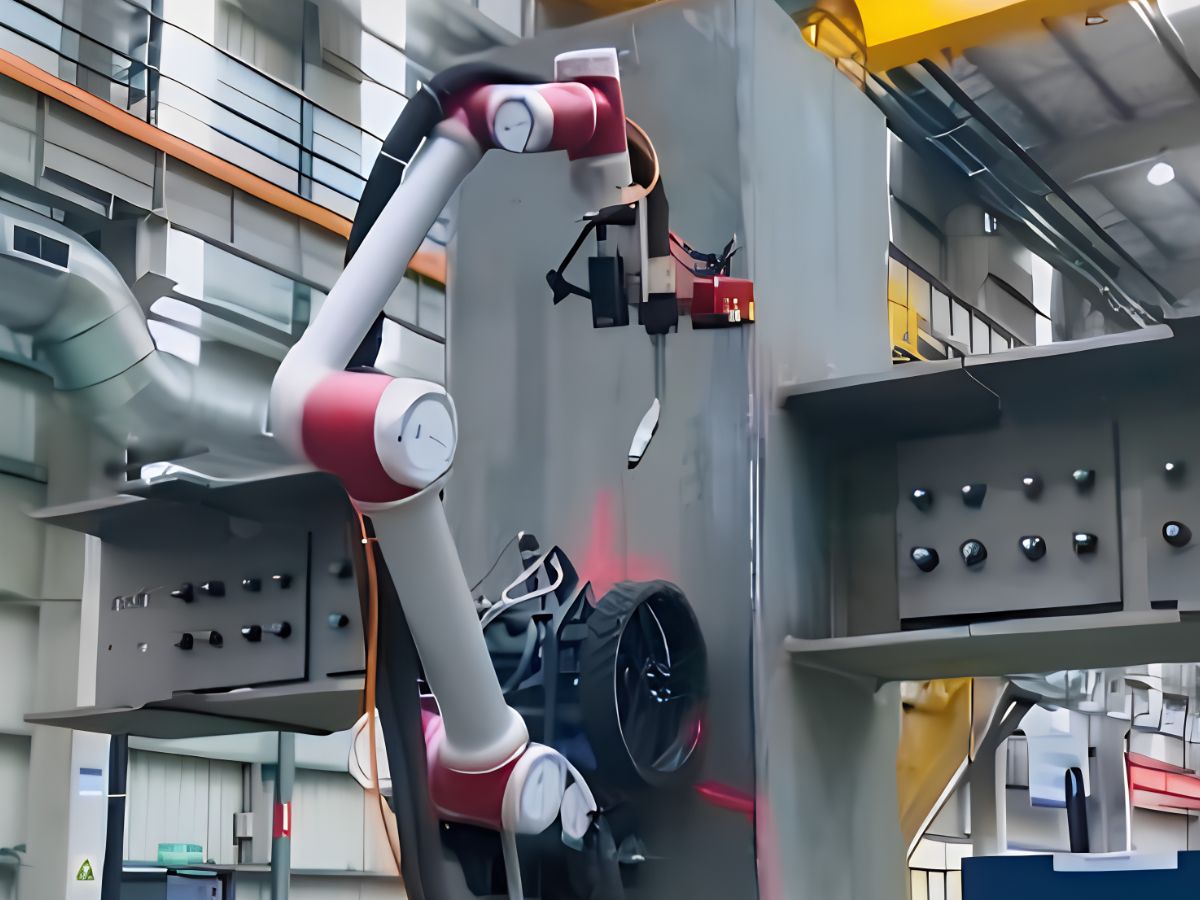
 Outdoor Robot Joint Solution: Harmonic Joint Module with Built-in Torque SensorHello everyone, I’m Theodore Li, Technical Director at HONPINE. As robots move beyond controlled factory environments, outdoor robotic applications are creating new requirements for robot joint design. Rain, dust, humidity, temperature fluctuations, low-temperature conditions, and unpredictable external loads can all affect how a robotic joint performs in the field. In these environments, a joint needs to provide more than precise rotation. It also needs reliable torque feedback, suitable environmental protection, stable operation under changing temperatures, and practical mechanical integration. In this article, I will explain the key engineering considerations behind our outdoor robot joint solution, including the harmonic joint module, built-in torque sensor, IP65 protection, low-temperature lubrication, cable outlet protection, and mechanical integration, based on our experience with outdoor robotic applications such as solar panel installation, construction, and cleaning robots.
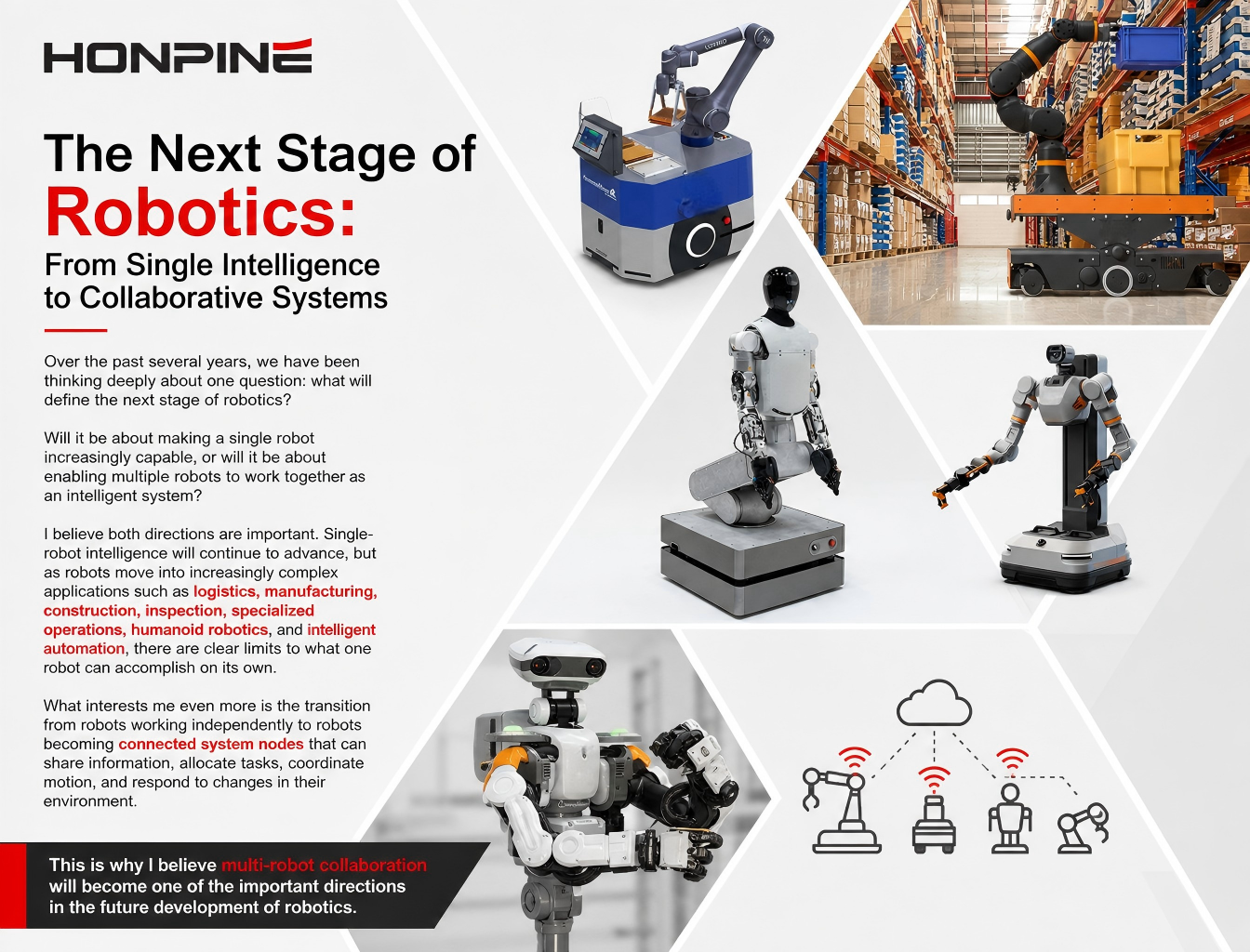
 Multi-Robot Collaboration: From Single-Robot Intelligence to System IntelligenceHello, I’m Allen Li, Founder of HONPINE. As robotics continues to evolve, I believe the next major step will not come only from making individual robots more intelligent, but from enabling multiple robots to work together as coordinated systems. Multi-robot collaboration introduces new requirements for communication, task allocation, motion coordination, state awareness, and safety. This evolution also changes the role of the robot joint. A future intelligent robot joint will need to do more than generate precise motion. With technologies such as dual encoders, torque sensing, integrated drives, real-time communication, and safety functions, the robot joint can become an intelligent motion node connecting robot intelligence with physical movement. In this article, I would like to share how I see the relationship between multi-robot collaboration, system intelligence, and the next generation of HONPINE robot joint modules.
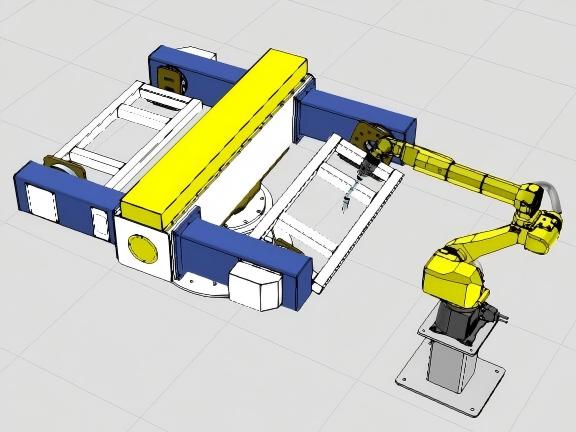
 RV Reducer for Welding Positioners: Selection and Torque Calculation for Heavy-Duty Welding ApplicationsSelecting the right RV reducer for a welding positioner requires more than simply matching the reducer to the workpiece weight. A heavy-duty welding positioner must provide sufficient output torque, high torsional rigidity, stable low-speed rotation, accurate positioning, and reliable performance during acceleration, deceleration, and reversing. In this article, we explain how to select an RV reducer and servo motor for a welding positioner by calculating output speed, reduction ratio, workpiece inertia, gravity load torque, acceleration torque, motor torque, and peak torque. A practical 500 kg welding positioner example is also used to show how these parameters affect RV reducer selection.

Double Click
We provide harmonic drive reducer,planetary reducer,robot joint motor,robot rotary actuators,RV gear reducer,robot end effector,dexterous robot hand
 What is robot joint actuator?How to Choose the Best Robot Rotary Joint Actuator?In core robot joint transmission solutions, planetary and harmonic rotary actuators each have their own strengths. Choosing the right type based on application requirements is essential to achieve the optimal balance between performance and cost.
 DD Motors VS Harmonic Rotary ActuatorsThis article provides an in-depth comparison between Direct Drive (DD) motors and harmonic rotary actuators, covering their transmission principles, advantages and disadvantages, and typical application fields.
 OMG Ultra Compact Harmonic Drive Joint Module with Built-in Torque SensorHONPINE TCHL series harmonic drive joint module is a game-changing product that achieves disruptive improvements in multiple aspects such as lightweight design, integration level, and connection convenience. This article will analyze its revolutionary enhancements with you.
 Lightweight Humanoid Robots Start with Precision TransmissionAs humanoid robots move from experimental prototypes toward practical applications, lightweight design, energy efficiency, motion performance, and long-term reliability are becoming increasingly important. At the center of these challenges is precision transmission. From harmonic reducers and lightweight robot joints to integrated development kits, the design of each core component directly affects the overall performance of a humanoid robot. In this article, Allen Li, Founder of HONPINE, shares his perspective on how precision transmission technology can support the development of lightweight humanoid robots and how HONPINE is extending its expertise from harmonic reducers toward lightweight robot joints and integrated robotics solutions.
 How to Choose a Robot Joint Actuator: 3 Key Criteria Engineers Should Check?Choosing a robot joint actuator is an engineering decision that affects not only torque and motion performance, but also control stability, mechanical integration, and development time. For industrial robots, collaborative robots, humanoid robots, and other robotic systems, the right actuator must match the actual requirements of each joint while remaining compatible with the robot’s motor, encoder, controller, communication network, and power architecture. In this article, I will explain three key criteria engineers should evaluate when selecting a robot joint actuator: torque and gear ratio matching, encoder and communication compatibility, and the manufacturer’s technical documentation and engineering support.
 Outdoor Robot Joint Solution: Harmonic Joint Module with Built-in Torque SensorHello everyone, I’m Theodore Li, Technical Director at HONPINE. As robots move beyond controlled factory environments, outdoor robotic applications are creating new requirements for robot joint design. Rain, dust, humidity, temperature fluctuations, low-temperature conditions, and unpredictable external loads can all affect how a robotic joint performs in the field. In these environments, a joint needs to provide more than precise rotation. It also needs reliable torque feedback, suitable environmental protection, stable operation under changing temperatures, and practical mechanical integration. In this article, I will explain the key engineering considerations behind our outdoor robot joint solution, including the harmonic joint module, built-in torque sensor, IP65 protection, low-temperature lubrication, cable outlet protection, and mechanical integration, based on our experience with outdoor robotic applications such as solar panel installation, construction, and cleaning robots.
 RV Reducer for Welding Positioners: Selection and Torque Calculation for Heavy-Duty Welding ApplicationsSelecting the right RV reducer for a welding positioner requires more than simply matching the reducer to the workpiece weight. A heavy-duty welding positioner must provide sufficient output torque, high torsional rigidity, stable low-speed rotation, accurate positioning, and reliable performance during acceleration, deceleration, and reversing. In this article, we explain how to select an RV reducer and servo motor for a welding positioner by calculating output speed, reduction ratio, workpiece inertia, gravity load torque, acceleration torque, motor torque, and peak torque. A practical 500 kg welding positioner example is also used to show how these parameters affect RV reducer selection.
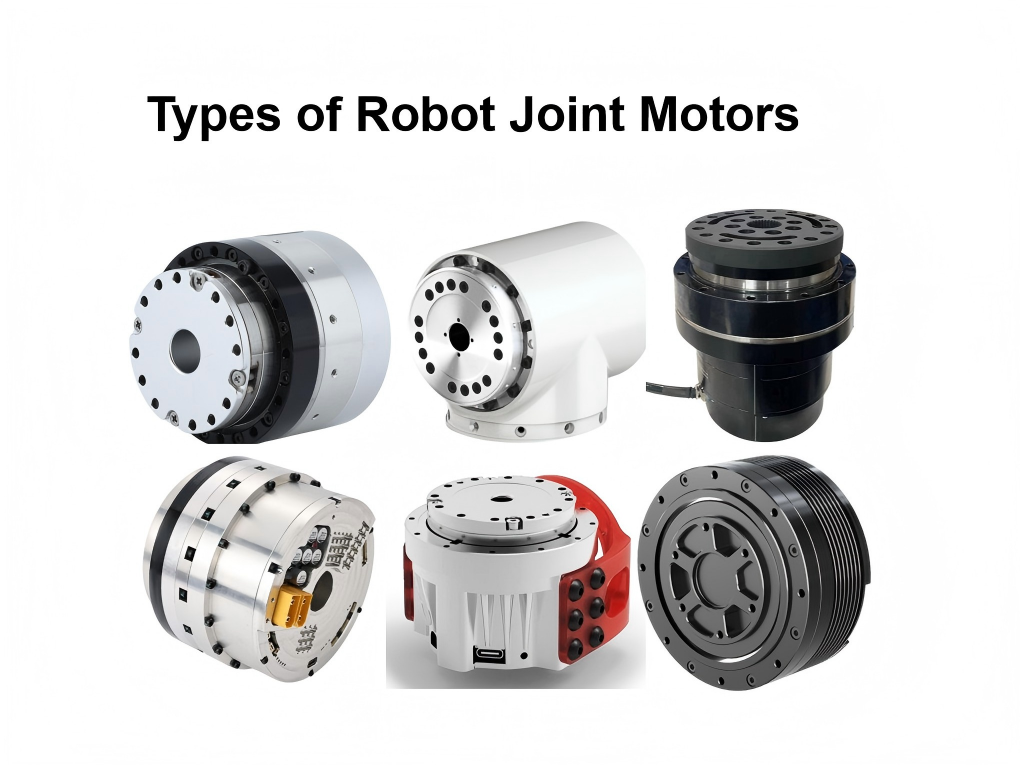
 Types of Robot Joint Motors: Model Selection, Advantages and DisadvantagesRobot joint motors are one of the key components that determine the performance, precision, efficiency, and load capacity of a robot. Depending on the application, robot joints can use electric, hydraulic, pneumatic, or other drive technologies. Among them, electric-drive solutions have become the mainstream choice for modern robots, especially humanoid robots, industrial robots, collaborative robots, and mobile robots. Electric robot joint motors can be further divided according to their transmission methods, including harmonic drive, planetary reducer, cycloidal reducer, ball screw, and direct drive solutions. Each type has its own advantages and disadvantages in terms of precision, torque density, efficiency, impact resistance, size, cost, and backdrivability. Understanding these differences is essential for selecting the right robot joint motor for a specific application.
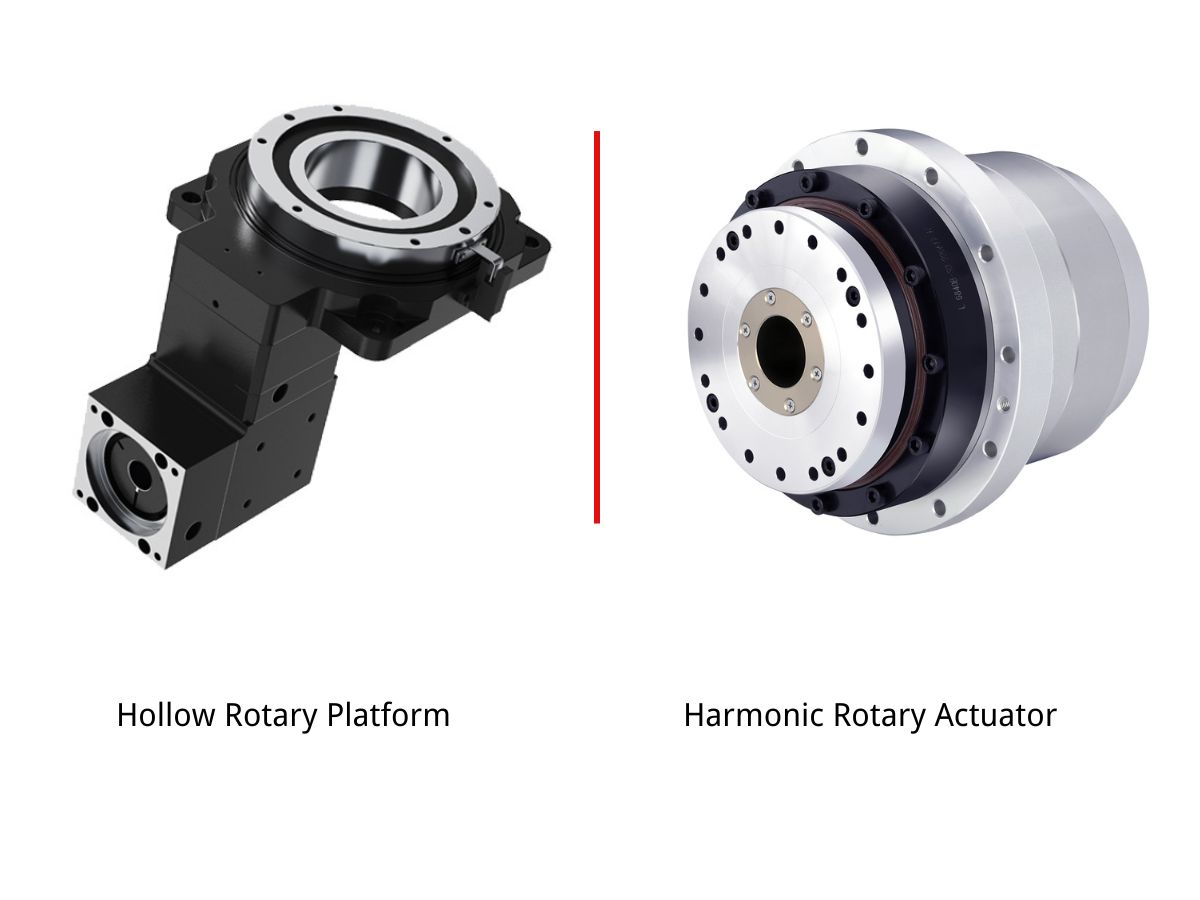
 Hollow Rotary Platform vs. Harmonic Rotary Actuator: Application Comparison and InterchangeabilityHello everyone, I’m Theodore Li, Technical Director at HONPINE. For engineers designing precision rotary stations for industrial automation, one question often comes up: when a machine requires high-precision rotation, indexing, or rotary positioning, should you choose a hollow rotary platform or a harmonic rotary actuator? Can they be used interchangeably? Although both are precision rotary motion solutions, their mechanical structures and application characteristics are quite different. In actual equipment, choosing the wrong solution can lead to insufficient load capacity, inadequate rigidity, vibration, speed limitations, or reduced service life. In this article, I’ll compare their application characteristics and explain where they can be used interchangeably, where one is more suitable than the other, and what engineers should check before making a replacement.
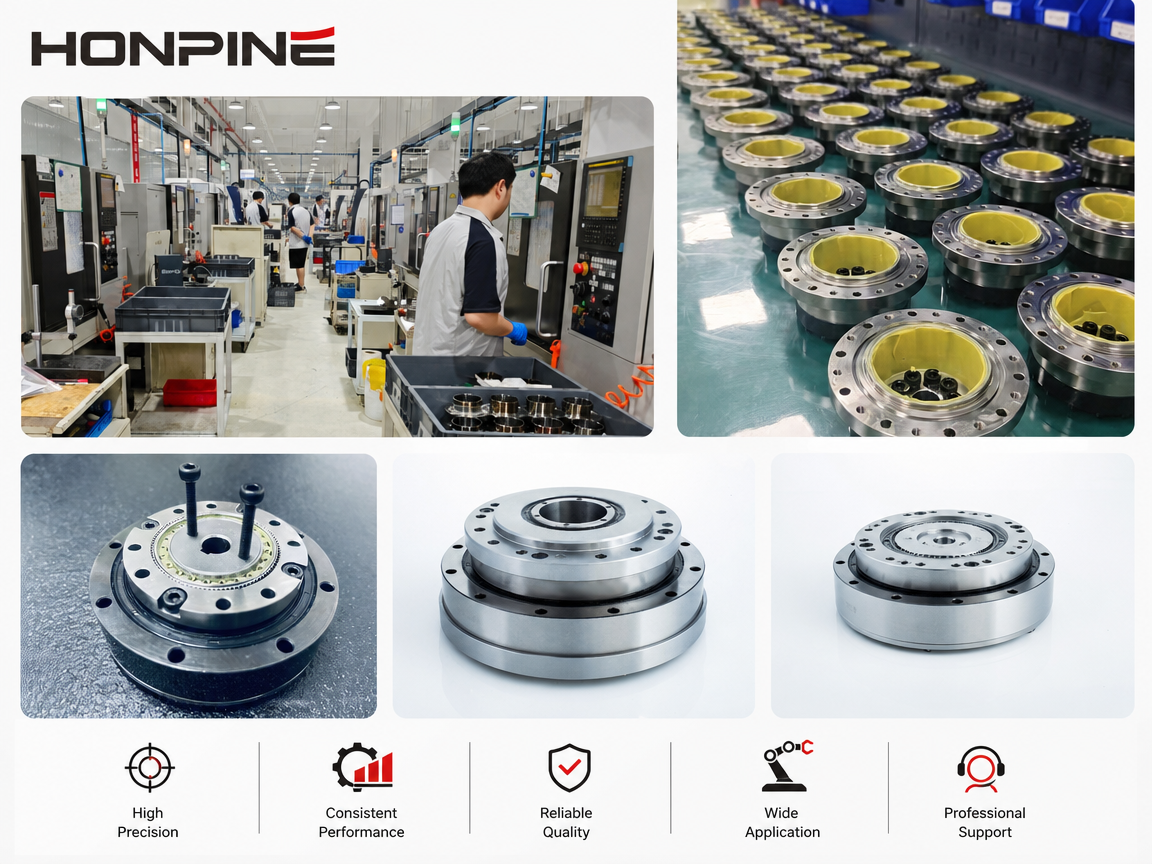
 How HONPINE Manufactures Precision Harmonic Reducers: Technology, Quality and Manufacturing Challenges?A precision harmonic reducer is more than a compact high-ratio transmission component. Its actual performance depends on how accurately every critical component is designed, manufactured, assembled, and tested. Tooth profile accuracy, flexspline material, heat treatment, machining tolerances, wave generator geometry, assembly precision, and production consistency can all influence backlash, torsional stiffness, efficiency, durability, and positioning accuracy. For robotics, CNC equipment, semiconductor manufacturing, optical inspection, and other precision automation applications, these factors become even more important. This article explores how HONPINE manufactures precision harmonic reducers, the key technologies and manufacturing challenges involved, and why stable production capability is essential for achieving reliable transmission performance at scale.
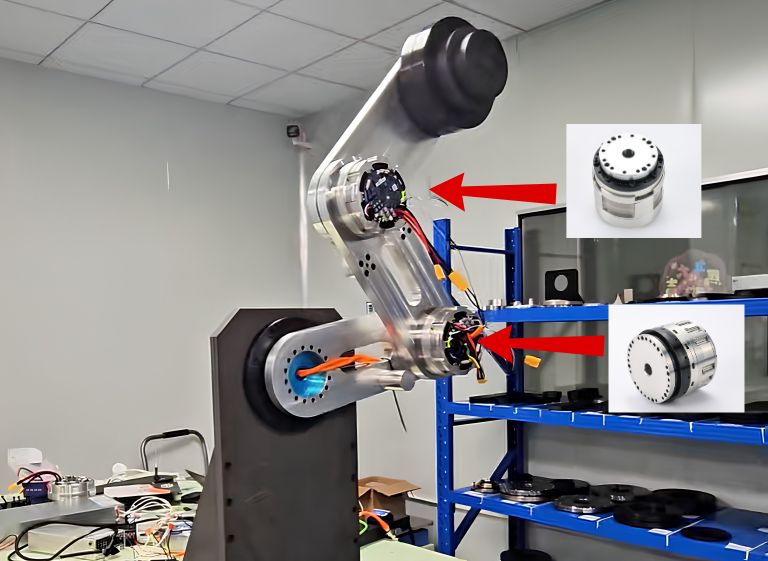
 HONPINE HAG Harmonic Joint Actuator Real Load Test for Heavy Duty Robot ArmTest the HONPINE HAG40 harmonic joint actuator with an 80 kg payload, 800 N·m peak torque and 557 N·m rated torque for heavy-duty robotic arms.
 Small Size DD Motor for Precision Rotary Motion and Industrial AutomationAs industrial automation equipment becomes smaller, faster, and more precise, rotary motion systems require higher performance within increasingly limited installation space. A Small Size DD Motor provides a direct-drive solution that eliminates the need for a conventional reduction gearbox, offering a direct torque transmission path, high dynamic response, and precise rotary motion control. From 3C electronics and semiconductor equipment to laser processing, inspection systems, and precision rotary tables, Direct Drive Motor technology offers a compact alternative to traditional geared systems. However, when applications require higher output torque and torque density, a Harmonic Servo Actuator may be a more suitable solution. This article explains the working principles, advantages, applications, and key selection factors of small DD motors, while comparing direct-drive and harmonic actuator architectures from an engineering perspective.
- harmonic reduction
- harmonic transmission
- harmonic actuator
- honpine
- precision transmission
- robot joint actuator
- robot joint
- harmonic
- planetary
- robotic joint
- humanoid robot
- servo
- actuator
- joint actuator
- joint actuators
- robotic joint actuator
- harmonic robot joint
- planetary actuator
- robotic arm
- harmonic actuators