

Why Choose an RV Reducer for Specialized Rotary Equipment? Welding, Cutting, Waterjet, and Die-Casting Applications
In specialized rotary equipment, the reducer directly affects positioning accuracy, load capacity, operational stability, and long-term reliability. Applications such as welding positioners, rotary cutting tables, waterjet rotary tables, and die-casting ladling machines often operate under eccentric loads, frequent start-stop cycles, or continuous production conditions.
A precision planetary gearbox can be a suitable solution for many rotary applications, particularly where high efficiency, compact dimensions, and cost control are priorities. However, when equipment must handle substantial overturning moments, repeated impact loads, or long-term positioning requirements, an RV reducer may offer advantages in mechanical support and load-bearing capability.
Choosing an RV reducer is not simply a matter of selecting a gearbox with a higher torque rating. The actual decision should consider the workpiece mass, center-of-gravity offset, acceleration, braking conditions, duty cycle, positioning requirements, and the mechanical structure of the rotary axis.
This article examines why RV reducers are used in several types of specialized rotary equipment and explains when they are worth considering over precision planetary gearboxes.
What Makes an RV Reducer Suitable for Heavy-Duty Rotary Equipment?
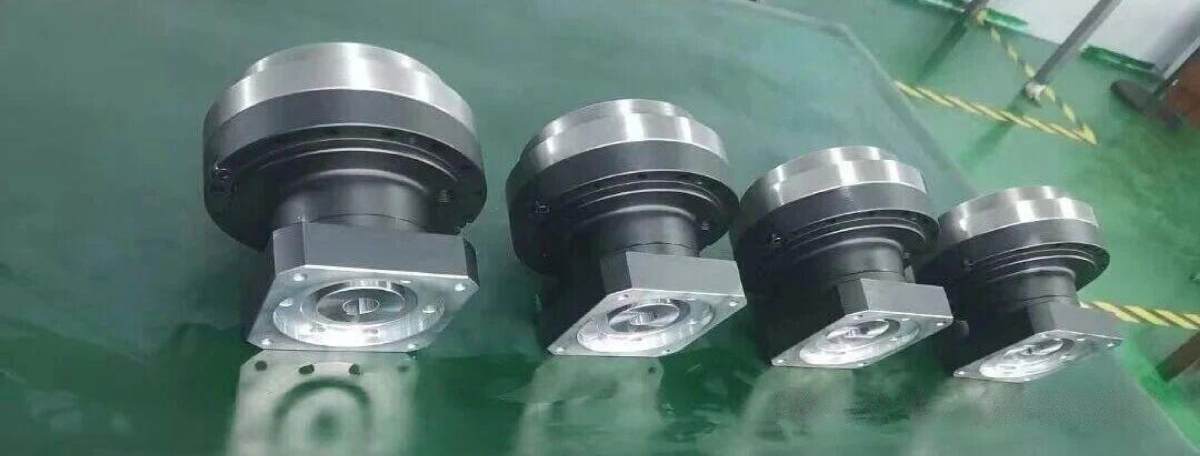
An RV reducer is a precision cycloidal transmission mechanism commonly used in industrial robots and heavy-duty positioning equipment. Its transmission structure typically combines a planetary gear stage with a cycloidal reduction stage, providing a high reduction ratio, substantial torque capacity, and good torsional rigidity within a relatively compact assembly.
One important characteristic of many RV reducer designs is their integrated main bearing structure. Depending on the model, the bearing arrangement can support radial loads, axial loads, and overturning moments generated by eccentric workpieces. This can simplify the mechanical design of a rotary axis and reduce the need for additional external bearing arrangements.
Another advantage is backlash stability under demanding operating conditions. In applications involving frequent starts, stops, and reversals, transmission backlash and torsional deformation can affect positioning repeatability. A properly selected RV reducer can provide the rigidity and transmission stability required for these operating conditions.
Some RV reducer models also offer high instantaneous overload and shock-load capacity. However, these capabilities must be evaluated against the manufacturer's specified allowable torque, acceleration, and service-life limits. Emergency-stop torque capacity should never be treated as an allowable continuous operating torque.
RV Reducer vs. Precision Planetary Gearbox: What Is the Difference?
Precision planetary gearboxes are widely used in automation equipment because of their high transmission efficiency, compact structure, and relatively low cost. High-end planetary gearboxes can also achieve very low backlash and are suitable for many precision positioning applications.
The main difference is not simply the reduction principle. It is how the complete transmission system handles mechanical loads.
In an RV reducer, the integrated bearing arrangement of many models allows the reducer to support certain external loads and overturning moments directly. A planetary gearbox may require an additional crossed roller bearing, slewing bearing, or other mechanical support when the output shaft is subjected to substantial radial loads, axial loads, or eccentric moments.
In terms of transmission efficiency, precision planetary gearboxes generally have an advantage. Typical reference ranges are approximately 90–96% for planetary gearboxes and 85–92% for RV reducers, although actual efficiency varies with the model, reduction ratio, operating speed, lubrication, and load.
Cost is another consideration. At comparable torque capacities, an RV reducer may cost approximately two to four times as much as a standard precision planetary gearbox, depending on the manufacturer and configuration. This higher cost is justified only when the application benefits from its mechanical support, rigidity, overload capability, or long-term positioning stability.
Therefore, an RV reducer is not automatically the better choice. For light loads, high-speed operation, and cost-sensitive equipment, a precision planetary gearbox may be more appropriate. For heavy eccentric loads, repeated shock loading, and demanding continuous operation, an RV reducer deserves closer consideration.
Why Do Welding Positioners Often Use RV Reducers?
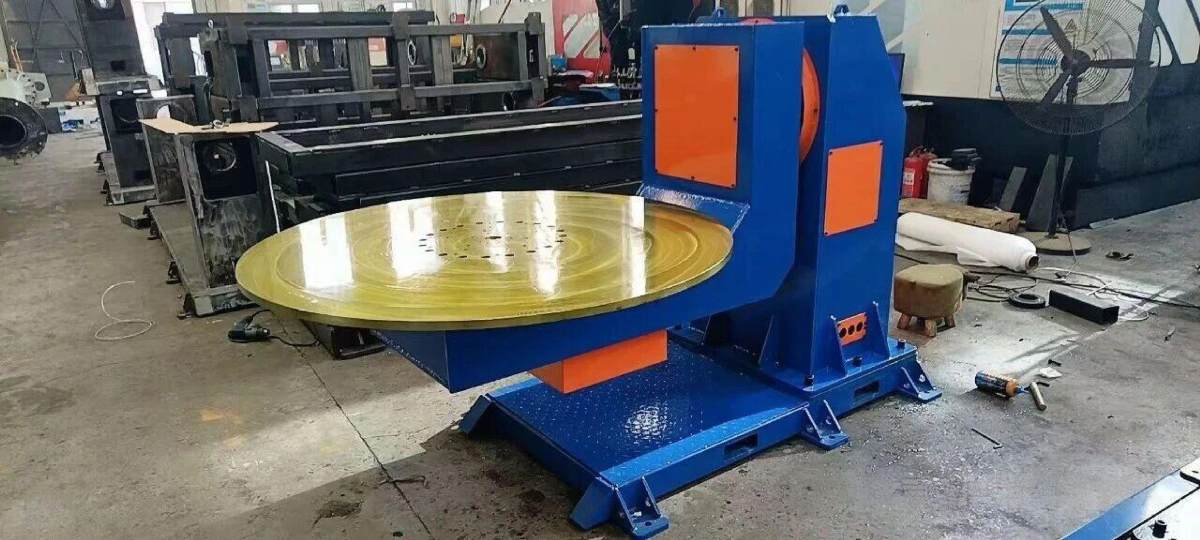
Welding positioners are used to rotate and tilt workpieces so that weld seams can be placed in suitable positions. During operation, the equipment may need to support large workpieces while repeatedly accelerating, decelerating, stopping, and reversing direction.
The main challenge is not only the weight of the workpiece. The distance between its center of gravity and the rotary axis can generate a substantial overturning moment.
For example, consider a welding positioner carrying a 500 kg workpiece with its center of gravity offset by 0.6 m from the rotation axis. The static gravitational moment can be estimated as:
T = m × g × e
Where:
T is the static gravitational moment
m is the workpiece mass
g is gravitational acceleration, approximately 9.81 m/s²
e is the horizontal distance between the rotation axis and the workpiece center of gravity
The resulting moment is:
500 × 9.81 × 0.6 = 2,943 N·m
This is only the static gravitational moment. It does not include the inertia of the workpiece and fixture, acceleration torque, braking torque, friction, or dynamic loads during operation.
When a welding positioner handles heavy workpieces with substantial eccentricity, an RV reducer can provide useful advantages through its integrated bearing support and high torsional rigidity. These characteristics can help maintain stable positioning during repeated movement and coordinated operation with welding robots.
For example, an RV reducer becomes worth evaluating when the workpiece weighs more than approximately 500 kg, the center-of-gravity offset exceeds 0.3 m, or the equipment operates continuously in coordinated production.
However, small welding positioners handling workpieces below approximately 100 kg for occasional single-piece welding may not need an RV reducer. A properly selected planetary gearbox can be a more economical solution if the load and positioning requirements are within its rated limits.
When Should a Rotary Cutting Table Use an RV Reducer?
Rotary cutting tables are used in metal processing, CNC cutting systems, and other equipment that requires controlled rotation of a workpiece. Their performance depends on positioning accuracy, rotational stability, and the ability to maintain repeatability over extended operating periods.
For equipment operating over multiple shifts, the reducer may experience thousands of indexing movements and repeated acceleration and deceleration cycles. Over time, backlash, torsional deformation, and mechanical wear can influence positioning performance.
An RV reducer can be considered when the rotary table carries a heavy or eccentric workpiece, operates continuously, or requires stable positioning accuracy over a long service period.
Its higher torsional rigidity and transmission stability can help reduce the effects of mechanical deformation during load changes. In applications where the rotary table must coordinate with other CNC axes, the reducer's mechanical characteristics also contribute to the overall positioning performance.
However, the reducer alone does not determine the final positioning accuracy. Encoder resolution, servo tuning, mechanical assembly, structural rigidity, thermal deformation, and control-system performance all contribute to the result.
For light-duty rotary cutting tables that perform simple indexing operations during a single shift, a precision planetary gearbox may be sufficient. If the external bearing and support structure are already well designed, the additional mechanical support offered by an RV reducer may not justify its higher cost.
Is an RV Reducer Suitable for a Waterjet Rotary Table?
Waterjet rotary tables are used to rotate workpieces during waterjet cutting, particularly when machining complex contours or multiple surfaces. These systems must maintain positioning stability while operating in an environment where water, abrasive particles, and cutting residue can affect mechanical components.
Two issues need to be considered when selecting a reducer: mechanical loading and environmental protection.
From a mechanical perspective, an RV reducer may be suitable for rotary tables handling heavy or eccentric workpieces. Its rigidity and load-bearing characteristics can help maintain stable positioning during rotation and synchronized servo movement.
For applications involving large workpieces, significant center-of-gravity offsets, or continuous production, an RV reducer may provide a more robust transmission solution than a standard planetary gearbox.
However, environmental protection requires separate consideration. An RV reducer is not automatically waterproof or resistant to abrasive contamination. Its actual protection depends on the housing, seals, output connection, cable routing, and the overall machine enclosure.
The sealing design must prevent water and abrasive particles from entering the reducer and surrounding transmission components. Lubrication, drainage, maintenance access, and corrosion protection should also be considered during equipment design.
For light-load indexing applications, a precision planetary gearbox may be sufficient when the machine already has a mature sealed enclosure and an appropriate external bearing arrangement. In this situation, using an RV reducer may not provide enough additional benefit to justify the cost.
Why Are RV Reducers Considered for Die-Casting Ladling Machines?
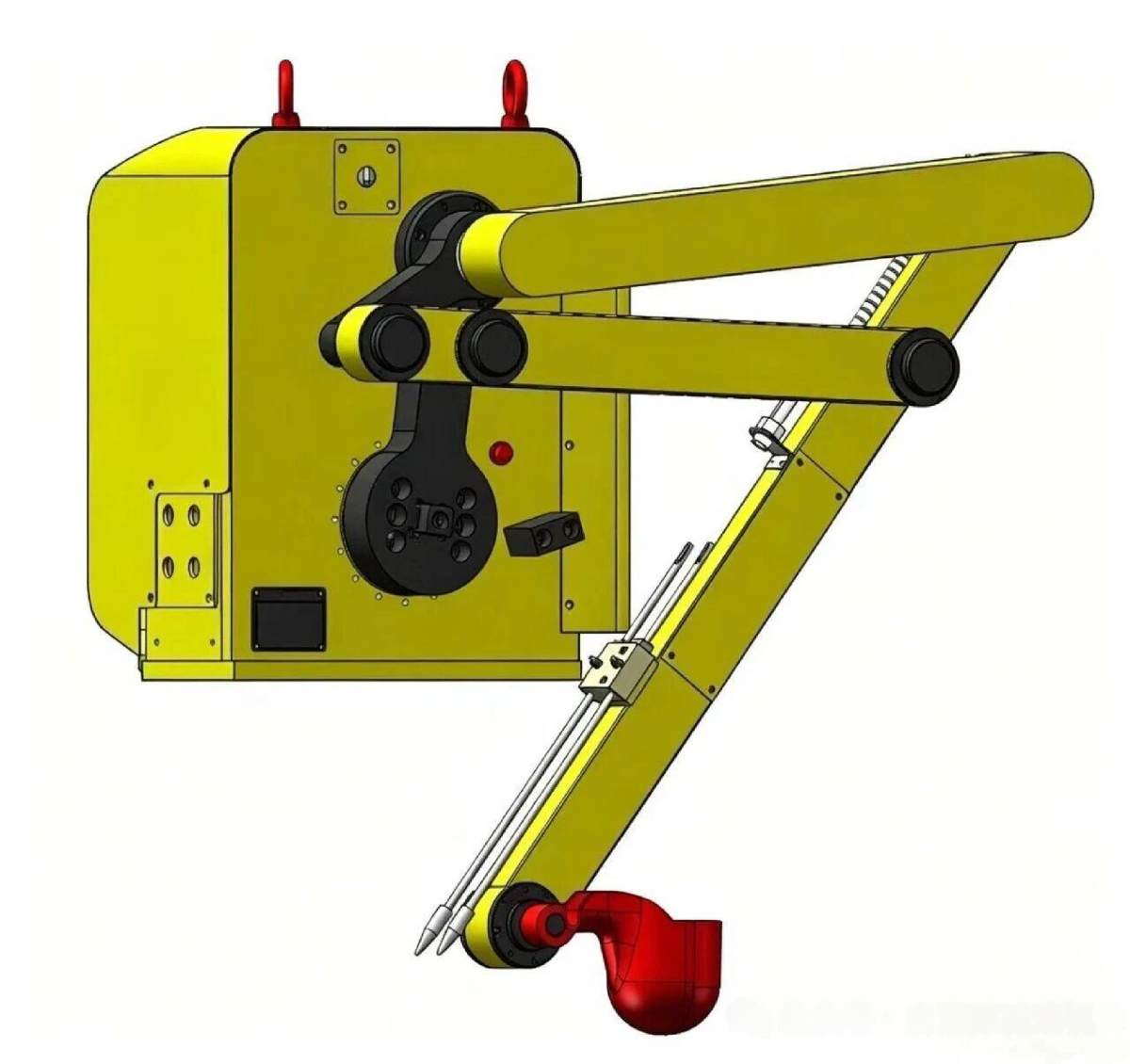
Die-casting ladling machines transfer molten metal from a holding furnace to a die-casting machine. Their operating environment is demanding because of high ambient temperatures, repeated movement cycles, and the need for stable pouring positions.
The rotary or tilting mechanism must handle the combined mass of the ladle, molten metal, and supporting structure. Depending on the machine design, the load may also be offset from the rotation axis, creating a significant overturning moment.
In large-capacity ladling machines, repeated acceleration, deceleration, and tilting movements can place considerable demands on the transmission system. Positioning drift or excessive mechanical deformation may affect pouring consistency and production stability.
An RV reducer can be considered for large-capacity equipment with eccentric loads and servo-controlled tilting mechanisms. Its high torsional rigidity and integrated bearing support can help the rotary axis withstand demanding mechanical conditions.
Nevertheless, high-temperature protection must be addressed independently. The reducer should be installed with appropriate thermal isolation, lubrication selection, sealing, and protection against heat radiation and contamination. The allowable operating temperature must be checked against the manufacturer's specifications.
For linkage-driven ladling systems or smaller-capacity equipment with relatively simple motion requirements, a planetary gearbox or another transmission solution may be sufficient. The choice should be based on the actual torque, load distribution, duty cycle, and environmental conditions rather than equipment type alone.
How Should You Calculate the Required Torque for an RV Reducer?
Selecting an RV reducer based only on workpiece weight or motor power is not sufficient. The design must account for both static and dynamic loads.
For a rotary axis carrying an eccentric load, a simplified peak-torque calculation can be expressed as:
T_peak = m × g × e + J × α + T_f
Where:
T_peak is the estimated peak output torque
m is the total moving mass
g is gravitational acceleration
e is the horizontal distance between the center of gravity and the rotation axis
J is the total rotational inertia around the axis
α is angular acceleration
T_f is the friction and other resisting torque
This formula provides a starting point for evaluating the load. The actual calculation may need to account for the direction of rotation, changing gravitational moment, braking conditions, impact loads, and the geometry of the complete mechanism.
It is also important to distinguish between the physical radius of the workpiece and the center-of-gravity offset. A large workpiece does not necessarily generate a large gravitational moment if its center of gravity is close to the rotation axis.
When selecting an RV reducer, engineers should also check the following factors:
Output torque and overload capacity: Confirm that rated output torque, acceleration torque, and peak torque are within the manufacturer's allowable limits. Do not use emergency-stop or short-duration overload figures as continuous operating ratings.
Radial and axial loads: Check whether the reducer's integrated bearing can support the external loads generated by the workpiece and fixture. If additional support is required, include it in the mechanical design.
Backlash and torsional rigidity: Evaluate the transmission requirements under actual operating loads. Low backlash alone does not guarantee high positioning accuracy if the supporting structure or servo-control system is insufficient.
Reduction ratio and output speed: Confirm that the reducer ratio matches the required output speed and motor operating range. The selected ratio should also allow sufficient torque and acceleration performance.
Duty cycle and service life: Consider operating hours, start-stop frequency, load variations, lubrication conditions, and maintenance intervals. A reducer that meets the peak torque requirement may still be unsuitable for a high-duty-cycle application.
What Are the Common Mistakes When Selecting an RV Reducer?
One common mistake is selecting a reducer based only on the maximum workpiece weight. The same workpiece mass can generate very different mechanical loads depending on its center-of-gravity offset and rotation axis.
Another mistake is treating peak torque as rated torque. A reducer may tolerate a high instantaneous torque for a limited period, but continuous operation at that level can lead to excessive temperature, wear, or premature failure.
Engineers should also avoid assuming that an RV reducer eliminates the need for external mechanical support in every application. Although many RV reducers feature integrated bearings, the allowable radial load, axial load, and overturning moment vary by model. These limits must be checked against the manufacturer's technical documentation.
Finally, transmission accuracy should not be evaluated independently of the complete machine. Reducer backlash, torsional rigidity, bearing clearance, mounting accuracy, encoder feedback, servo tuning, and structural deformation all influence the final positioning result.
How Can You Decide Between an RV Reducer and a Planetary Gearbox?
The decision should begin with the actual operating conditions rather than a preference for one transmission type.
An RV reducer is worth considering when the rotary axis handles heavy eccentric loads, experiences frequent start-stop cycles, requires high torsional rigidity, or operates continuously under demanding positioning conditions. Its integrated bearing structure may also simplify the mechanical design when the reducer is expected to support external loads.
A precision planetary gearbox is often a more practical choice for light or medium loads, higher operating speeds, and applications where efficiency and cost are major priorities. It can also be suitable when the machine already has a separate bearing arrangement capable of handling the external loads.
For specialized rotary equipment, the most suitable solution is the one that meets the complete mechanical and control requirements without unnecessary cost or complexity.
Conclusion: Is an RV Reducer Always the Best Choice for Rotary Equipment?
RV reducers offer advantages in applications involving heavy eccentric loads, substantial overturning moments, frequent start-stop operation, and long-term positioning requirements. These characteristics make them worth considering for heavy welding positioners, continuous rotary cutting tables, selected waterjet rotary tables, and large servo-controlled die-casting ladling machines.
However, an RV reducer is not universally superior to a precision planetary gearbox. Planetary gearboxes can provide higher transmission efficiency and lower cost, making them suitable for many light-duty and medium-duty rotary applications.
Before selecting a reducer, engineers should evaluate the total moving mass, center-of-gravity offset, peak torque, output speed, radial and axial loads, duty cycle, positioning accuracy, and environmental conditions. The final model should always be verified against the manufacturer's rated and allowable load specifications.
For specialized rotary equipment, a correct transmission selection is not simply about choosing a reducer with a higher torque rating. It is about matching the reducer's mechanical characteristics to the actual operating conditions of the machine.
Read More
Learn more about the story of HONPINE and industry trends related to precision transmission.
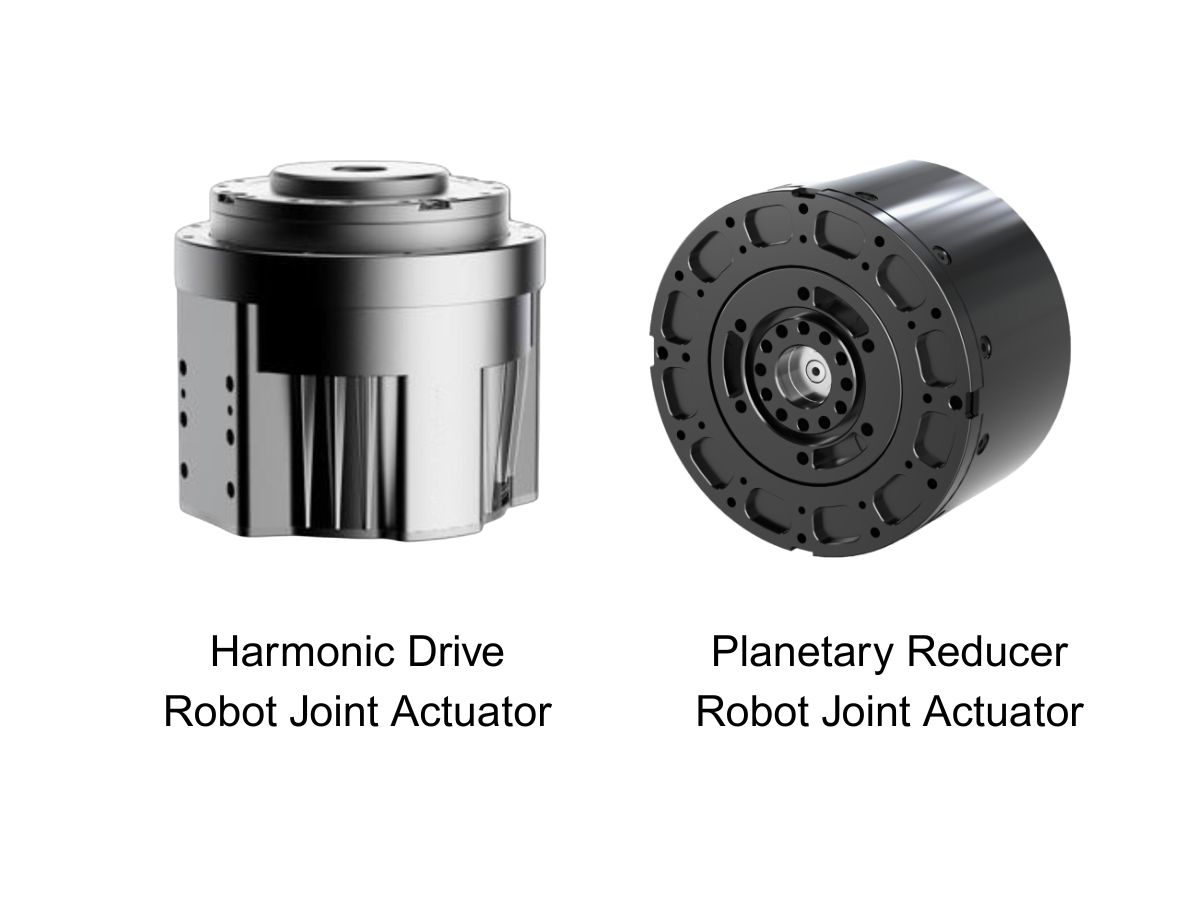
 What is robot joint actuator?How to Choose the Best Robot Rotary Joint Actuator?In core robot joint transmission solutions, planetary and harmonic rotary actuators each have their own strengths. Choosing the right type based on application requirements is essential to achieve the optimal balance between performance and cost.
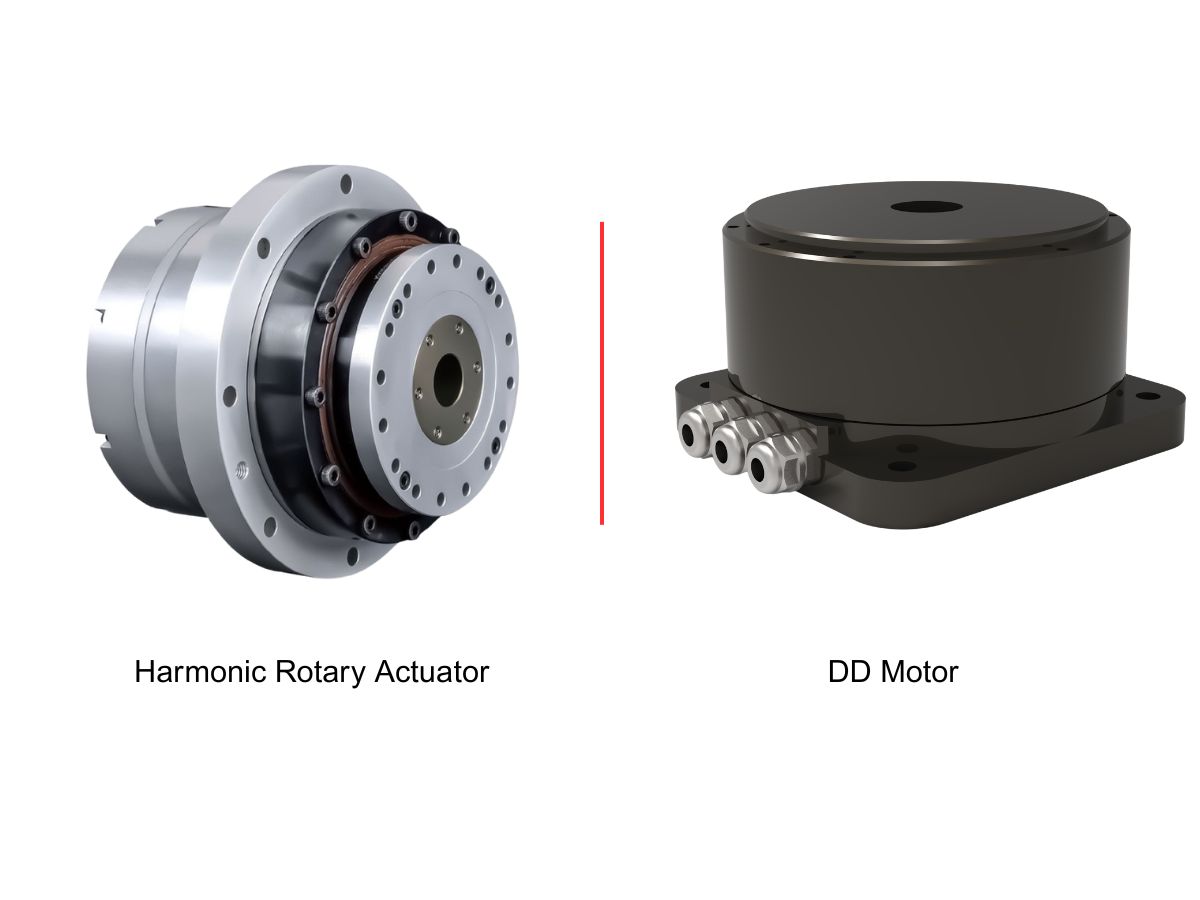
 DD Motors VS Harmonic Rotary ActuatorsThis article provides an in-depth comparison between Direct Drive (DD) motors and harmonic rotary actuators, covering their transmission principles, advantages and disadvantages, and typical application fields.
 OMG Ultra Compact Harmonic Drive Joint Module with Built-in Torque SensorHONPINE TCHL series harmonic drive joint module is a game-changing product that achieves disruptive improvements in multiple aspects such as lightweight design, integration level, and connection convenience. This article will analyze its revolutionary enhancements with you.
 The Role of Harmonic Drive Gears in Achieving 5–10 μm Accuracy in Dental Milling MachinesA dental milling machine is a CNC machining system used to directly process digital dental models into restorations such as crowns, bridges, veneers, inlays, and implant abutments. Dental milling machines require far higher operational accuracy and motion stability than ordinary equipment. This article explains how harmonic drive gear help dental milling machines achieve stable, continuous, and controllable operation.
 Why Are Harmonic Rotary Actuators Perfect for Medical Equipment?Harmonic rotary actuators (typically integrated systems consisting of a harmonic drive reducer, frameless torque motor, encoder, and optional brake) are regarded as key components in medical equipment. The core reason is that they simultaneously meet the most stringent medical requirements for precision, compact size, safety, and controllability. The following explanation is structured from three perspectives: technical characteristics, application scenarios, and medical value.
 High-Precision RV Reducers Perfectly Matched for Walking RobotsThe walking axis of a robot is a core component for power transmission and support. RV reducers provide extremely high rigidity, precision, and torque while maintaining a compact size and exceptional reliability, making them an ideal match for the demanding requirements of walking robot joints in terms of load capacity, impact resistance, and precision.
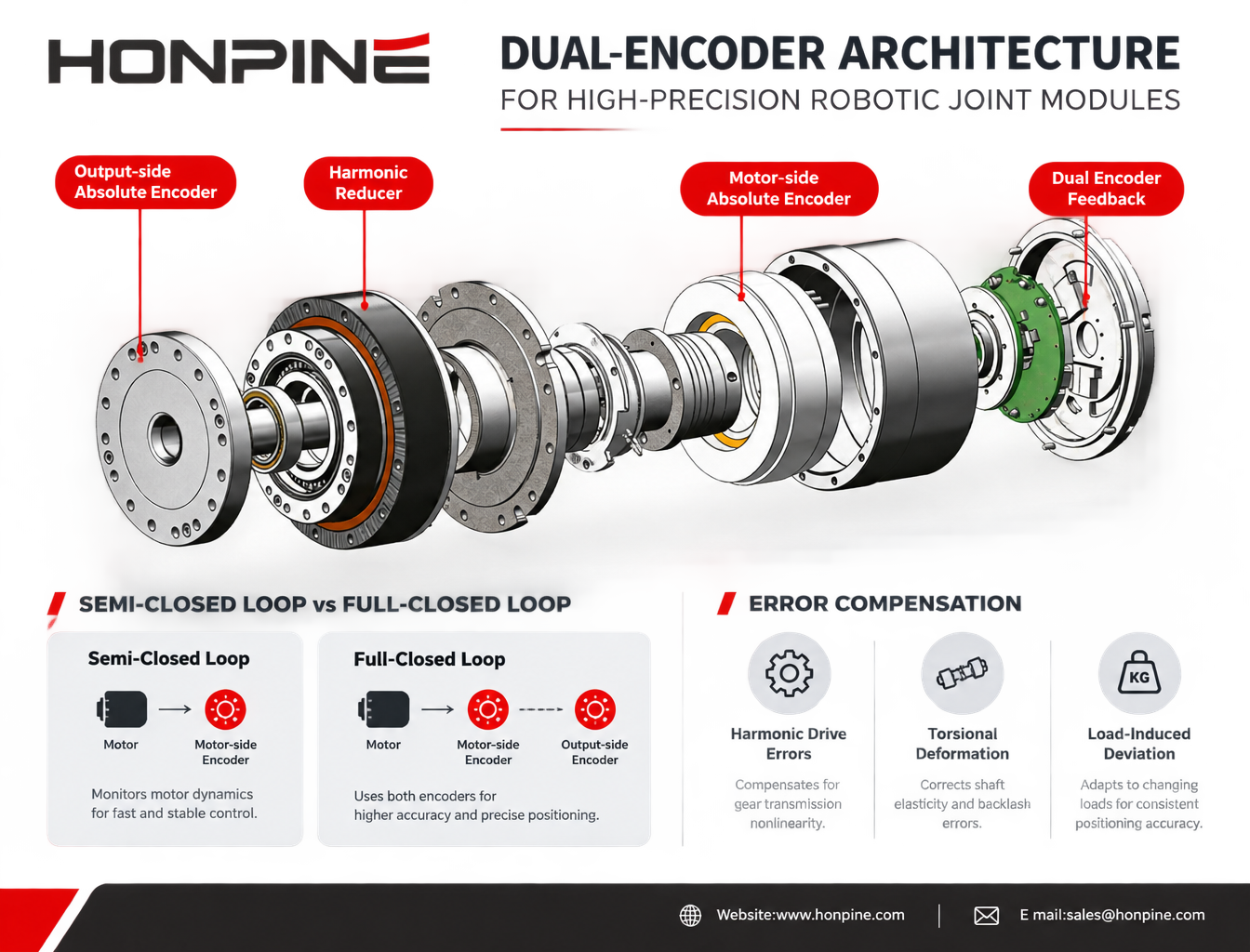
 Motor-Side vs. Output-Side Absolute Encoders in Robot Joint Modules: Position Feedback and Error CompensationA dual-encoder architecture plays an important role in improving the positioning accuracy of integrated robot joint modules. By combining a high-speed motor-side absolute encoder with a low-speed output-side absolute encoder, the system can monitor both motor rotation and actual joint output position. But what does each encoder do? How does dual-encoder feedback differ from single-encoder control? And how can it compensate for harmonic drive transmission errors, torsional deformation, and load-induced positioning deviations? This article explores the working principles, feedback architecture, and error compensation methods behind dual-encoder robot joint modules.
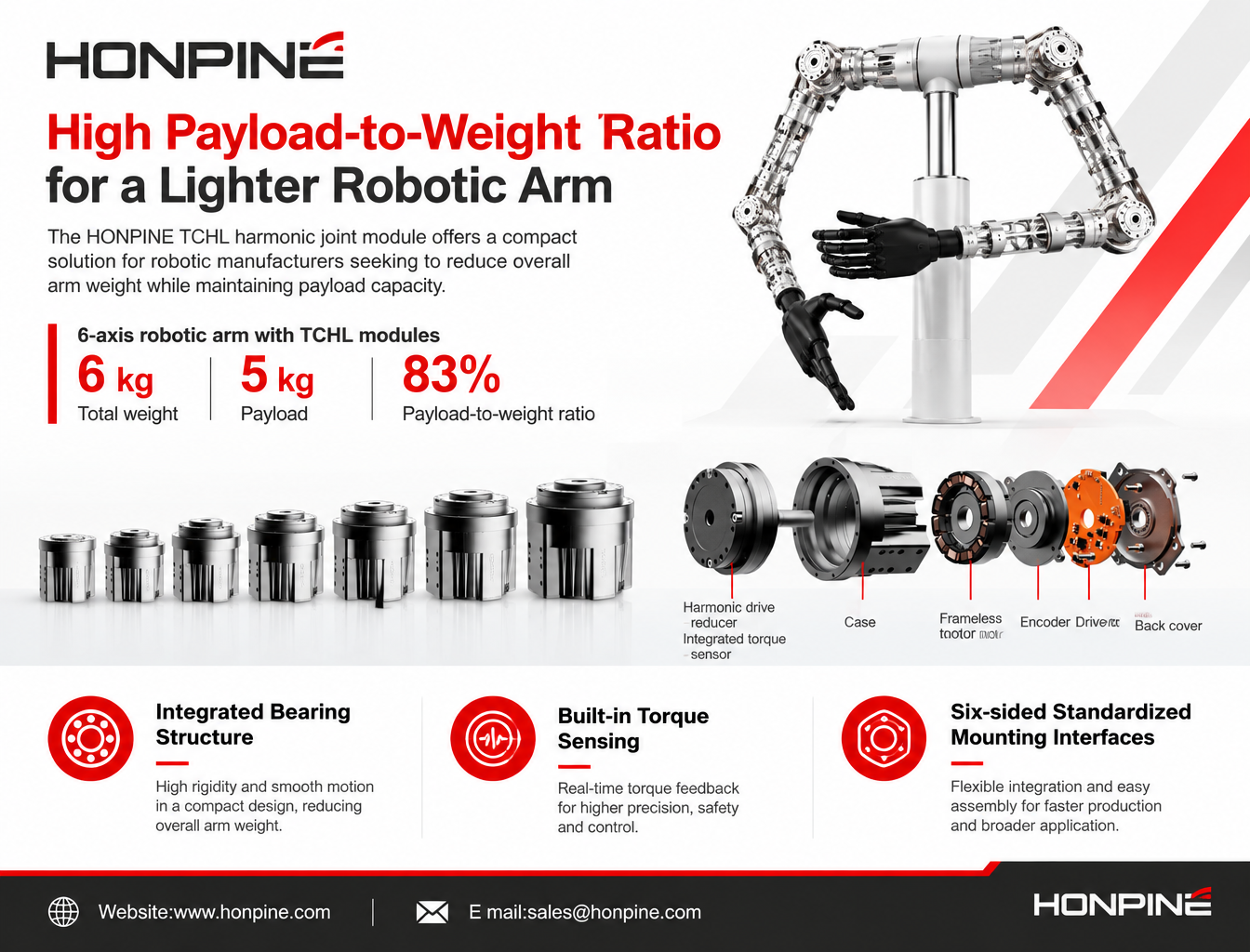
 How Does the HONPINE TCHL Harmonic Joint Module Achieve an 83% Payload-to-Weight Ratio?Discover how the HONPINE TCHL harmonic joint module helps a 6 kg robotic arm achieve an 83% payload-to-weight ratio through integrated bearing design, built-in torque sensing, and six-sided mounting interfaces.
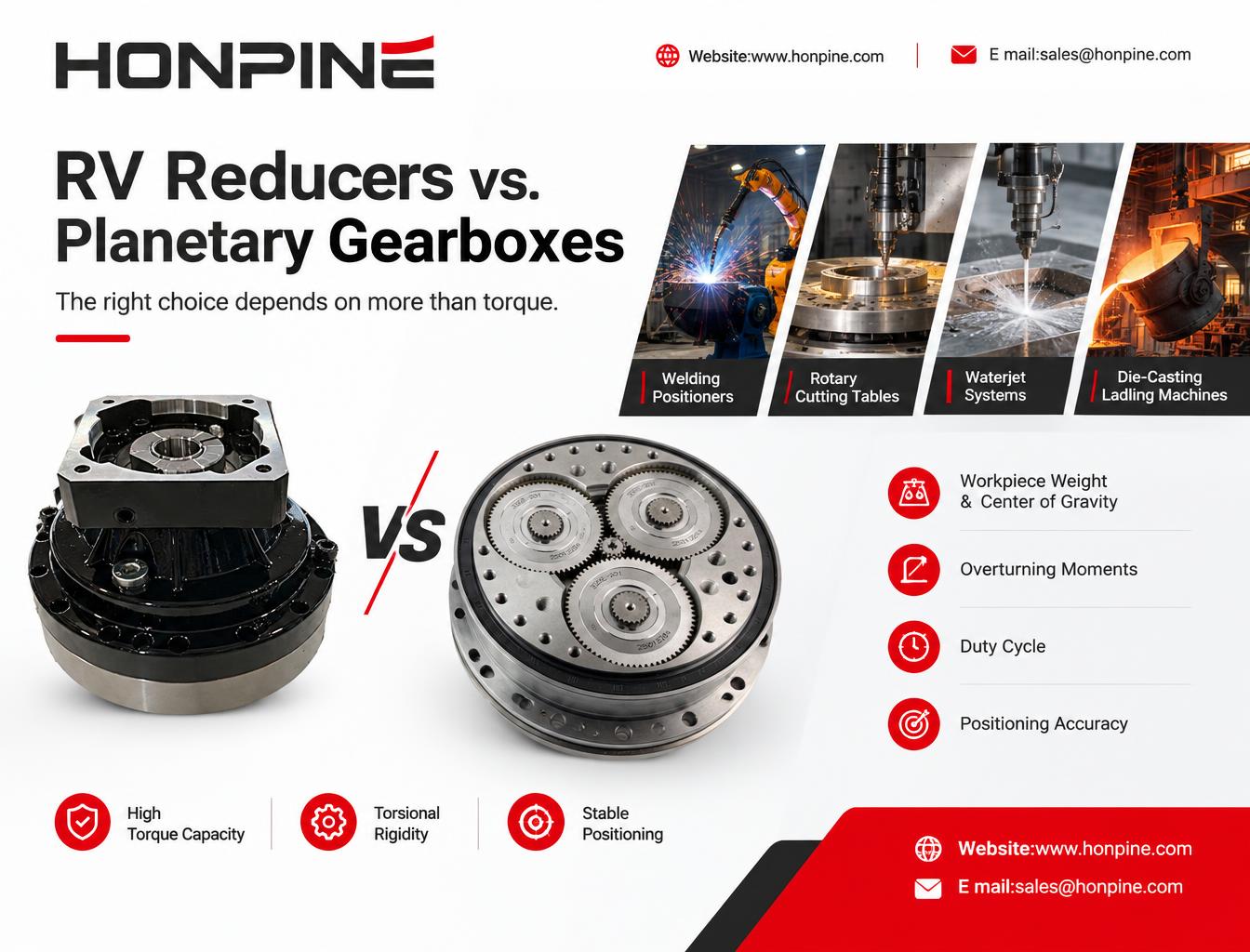
 Why Choose an RV Reducer for Specialized Rotary Equipment? Welding, Cutting, Waterjet, and Die-Casting ApplicationsRV reducers are widely used in industrial robots and heavy-duty rotary equipment where high torque capacity, torsional rigidity, and stable positioning are essential. But are they always better than precision planetary gearboxes? In applications such as welding positioners, rotary cutting tables, waterjet systems, and die-casting ladling machines, the right choice depends on more than rated torque. Workpiece weight, center-of-gravity offset, overturning moments, duty cycle, and positioning requirements all influence reducer selection. This guide explores where RV reducers offer practical advantages, when planetary gearboxes may be sufficient, and how to evaluate the key parameters for specialized rotary equipment.
 Top 5 China Harmonic Actuator Manufacturers in 2026Japan has traditionally been a major source of precision harmonic drive technology. However, China's robotics industry and precision manufacturing sector have developed rapidly, creating new opportunities for domestic harmonic actuator manufacturers. Today, Chinese suppliers offer a growing range of harmonic reducers, integrated rotary actuators, and robotic joint modules for humanoid robots, industrial automation, medical equipment, and precision machinery. In this article, we introduce five Chinese harmonic actuator manufacturers in 2026, comparing their company backgrounds, product portfolios, and technical capabilities to help buyers identify potential suppliers.
 What Limits the Maximum Speed of a Harmonic Drive Reducer?Learn what limits the maximum speed of a harmonic drive reducer. This guide explains the relationship between input and output speed, and examines how flexspline fatigue, flexible bearing performance, heat generation, and lubrication affect operating speed. Discover how to evaluate speed, torque, and duty cycle when selecting a harmonic drive for high-speed applications.
 AGV Drive Wheel Selection Guide: Non-Steering Drive Wheels vs. Differential Drive vs. Steering Drive WheelsChoosing the right AGV drive wheels is essential for achieving the required mobility, load capacity, and positioning performance in mobile robots. Different drive configurations offer different advantages in terms of maneuverability, mechanical complexity, control requirements, and overall cost. This guide compares three common AGV drive wheel types: non-steering drive wheels, differential drive systems, and steering drive wheels. By understanding how each configuration works and where it performs best, AGV and AMR manufacturers can make more informed decisions when designing their mobile robot platforms.
Double Click
We provide harmonic drive reducer,planetary reducer,robot joint motor,robot rotary actuators,RV gear reducer,robot end effector,dexterous robot hand
 What is robot joint actuator?How to Choose the Best Robot Rotary Joint Actuator?In core robot joint transmission solutions, planetary and harmonic rotary actuators each have their own strengths. Choosing the right type based on application requirements is essential to achieve the optimal balance between performance and cost.
 DD Motors VS Harmonic Rotary ActuatorsThis article provides an in-depth comparison between Direct Drive (DD) motors and harmonic rotary actuators, covering their transmission principles, advantages and disadvantages, and typical application fields.
 OMG Ultra Compact Harmonic Drive Joint Module with Built-in Torque SensorHONPINE TCHL series harmonic drive joint module is a game-changing product that achieves disruptive improvements in multiple aspects such as lightweight design, integration level, and connection convenience. This article will analyze its revolutionary enhancements with you.
 Motor-Side vs. Output-Side Absolute Encoders in Robot Joint Modules: Position Feedback and Error CompensationA dual-encoder architecture plays an important role in improving the positioning accuracy of integrated robot joint modules. By combining a high-speed motor-side absolute encoder with a low-speed output-side absolute encoder, the system can monitor both motor rotation and actual joint output position. But what does each encoder do? How does dual-encoder feedback differ from single-encoder control? And how can it compensate for harmonic drive transmission errors, torsional deformation, and load-induced positioning deviations? This article explores the working principles, feedback architecture, and error compensation methods behind dual-encoder robot joint modules.
 How Does the HONPINE TCHL Harmonic Joint Module Achieve an 83% Payload-to-Weight Ratio?Discover how the HONPINE TCHL harmonic joint module helps a 6 kg robotic arm achieve an 83% payload-to-weight ratio through integrated bearing design, built-in torque sensing, and six-sided mounting interfaces.
 Why Choose an RV Reducer for Specialized Rotary Equipment? Welding, Cutting, Waterjet, and Die-Casting ApplicationsRV reducers are widely used in industrial robots and heavy-duty rotary equipment where high torque capacity, torsional rigidity, and stable positioning are essential. But are they always better than precision planetary gearboxes? In applications such as welding positioners, rotary cutting tables, waterjet systems, and die-casting ladling machines, the right choice depends on more than rated torque. Workpiece weight, center-of-gravity offset, overturning moments, duty cycle, and positioning requirements all influence reducer selection. This guide explores where RV reducers offer practical advantages, when planetary gearboxes may be sufficient, and how to evaluate the key parameters for specialized rotary equipment.
 Top 5 China Harmonic Actuator Manufacturers in 2026Japan has traditionally been a major source of precision harmonic drive technology. However, China's robotics industry and precision manufacturing sector have developed rapidly, creating new opportunities for domestic harmonic actuator manufacturers. Today, Chinese suppliers offer a growing range of harmonic reducers, integrated rotary actuators, and robotic joint modules for humanoid robots, industrial automation, medical equipment, and precision machinery. In this article, we introduce five Chinese harmonic actuator manufacturers in 2026, comparing their company backgrounds, product portfolios, and technical capabilities to help buyers identify potential suppliers.
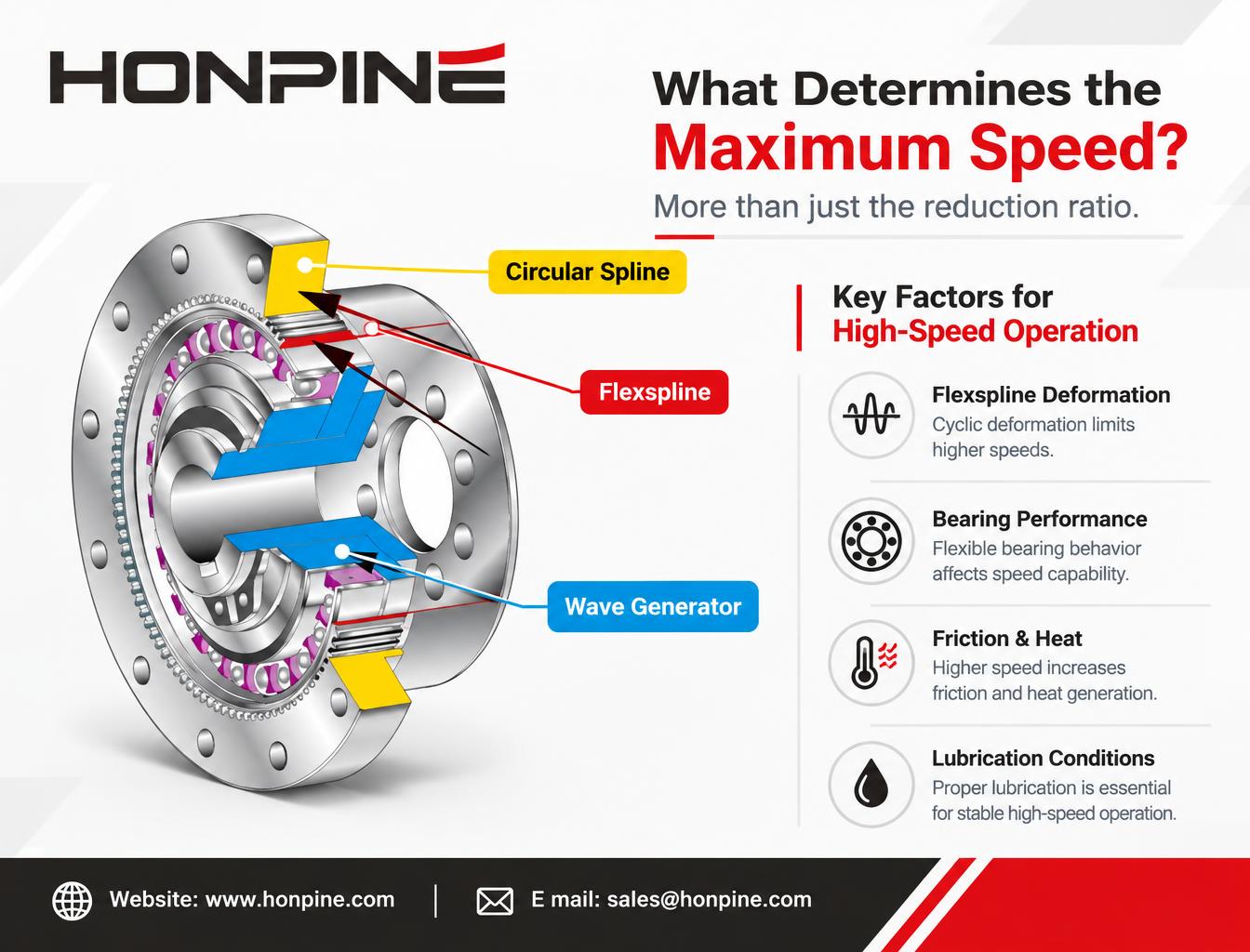
 What Limits the Maximum Speed of a Harmonic Drive Reducer?Learn what limits the maximum speed of a harmonic drive reducer. This guide explains the relationship between input and output speed, and examines how flexspline fatigue, flexible bearing performance, heat generation, and lubrication affect operating speed. Discover how to evaluate speed, torque, and duty cycle when selecting a harmonic drive for high-speed applications.
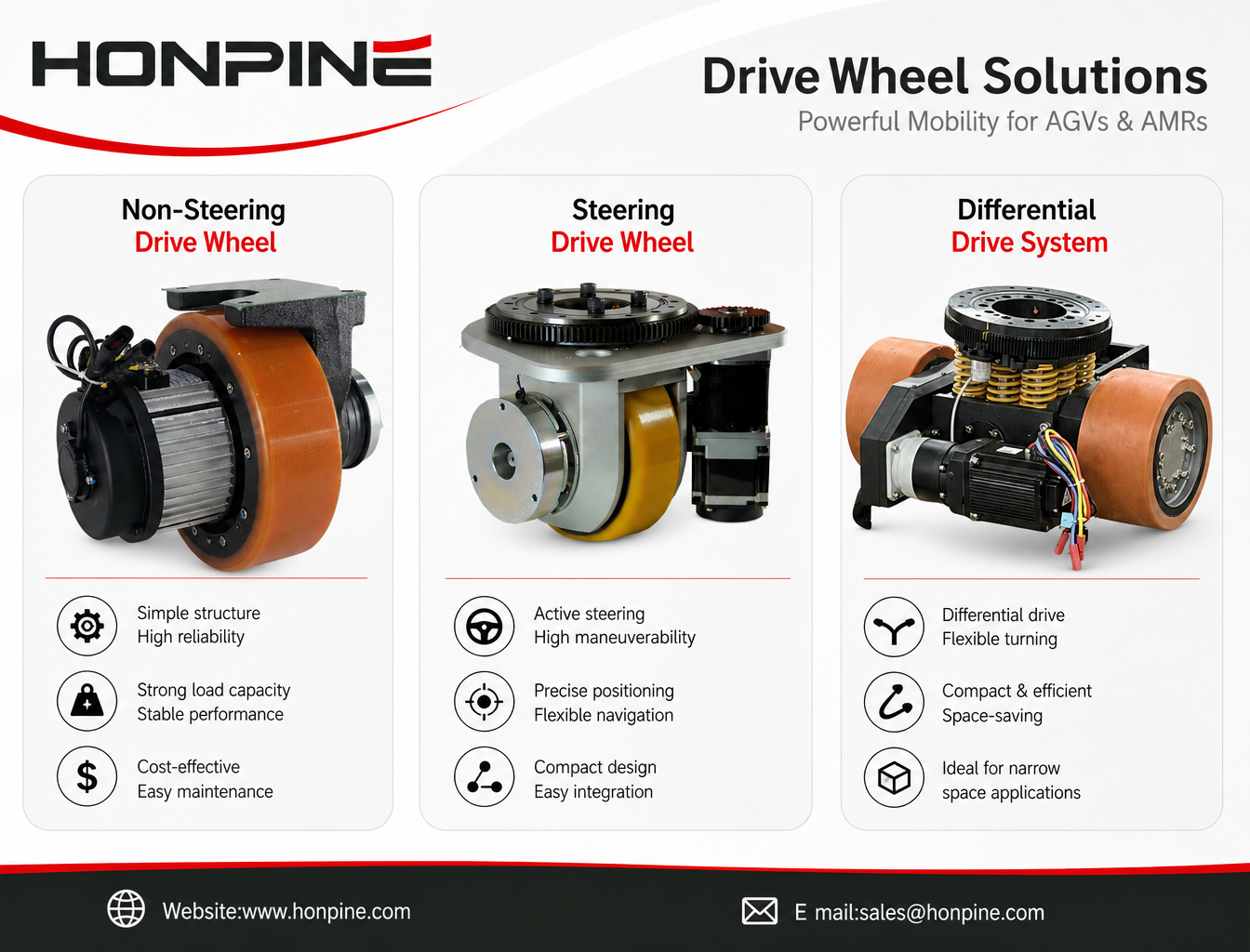
 AGV Drive Wheel Selection Guide: Non-Steering Drive Wheels vs. Differential Drive vs. Steering Drive WheelsChoosing the right AGV drive wheels is essential for achieving the required mobility, load capacity, and positioning performance in mobile robots. Different drive configurations offer different advantages in terms of maneuverability, mechanical complexity, control requirements, and overall cost. This guide compares three common AGV drive wheel types: non-steering drive wheels, differential drive systems, and steering drive wheels. By understanding how each configuration works and where it performs best, AGV and AMR manufacturers can make more informed decisions when designing their mobile robot platforms.
 How Does a Robot Joint Module Affect Motion Control in Humanoid Robots and Collaborative Arms?Robot motion performance depends on more than the motor or reducer alone. The robot joint module integrates key transmission and control components, directly influencing torque output, positioning accuracy, dynamic response, and force control capability. For humanoid robots and collaborative robot arms, these factors determine how smoothly, accurately, and reliably each joint operates under different working conditions. This article explores how robot joint modules affect overall motion control, why integrated designs are becoming increasingly important, and how different joint module architectures support the development of advanced robotic systems.
 HONPINE HAG Harmonic Joint Module: Redefining Robotic Motion Control with Wide Bandwidth, Low Phase Lag, and High CoherenceWhen a robot experiences joint vibration, inaccurate trajectory tracking, or delayed force feedback, the problem may lie in the dynamic response of its joint actuator. Bandwidth, phase lag, and signal coherence are critical indicators of robotic motion performance. In this article, we examine the actual sine-sweep test results of the HONPINE HAG 17 harmonic joint module, including its 87 Hz ±1 dB bandwidth, 139 Hz ±3 dB bandwidth, and 164 Hz -90° phase frequency. We also explore how its torque density, positioning accuracy, and hollow-shaft design support advanced humanoid robots and collaborative robotic applications.
 How to Find a Reliable Harmonic Reducer Wholesaler in China?Choosing a reliable harmonic reducer wholesaler in China involves more than comparing prices and product specifications. Buyers need to evaluate technical capabilities, manufacturing quality, product consistency, and long-term supply reliability. Whether you are sourcing harmonic reducers for robotics, semiconductor equipment, CNC machinery, or industrial automation, understanding how to assess suppliers is essential. This guide outlines four practical steps to help you verify product performance, evaluate manufacturers, and make informed bulk purchasing decisions.