









How Does a Harmonic Drive Actuator Achieve High Torque Density?
Introduction
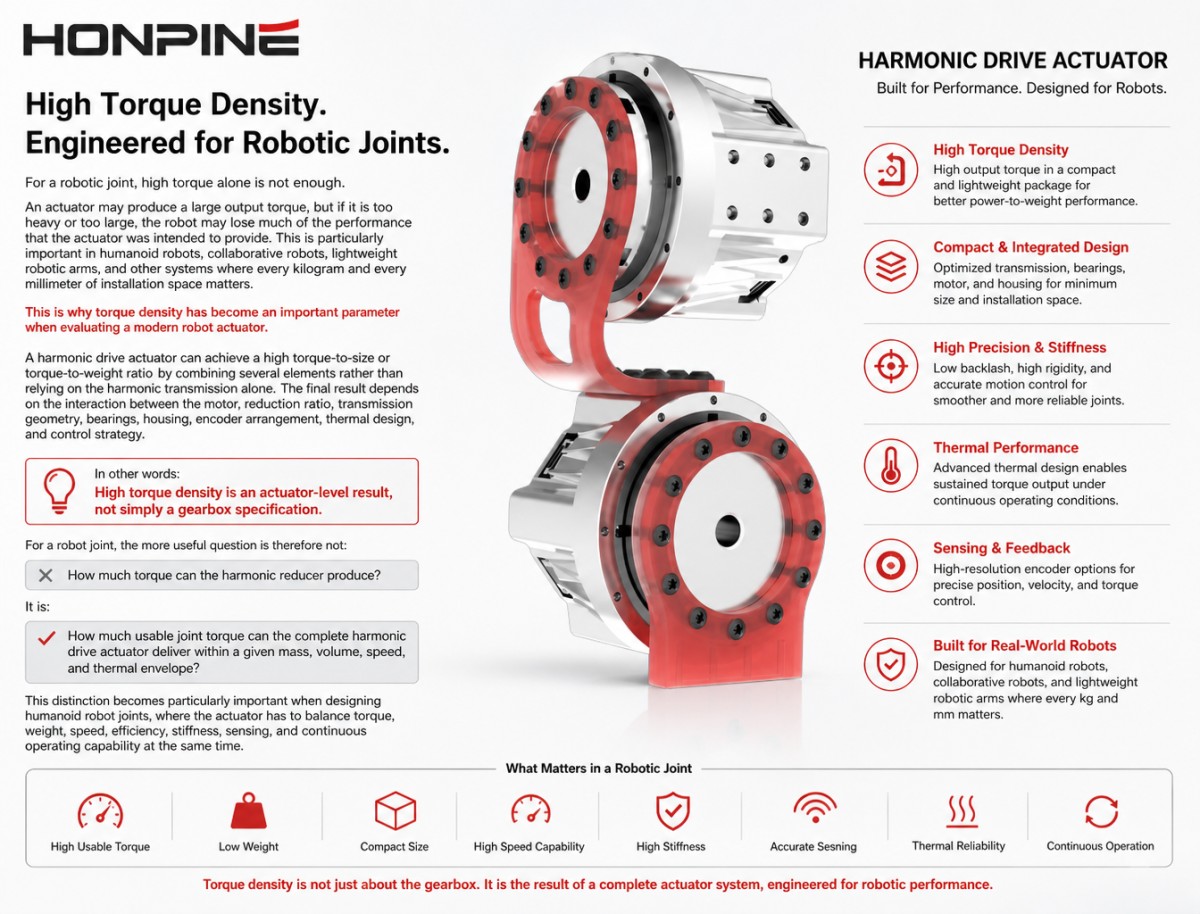
For a robotic joint, high torque alone is not enough.
An actuator may produce a large output torque, but if it is too heavy or too large, the robot may lose much of the performance that the actuator was intended to provide. This is particularly important in humanoid robots, collaborative robots, lightweight robotic arms, and other systems where every kilogram and every millimeter of installation space matters.
This is why torque density has become an important parameter when evaluating a modern robot actuator.
A harmonic drive actuator can achieve a high torque-to-size or torque-to-weight ratio by combining several elements rather than relying on the harmonic transmission alone. The final result depends on the interaction between the motor, reduction ratio, transmission geometry, bearings, housing, encoder arrangement, thermal design, and control strategy.
In other words:
High torque density is an actuator-level result, not simply a gearbox specification.
For a robot joint, the more useful question is therefore not:
How much torque can the harmonic reducer produce?
It is:
How much usable joint torque can the complete harmonic drive actuator deliver within a given mass, volume, speed, and thermal envelope?
This distinction becomes particularly important when designing humanoid robot joints, where the actuator has to balance torque, weight, speed, efficiency, stiffness, sensing, and continuous operating capability at the same time.
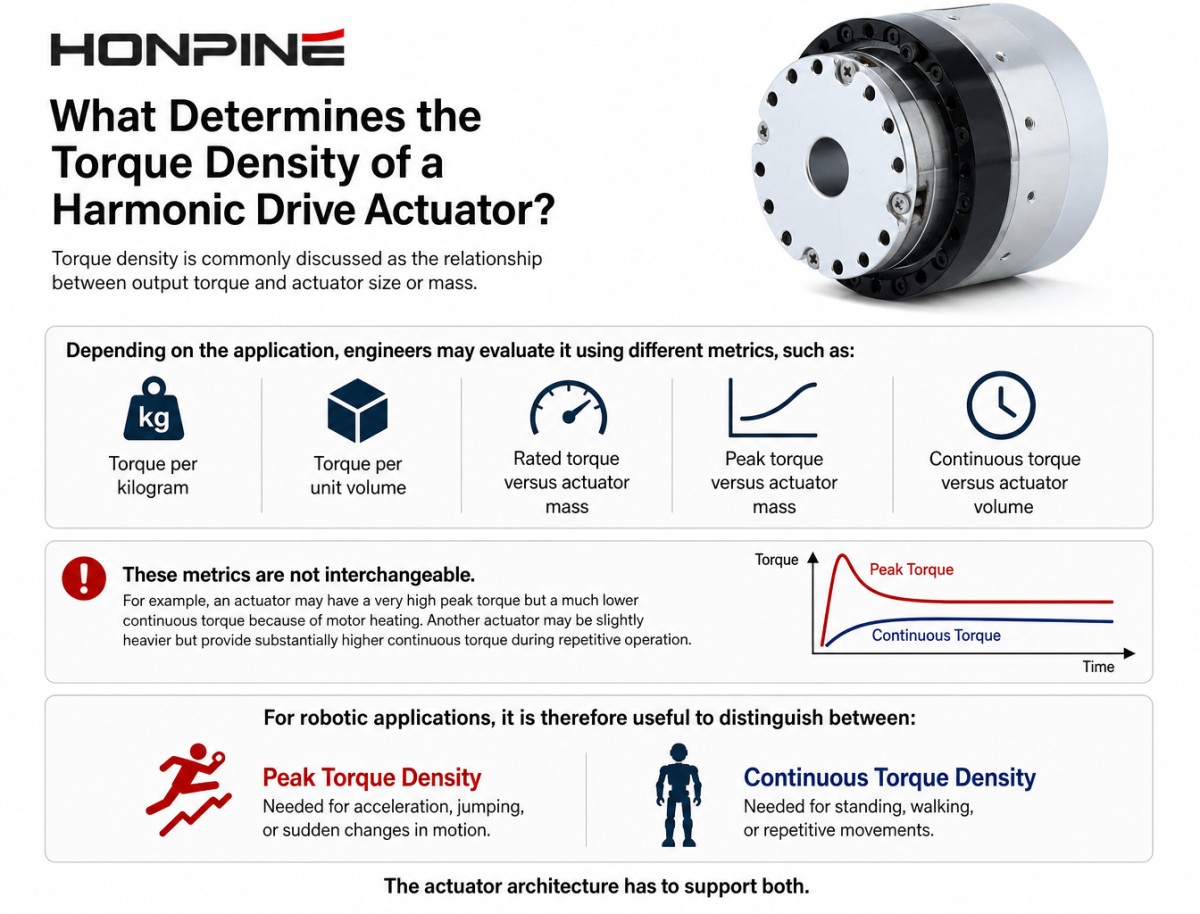
What Determines the Torque Density of a Harmonic Drive Actuator?
Torque density is commonly discussed as the relationship between output torque and actuator size or mass.
Depending on the application, engineers may evaluate it using different metrics, such as:
Torque per kilogram
Torque per unit volume
Rated torque versus actuator mass
Peak torque versus actuator mass
Continuous torque versus actuator volume
These metrics are not interchangeable.
For example, an actuator may have a very high peak torque but a much lower continuous torque because of motor heating. Another actuator may be slightly heavier but provide substantially higher continuous torque during repetitive operation.
For robotic applications, it is therefore useful to distinguish between:
Peak torque density and Continuous torque density
A humanoid robot may need high peak torque during acceleration, jumping, or sudden changes in motion, while the same joint also needs sufficient continuous torque for standing, walking, or repetitive movements.
The actuator architecture has to support both.
The Motor Sets the Starting Point for Torque Density
The harmonic reducer does not generate torque by itself.
The motor provides the initial torque, while the transmission converts motor speed and torque into the required joint output.
A simplified relationship is:
Motor torque → Reduction → Joint output torque
For an ideal transmission:
Output Torque ≈ Motor Torque × Reduction Ratio
In a real actuator, transmission losses must also be considered.
This means that selecting a motor with high torque density is the first step toward achieving a high torque-density actuator.
However, simply installing a larger motor is not always the best solution.
A larger motor can increase:
Actuator mass
Housing size
Thermal load
Rotor inertia
Power consumption
Instead, actuator designers need to find an appropriate operating point where the motor can deliver the required torque without occupying excessive space or adding unnecessary weight.
This is one reason integrated actuator design is important.
The motor and harmonic transmission should be considered as one system rather than as completely independent components.
High Reduction Ratio Helps Multiply Output Torque
One of the most important contributors to harmonic actuator torque density is the reduction ratio.
A high reduction ratio allows a relatively small high-speed motor to produce a much larger output torque.
For example, consider a simplified transmission:
Motor → Harmonic Reduction → Joint Output
If the motor produces a certain input torque, the reduction mechanism can multiply the available output torque according to its reduction ratio and transmission efficiency.
This allows the motor to operate at a speed range where it can deliver power efficiently while the gearbox converts that speed into the lower-speed, higher-torque output required by the robot joint.
However, a higher reduction ratio is not automatically better.
Increasing the reduction ratio can affect:
Output speed
Efficiency
Backdrivability
Dynamic response
Motor operating point
Thermal performance
Therefore, the reduction ratio should be selected according to the joint's actual torque and speed requirements.
Why High Reduction Ratio Does Not Automatically Mean High Torque Density?
This is an important point that is often overlooked.
Suppose two actuators use different reduction ratios.
The actuator with the higher ratio may produce more output torque from the same motor torque.
But if achieving that ratio requires:
Additional transmission stages
Larger components
Heavier bearings
A larger housing
More cooling capacity
the overall actuator may not have better torque density.
The relevant metric is the performance of the complete actuator, not the reduction ratio alone.
This is why a good harmonic drive actuator needs to balance:
Motor Torque + Reduction Ratio + Efficiency + Mass + Volume
rather than maximizing any single parameter.
Harmonic Transmission Geometry Contributes to Compact Torque Capacity
The mechanical architecture of a harmonic transmission is another reason it can achieve substantial torque capacity within a relatively compact package.
Unlike a conventional spur gear arrangement where torque is transmitted through a relatively simple gear pair, harmonic transmission uses multiple tooth engagements between the flexspline and circular spline.
This allows the transmitted load to be distributed across multiple engagement points.
The result is a transmission architecture capable of delivering significant torque within a compact diameter.
For a robot joint, this matters because the actuator often has to fit inside a limited mechanical envelope.
The available space may already be occupied by:
Structural components
Bearings
Wiring
Sensors
Motor components
Cooling paths
A transmission that can provide the required torque without significantly increasing the joint diameter can therefore contribute directly to actuator-level torque density.
The Output Bearing Is Part of the Torque-Density Equation
A common mistake when comparing robot actuators is to focus only on the motor and reducer.
The output bearing can also have a significant influence on the final actuator size and mass.
A robot joint does not only transmit rotational torque.
It may also experience:
Radial loads
Axial loads
Overturning moments
External forces
Dynamic impacts
The actuator therefore needs an appropriate output bearing arrangement.
If the bearing is oversized, the actuator becomes heavier.
If it is undersized, the actuator may not provide sufficient mechanical durability or stiffness.
A well-designed harmonic drive actuator integrates the transmission and bearing structure so that the joint can carry the expected external loads without unnecessarily increasing the overall package.
This is particularly important for humanoid robot joints.
For example, a knee or ankle actuator may experience significant external moments that are not represented by the motor torque alone.
Housing Design Can Increase or Reduce Torque Density
The actuator housing is another part of the torque-density equation.
A housing has to provide:
Structural stiffness
Bearing support
Gear alignment
Heat dissipation
Protection for internal components
But excessive housing material increases weight.
The challenge is therefore to achieve sufficient rigidity with minimal unnecessary mass.
This is especially relevant in humanoid robots.
A heavy actuator installed near the hip or knee does not only increase the robot's total mass. It can also increase the load that downstream joints need to move.
This creates a cascading effect:
Heavier actuator → Higher joint load → Higher required torque → Larger actuator → Higher total mass
Breaking this cycle is one of the reasons lightweight, high-torque-density actuators are important for humanoid robotics.
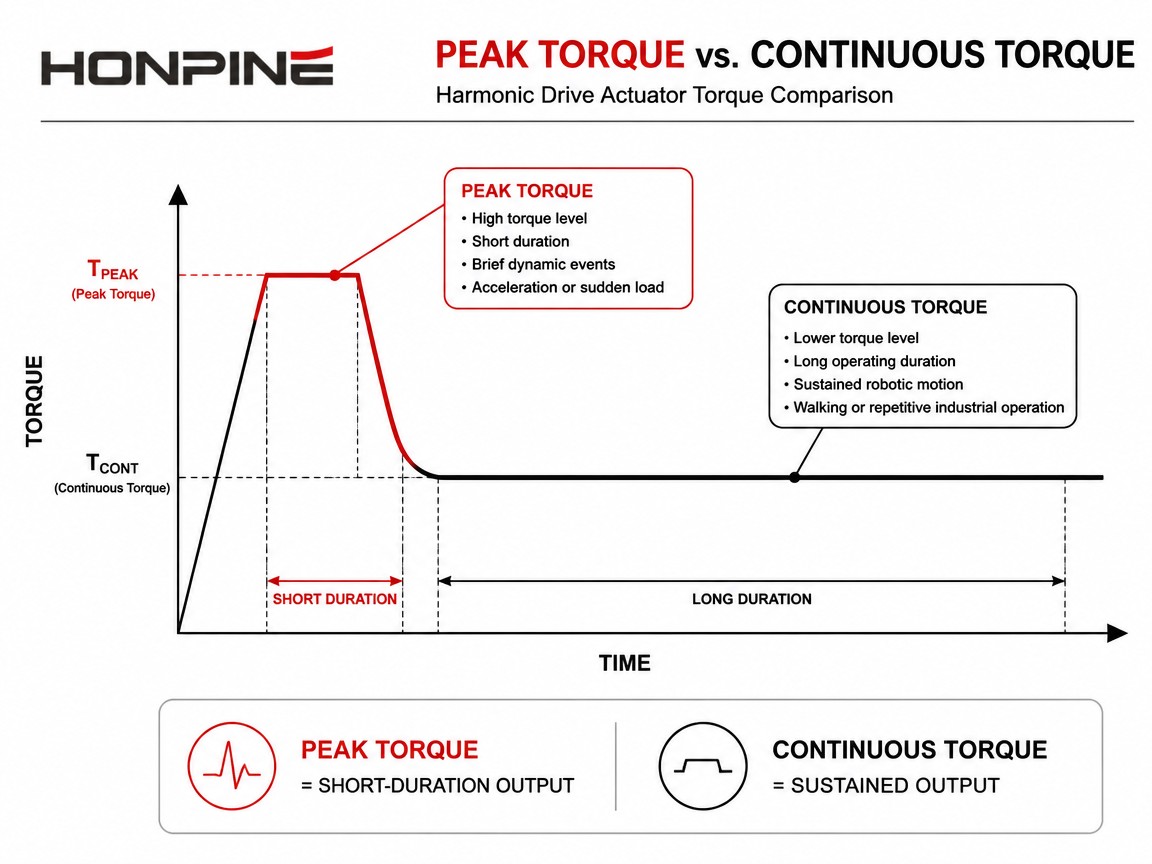
Torque Density Depends on Continuous Torque, Not Just Peak Torque
When comparing harmonic drive actuators, peak torque can look impressive on a specification sheet.
However, peak torque is usually associated with short-duration operation.
For many robots, continuous torque is equally important.
Consider a humanoid robot standing upright.
The leg joints may need to produce torque continuously rather than only for a few seconds.
Similarly, a robotic arm performing repetitive assembly may operate for hours.
In these situations, the useful metric is closer to:
Continuous Output Torque / Actuator Mass
rather than:
Peak Output Torque / Actuator Mass
A well-designed actuator therefore needs to manage:
Motor copper losses
Iron losses
Bearing losses
Transmission losses
Heat transfer
Ambient temperature
Duty cycle
High peak torque is useful, but high continuous torque density is often more relevant to real-world robot performance.
Thermal Management Sets a Practical Limit on Torque Density
Torque generates heat.
This creates an important relationship between torque density and thermal design.
As actuator size decreases, the available surface area for heat dissipation can also decrease.
At the same time, a compact actuator may have less internal space for:
Heat sinks
Cooling channels
Fans
Thermal interfaces
The actuator therefore has to manage heat within a smaller physical envelope.
For this reason, increasing torque density indefinitely is not realistic.
The actuator designer has to find a balance between:
Torque → Current → Heat → Temperature → Continuous Operating Capability
An actuator that achieves extremely high torque for a few seconds but overheats during normal operation may not be suitable for a production robot.
This is why thermal performance should be evaluated together with torque specifications.
Efficiency Directly Influences Usable Torque Density
Harmonic drive efficiency is another factor that affects actuator performance.
Not all of the input mechanical power becomes useful output power.
Some energy is lost through:
Gear deformation
Friction
Bearing losses
Lubrication
Sealing
Other mechanical effects
These losses become heat.
The relationship can be simplified as:
Input Power → Useful Output Power + Losses
Higher transmission losses mean more heat must be removed from the actuator.
This can reduce the amount of torque that the actuator can continuously deliver.
Therefore, when comparing two harmonic drive actuators with similar peak torque, it is useful to examine:
Rated torque
Continuous torque
Efficiency
Input speed
Duty cycle
Thermal rating
rather than relying on peak torque alone.
Why Actuator Weight Matters More Than Reducer Weight?
For a stationary industrial machine, adding several hundred grams may have little effect on system performance.
For a humanoid robot, the situation is different.
Every actuator contributes to the total moving mass of the robot.
If an actuator is installed on the upper leg, for example, its mass becomes part of the load that other joints need to move.
This means actuator mass can influence:
Acceleration
Energy consumption
Walking efficiency
Dynamic balance
Payload
Joint torque requirements
Therefore, a lightweight actuator with slightly lower absolute torque may sometimes be more useful than a heavier actuator with a larger peak torque rating.
This is why torque-to-weight ratio is increasingly important in humanoid robot actuator design.
Motor Size and Reduction Ratio Must Be Matched
A harmonic drive actuator cannot be optimized by selecting the reducer independently from the motor.
The motor and transmission need to operate as a matched pair.
For example, a designer may have two possible approaches:
Option A
Large motor + lower reduction ratio
Option B
Smaller motor + higher reduction ratio
Both approaches may produce similar output torque.
However, they can have very different:
Mass
Volume
Efficiency
Speed
Thermal behavior
Dynamic response
Cost
The better solution depends on the target joint.
For a compact humanoid wrist, minimizing mass and diameter may be critical.
For a high-load industrial joint, continuous torque and rigidity may be more important.
This is why actuator optimization should begin with the joint's actual operating profile rather than starting with a predefined gearbox size.
Peak Torque, Rated Torque and Continuous Torque Should Be Evaluated Separately
When evaluating a harmonic drive actuator, three torque values should not be treated as interchangeable.
Peak Torque
Peak torque represents the maximum torque the actuator can deliver under specified conditions for a limited duration.
It is important for:
Acceleration
Short-term dynamic movement
Impact response
Rapid changes in direction
Rated or Continuous Torque
Rated torque represents the torque the actuator can deliver under defined operating conditions for sustained operation.
This is more relevant for:
Walking
Repetitive motion
Continuous industrial operation
Sustained load
Overload Capacity
Some applications also require short-term overload capability.
This can be important when a robot experiences:
Sudden acceleration
External impact
Emergency braking
Unexpected load changes
The relationship between these values gives a much clearer picture of actual actuator capability than a single torque number.
Why Torque Density Is Especially Important for Humanoid Robot Joints?
Humanoid robots place unusually strict constraints on actuator design.
A humanoid joint often has to fit inside a body structure designed around approximate human dimensions.
At the same time, it needs to provide enough torque to move the robot's mass.
This creates competing requirements:
Small Size
↓
Low Weight
↓
High Torque
↓
High Speed
↓
High Efficiency
↓
Thermal Stability
The actuator has to balance all of them.
This is particularly challenging in:
Hip joints
Knee joints
Ankle joints
Shoulder joints
Elbow joints
The best actuator for each joint may therefore be different.
A high-torque leg joint may prioritize continuous torque and thermal performance, while a wrist actuator may prioritize low mass, compact dimensions, and low inertia.
Torque Density Is Not the Same as Power Density
These two terms are sometimes confused.
Torque density describes how much torque an actuator can provide relative to its mass or volume.
Power density also considers rotational speed.
A simplified relationship is:
Power = Torque × Angular Speed
This means that an actuator with extremely high torque but relatively low speed may not have the same power density as a faster actuator.
For dynamic robots, both metrics can matter.
For example:
A knee actuator may require high torque at moderate speed.
A wrist actuator may require lower torque but high speed.
A mobile robot wheel drive may require continuous torque and relatively high rotational speed.
Therefore, actuator selection should consider the complete torque-speed operating envelope rather than a single torque-density figure.
How Encoder Integration Affects the Actuator Architecture?
Sensors do not directly create torque, but they affect how effectively the actuator can use its available torque.
A harmonic drive actuator may incorporate:
Motor-side encoder
Output-side encoder
Dual encoders
Torque sensor
Temperature sensing
A motor-side encoder can provide feedback for motor control.
An output-side encoder can measure the actual joint output position after the reduction mechanism.
For applications requiring highly accurate joint control, measuring the output shaft can provide information that cannot be obtained from the motor encoder alone.
This is especially relevant when the actuator needs to compensate for:
Transmission errors
Elastic deformation
External loads
Position deviations
Therefore, sensor integration should be considered as part of the complete actuator architecture.
Does a Torque Sensor Improve the Effective Performance of a High-Torque-Density Actuator?
A torque sensor does not increase the mechanical torque capacity of the actuator.
Its value is different.
It gives the controller information about the torque being transmitted through the joint.
This can support:
Torque control
Force control
Collision detection
Compliance control
Contact detection
For humanoid robots, this information can be particularly useful during:
Walking
Object manipulation
Physical interaction
Balance control
Contact-rich tasks
However, adding a torque sensor also adds:
Mass
Volume
Cost
Mechanical integration requirements
Therefore, sensor selection becomes another part of the torque-density optimization problem.
The goal is not simply to integrate as many sensors as possible.
The goal is to achieve the required sensing capability without unnecessarily increasing actuator mass and volume.
Harmonic Drive Actuator Torque Density Is a System-Level Optimization
The previous factors show why torque density cannot be attributed to the harmonic reducer alone.
A complete actuator includes multiple elements:
Motor
Harmonic Transmission
Bearings
Housing
Encoder
Driver
Sensors
Thermal Structure
The final torque density is determined by the complete package.
For example, an actuator may use a very high-performance harmonic reducer but still have poor torque-to-weight performance if:
The motor is oversized
The housing is unnecessarily heavy
The bearing arrangement is inefficient
The cooling system adds excessive mass
The driver is physically separated from the actuator
The sensor architecture is poorly integrated
This is why integrated actuator design can provide an advantage over simply assembling individual components.
How Integrated Design Can Improve Torque-to-Weight Ratio?
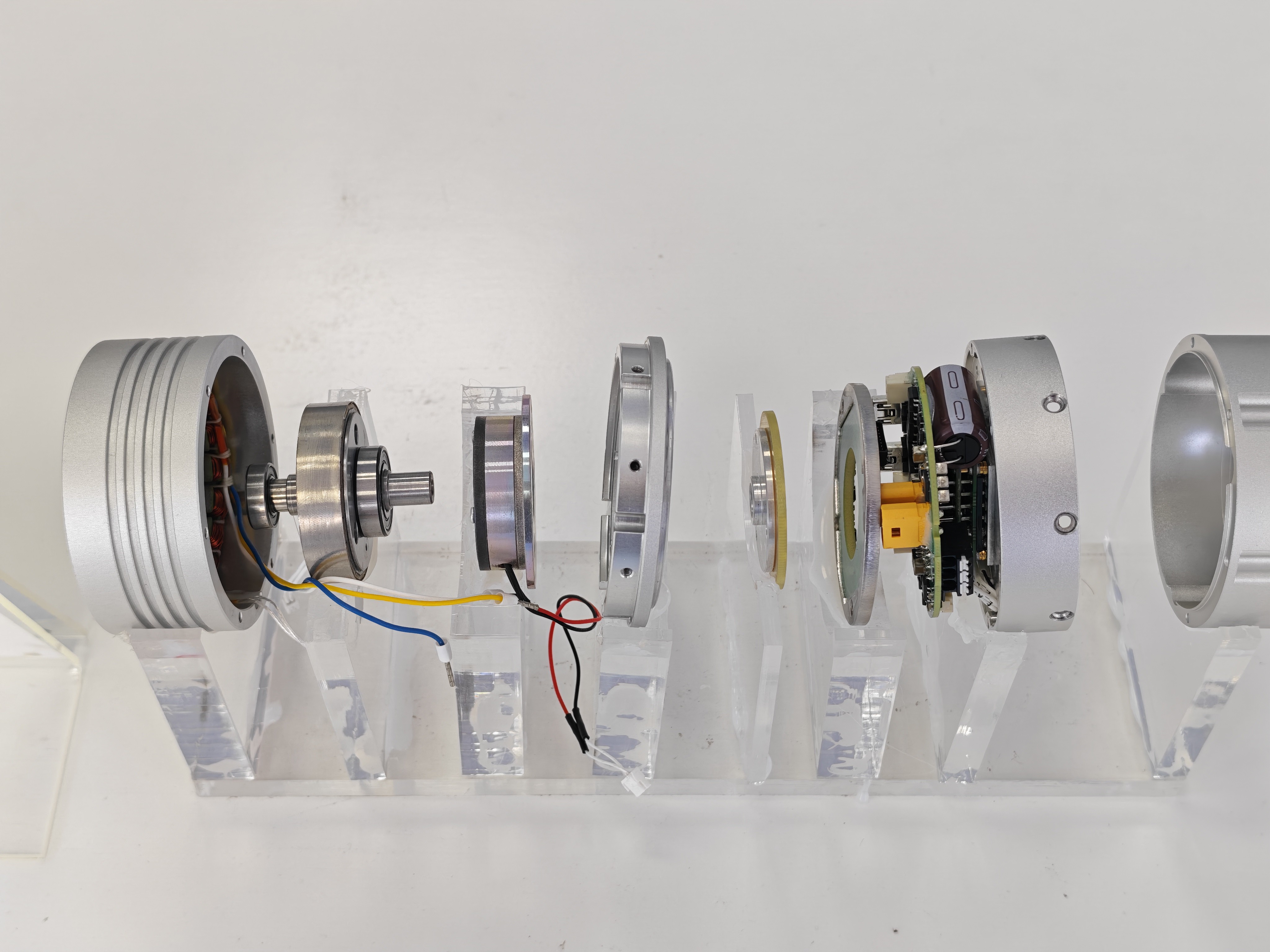
Integration allows designers to optimize components around a common mechanical envelope.
Instead of designing:
Motor → Separate Gearbox → Separate Encoder → Separate Housing → Separate Driver
the system can be designed as:
Integrated Motor + Harmonic Reducer + Encoder + Electronics + Joint Output
This can reduce duplicated:
Housings
Mounting structures
Connectors
Shafts
Couplings
Mechanical interfaces
The result can be a more compact actuator with a lower overall system mass.
For robotic applications, the important comparison is therefore not:
Which reducer is lighter?
but:
Which complete actuator delivers the required joint performance with the lowest practical mass and volume?
Why Mechanical Integration Matters in High-Torque Robot Joints?
High torque creates mechanical loads throughout the actuator.
The motor, reducer, bearings, housing, shaft, and mounting structure all need to handle these loads.
If the actuator is designed as a collection of unrelated components, the mechanical interfaces can become unnecessarily large.
An integrated architecture allows the designer to optimize:
Bearing placement
Load paths
Housing thickness
Shaft geometry
Motor position
Encoder position
Heat paths
This can improve the ratio between structural mass and usable output torque.
For a robot joint, this matters because the actuator is not simply a transmission component.
It is part of the robot's structural system.
What Limits the Torque Density of a Harmonic Drive Actuator?
There are several practical limits.
Motor Thermal Limits
The motor cannot continuously produce unlimited torque because current creates heat.
Transmission Load Limits
The harmonic transmission has defined torque and service-life limits.
Bearing Capacity
The output bearing must handle both torque-related loads and external joint forces.
Housing Stiffness
The housing must remain sufficiently rigid under load.
Thermal Dissipation
Heat generated inside the actuator must be transferred to the surrounding structure.
Speed Requirements
High torque at high speed creates substantially greater power and thermal demands.
Weight Constraints
Adding structural material can increase load capacity, but excessive mass reduces actuator-level torque density.
These constraints interact with one another.
Improving one parameter may negatively affect another.
That is why actuator design is fundamentally an optimization problem.
How to Compare the Torque Density of Two Harmonic Drive Actuators?
When comparing two actuators, avoid comparing only their maximum torque.
A better comparison should include:
1. Continuous Output Torque
How much torque can the actuator deliver during sustained operation?
2. Peak Output Torque
How much torque can it provide during short dynamic events?
3. Actuator Mass
Does the torque rating include the complete actuator?
4. Overall Dimensions
What is the diameter, length, and installation volume?
5. Output Speed
Can the actuator provide the required torque at the required speed?
6. Efficiency
How much input power is converted into useful mechanical output?
7. Thermal Rating
Can the actuator maintain its rated torque without exceeding its allowable temperature?
8. Encoder Configuration
Is feedback measured at the motor, output shaft, or both?
9. External Load Capacity
Can the output bearing handle the required radial, axial, and moment loads?
10. Duty Cycle
Is the actuator intended for intermittent or continuous operation?
This approach produces a much more meaningful comparison than simply selecting the actuator with the largest torque number.
How to Improve Torque Density in a Harmonic Drive Actuator?
If an actuator needs higher torque density, engineers can look at several areas simultaneously.
Optimize Motor Operating Point
Select a motor that provides the required torque without excessive mass or thermal overhead.
Optimize Reduction Ratio
Choose a reduction ratio that balances torque multiplication, speed, efficiency, and dynamic response.
Reduce Structural Mass
Use an appropriately designed housing and load path rather than simply increasing material thickness.
Optimize Bearing Arrangement
Select bearing dimensions according to actual radial, axial, and moment loads.
Improve Heat Dissipation
Better thermal paths can allow the actuator to maintain higher continuous torque without excessive temperature rise.
Integrate Electronics
Where appropriate, integrated drive electronics can reduce external hardware and wiring.
Optimize Sensor Integration
Use the feedback architecture required by the application without adding unnecessary components.
The best results usually come from optimizing several parameters together rather than maximizing one component's performance.
Harmonic Drive Actuator Torque Density for Different Robot Applications
The required torque density is highly dependent on the application.
Humanoid Robot Legs
Leg actuators typically require:
High continuous torque
High peak torque
Low mass
High dynamic response
Thermal stability
Torque-to-weight ratio becomes particularly important because actuator mass directly influences the robot's total energy requirements.
Humanoid Robot Arms
Arm joints generally require a different balance between:
Torque
Speed
Weight
Range of motion
Precision
Robot Wrists
Wrist actuators often place greater emphasis on:
Compact size
Low inertia
Low weight
High positioning accuracy
Collaborative Robot Joints
Cobots may require:
Compact packaging
Low backlash
Smooth motion
Torque sensing
Controlled interaction with external loads
Industrial Robot Joints
Industrial robots may prioritize:
Rated torque
Repeatability
Rigidity
Service life
Continuous operation
This demonstrates why there is no single torque-density target that applies to every robot.
Why Continuous Torque Density May Matter More Than Peak Torque Density?
For production robots, the most impressive specification is not always the most useful one.
A high peak torque rating may be valuable for dynamic motion, but the actuator also needs to operate reliably during the majority of its duty cycle.
For example, a humanoid robot may spend considerable time:
Standing
Walking
Maintaining balance
Holding an object
These activities require sustained actuator output.
Similarly, an industrial robot may repeat the same movement thousands of times.
For these applications, continuous torque density can be a more useful engineering metric than peak torque density.
A Practical Way to Evaluate High-Torque-Density Actuators
Before selecting a harmonic drive actuator, define the actual joint operating profile.
At minimum, determine:
Required continuous torque
Required peak torque
Required speed
Acceleration
Duty cycle
External load
Installation space
Maximum actuator mass
Ambient temperature
Cooling conditions
Required position accuracy
Required torque sensing
Communication interface
Then compare the complete actuator against those requirements.
This prevents a common mistake:
Choosing an actuator based on a single headline specification.
A 100 Nm actuator is not necessarily better than an 80 Nm actuator if the 100 Nm model is significantly heavier, larger, less efficient, or unable to sustain the required torque under the actual duty cycle.
The Future of High-Torque-Density Harmonic Actuators
As robots become more compact and dynamic, actuator development is moving beyond simply increasing maximum torque.
Future actuator designs are likely to focus on the combined optimization of:
Torque Density
Power Density
Efficiency
Thermal Performance
Sensing
Control Integration
Weight
Mechanical Rigidity
This is particularly relevant to humanoid robots.
A high-performance humanoid actuator may need to combine a precision harmonic transmission with:
High-resolution encoders
Integrated motor control
Torque sensing
Compact bearings
Lightweight housing
Efficient thermal paths
High-speed communication
The result is no longer simply a motor with a gearbox.
It becomes a complete robotic joint actuator designed around the mechanical and control requirements of the robot.
How HONPINE Approaches High-Torque-Density Harmonic Actuator Design?
For robotic applications, HONPINE develops integrated harmonic actuator and robot joint solutions that combine precision transmission with motor, sensing, and control technologies.
Depending on the actuator architecture, the integrated system can incorporate:
Harmonic transmission
Servo motor
High-resolution encoder
Output-side position feedback
Integrated driver
Torque sensing
Industrial communication interfaces
The objective is not simply to maximize the torque rating of one component.
Instead, the actuator needs to provide an appropriate balance between:
Output Torque + Weight + Size + Speed + Precision + Thermal Performance
This approach is particularly relevant to humanoid robot joints, collaborative robots, robotic arms, and other applications where actuator mass and installation space directly affect system performance.
For applications requiring force feedback, an integrated torque-sensing architecture can further support torque control, compliant motion, and interaction with external loads.
Frequently Asked Questions About Harmonic Drive Actuator Torque Density
What makes a harmonic drive actuator achieve high torque density?
High torque density comes from the combined design of the motor, harmonic transmission, reduction ratio, bearings, housing, thermal system, and control architecture. The harmonic transmission provides high torque multiplication within a compact package, but actuator-level torque density depends on the complete system.
Does a higher harmonic reduction ratio always increase torque density?
No. A higher reduction ratio can increase output torque from a given motor, but it can also affect output speed, efficiency, backdrivability, and thermal performance. The complete actuator must be evaluated rather than focusing on reduction ratio alone.
Is torque density more important than peak torque?
For many robotic applications, yes. A high peak torque rating does not necessarily mean that an actuator can deliver high torque continuously. Torque-to-weight ratio, continuous torque, duty cycle, and thermal performance should all be considered.
Why is torque density important for humanoid robots?
Humanoid robots have strict weight and space constraints. A lightweight actuator with high usable torque can reduce overall robot mass and help improve acceleration, energy efficiency, balance, and dynamic performance.
How does actuator weight affect humanoid robot performance?
Actuator mass becomes part of the robot's moving load. Heavier actuators can increase the torque required from other joints, particularly in leg mechanisms. Reducing actuator mass while maintaining sufficient torque can therefore improve overall system efficiency.
Can a harmonic actuator provide both high torque and high speed?
It depends on the actuator design and operating conditions. High reduction ratios increase output torque but reduce output speed. The motor, reduction ratio, thermal design, and transmission efficiency must be matched to the required torque-speed operating range.
What is more important: peak torque or continuous torque?
It depends on the application. Peak torque is important for acceleration and short dynamic events, while continuous torque is critical for sustained loads and repetitive operation. For production robots, both should be evaluated.
Does adding a torque sensor reduce torque density?
A torque sensor can add some mass, volume, and mechanical complexity. However, if the sensor is integrated into the actuator architecture efficiently, the additional weight can be minimized while providing valuable torque feedback for force control and interaction applications.
Conclusion
A harmonic drive actuator achieves high torque density through the combined optimization of the motor, reduction ratio, harmonic transmission, bearings, housing, thermal design, sensing, and control system.
The harmonic transmission is an important part of this equation because it can provide substantial torque multiplication within a compact mechanical package. But the final torque density of the actuator depends on much more than the reducer itself.
For practical robot design, engineers should evaluate:
Continuous Torque
→ Peak Torque
→ Speed
→ Reduction Ratio
→ Efficiency
→ Thermal Performance
→ Actuator Mass
→ Installation Volume
→ External Load Capacity
→ Feedback and Sensing
rather than relying on a single torque specification.
This becomes particularly important in humanoid robotics, where actuator weight, torque, speed, and thermal performance are closely interconnected.
The goal is therefore not simply to build an actuator with the highest possible torque.
The goal is to develop an actuator that delivers the required usable torque within the smallest practical mass and volume, while maintaining the speed, precision, efficiency, thermal stability, and sensing capability required by the robot.
That is the real engineering meaning of high torque density in a harmonic drive actuator.
Read More
Learn more about the story of HONPINE and industry trends related to precision transmission.
 What is robot joint actuator?How to Choose the Best Robot Rotary Joint Actuator?In core robot joint transmission solutions, planetary and harmonic rotary actuators each have their own strengths. Choosing the right type based on application requirements is essential to achieve the optimal balance between performance and cost.
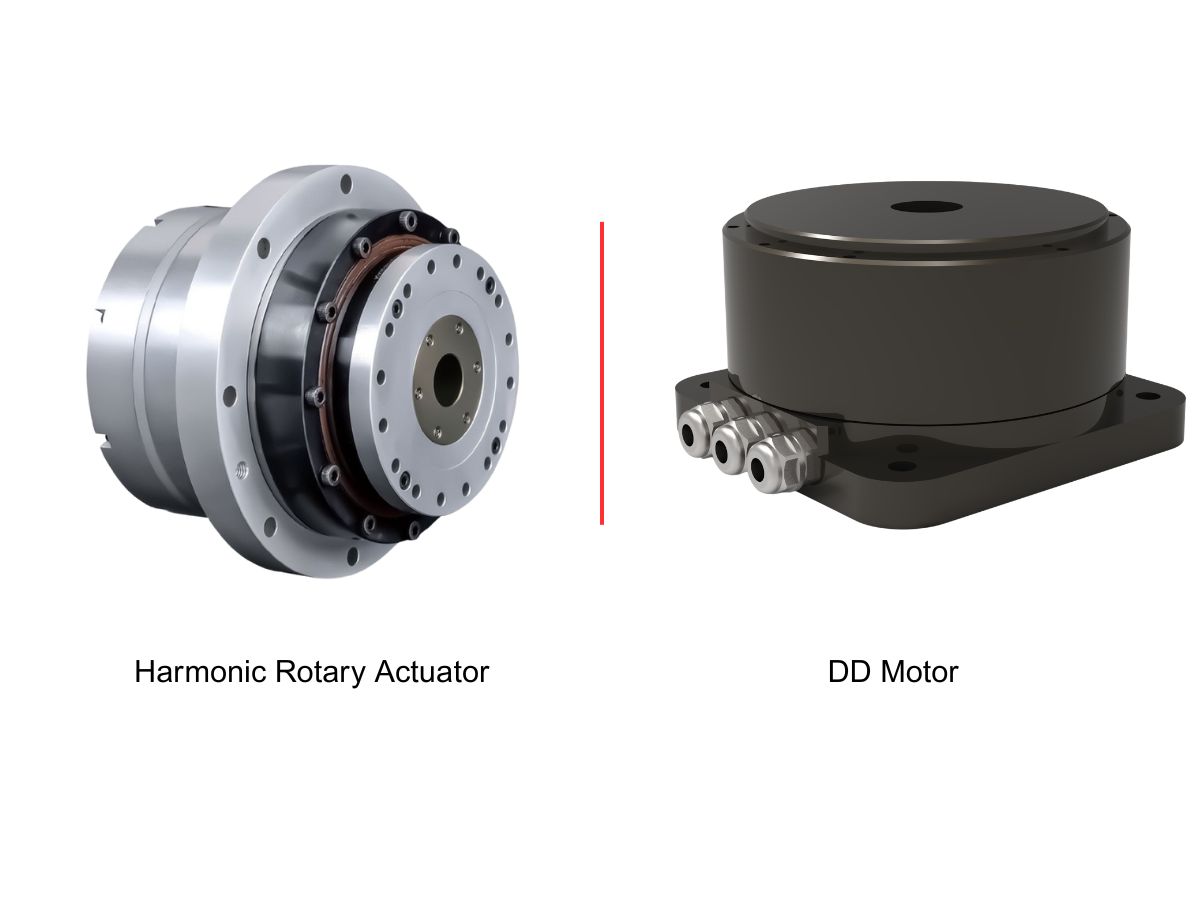
 DD Motors VS Harmonic Rotary ActuatorsThis article provides an in-depth comparison between Direct Drive (DD) motors and harmonic rotary actuators, covering their transmission principles, advantages and disadvantages, and typical application fields.
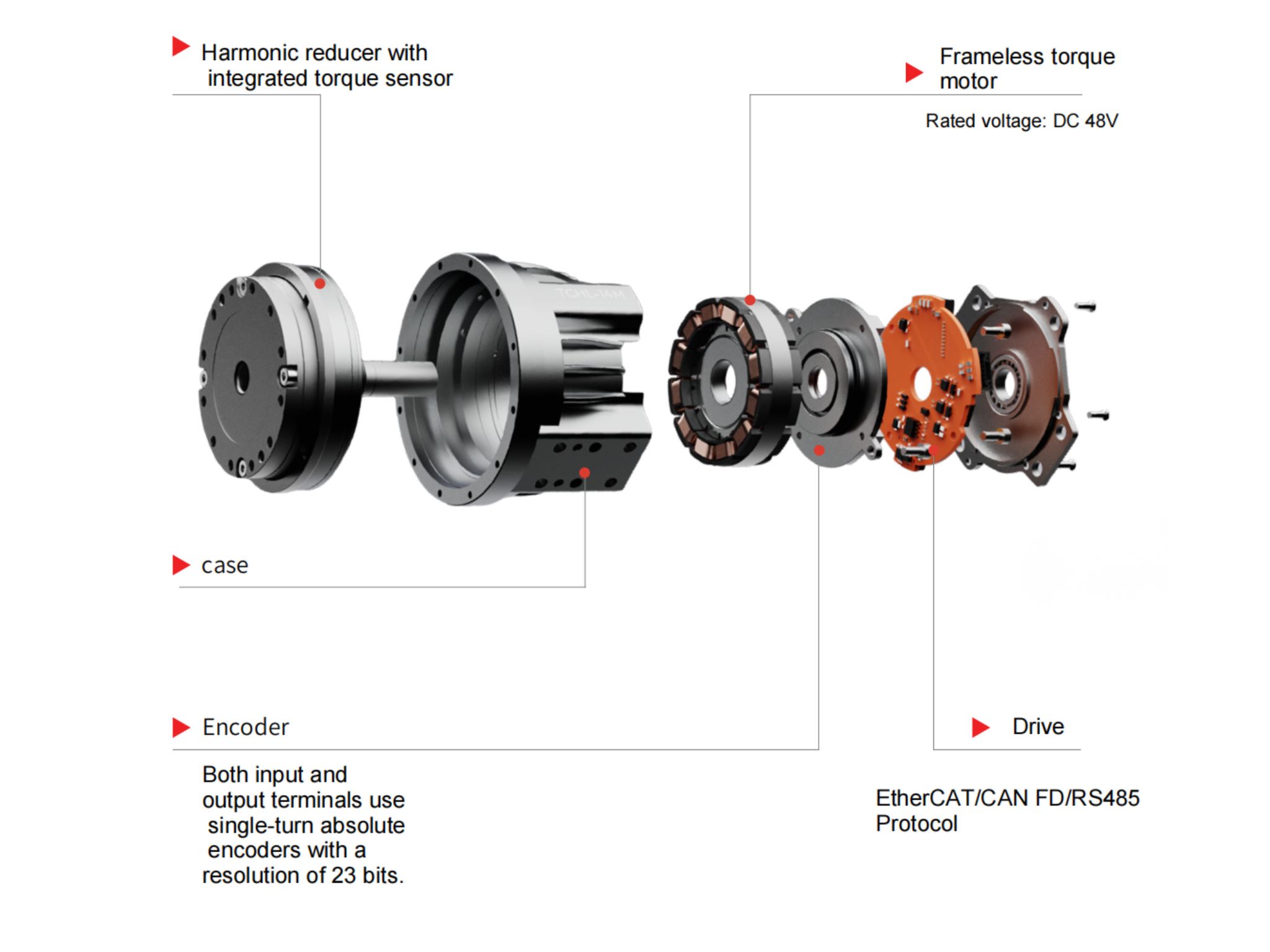
 OMG Ultra Compact Harmonic Drive Joint Module with Built-in Torque SensorHONPINE TCHL series harmonic drive joint module is a game-changing product that achieves disruptive improvements in multiple aspects such as lightweight design, integration level, and connection convenience. This article will analyze its revolutionary enhancements with you.
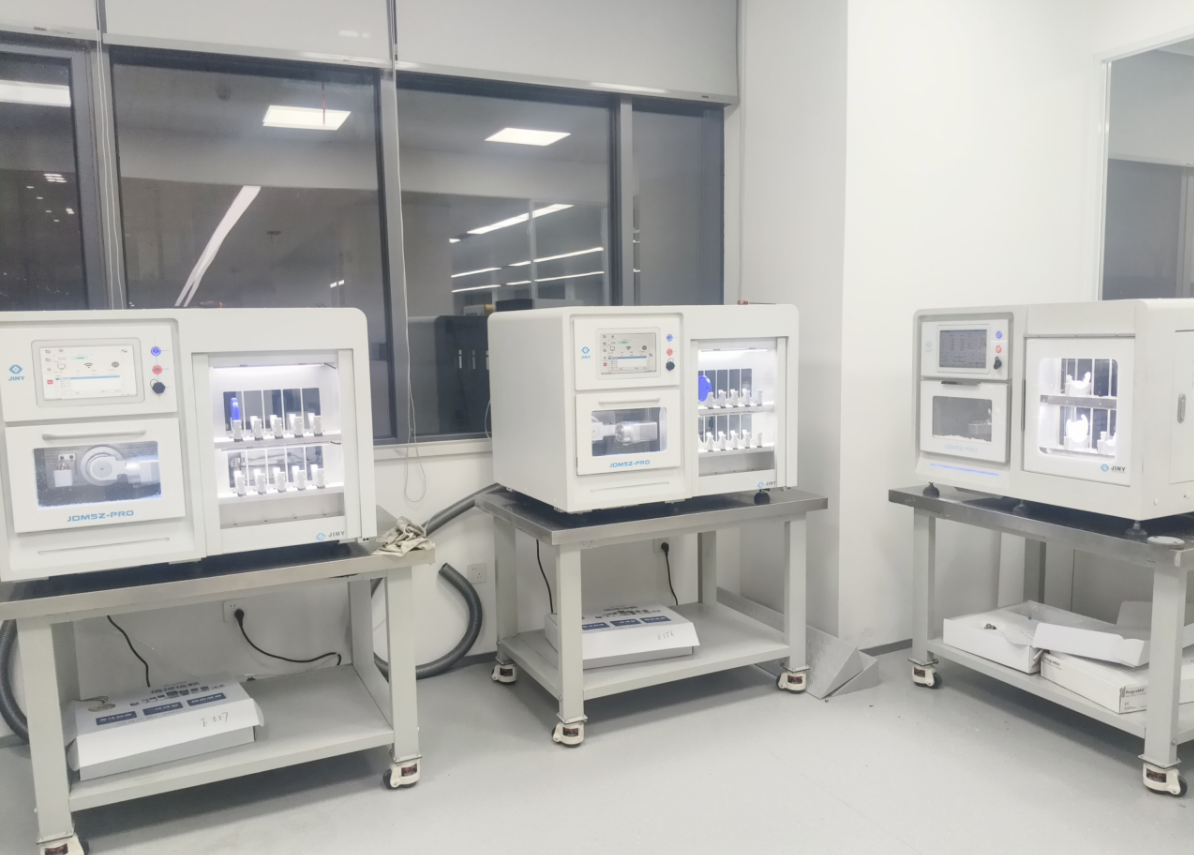
 The Role of Harmonic Drive Gears in Achieving 5–10 μm Accuracy in Dental Milling MachinesA dental milling machine is a CNC machining system used to directly process digital dental models into restorations such as crowns, bridges, veneers, inlays, and implant abutments. Dental milling machines require far higher operational accuracy and motion stability than ordinary equipment. This article explains how harmonic drive gear help dental milling machines achieve stable, continuous, and controllable operation.
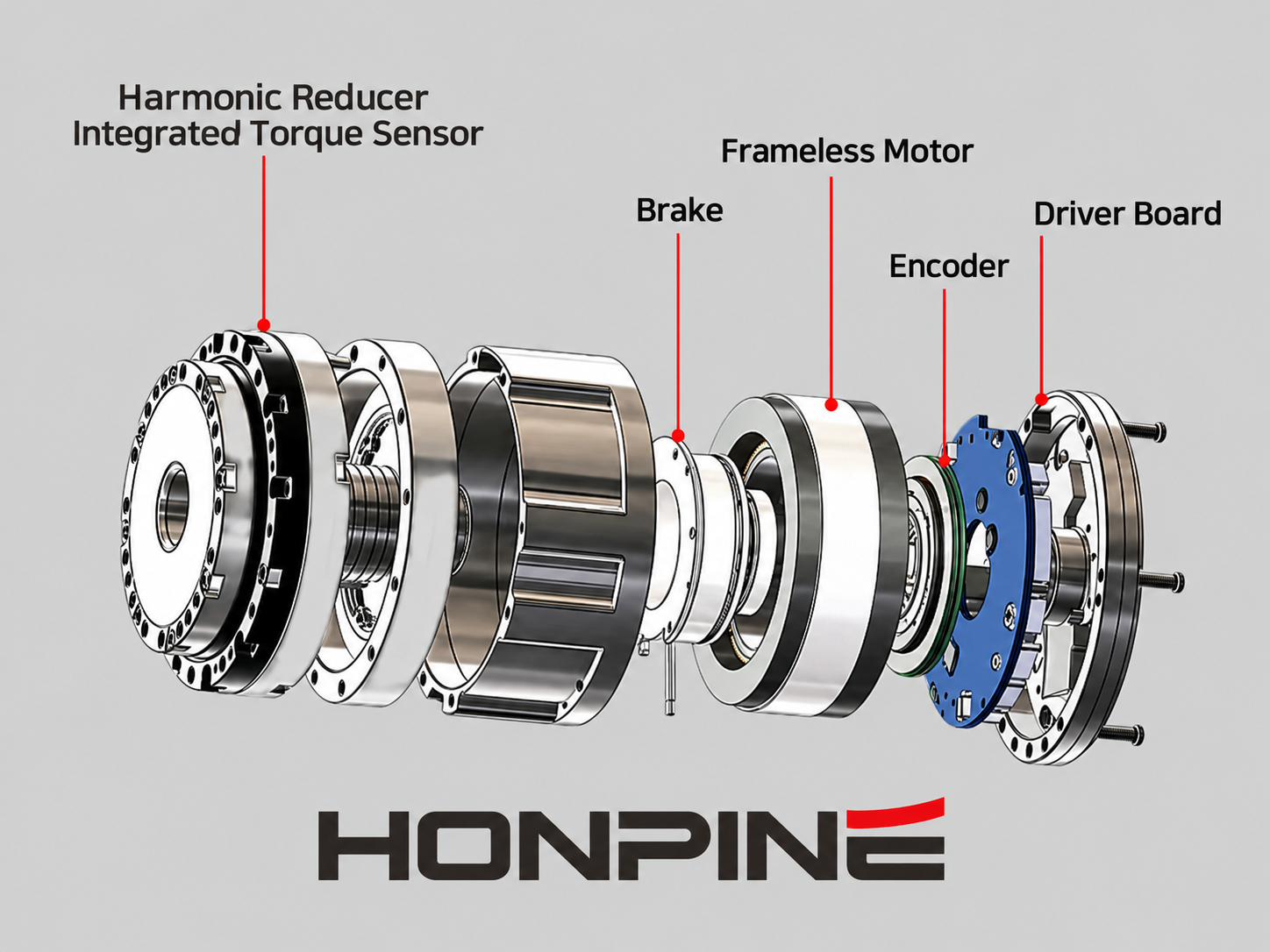
 Why Are Harmonic Rotary Actuators Perfect for Medical Equipment?Harmonic rotary actuators (typically integrated systems consisting of a harmonic drive reducer, frameless torque motor, encoder, and optional brake) are regarded as key components in medical equipment. The core reason is that they simultaneously meet the most stringent medical requirements for precision, compact size, safety, and controllability. The following explanation is structured from three perspectives: technical characteristics, application scenarios, and medical value.
 High-Precision RV Reducers Perfectly Matched for Walking RobotsThe walking axis of a robot is a core component for power transmission and support. RV reducers provide extremely high rigidity, precision, and torque while maintaining a compact size and exceptional reliability, making them an ideal match for the demanding requirements of walking robot joints in terms of load capacity, impact resistance, and precision.
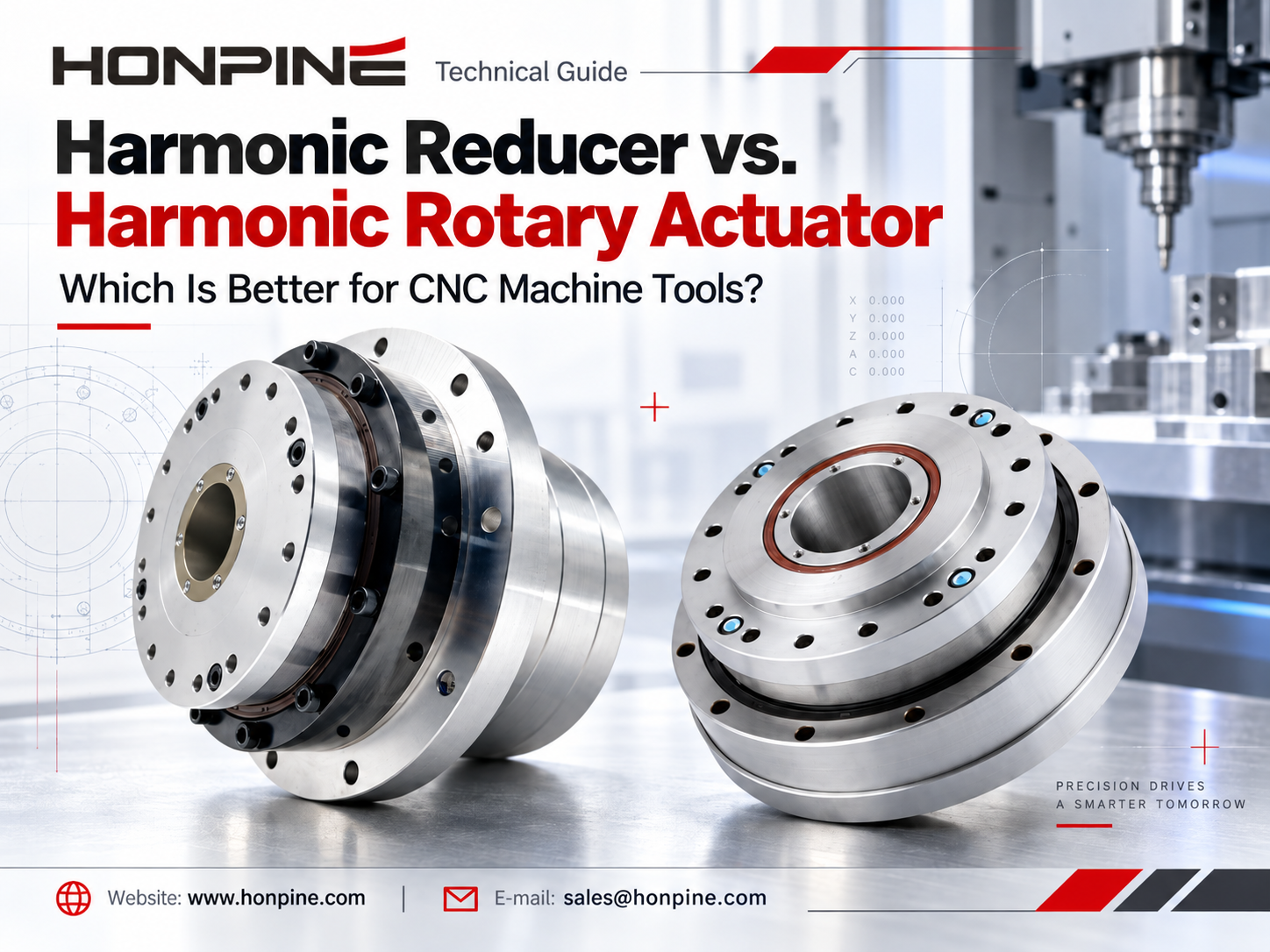
 Harmonic Reducer vs. Harmonic Rotary Actuator: Which Is Better for CNC Machine Tools?Choosing between a harmonic reducer and a harmonic rotary actuator is an important decision in CNC machine tool design. Both solutions offer high-precision motion control, but they differ in integration, installation requirements, rigidity, and system flexibility. For CNC fourth-axis rotary tables and compact five-axis machining systems, selecting the right harmonic drive can significantly influence machine performance. In this article, HONPINE Technical Director Theodore Li compares harmonic reducers and harmonic rotary actuators to help engineers identify the most suitable solution for their CNC applications.
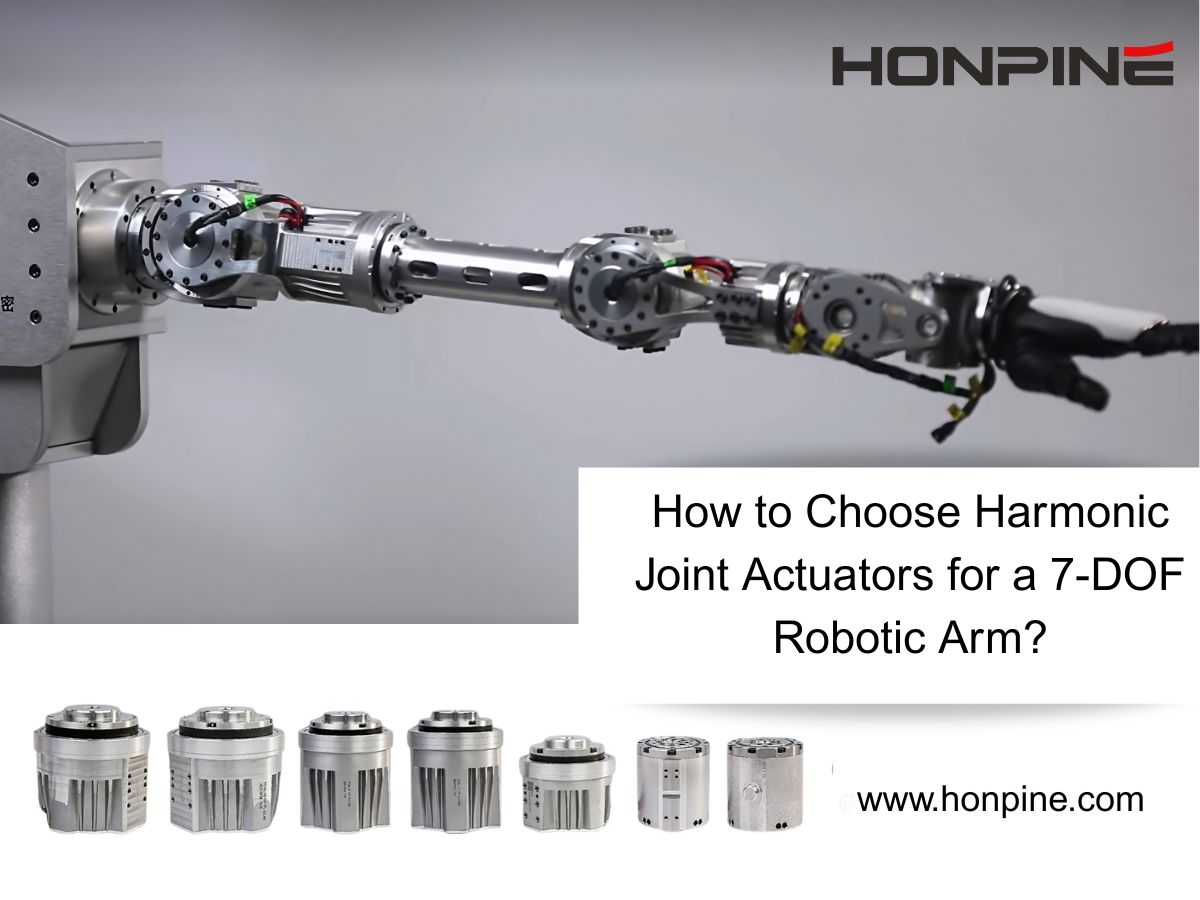
 How to Choose Harmonic Joint Actuators for a 7-DOF Robotic Arm?I'm Theodore Li, Technical Director at HONPINE. Choosing harmonic joint actuators for a 7-DOF robotic arm starts with the torque, weight, and installation needs of each joint. This guide uses a TCHL 20 shoulder and TCHL 14 wrist configuration as an example, then explores torque sensing, compliant control, and HAG Series considerations for demanding robotic applications.
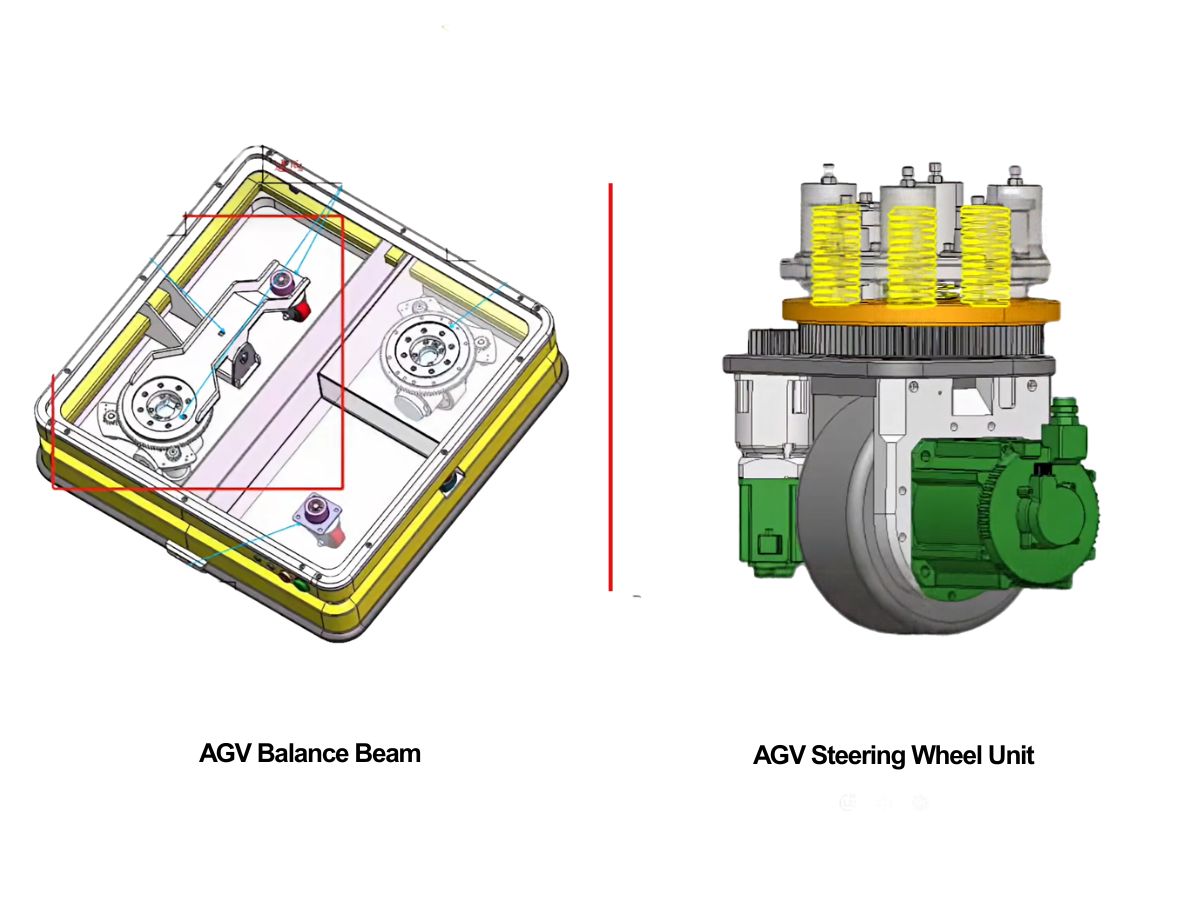
 AGV Suspension: Should You Choose a Balance Beam or a Spring-Loaded Steering Drive Unit?Choosing an AGV suspension system starts with the vehicle’s load range and floor conditions. Balance beams and spring-loaded steering drive units offer different approaches to maintaining wheel contact and managing wheel loads. This HONPINE guide compares both options and explains how to evaluate traction, suspension travel, installation space, and maintenance before choosing a configuration.
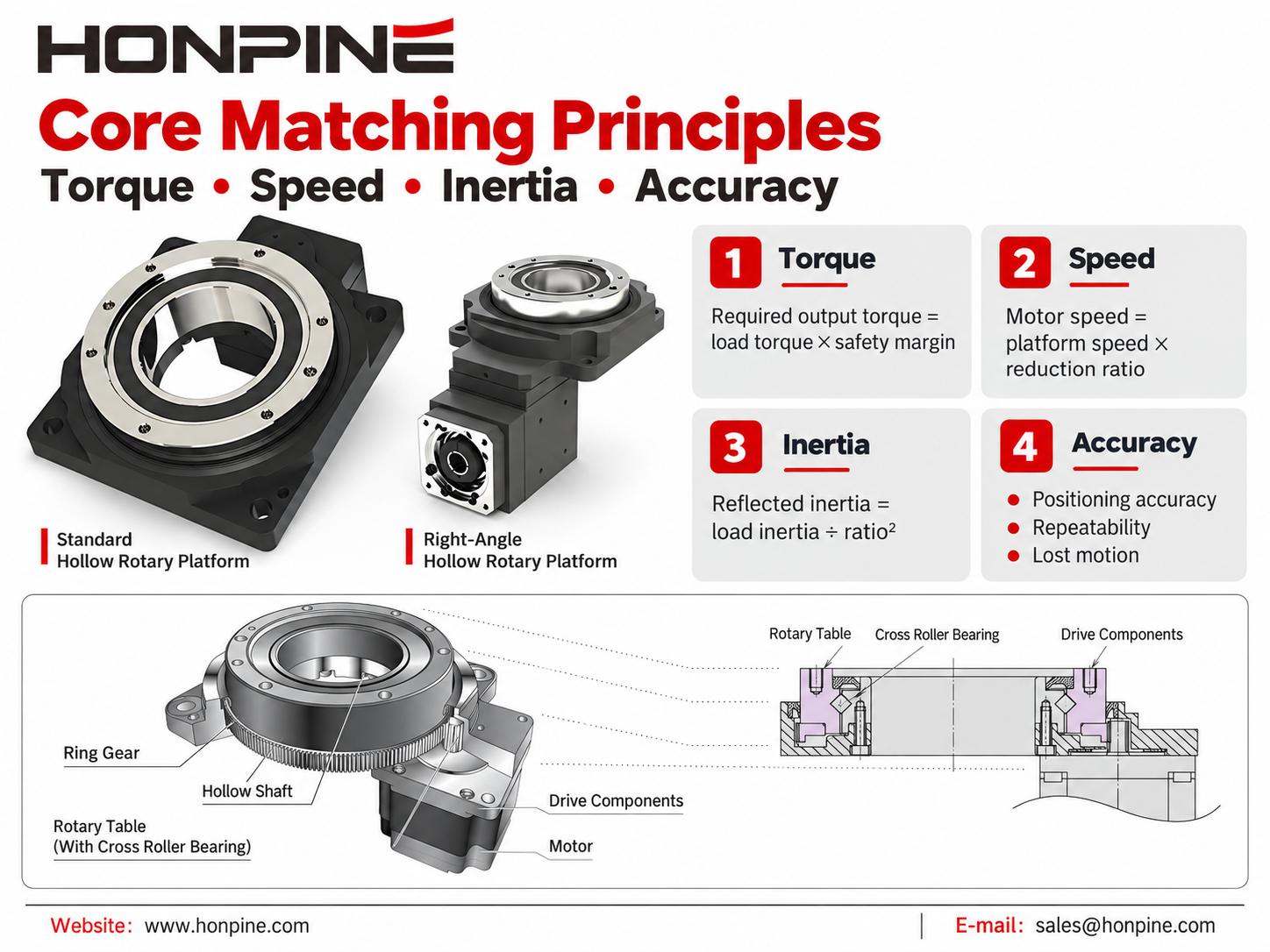
 Hollow Rotary Platform Motor Matching: A Complete GuideSelecting the right motor for a hollow rotary platform is essential for achieving precise positioning, stable operation, and efficient automation. This guide explains how to match servo motors, stepper motors, and brushless DC motors with hollow rotary platforms based on torque, speed, inertia, accuracy, and installation requirements. Explore practical motor selection guidelines, typical application combinations, and space-saving mounting solutions to find the right configuration for your automation project.
 Can Robots Feel Touch? HONPINE HAG Force-Controlled Harmonic Robot Joint MotorsCan robots respond to a gentle touch? The HONPINE HAG robot joint motor with torque sensor combines a harmonic reducer, integrated torque sensing, and closed-loop control to detect external forces and support smooth, compliant motion. In this article, HONPINE founder Allen Li demonstrates the module's response to light contact and hand-guided movement, explains its key force-control technologies, and shares the vision behind joint modules designed for practical industrial robotics.
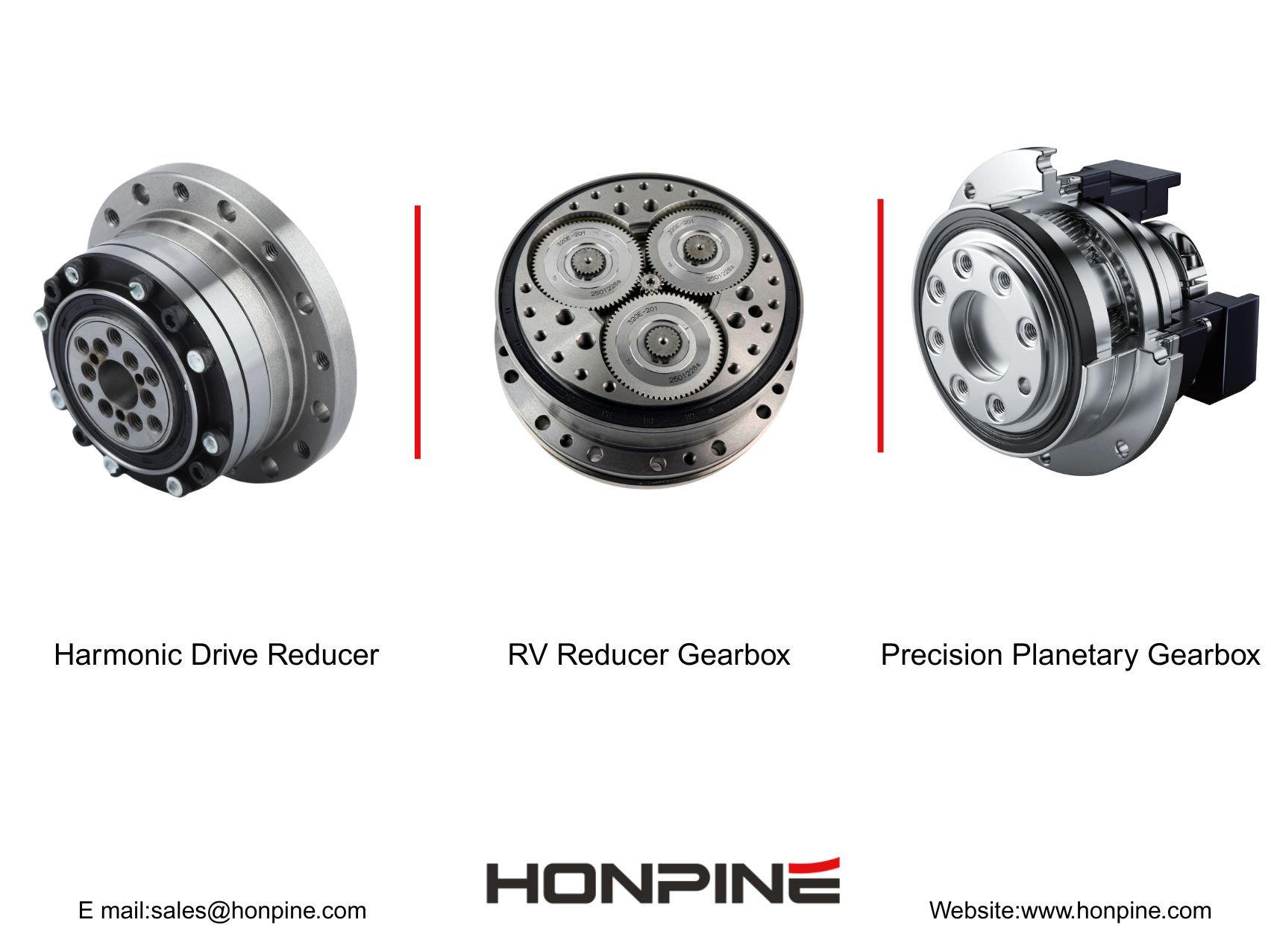
 Does a Higher Gearbox Ratio Mean More Torque? Planetary, Harmonic, and RV Gearboxes ExplainedDoes a higher gearbox ratio mean more torque? This engineering guide explains the relationship between gearbox ratio, output torque, and output speed, and compares planetary gearboxes, harmonic gearboxes, and RV gearboxes. Learn why reduction ratio alone cannot determine gearbox torque capacity, efficiency, dynamic response, precision, or service life, and what engineers should consider when selecting a gearbox for robotics, CNC machines, servo systems, and industrial motion control.
Double Click
We provide harmonic drive reducer,planetary reducer,robot joint motor,robot rotary actuators,RV gear reducer,robot end effector,dexterous robot hand
 What is robot joint actuator?How to Choose the Best Robot Rotary Joint Actuator?In core robot joint transmission solutions, planetary and harmonic rotary actuators each have their own strengths. Choosing the right type based on application requirements is essential to achieve the optimal balance between performance and cost.
 DD Motors VS Harmonic Rotary ActuatorsThis article provides an in-depth comparison between Direct Drive (DD) motors and harmonic rotary actuators, covering their transmission principles, advantages and disadvantages, and typical application fields.
 OMG Ultra Compact Harmonic Drive Joint Module with Built-in Torque SensorHONPINE TCHL series harmonic drive joint module is a game-changing product that achieves disruptive improvements in multiple aspects such as lightweight design, integration level, and connection convenience. This article will analyze its revolutionary enhancements with you.
 Harmonic Reducer vs. Harmonic Rotary Actuator: Which Is Better for CNC Machine Tools?Choosing between a harmonic reducer and a harmonic rotary actuator is an important decision in CNC machine tool design. Both solutions offer high-precision motion control, but they differ in integration, installation requirements, rigidity, and system flexibility. For CNC fourth-axis rotary tables and compact five-axis machining systems, selecting the right harmonic drive can significantly influence machine performance. In this article, HONPINE Technical Director Theodore Li compares harmonic reducers and harmonic rotary actuators to help engineers identify the most suitable solution for their CNC applications.
 How to Choose Harmonic Joint Actuators for a 7-DOF Robotic Arm?I'm Theodore Li, Technical Director at HONPINE. Choosing harmonic joint actuators for a 7-DOF robotic arm starts with the torque, weight, and installation needs of each joint. This guide uses a TCHL 20 shoulder and TCHL 14 wrist configuration as an example, then explores torque sensing, compliant control, and HAG Series considerations for demanding robotic applications.
 AGV Suspension: Should You Choose a Balance Beam or a Spring-Loaded Steering Drive Unit?Choosing an AGV suspension system starts with the vehicle’s load range and floor conditions. Balance beams and spring-loaded steering drive units offer different approaches to maintaining wheel contact and managing wheel loads. This HONPINE guide compares both options and explains how to evaluate traction, suspension travel, installation space, and maintenance before choosing a configuration.
 Hollow Rotary Platform Motor Matching: A Complete GuideSelecting the right motor for a hollow rotary platform is essential for achieving precise positioning, stable operation, and efficient automation. This guide explains how to match servo motors, stepper motors, and brushless DC motors with hollow rotary platforms based on torque, speed, inertia, accuracy, and installation requirements. Explore practical motor selection guidelines, typical application combinations, and space-saving mounting solutions to find the right configuration for your automation project.
 Can Robots Feel Touch? HONPINE HAG Force-Controlled Harmonic Robot Joint MotorsCan robots respond to a gentle touch? The HONPINE HAG robot joint motor with torque sensor combines a harmonic reducer, integrated torque sensing, and closed-loop control to detect external forces and support smooth, compliant motion. In this article, HONPINE founder Allen Li demonstrates the module's response to light contact and hand-guided movement, explains its key force-control technologies, and shares the vision behind joint modules designed for practical industrial robotics.
 Does a Higher Gearbox Ratio Mean More Torque? Planetary, Harmonic, and RV Gearboxes ExplainedDoes a higher gearbox ratio mean more torque? This engineering guide explains the relationship between gearbox ratio, output torque, and output speed, and compares planetary gearboxes, harmonic gearboxes, and RV gearboxes. Learn why reduction ratio alone cannot determine gearbox torque capacity, efficiency, dynamic response, precision, or service life, and what engineers should consider when selecting a gearbox for robotics, CNC machines, servo systems, and industrial motion control.
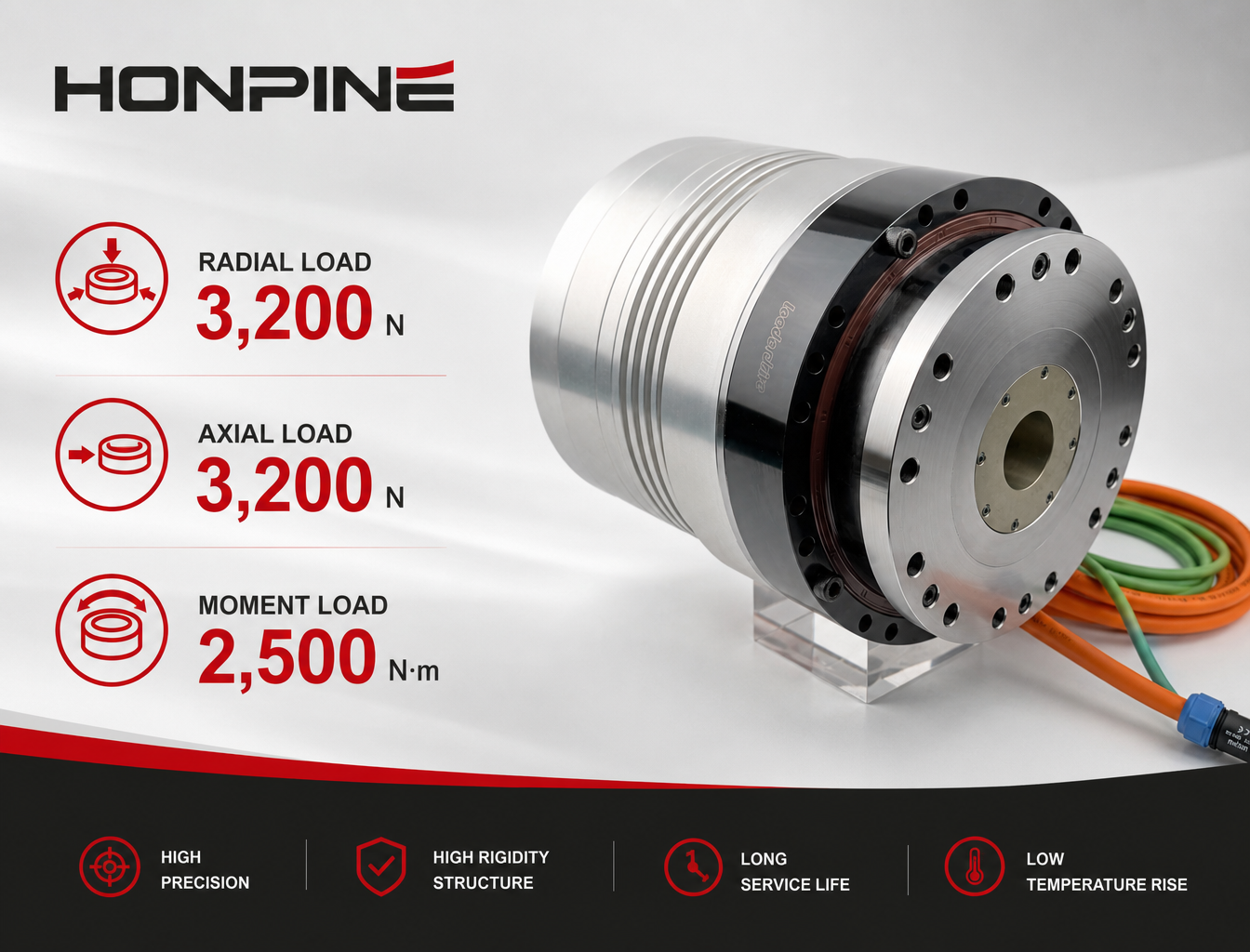
 High-Precision Hollow Harmonic Rotary Actuator for CNC Machines and Heavy-Duty Rotary AxesHONPINE 58 Series Hollow Harmonic Rotary Actuator is designed for CNC rotary tables, precision rotary axes, laser processing equipment, and heavy-duty rotary positioning applications. With a 50 mm hollow bore, up to 2,722 N·m peak torque, integrated crossed roller bearing, multi-turn absolute encoder options, positioning accuracy below 30 arcsec, and repeat positioning accuracy below 5 arcsec, it combines high torque capacity with precision rotary motion and flexible mechanical integration.
 How Does the HONPINE JRM Planetary Robot Joint Module Address Temperature Rise in Continuous Operation?HONPINE JRM planetary robot joint modules are designed for long-duration and high-load robotic operation. This article examines how motor electromagnetic optimization, high-efficiency planetary transmission, GaN-based drive technology, and system-level low-loss design help control temperature rise. Using the C6345 planetary robot joint module as a test example, HONPINE also presents full-load thermal validation under continuous operation, including motor efficiency up to 92%, planetary gearbox efficiency up to 97%, and a final equilibrium temperature of 61.42°C at a 25°C ambient temperature.
 Direct Drive Motor Sizing: A Complete Guide to Torque Calculation and SelectionSelecting a direct drive motor for a precision rotary system requires more than matching motor torque to the equipment weight. Engineers need to evaluate gravity torque, inertial torque, wind torque, friction, rotational inertia, speed, acceleration, duty cycle, and positioning requirements. In this guide, Theodore Li, Technical Director at HONPINE, explains a practical approach to direct drive motor sizing and torque calculation using an azimuth and elevation turntable as an engineering example. The article covers continuous and peak torque calculation, motor selection criteria, and the application of frameless direct drive motors in integrated rotary systems.
- harmonic reducer
- harmonic reduction
- harmonic drive
- harmonic transmission
- harmonic actuator
- honpine
- precision transmission
- harmonic drive actuators
- robot actuator
- harmonic drive actuator
- robot joint
- harmonic
- small
- precision
- robotic joint
- humanoid robot
- servo
- actuator
- humanoid joint
- joint actuator
- robotic joint actuator
- Integrated Motor
- robotic arm
- collaborative robot
- harmonic actuators