





Direct Drive Motor vs Hollow Rotary Platform: How to Choose the Right Rotary Motion Solution for Automation Equipment
In 3C manufacturing, semiconductor equipment, precision inspection, laser processing, machine tools, and automated assembly systems, selecting a rotary axis is not simply a matter of choosing a motor.
A complete rotary motion system needs to address torque, speed, positioning accuracy, load inertia, rigidity, response time, cable routing, installation space, and long-term operating stability.
This is why equipment designers often face a fundamental question:
Should the rotary load be driven directly by a Direct Drive Motor, or should a Hollow Rotary Platform be used to achieve higher output torque through an integrated precision reduction mechanism?
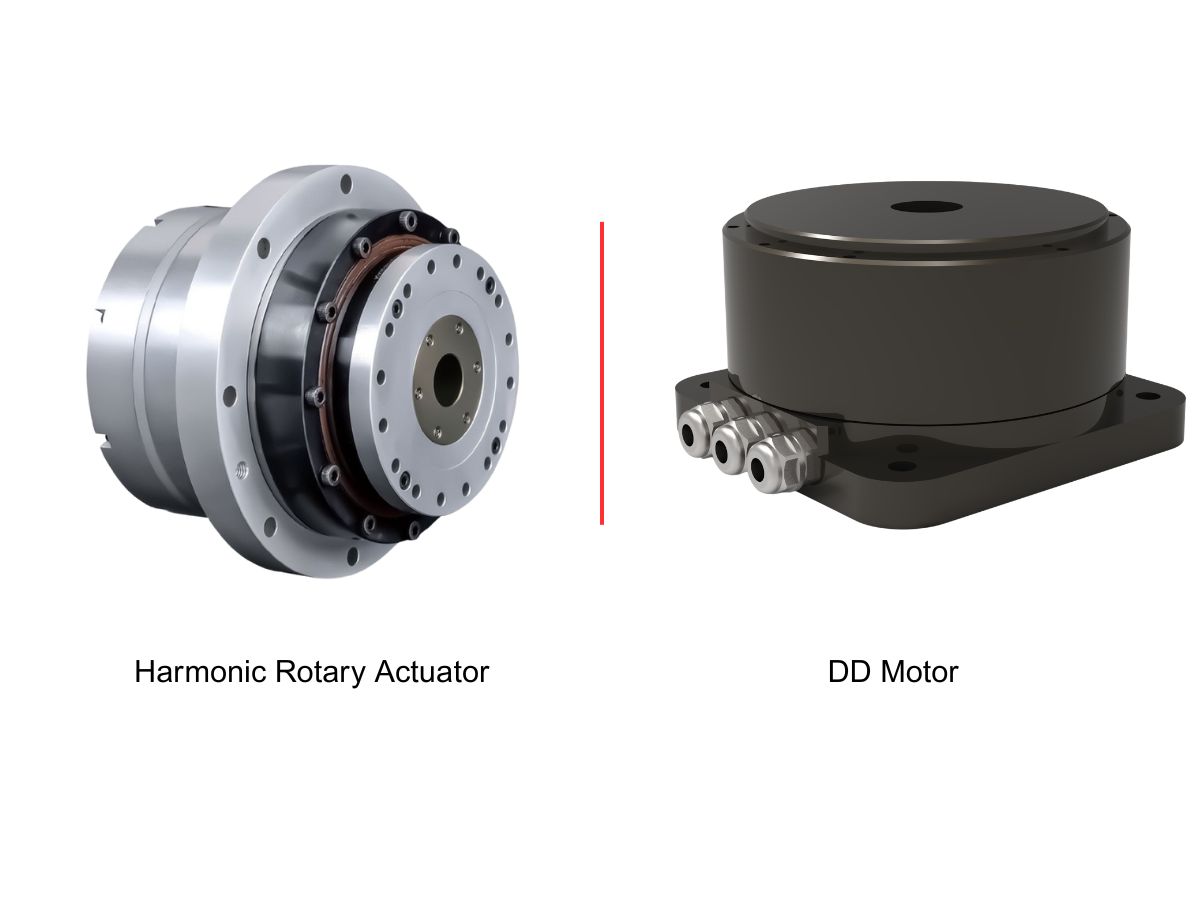
For some applications, other solutions such as harmonic rotary actuators and precision planetary reducers may also be considered.
The right approach is not to decide in advance that a machine must use a Direct Drive Motor or a Hollow Rotary Platform. Instead, the rotary motion requirements should be analyzed first, and the appropriate mechanical architecture should then be selected.
Start by Defining What the Rotary Axis Needs to Achieve
A rotary axis may look similar from the outside, but its actual function can be completely different depending on the machine.
For example, a rotary stage in semiconductor inspection equipment may require extremely stable angular positioning and high-speed scanning. A multi-station rotary table in a 3C assembly machine may place greater emphasis on cycle time, load capacity, and repeatability. A laser processing system may require continuous rotation and precise trajectory control, while a fourth-axis machine tool may prioritize rigidity, load capacity, and resistance to cutting forces.
All of these systems require rotary motion, but they do not necessarily require the same solution.
The first step in rotary axis selection should therefore be to establish a complete motion profile.
The equipment designer needs to understand the load, moment of inertia, required rotation angle, maximum speed, acceleration time, settling time, and daily operating hours.
Once these parameters are clear, the choice between a Direct Drive Motor and a Hollow Rotary Platform becomes much more meaningful.
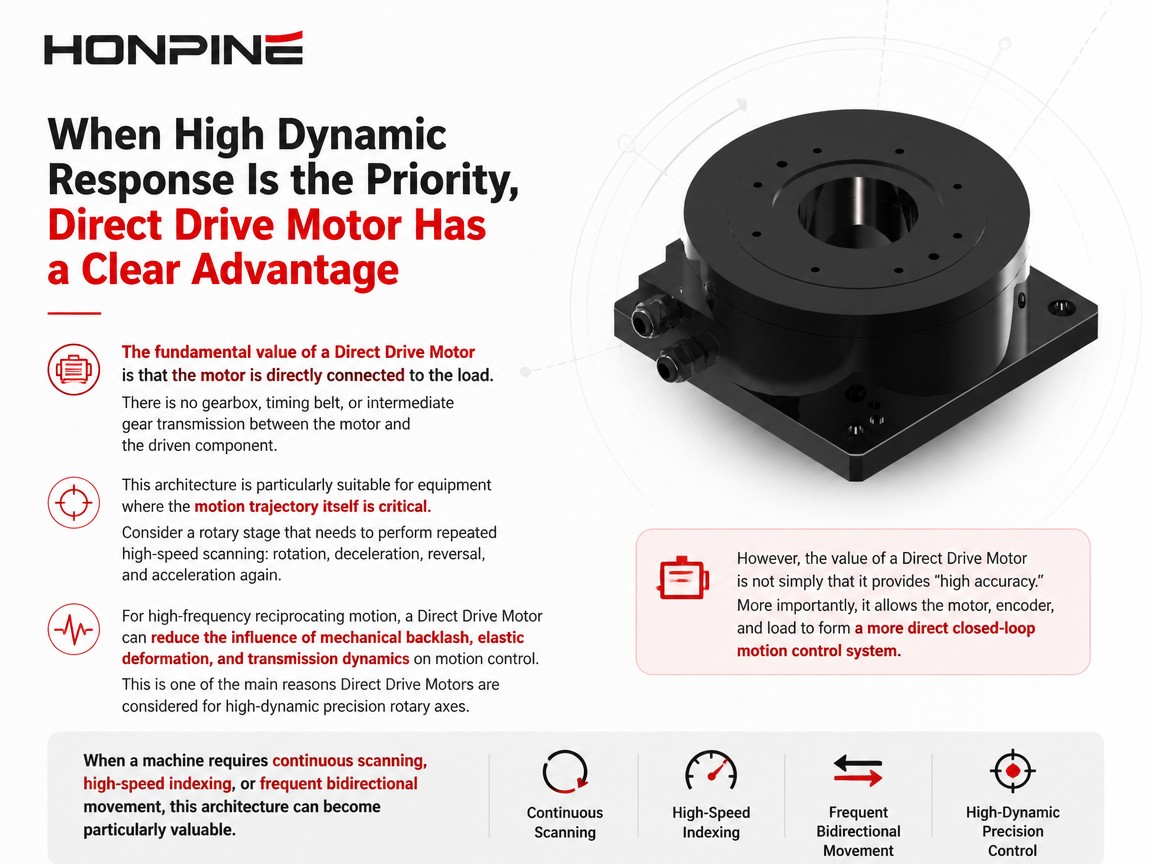
When High Dynamic Response Is the Priority, Direct Drive Motor Has a Clear Advantage
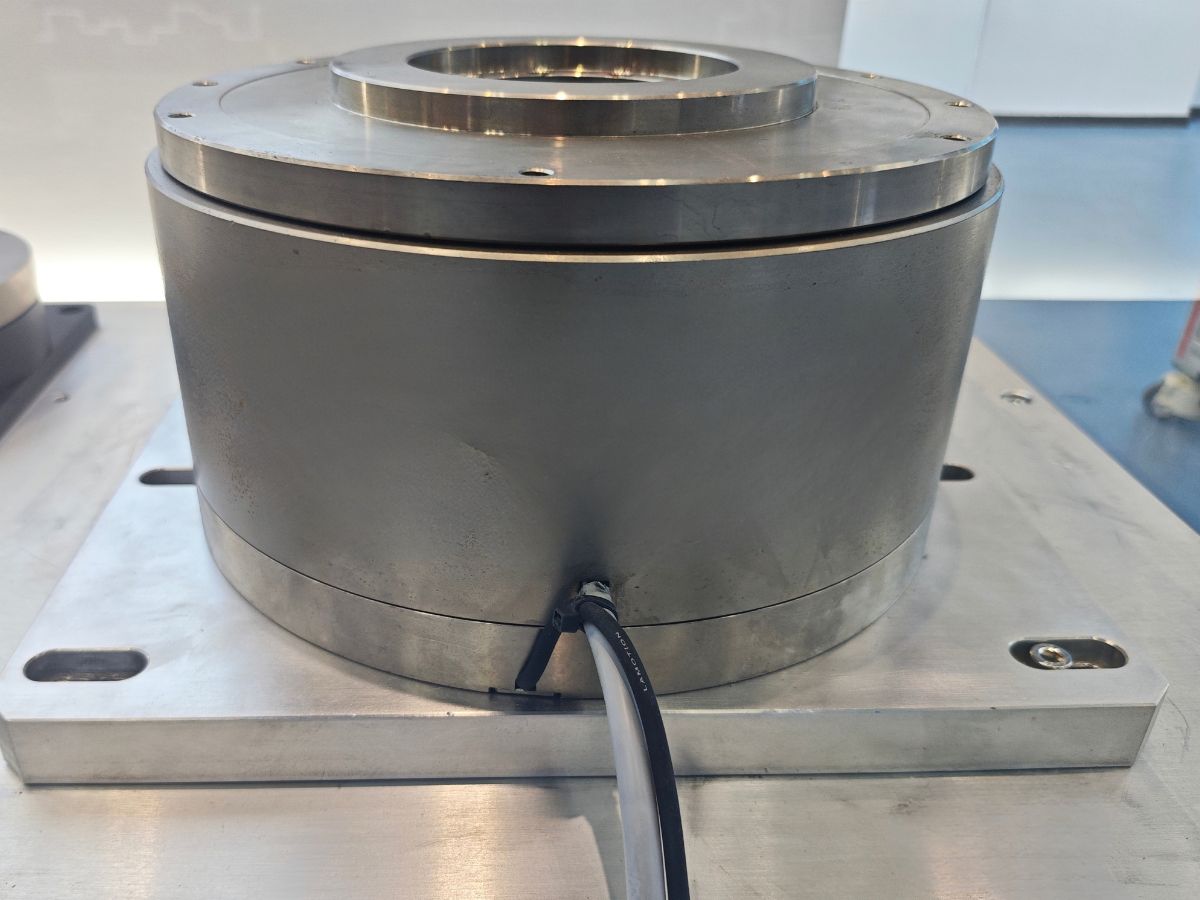
The fundamental value of a Direct Drive Motor is that the motor is directly connected to the load.
There is no gearbox, timing belt, or intermediate gear transmission between the motor and the driven component.
This architecture is particularly suitable for equipment where the motion trajectory itself is critical.
Consider a rotary stage that needs to perform repeated high-speed scanning:
rotation, deceleration, reversal, and acceleration again.
The shorter the mechanical transmission path, the more directly the control system can act on the load.
For high-frequency reciprocating motion, a Direct Drive Motor can reduce the influence of mechanical backlash, elastic deformation, and transmission dynamics on motion control.
This is one of the main reasons Direct Drive Motors are considered for high-dynamic precision rotary axes.
However, the value of a Direct Drive Motor is not simply that it provides "high accuracy."
More importantly, it allows the motor, encoder, and load to form a more direct closed-loop motion control system.
When a machine requires continuous scanning, high-speed indexing, or frequent bidirectional movement, this architecture can become particularly valuable.
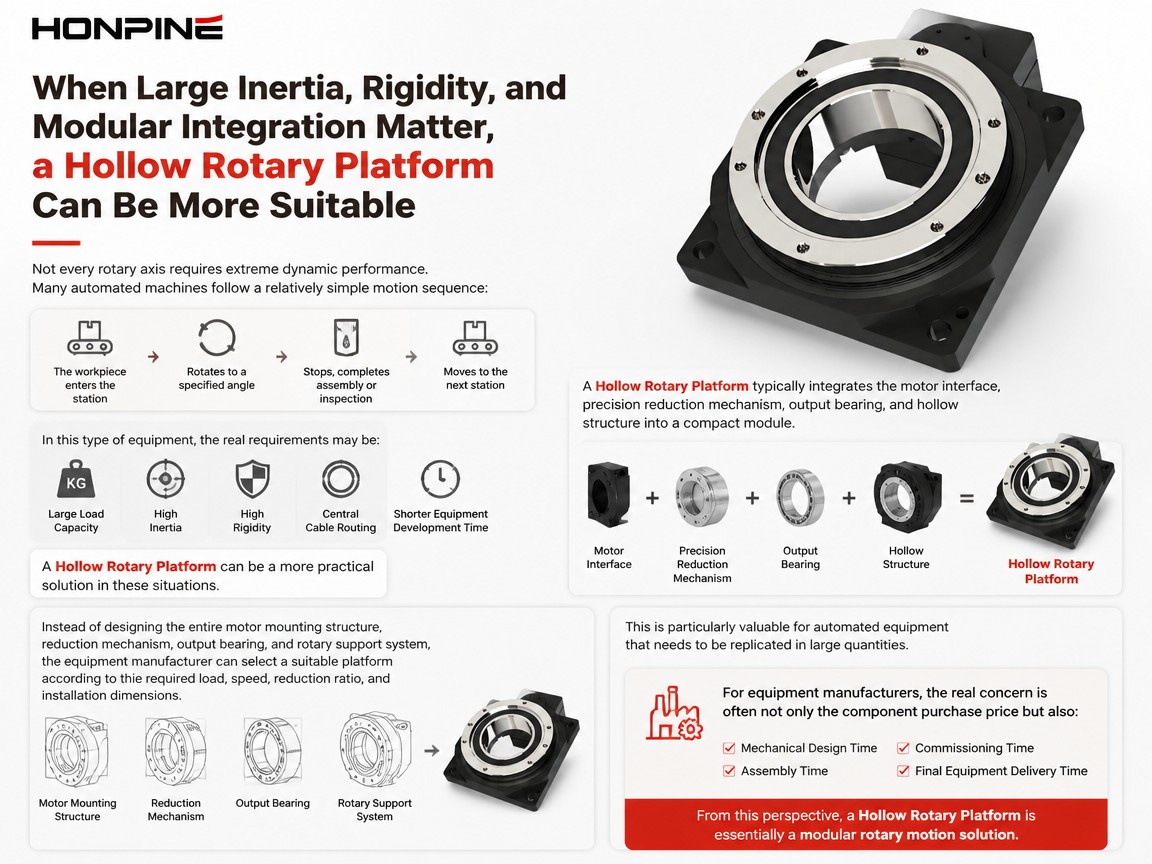
When Large Inertia, Rigidity, and Modular Integration Matter, a Hollow Rotary Platform Can Be More Suitable
Not every rotary axis requires extreme dynamic performance.
Many automated machines follow a relatively simple motion sequence:
The workpiece enters the station, rotates to a specified angle, stops, completes assembly or inspection, and then moves to the next station.
In this type of equipment, the real requirements may be:
large load capacity, high inertia, high rigidity, central cable routing, and shorter equipment development time.
A Hollow Rotary Platform can be a more practical solution in these situations.
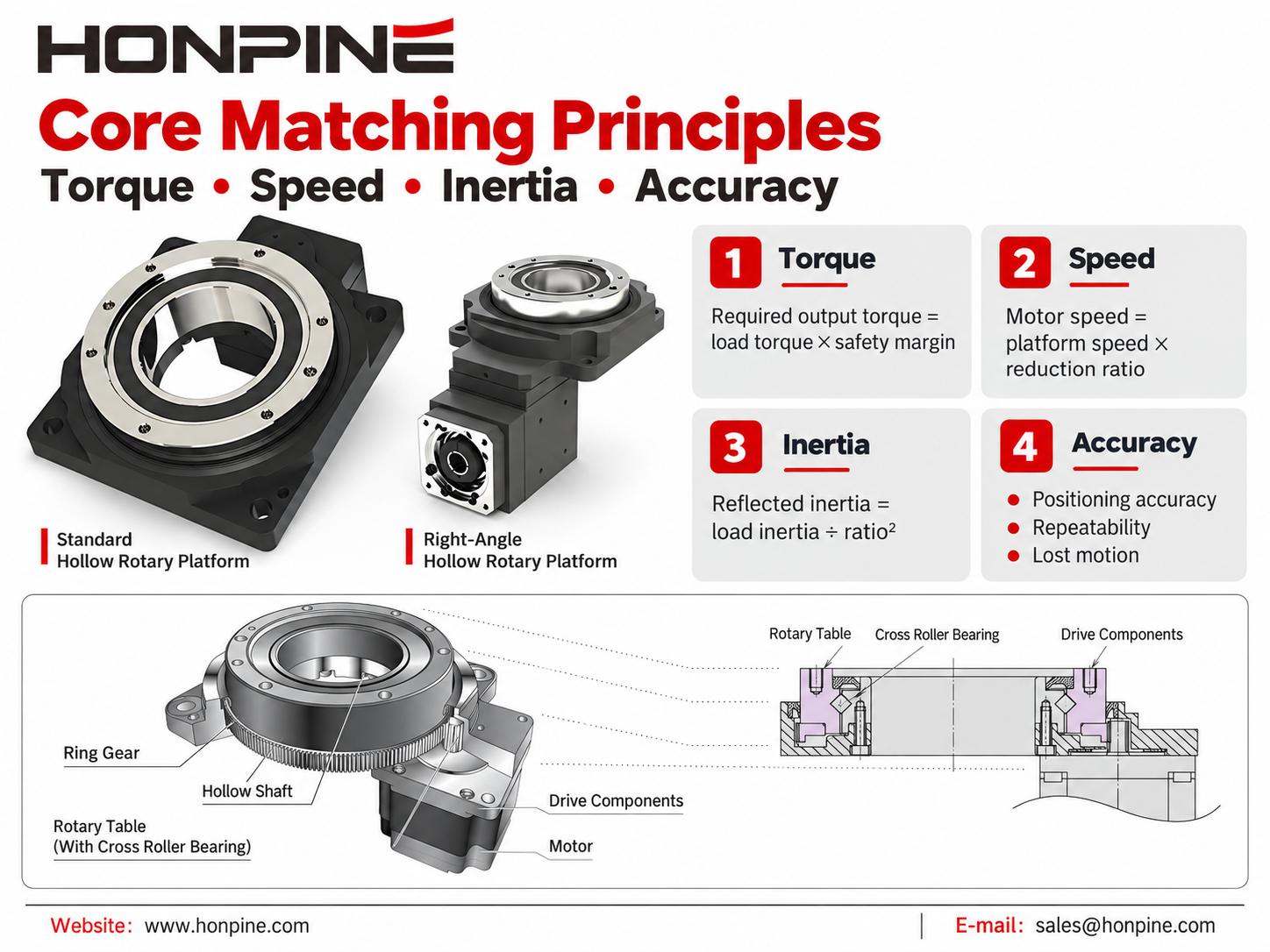
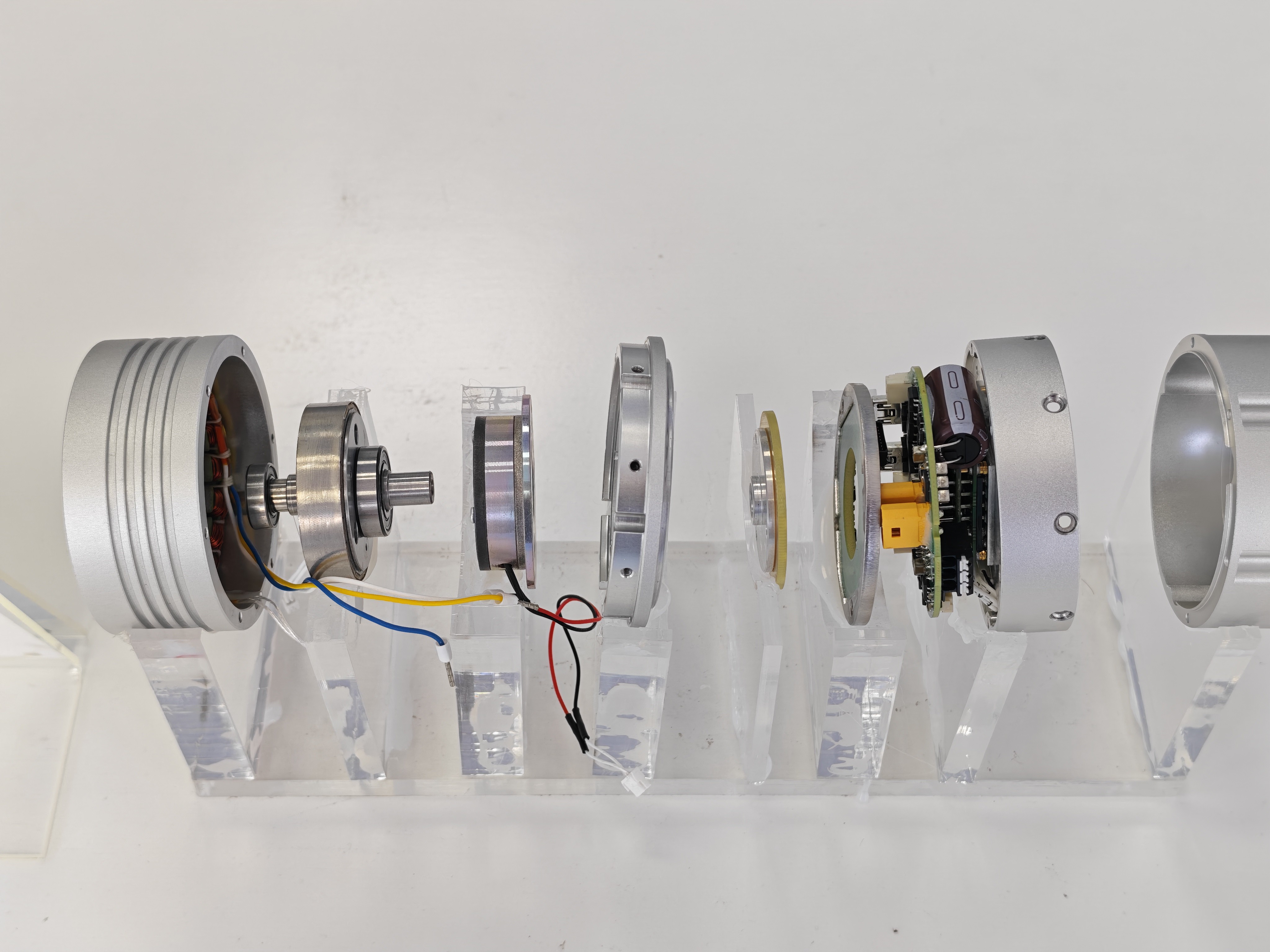
A Hollow Rotary Platform typically integrates the motor interface, precision reduction mechanism, output bearing, and hollow structure into a compact module.
Instead of designing the entire:
motor mounting structure
reduction mechanism
output bearing
rotary support system
the equipment manufacturer can select a suitable platform according to the required load, speed, reduction ratio, and installation dimensions.
This is particularly valuable for automated equipment that needs to be replicated in large quantities.
For equipment manufacturers, the real concern is often not only the component purchase price but also:
mechanical design time
assembly time
commissioning time
final equipment delivery time.
From this perspective, a Hollow Rotary Platform is essentially a modular rotary motion solution.
Do Not Judge the Solution by Accuracy Alone
One common mistake in rotary axis selection is assuming:
"The higher the accuracy requirement, the more appropriate a Direct Drive Motor must be."
This is not always true.
For example, a multi-station 3C assembly machine may need to rotate to several positions and remain stable at each station.
Its actual priorities may be:
repeatability
load stability
rotary rigidity
cycle time.
If a Hollow Rotary Platform can already meet these requirements, there may be little justification for adding system complexity simply to achieve higher theoretical dynamic performance.
On the other hand, if the machine needs to maintain highly accurate motion during continuous rotation, such as scanning, vision inspection, or laser processing, the direct-drive architecture of a Direct Drive Motor can offer significant advantages.
Therefore, the selection question should change from:
"Which product has higher accuracy?"
to:
"Is the rotary axis primarily performing positioning, or is it performing continuous motion control?"
These are fundamentally different design requirements.
For High-Inertia Rotary Loads, Evaluate the Entire Motion System
Suppose an automated machine needs to drive a relatively large rotary table.
The table itself may not be extremely heavy, but because a significant portion of the mass is located away from the rotational center, its moment of inertia can become substantial.
In this situation, looking only at motor rated torque is not enough.
The system should be evaluated based on:
load inertia, acceleration, acceleration time, and target cycle time.
A Direct Drive Motor must generate the required acceleration torque directly, so the motor size may increase rapidly as the load inertia increases.
A Hollow Rotary Platform can use a reduction mechanism to reduce the reflected load inertia on the motor side while increasing output torque.
Therefore, for large rotary tables, heavy fixtures, and multi-station rotary mechanisms, the motor, reduction mechanism, bearing system, and output structure should be evaluated as one integrated system.
This is one of the reasons Hollow Rotary Platforms remain highly competitive in many automation applications.
A Hollow Structure Is More Than Convenient Cable Routing
The hollow structure of a rotary platform is sometimes treated as a secondary feature.
In automation equipment, however, it can directly influence the overall mechanical architecture.
Imagine a rotary stage that needs to route:
power cables
encoder cables
pneumatic tubing
vacuum lines
sensor wiring
With a solid rotary shaft, these lines may have to be routed around the outside.
As the platform rotates continuously, additional components such as cable carriers, rotary unions, or cable protection mechanisms may be required.
A hollow structure allows these lines to pass through the center of the rotary axis.
This can reduce cable interference while making the equipment more compact.
Therefore, for multi-station rotary tables, automated assembly equipment, inspection platforms, and rotary fixtures, a hollow structure is not simply another specification. It can be an important mechanical design advantage.
The Right Solution Should Be Evaluated Over the Entire Equipment Lifecycle
If only the initial purchase price is considered, one solution may appear less expensive.
For equipment manufacturers, however, the more meaningful calculation is the total lifecycle cost.
For example, a Frameless Direct Drive Motor may require additional engineering work to design:
the bearing system
rotor support
encoder mounting structure
mechanical alignment.
The initial mechanical engineering investment may therefore be higher.
However, for high-volume equipment, this architecture may provide sufficient motion performance to justify the additional engineering effort.
A Hollow Rotary Platform, on the other hand, can significantly reduce mechanical development work.
A standardized module can shorten design, assembly, and commissioning time.
For an equipment manufacturer, this value may not appear directly in the component purchase price. It can instead appear as:
shorter development cycles
faster delivery
lower engineering costs.
For this reason, a real solution comparison should consider:
Component Cost + Engineering Cost + Assembly Cost + Commissioning Cost + Maintenance Cost
rather than simply comparing the purchase prices of two components.
Different Rotary Axes Can Use Different Solutions
A complex machine does not necessarily need to use the same rotary technology for every axis.
For example, a 3C automation machine may contain:
a high-speed vision scanning axis, a multi-station rotary axis, a precision positioning axis, and several auxiliary rotary axes.
These axes have completely different motion requirements.
A high-speed scanning axis may benefit from a Direct Drive Motor.
A rotary axis responsible for driving a large-inertia table or multi-station indexing mechanism may be better suited to a Hollow Rotary Platform.
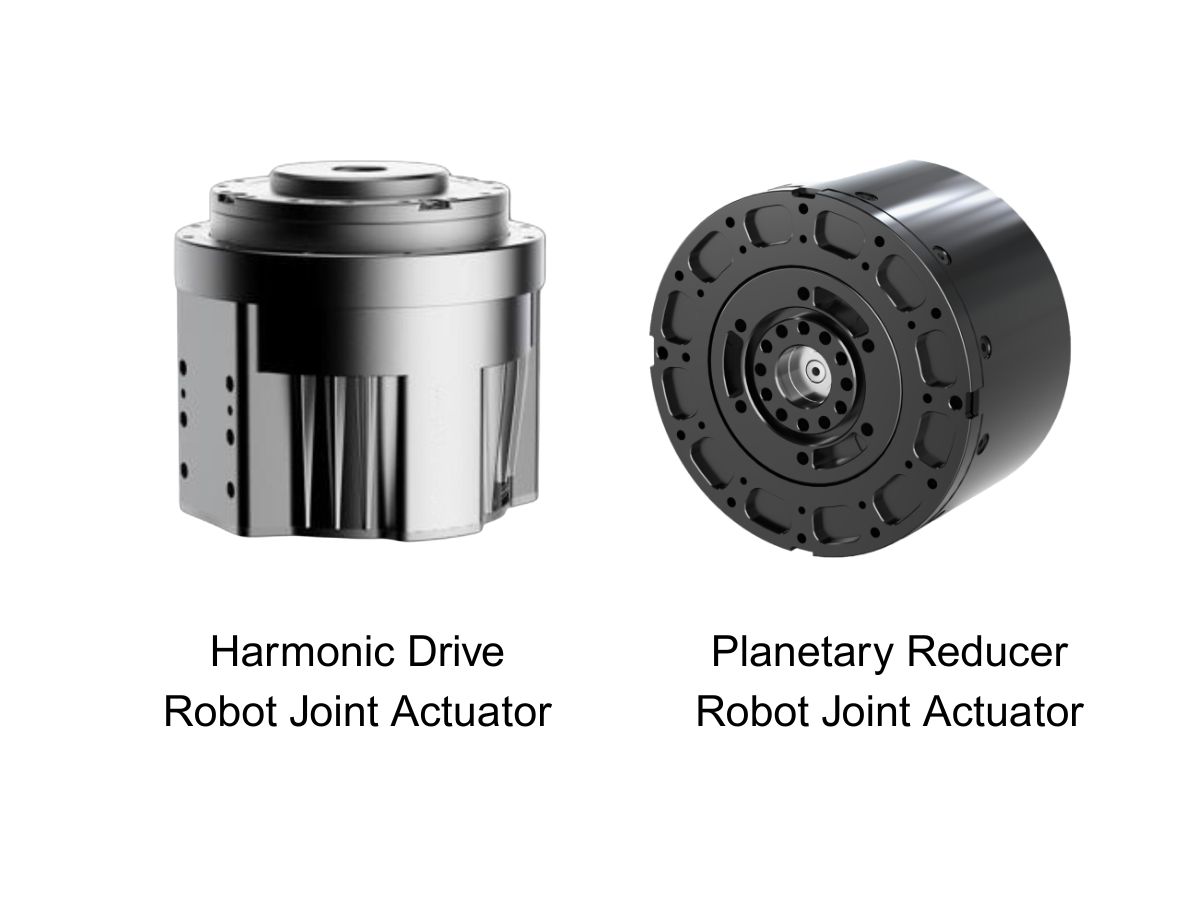
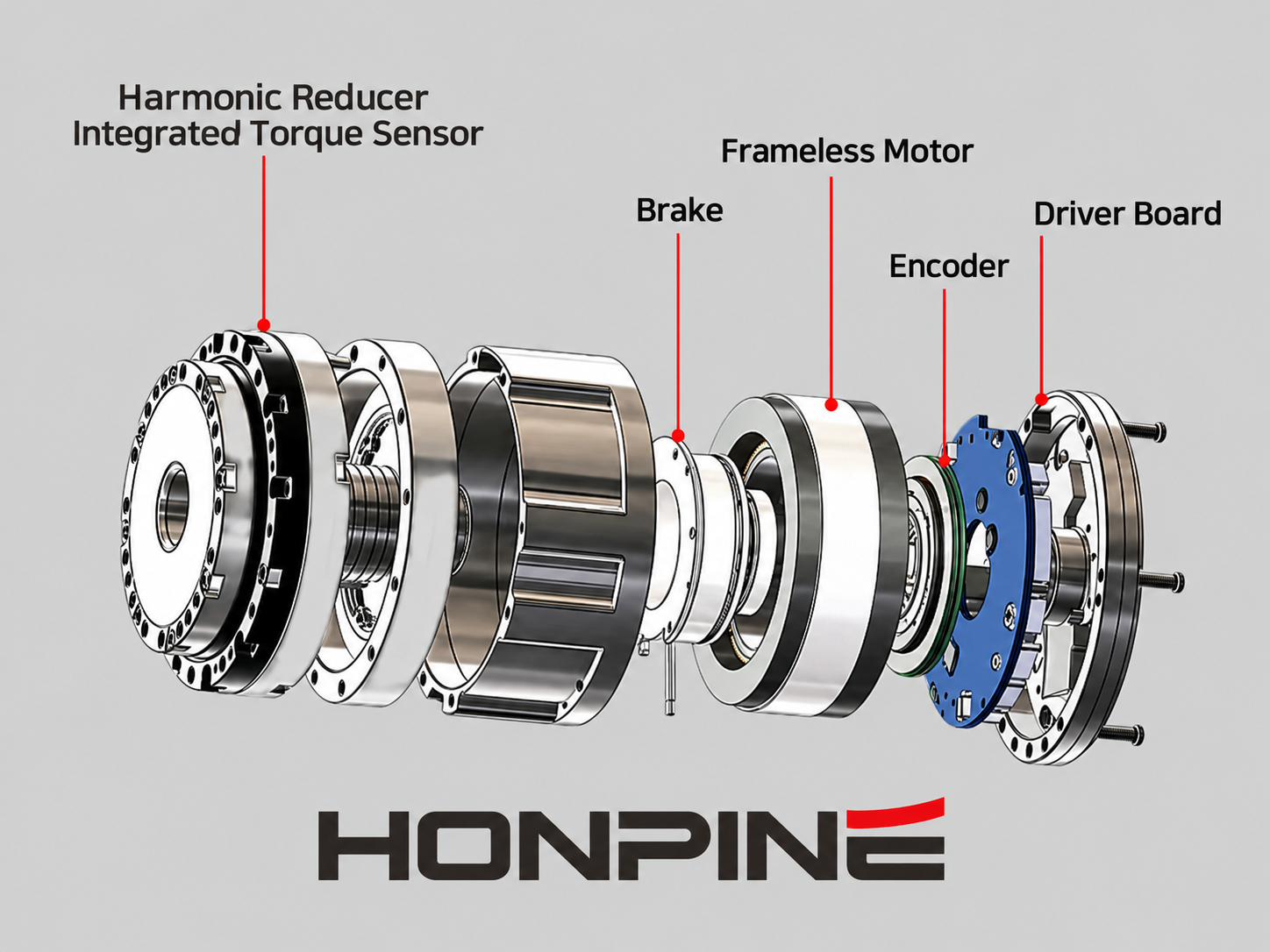
A robotic rotary joint operating in a limited installation space may require a Harmonic Drive Actuator or harmonic joint module to achieve high reduction ratio and high torque density.
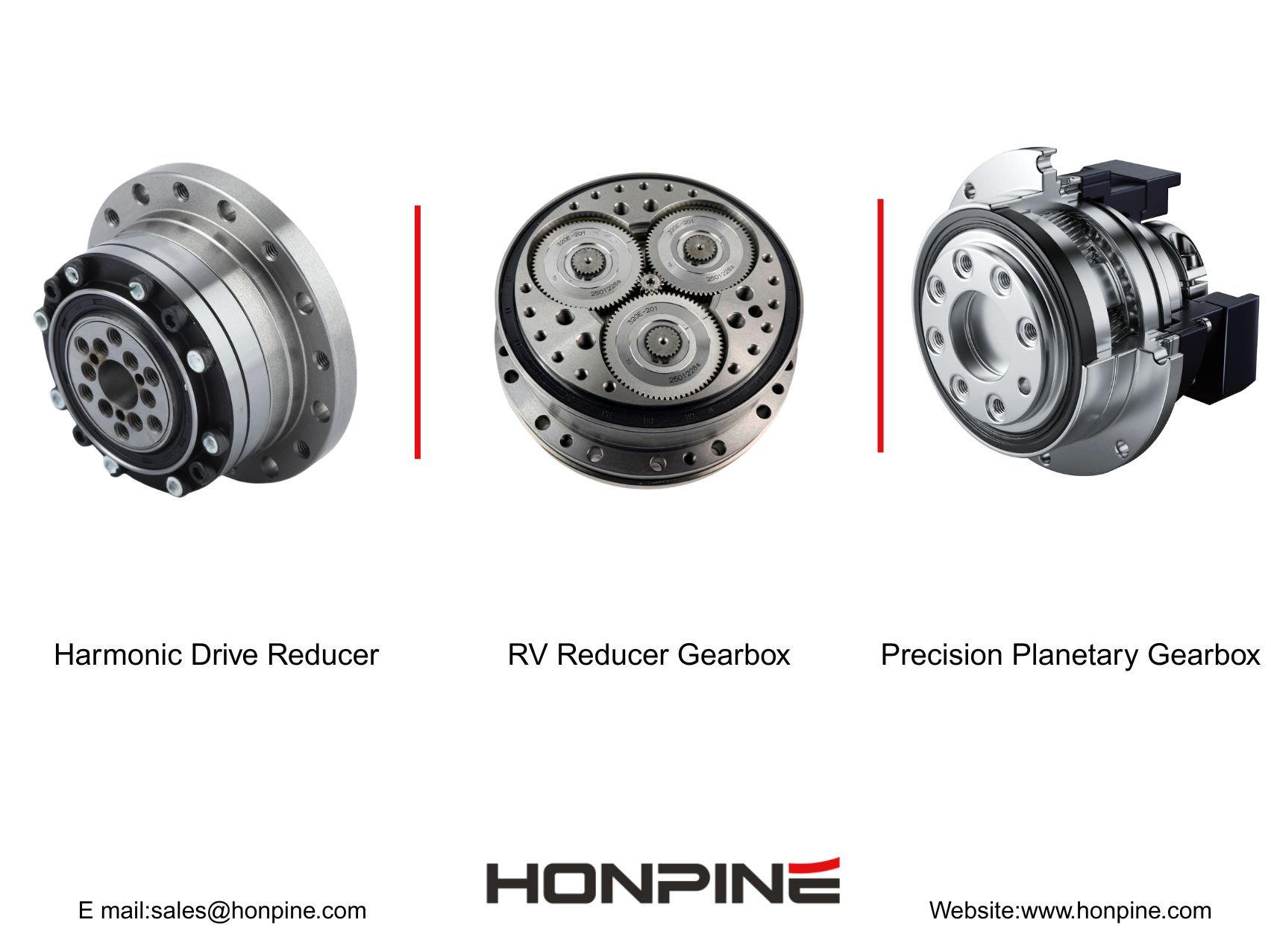
For transmission axes where efficiency, speed, and cost need to be balanced, a Precision Planetary Reducer combined with a servo motor can be another practical option.
This approach is closer to real-world machine design.
The goal is not to use one product for every rotary axis, but to select the most appropriate motion solution for each axis according to its operating conditions.
Select the Rotary Solution by Working Backward from the Machine Requirements
The selection process can be simplified by starting with several fundamental questions.
First, does the equipment require direct motion control or torque multiplication through reduction?
If high dynamic response, continuous scanning, and fast response are critical, a Direct Drive Motor should be evaluated.
If high output torque and large load capacity are more important, a Hollow Rotary Platform may be more suitable.
Second, does the machine require central cable routing?
If pneumatic tubing, cables, vacuum lines, or sensors need to pass through the rotary axis, the value of a hollow structure becomes much more significant.
Third, does the rotary axis have a large load inertia or external load?
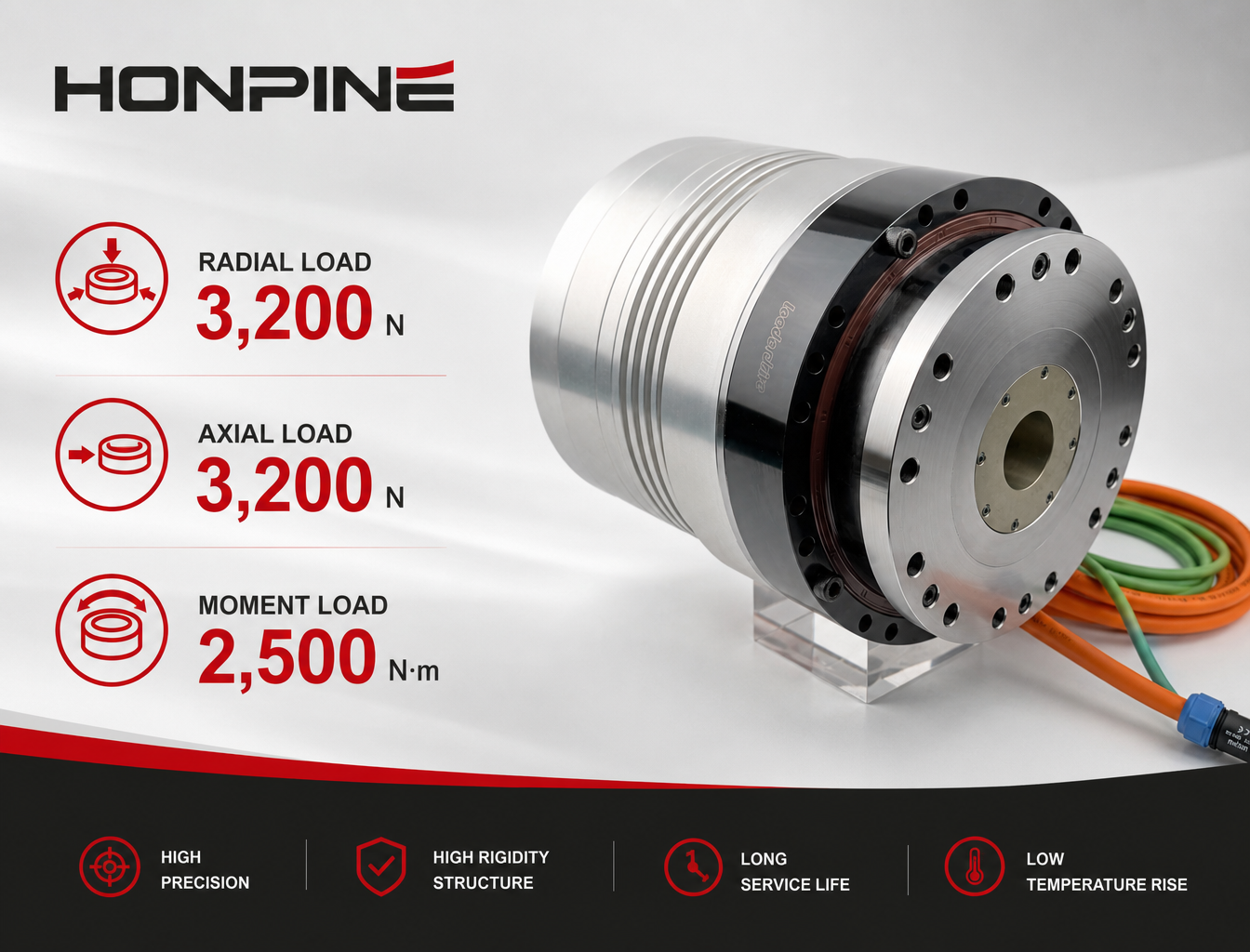
If the system experiences significant radial loads, axial loads, or overturning moments, the output bearing and mechanical rigidity need to be evaluated carefully rather than looking only at motor torque.
Finally, the equipment manufacturer's own engineering capability and delivery requirements should also be considered.
If the engineering team needs a highly customized rotary axis, a Frameless Direct Drive Motor provides greater freedom for mechanical integration.
If the goal is to develop standardized equipment quickly, a Hollow Rotary Platform can reduce a considerable amount of mechanical design and commissioning work.
Direct Drive Motor, Hollow Rotary Platform, and Other Technologies Can Form a Complete Motion Solution
From a machine solution perspective, Direct Drive Motors and Hollow Rotary Platforms should not be treated as isolated products.
They can complement other motion technologies.
For high-dynamic precision rotary axes, a Direct Drive Motor can provide direct load control.
For automated rotary mechanisms requiring high rigidity, large inertia capacity, and central cable routing, a Hollow Rotary Platform can provide a highly integrated solution.
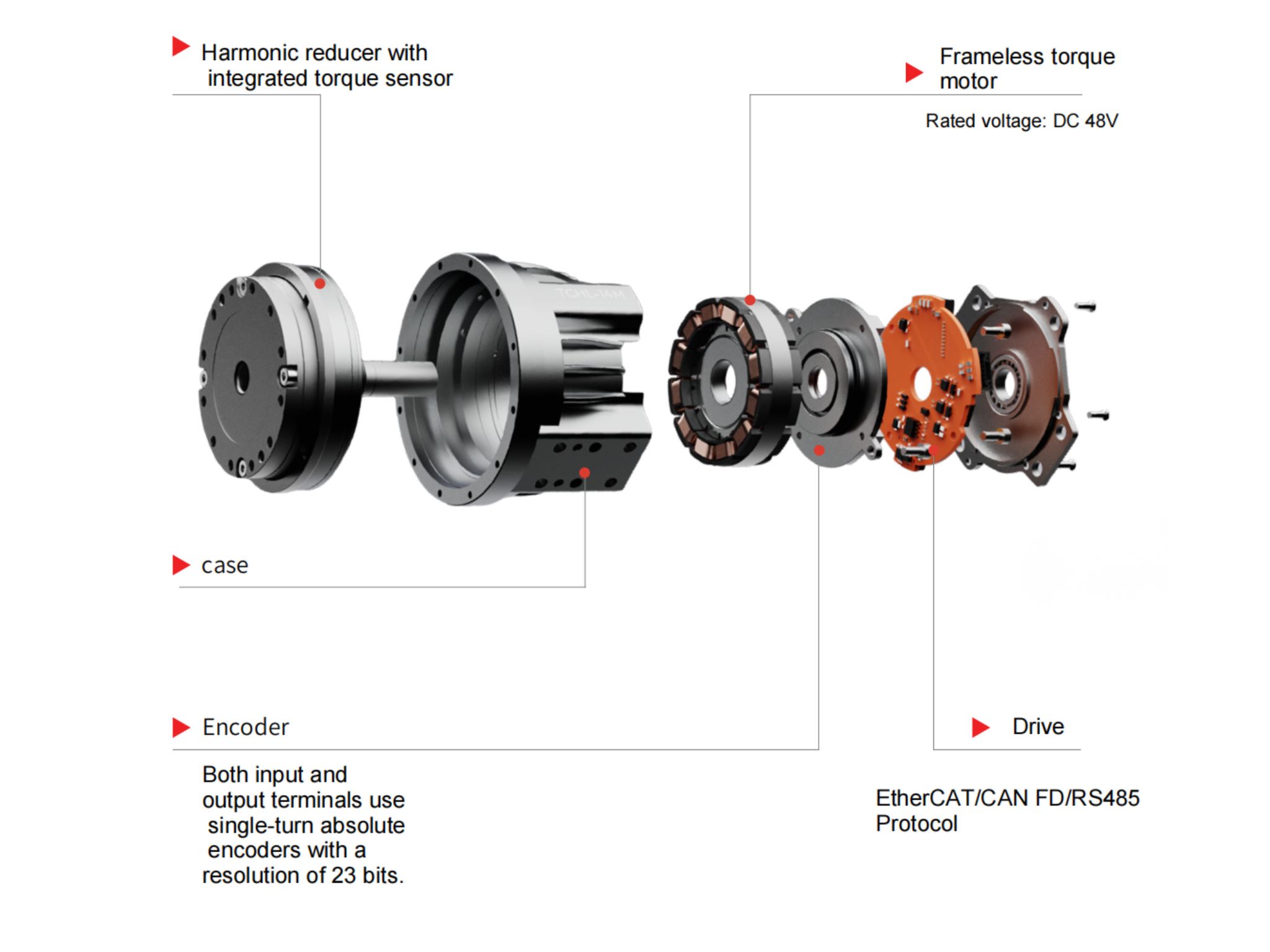
For robotic joints that require a high reduction ratio, high torque density, and compact dimensions, a Harmonic Drive Actuator or harmonic joint module can be more appropriate.
For transmission systems that require a balance between efficiency, input speed, output torque, and cost, a Precision Planetary Reducer can provide another practical solution.
Together, these technologies form a broader:
Rotary Motion Solution
rather than simply a collection of individual components.
Conclusion: There Is No Single Best Rotary Axis Solution
Direct Drive Motors and Hollow Rotary Platforms should not be viewed simply as competing products.
They solve different engineering problems.
A Direct Drive Motor is particularly suitable for rotary axes that prioritize direct drive, high dynamic response, continuous motion, and precise motion control.
A Hollow Rotary Platform is particularly suitable for automated equipment that requires torque multiplication, high rigidity, large-inertia load handling, central cable routing, and rapid modular integration.
In more complex machines, Direct Drive Motors, Hollow Rotary Platforms, Harmonic Rotary Actuators, and Precision Planetary Reducers can all be used within the same system.
Therefore, the more useful question for an equipment engineer is not:
"Which is better, a Direct Drive Motor or a Hollow Rotary Platform?"
The better question is:
"What problem does this rotary axis actually need to solve?"
Once the load, inertia, speed, accuracy, rigidity, cycle time, installation space, and cable-routing requirements are clearly defined, the appropriate rotary solution becomes much easier to identify.
This is also the direction that HONPINE can emphasize in its motion product portfolio: not simply supplying a single transmission component, but helping customers select the appropriate rotary motion solution according to the actual operating conditions of their equipment.
Read More
Learn more about the story of HONPINE and industry trends related to precision transmission.
 What is robot joint actuator?How to Choose the Best Robot Rotary Joint Actuator?In core robot joint transmission solutions, planetary and harmonic rotary actuators each have their own strengths. Choosing the right type based on application requirements is essential to achieve the optimal balance between performance and cost.
 DD Motors VS Harmonic Rotary ActuatorsThis article provides an in-depth comparison between Direct Drive (DD) motors and harmonic rotary actuators, covering their transmission principles, advantages and disadvantages, and typical application fields.
 OMG Ultra Compact Harmonic Drive Joint Module with Built-in Torque SensorHONPINE TCHL series harmonic drive joint module is a game-changing product that achieves disruptive improvements in multiple aspects such as lightweight design, integration level, and connection convenience. This article will analyze its revolutionary enhancements with you.
 The Role of Harmonic Drive Gears in Achieving 5–10 μm Accuracy in Dental Milling MachinesA dental milling machine is a CNC machining system used to directly process digital dental models into restorations such as crowns, bridges, veneers, inlays, and implant abutments. Dental milling machines require far higher operational accuracy and motion stability than ordinary equipment. This article explains how harmonic drive gear help dental milling machines achieve stable, continuous, and controllable operation.
 Why Are Harmonic Rotary Actuators Perfect for Medical Equipment?Harmonic rotary actuators (typically integrated systems consisting of a harmonic drive reducer, frameless torque motor, encoder, and optional brake) are regarded as key components in medical equipment. The core reason is that they simultaneously meet the most stringent medical requirements for precision, compact size, safety, and controllability. The following explanation is structured from three perspectives: technical characteristics, application scenarios, and medical value.
 High-Precision RV Reducers Perfectly Matched for Walking RobotsThe walking axis of a robot is a core component for power transmission and support. RV reducers provide extremely high rigidity, precision, and torque while maintaining a compact size and exceptional reliability, making them an ideal match for the demanding requirements of walking robot joints in terms of load capacity, impact resistance, and precision.
 Hollow Rotary Platform Motor Matching: A Complete GuideSelecting the right motor for a hollow rotary platform is essential for achieving precise positioning, stable operation, and efficient automation. This guide explains how to match servo motors, stepper motors, and brushless DC motors with hollow rotary platforms based on torque, speed, inertia, accuracy, and installation requirements. Explore practical motor selection guidelines, typical application combinations, and space-saving mounting solutions to find the right configuration for your automation project.
 Can Robots Feel Touch? HONPINE HAG Force-Controlled Harmonic Robot Joint MotorsCan robots respond to a gentle touch? The HONPINE HAG robot joint motor with torque sensor combines a harmonic reducer, integrated torque sensing, and closed-loop control to detect external forces and support smooth, compliant motion. In this article, HONPINE founder Allen Li demonstrates the module's response to light contact and hand-guided movement, explains its key force-control technologies, and shares the vision behind joint modules designed for practical industrial robotics.
 Does a Higher Gearbox Ratio Mean More Torque? Planetary, Harmonic, and RV Gearboxes ExplainedDoes a higher gearbox ratio mean more torque? This engineering guide explains the relationship between gearbox ratio, output torque, and output speed, and compares planetary gearboxes, harmonic gearboxes, and RV gearboxes. Learn why reduction ratio alone cannot determine gearbox torque capacity, efficiency, dynamic response, precision, or service life, and what engineers should consider when selecting a gearbox for robotics, CNC machines, servo systems, and industrial motion control.
 High-Precision Hollow Harmonic Rotary Actuator for CNC Machines and Heavy-Duty Rotary AxesHONPINE 58 Series Hollow Harmonic Rotary Actuator is designed for CNC rotary tables, precision rotary axes, laser processing equipment, and heavy-duty rotary positioning applications. With a 50 mm hollow bore, up to 2,722 N·m peak torque, integrated crossed roller bearing, multi-turn absolute encoder options, positioning accuracy below 30 arcsec, and repeat positioning accuracy below 5 arcsec, it combines high torque capacity with precision rotary motion and flexible mechanical integration.
 How Does the HONPINE JRM Planetary Robot Joint Module Address Temperature Rise in Continuous Operation?HONPINE JRM planetary robot joint modules are designed for long-duration and high-load robotic operation. This article examines how motor electromagnetic optimization, high-efficiency planetary transmission, GaN-based drive technology, and system-level low-loss design help control temperature rise. Using the C6345 planetary robot joint module as a test example, HONPINE also presents full-load thermal validation under continuous operation, including motor efficiency up to 92%, planetary gearbox efficiency up to 97%, and a final equilibrium temperature of 61.42°C at a 25°C ambient temperature.
 Direct Drive Motor Sizing: A Complete Guide to Torque Calculation and SelectionSelecting a direct drive motor for a precision rotary system requires more than matching motor torque to the equipment weight. Engineers need to evaluate gravity torque, inertial torque, wind torque, friction, rotational inertia, speed, acceleration, duty cycle, and positioning requirements. In this guide, Theodore Li, Technical Director at HONPINE, explains a practical approach to direct drive motor sizing and torque calculation using an azimuth and elevation turntable as an engineering example. The article covers continuous and peak torque calculation, motor selection criteria, and the application of frameless direct drive motors in integrated rotary systems.
Double Click
We provide harmonic drive reducer,planetary reducer,robot joint motor,robot rotary actuators,RV gear reducer,robot end effector,dexterous robot hand
 What is robot joint actuator?How to Choose the Best Robot Rotary Joint Actuator?In core robot joint transmission solutions, planetary and harmonic rotary actuators each have their own strengths. Choosing the right type based on application requirements is essential to achieve the optimal balance between performance and cost.
 DD Motors VS Harmonic Rotary ActuatorsThis article provides an in-depth comparison between Direct Drive (DD) motors and harmonic rotary actuators, covering their transmission principles, advantages and disadvantages, and typical application fields.
 OMG Ultra Compact Harmonic Drive Joint Module with Built-in Torque SensorHONPINE TCHL series harmonic drive joint module is a game-changing product that achieves disruptive improvements in multiple aspects such as lightweight design, integration level, and connection convenience. This article will analyze its revolutionary enhancements with you.
 Hollow Rotary Platform Motor Matching: A Complete GuideSelecting the right motor for a hollow rotary platform is essential for achieving precise positioning, stable operation, and efficient automation. This guide explains how to match servo motors, stepper motors, and brushless DC motors with hollow rotary platforms based on torque, speed, inertia, accuracy, and installation requirements. Explore practical motor selection guidelines, typical application combinations, and space-saving mounting solutions to find the right configuration for your automation project.
 Can Robots Feel Touch? HONPINE HAG Force-Controlled Harmonic Robot Joint MotorsCan robots respond to a gentle touch? The HONPINE HAG robot joint motor with torque sensor combines a harmonic reducer, integrated torque sensing, and closed-loop control to detect external forces and support smooth, compliant motion. In this article, HONPINE founder Allen Li demonstrates the module's response to light contact and hand-guided movement, explains its key force-control technologies, and shares the vision behind joint modules designed for practical industrial robotics.
 Does a Higher Gearbox Ratio Mean More Torque? Planetary, Harmonic, and RV Gearboxes ExplainedDoes a higher gearbox ratio mean more torque? This engineering guide explains the relationship between gearbox ratio, output torque, and output speed, and compares planetary gearboxes, harmonic gearboxes, and RV gearboxes. Learn why reduction ratio alone cannot determine gearbox torque capacity, efficiency, dynamic response, precision, or service life, and what engineers should consider when selecting a gearbox for robotics, CNC machines, servo systems, and industrial motion control.
 High-Precision Hollow Harmonic Rotary Actuator for CNC Machines and Heavy-Duty Rotary AxesHONPINE 58 Series Hollow Harmonic Rotary Actuator is designed for CNC rotary tables, precision rotary axes, laser processing equipment, and heavy-duty rotary positioning applications. With a 50 mm hollow bore, up to 2,722 N·m peak torque, integrated crossed roller bearing, multi-turn absolute encoder options, positioning accuracy below 30 arcsec, and repeat positioning accuracy below 5 arcsec, it combines high torque capacity with precision rotary motion and flexible mechanical integration.
 How Does the HONPINE JRM Planetary Robot Joint Module Address Temperature Rise in Continuous Operation?HONPINE JRM planetary robot joint modules are designed for long-duration and high-load robotic operation. This article examines how motor electromagnetic optimization, high-efficiency planetary transmission, GaN-based drive technology, and system-level low-loss design help control temperature rise. Using the C6345 planetary robot joint module as a test example, HONPINE also presents full-load thermal validation under continuous operation, including motor efficiency up to 92%, planetary gearbox efficiency up to 97%, and a final equilibrium temperature of 61.42°C at a 25°C ambient temperature.
 Direct Drive Motor Sizing: A Complete Guide to Torque Calculation and SelectionSelecting a direct drive motor for a precision rotary system requires more than matching motor torque to the equipment weight. Engineers need to evaluate gravity torque, inertial torque, wind torque, friction, rotational inertia, speed, acceleration, duty cycle, and positioning requirements. In this guide, Theodore Li, Technical Director at HONPINE, explains a practical approach to direct drive motor sizing and torque calculation using an azimuth and elevation turntable as an engineering example. The article covers continuous and peak torque calculation, motor selection criteria, and the application of frameless direct drive motors in integrated rotary systems.
 How Integrated Robot Joint Modules Are Reshaping Robot Wiring and Control Architecture?Integrated robot joint modules are changing how robots are designed by combining the motor, reducer, drive, encoder, and sensing components into a compact motion unit. Compared with traditional distributed architectures, this integrated approach can reduce cable complexity, simplify power and communication connections, and support more compact robot structures. As humanoid robots demand higher levels of motion coordination, response speed, precision, and integration, robot joint modules are becoming an increasingly important interface between intelligent control systems and physical movement. This article explains how integrated robot joint modules reshape robot wiring and control architecture, using the HONPINE TCHL harmonic drive robot joint module as an example.
 Force-Controlled Harmonic Joint Modules: A Key Solution for Robot CommercializationAs robots move from precise positioning toward physical interaction, joint-level torque feedback is becoming increasingly important. A force-controlled robot joint module allows the robot to sense changes in output torque and respond more appropriately to external loads, supporting compliant motion, contact detection, and force-controlled applications. HONPINE HAG and HAU harmonic joint modules integrate torque sensing directly into the joint, enabling torque closed-loop control, 360° continuous output rotation, less than 1% torque control accuracy, and a 50 Hz torque bandwidth. This integrated design also maintains consistent dimensions between force-controlled and non-force-controlled configurations, providing a flexible joint platform for robot manufacturers.
 6 Key Advantages of the HONPINE JRM Planetary Joint ModuleHigh-performance quadruped robots require joint modules that can respond quickly, maintain precise positioning, withstand repeated impacts, and deliver stable torque under demanding operating conditions. The HONPINE JRM planetary joint module combines high positioning accuracy, low backlash, fast three-loop response, high static rigidity, strong overload capability, and a wide operating temperature range. With clearly defined continuous and overload operating limits, the JRM is designed to balance dynamic performance with long-term reliability. This article introduces six key advantages of the HONPINE JRM planetary joint module and explains why it is suitable for industrial inspection quadrupeds, specialized inspection robots, explosion-proof quadruped robots, and other high-performance robotic platforms.