








Robot Joint Motor for Humanoid and Wheeled Robots: How to Choose the Right Joint Actuator?
Introduction
When people think about a Robot Joint Motor, humanoid robots are often the first application that comes to mind. A humanoid robot may contain dozens of independently controlled joints, including the hip, knee, ankle, shoulder, elbow, wrist, waist, neck, and hand. Each joint needs to generate controlled rotary motion while remaining compact, lightweight, precise, and capable of operating reliably under dynamic loads.
However, Robot Joint Motors are not limited to humanoid robots. As wheeled robots evolve from simple mobile platforms into mobile manipulation, inspection, and service systems, they are increasingly equipped with robotic arms, rotating heads, pan-tilt mechanisms, grippers, and other articulated structures. These mechanisms also require compact and accurately controlled rotary joints.
The important question, therefore, is not whether a robot is humanoid or wheeled. It is what type of joint motion the robot needs to perform.
A humanoid hip joint and a mobile robot's robotic-arm elbow may have very different torque requirements, but both depend on a controlled rotary actuator. A robot head may require much less torque than a humanoid knee, but its positioning accuracy and motion smoothness can be equally important.
This makes the Robot Joint Motor a fundamental building block for many types of articulated robotic systems.
Why Robot Joint Motors Are Becoming a Key Building Block for Robots?
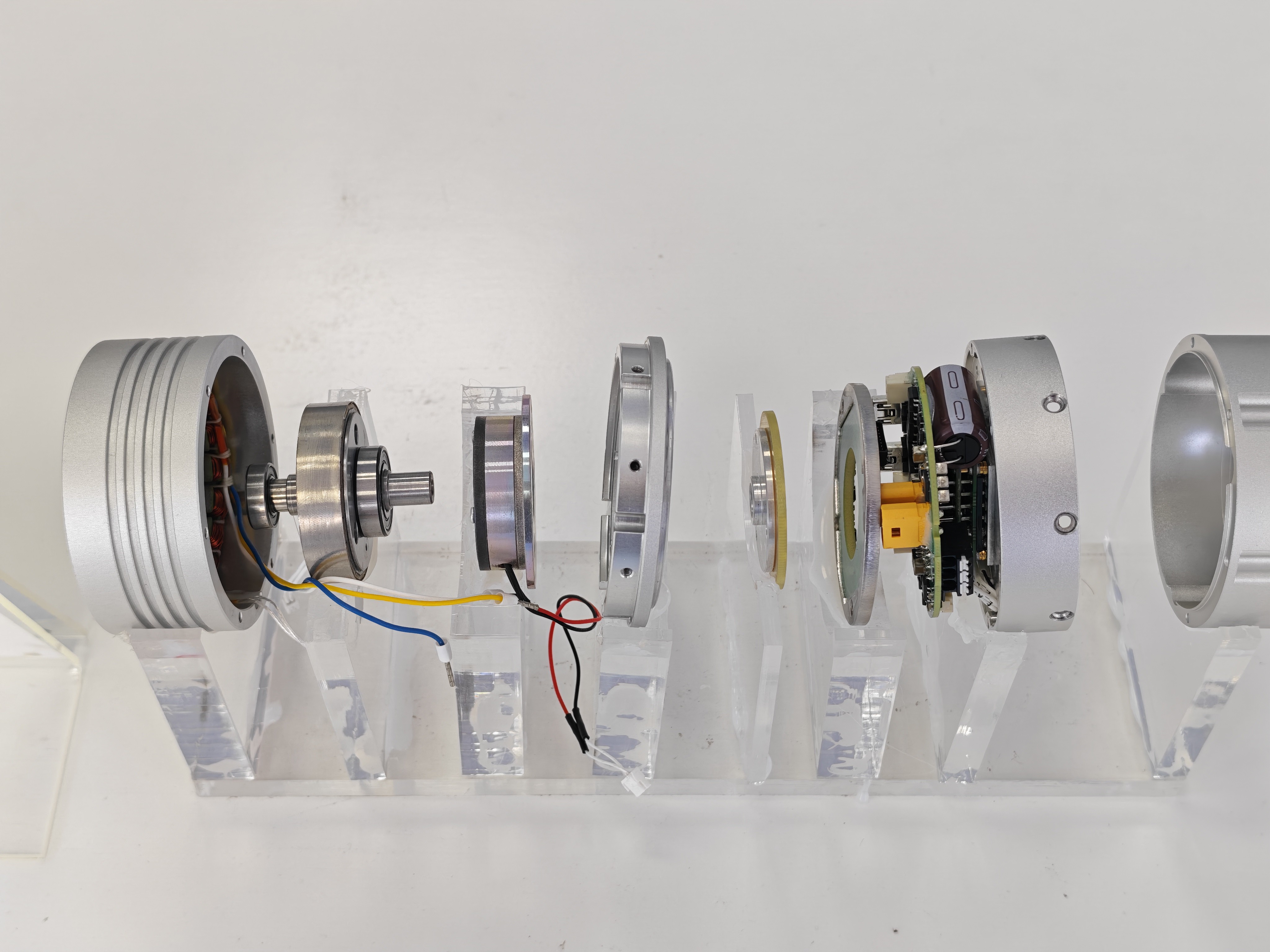
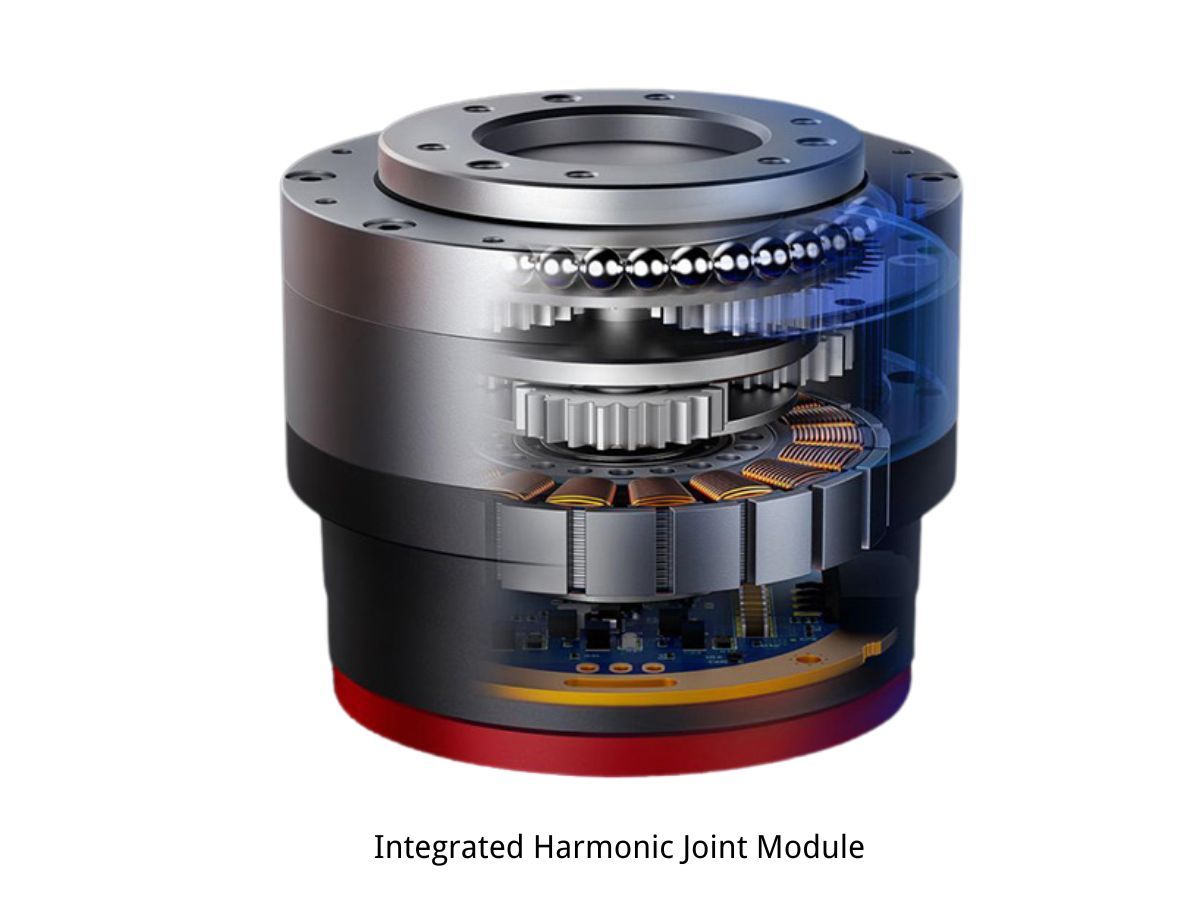
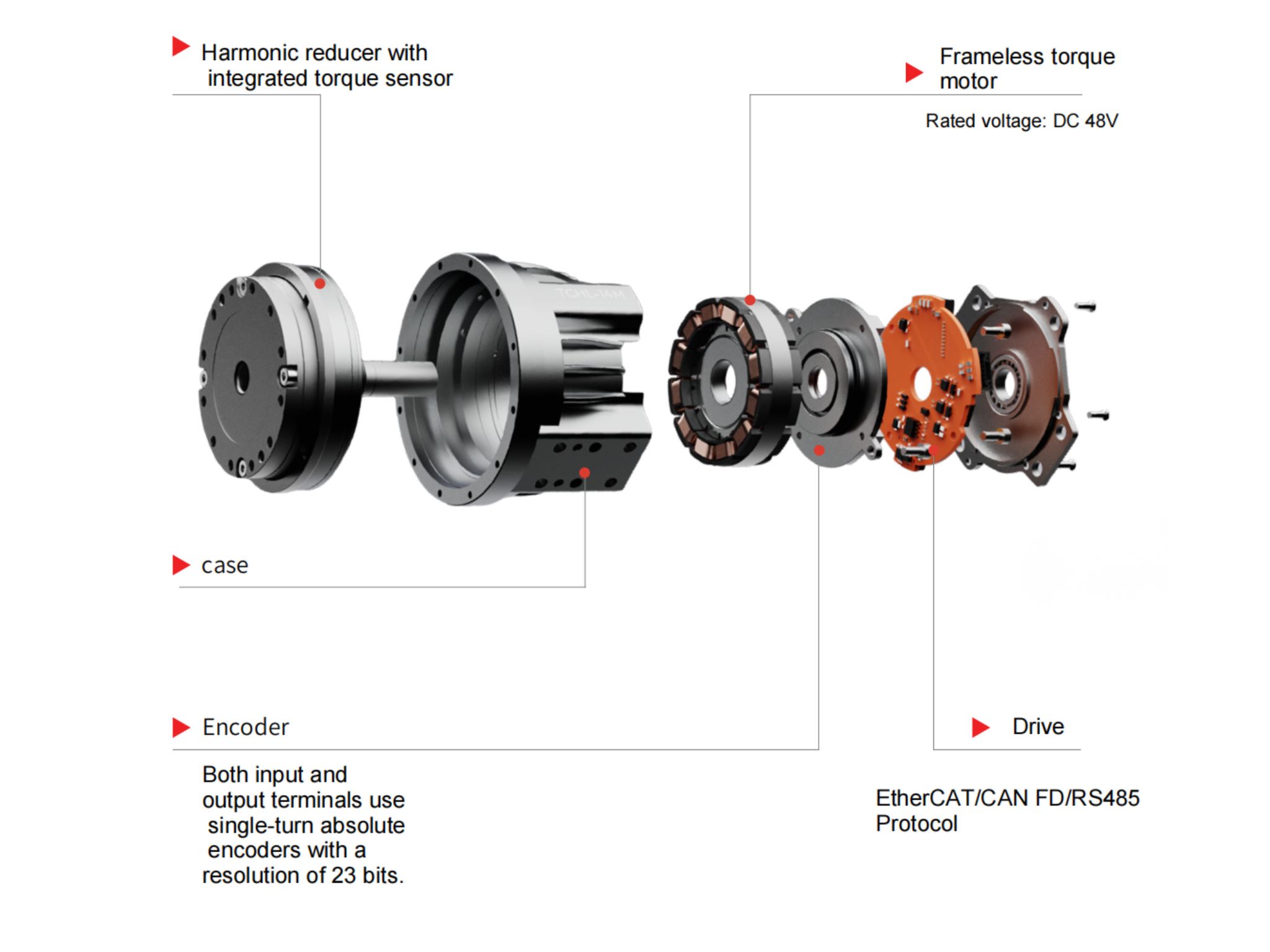
A Robot Joint Motor should not be viewed simply as a motor that produces rotation. In a modern robotic system, the joint is a complete electromechanical unit in which the motor, reducer, encoder, drive electronics, bearings, housing, and control system work together.
A typical integrated architecture can be represented as:
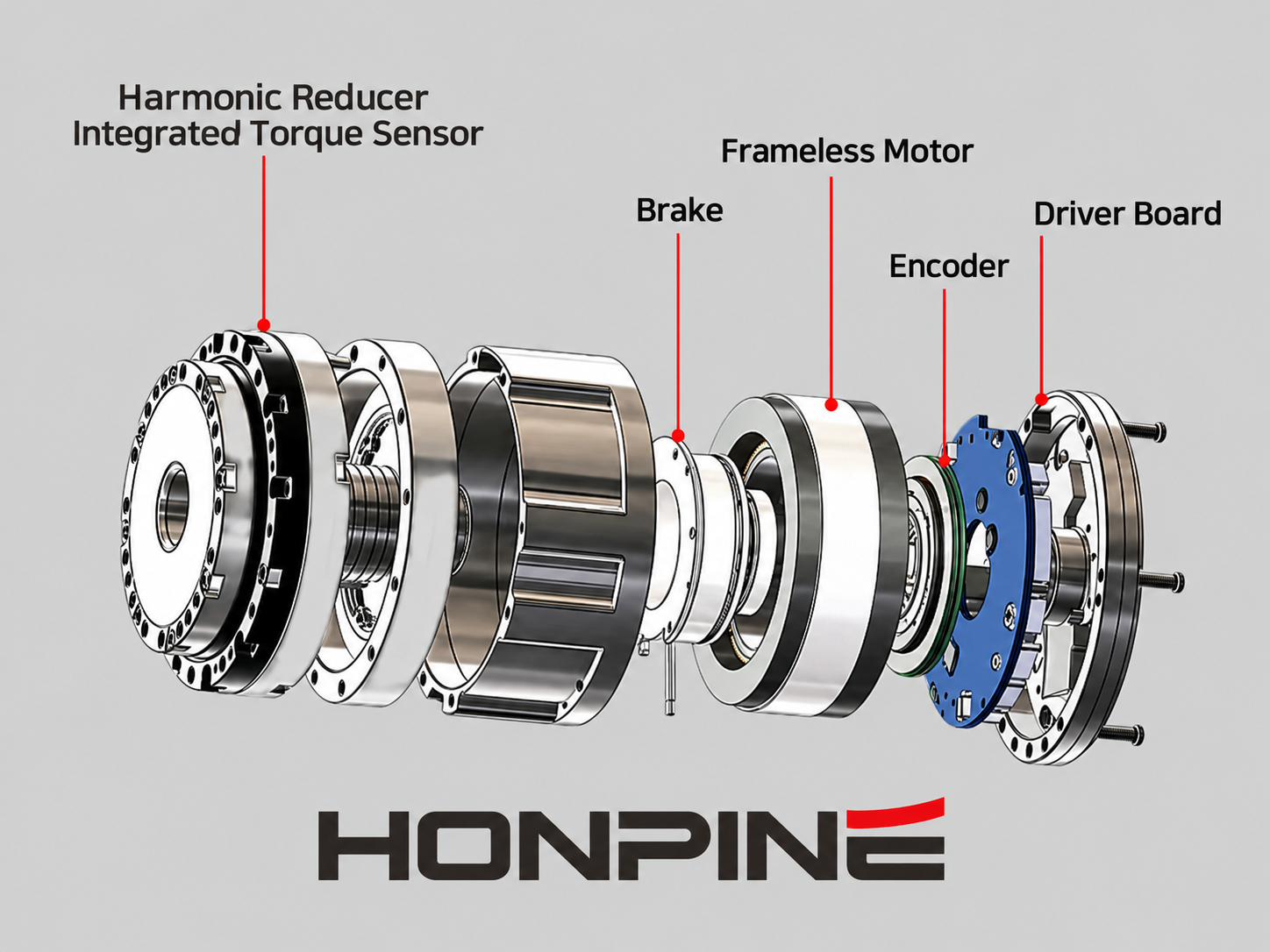
Motor + Reducer + Encoder + Driver = Integrated Robot Joint Motor
Depending on the application, additional functions such as torque sensing, braking, temperature monitoring, and communication interfaces can also be integrated into the joint.
This architecture changes the way robot manufacturers design their machines. Instead of selecting every component separately and then integrating them into the final joint, engineers can use a standardized joint module with defined mechanical, electrical, and communication interfaces.
This becomes particularly valuable as the number of robot joints increases. A humanoid robot may require dozens of actuated axes, while a mobile robot equipped with a robotic arm, rotating head, and manipulation system may also contain multiple independently controlled joints.
The more joints a robot has, the more valuable standardized and repeatable actuator architecture becomes.
Robot Joint Motor Requirements in Humanoid Robots
Humanoid robots place some of the most demanding requirements on robot joint motors because the actuator must fit within a human-scale mechanical structure while producing sufficient torque for dynamic motion.
Hip, knee, and ankle joints may need high continuous and peak torque while supporting a significant portion of the robot's weight. At the same time, shoulder, elbow, wrist, and neck joints require different combinations of torque, speed, compactness, and positioning accuracy.
This means that a humanoid robot cannot simply use one identical actuator throughout the entire body.
The actuator used for a hip joint may prioritize high torque density and mechanical stiffness, while a wrist actuator may place greater emphasis on low weight, compact dimensions, and precise positioning. A neck or head actuator may require relatively low torque but excellent motion smoothness and angular positioning.
For this reason, a practical humanoid robot actuator platform usually needs multiple torque and size classes while maintaining a consistent system architecture.
The key challenge is to achieve sufficient joint performance without allowing the actuator to become too heavy or too large. Every additional kilogram at a robot joint can affect the dynamic load experienced by other joints, increasing energy consumption and changing the robot's overall motion characteristics.
This is why torque density, compactness, mechanical stiffness, thermal performance, and feedback accuracy have become important evaluation criteria for humanoid robot joint motors.
Robot Joint Motors Are Also Important in Wheeled Robots
Wheeled robots are often discussed primarily in terms of their mobility platform, but their mechanical architecture can extend far beyond the mobile base.
A modern wheeled robot may carry a robotic arm for manipulation, a rotating head for perception, a pan-tilt mechanism for sensor positioning, or a multi-axis inspection system. Once these articulated mechanisms are introduced, the robot needs multiple controlled rotary joints.
For example, a mobile manipulator may have a mechanical chain consisting of a shoulder joint, elbow joint, wrist joint, and end-effector mechanism. The robot may move through its environment using a mobile platform, but its manipulation functions depend on the same basic principles as other robotic arms: each rotary joint needs controlled torque, accurate positioning, appropriate stiffness, and reliable feedback.
The same principle applies to robotic heads.
A wheeled inspection robot may use a camera, depth sensor, or other perception system mounted on a rotating head. The head may need to continuously scan its environment, track a target, or maintain a specific sensor orientation. In such applications, the actuator does not necessarily need the extremely high torque of a humanoid hip or knee, but low backlash, compact dimensions, smooth rotation, and accurate position control may become more important.
Therefore, the application of Robot Joint Motors in wheeled robots should not be understood as a substitute for their primary mobility system. Instead, it represents the increasing number of articulated functions carried by the robot beyond basic movement.
Different Robot Joints Require Different Motor Characteristics
The requirements of a Robot Joint Motor are determined primarily by the function of the joint.
This comparison shows why selecting a Robot Joint Motor based only on rated power is not sufficient.
A high-torque actuator may be ideal for a humanoid knee but unnecessarily large for a robot head. Conversely, an actuator optimized for low inertia and precise positioning may not provide enough continuous torque for a heavy robotic-arm joint.
The correct approach is to match the actuator to the actual torque, speed, duty cycle, mechanical stiffness, installation space, and feedback requirements of each joint.
Why Harmonic Joint Motors Are Attractive for Robotic Joints?
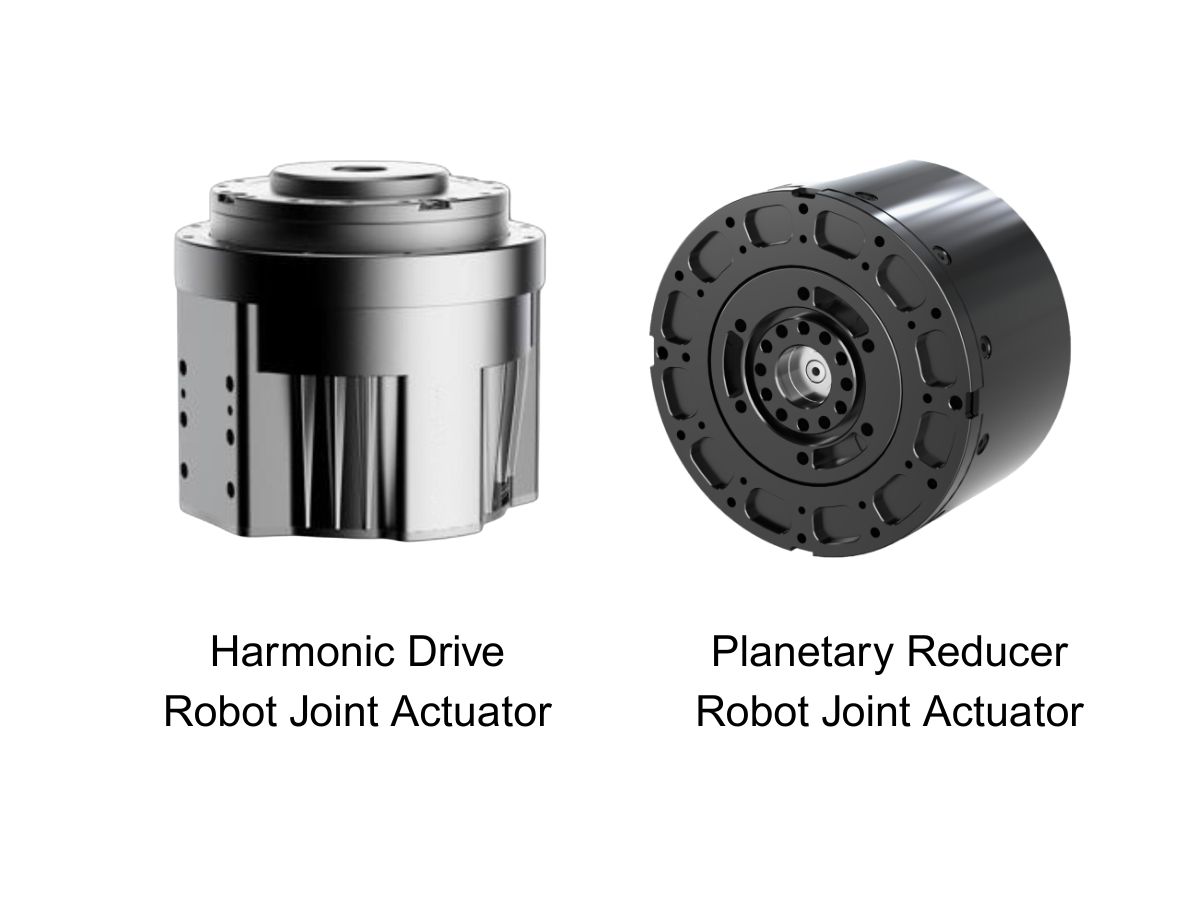
Among different transmission technologies, harmonic transmission is particularly attractive for robotic joints that require high reduction ratios, low backlash, compact dimensions, and high positioning accuracy.
A harmonic-based Robot Joint Motor combines the motor with a harmonic reducer to convert high-speed motor rotation into controlled high-torque output motion.
For applications with strict space constraints, this architecture can provide a useful balance between output torque and package size.
Low backlash is another important advantage for precision robotic joints. When multiple joints work together, transmission errors can affect the final position of the end effector or the robot body. A low-backlash transmission can therefore help improve the overall controllability of the joint.
At the same time, harmonic transmission should not be considered a universal answer for every robot joint. Reduction ratio, output speed, efficiency, backdrivability, torsional stiffness, thermal performance, and duty cycle must all be evaluated together.
For this reason, the right question is not whether a harmonic joint motor is better than every other actuator, but whether its characteristics match the specific requirements of the target joint.
Integrated Robot Joint Motor vs. Separate Motor and Reducer
Traditional robotic joints often use separate components for the motor, reducer, encoder, and drive. This approach provides flexibility during development because engineers can independently replace or modify individual components.
However, as robotic systems move toward higher integration and larger production volumes, the advantages of an integrated Robot Joint Motor become increasingly apparent.
When the motor, reducer, encoder, and electronics are designed as one module, the mechanical interfaces can be optimized from the beginning rather than being solved during final assembly. The housing can also be designed around the motor and transmission to improve structural stiffness and thermal conduction.
Integration can also reduce the complexity of external wiring. This is particularly valuable around rotating joints, where repeated cable bending and interference can create reliability problems.
Another important benefit is manufacturing consistency. Instead of assembling and calibrating every motor, reducer, encoder, and drive individually at the robot factory, a complete joint module can be tested and calibrated before delivery.
For robots with many joints, this can significantly reduce assembly and commissioning complexity.
However, integration does not automatically mean that every component should be physically packed into the smallest possible space. Thermal paths, maintenance requirements, sensor positioning, and mechanical stiffness must be considered during the initial joint architecture design.
A truly integrated joint is therefore not simply a collection of components placed inside one housing. It is a joint system designed around mechanical, electrical, thermal, and control requirements simultaneously.
How to Choose the Right Robot Joint Motor?
The selection of a Robot Joint Motor should begin with the required output motion rather than the motor's nominal power.
First, engineers need to determine the required continuous and peak output torque under the actual operating conditions. A robot joint that only reaches its peak torque for a fraction of a second has very different requirements from one that continuously holds a heavy load.
Output speed is equally important. The motor may operate at a relatively high speed, but the reducer determines the final joint speed and output torque. Therefore, the reduction ratio must be selected by considering both torque and speed rather than maximizing one parameter.
Mechanical stiffness and backlash should then be evaluated according to the application's precision requirements. High-precision robotic arms, humanoid joints, and positioning mechanisms may require significantly different transmission characteristics from less demanding rotary mechanisms.
Feedback architecture is another important consideration. A motor-side encoder can provide high-speed motor control, while an output-side encoder can provide more direct information about the final joint position. For advanced robotic applications, dual-encoder architectures can provide additional control and feedback capability.
Thermal performance should also be evaluated using the real operating cycle. Short-duration peak torque data alone cannot accurately represent the performance of a joint operating continuously under dynamic loads.
Finally, engineers need to consider the actuator's weight, dimensions, communication interface, wiring requirements, maintenance strategy, and level of integration.
The best Robot Joint Motor is therefore not necessarily the one with the highest torque or highest power. It is the one that provides the required torque, speed, precision, stiffness, thermal performance, and integration within the available mechanical envelope.
Why Modular Robot Joint Motors Are Becoming More Important?
As robot manufacturers develop different platforms and generations of robots, the need for modular actuator platforms is increasing.
Different joints require different performance levels, but redesigning the complete electrical and mechanical architecture for every joint creates unnecessary engineering work.
A modular Robot Joint Motor platform can instead provide several actuator sizes and torque classes while maintaining common mechanical and electrical design principles.
For example, a robot manufacturer could use a higher-torque actuator for a humanoid hip, a medium-size actuator for an elbow, and a compact actuator for a wrist or robot head.
The specific actuators can be different, but the overall development methodology remains consistent.
This approach can shorten development cycles, simplify testing, and make it easier to scale from prototype robots to production platforms.
For manufacturers developing multiple robotic products, modularity can therefore be as important as the performance of an individual actuator.
The Future of Robot Joint Motors
The development of Robot Joint Motors is moving toward deeper integration.
Future actuator modules are likely to combine more functions within a standardized mechanical package, including the motor, precision reducer, encoder, drive electronics, torque sensing, temperature monitoring, communication, and safety functions.
This means that the robot joint will increasingly become an independent electromechanical unit capable of receiving commands, generating torque, measuring its own operating state, and communicating with the robot controller.
The trend is particularly visible in humanoid robotics, but the underlying technology can also support robotic arms, mobile manipulators, inspection robots, collaborative robots, quadruped robots, and other articulated systems.
The common requirement across these platforms is not the robot's shape or mobility method.
It is the need to generate precise, controlled rotary motion from a compact and highly integrated joint.
Conclusion
Robot Joint Motor is no longer a component category limited to humanoid robots.
Humanoid robots require numerous joint motors across the hip, knee, ankle, shoulder, elbow, wrist, neck, and hand. Wheeled robots, meanwhile, are increasingly equipped with robotic arms, rotating heads, pan-tilt systems, inspection mechanisms, and other articulated structures that also depend on controlled rotary joints.
The important distinction is therefore not whether the robot is humanoid or wheeled.
It is what each joint needs to accomplish.
High-load humanoid joints may prioritize torque density, stiffness, thermal capacity, and dynamic response. Robotic-arm joints may require a balance of torque, speed, precision, and repeatability. Robot heads and pan-tilt mechanisms may place greater emphasis on low backlash, positioning accuracy, compactness, and smooth motion.
This is why Robot Joint Motor selection should begin with the actual requirements of the joint rather than the overall category of the robot.
For humanoid robots, mobile manipulators, inspection robots, robotic arms, and other articulated robotic systems, an integrated Robot Joint Motor combining a motor, precision reducer, encoder, and drive can provide a standardized foundation for building compact and high-performance robotic joints.
The future of robotic actuation is not simply about making the motor more powerful. It is about creating a joint module that integrates torque generation, transmission, feedback, control, and mechanical structure into a system optimized for the specific motion requirements of the robot.
Read More
Learn more about the story of HONPINE and industry trends related to precision transmission.
 What is robot joint actuator?How to Choose the Best Robot Rotary Joint Actuator?In core robot joint transmission solutions, planetary and harmonic rotary actuators each have their own strengths. Choosing the right type based on application requirements is essential to achieve the optimal balance between performance and cost.
 DD Motors VS Harmonic Rotary ActuatorsThis article provides an in-depth comparison between Direct Drive (DD) motors and harmonic rotary actuators, covering their transmission principles, advantages and disadvantages, and typical application fields.
 OMG Ultra Compact Harmonic Drive Joint Module with Built-in Torque SensorHONPINE TCHL series harmonic drive joint module is a game-changing product that achieves disruptive improvements in multiple aspects such as lightweight design, integration level, and connection convenience. This article will analyze its revolutionary enhancements with you.
 The Role of Harmonic Drive Gears in Achieving 5–10 μm Accuracy in Dental Milling MachinesA dental milling machine is a CNC machining system used to directly process digital dental models into restorations such as crowns, bridges, veneers, inlays, and implant abutments. Dental milling machines require far higher operational accuracy and motion stability than ordinary equipment. This article explains how harmonic drive gear help dental milling machines achieve stable, continuous, and controllable operation.
 Why Are Harmonic Rotary Actuators Perfect for Medical Equipment?Harmonic rotary actuators (typically integrated systems consisting of a harmonic drive reducer, frameless torque motor, encoder, and optional brake) are regarded as key components in medical equipment. The core reason is that they simultaneously meet the most stringent medical requirements for precision, compact size, safety, and controllability. The following explanation is structured from three perspectives: technical characteristics, application scenarios, and medical value.
 High-Precision RV Reducers Perfectly Matched for Walking RobotsThe walking axis of a robot is a core component for power transmission and support. RV reducers provide extremely high rigidity, precision, and torque while maintaining a compact size and exceptional reliability, making them an ideal match for the demanding requirements of walking robot joints in terms of load capacity, impact resistance, and precision.
 Harmonic Reducer vs. Harmonic Rotary Actuator: Which Is Better for CNC Machine Tools?Choosing between a harmonic reducer and a harmonic rotary actuator is an important decision in CNC machine tool design. Both solutions offer high-precision motion control, but they differ in integration, installation requirements, rigidity, and system flexibility. For CNC fourth-axis rotary tables and compact five-axis machining systems, selecting the right harmonic drive can significantly influence machine performance. In this article, HONPINE Technical Director Theodore Li compares harmonic reducers and harmonic rotary actuators to help engineers identify the most suitable solution for their CNC applications.
 How to Choose Harmonic Joint Actuators for a 7-DOF Robotic Arm?I'm Theodore Li, Technical Director at HONPINE. Choosing harmonic joint actuators for a 7-DOF robotic arm starts with the torque, weight, and installation needs of each joint. This guide uses a TCHL 20 shoulder and TCHL 14 wrist configuration as an example, then explores torque sensing, compliant control, and HAG Series considerations for demanding robotic applications.
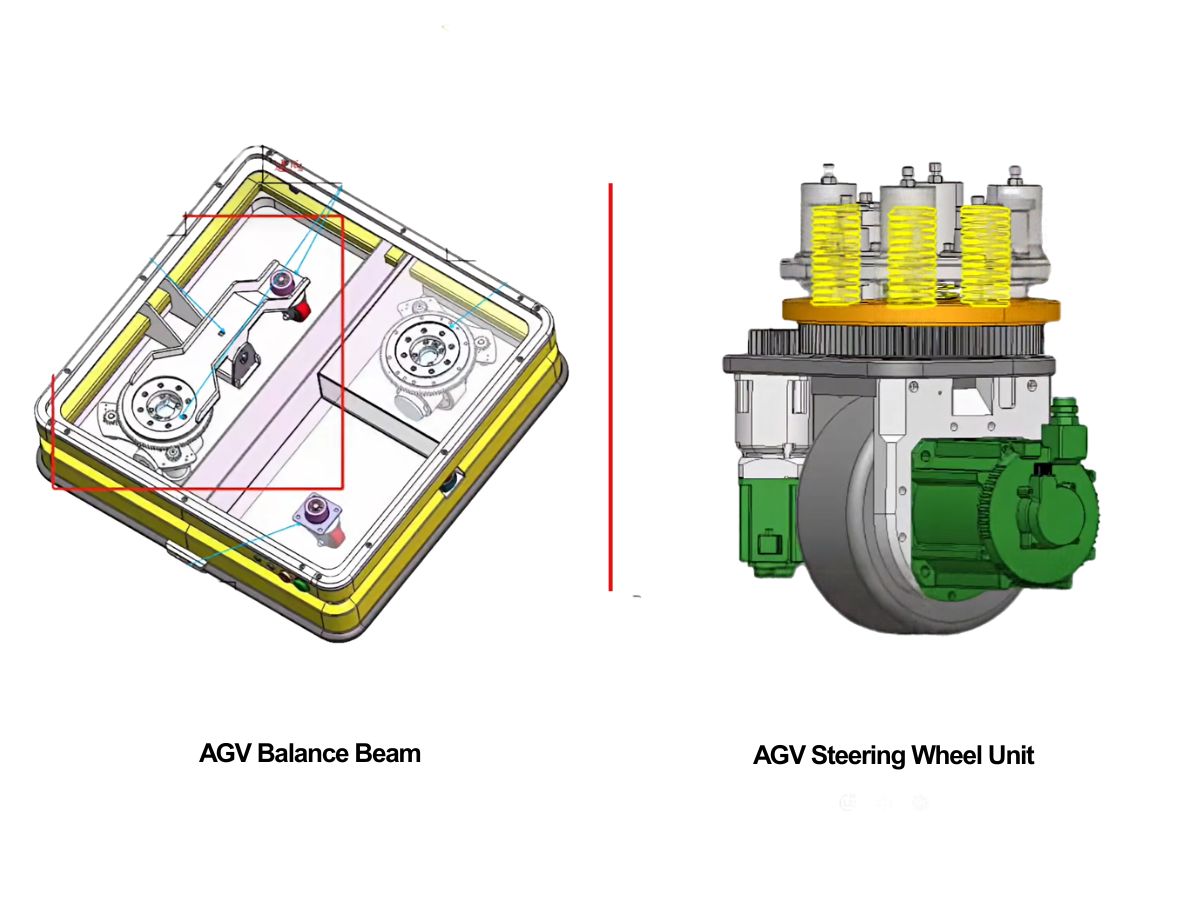
 AGV Suspension: Should You Choose a Balance Beam or a Spring-Loaded Steering Drive Unit?Choosing an AGV suspension system starts with the vehicle’s load range and floor conditions. Balance beams and spring-loaded steering drive units offer different approaches to maintaining wheel contact and managing wheel loads. This HONPINE guide compares both options and explains how to evaluate traction, suspension travel, installation space, and maintenance before choosing a configuration.
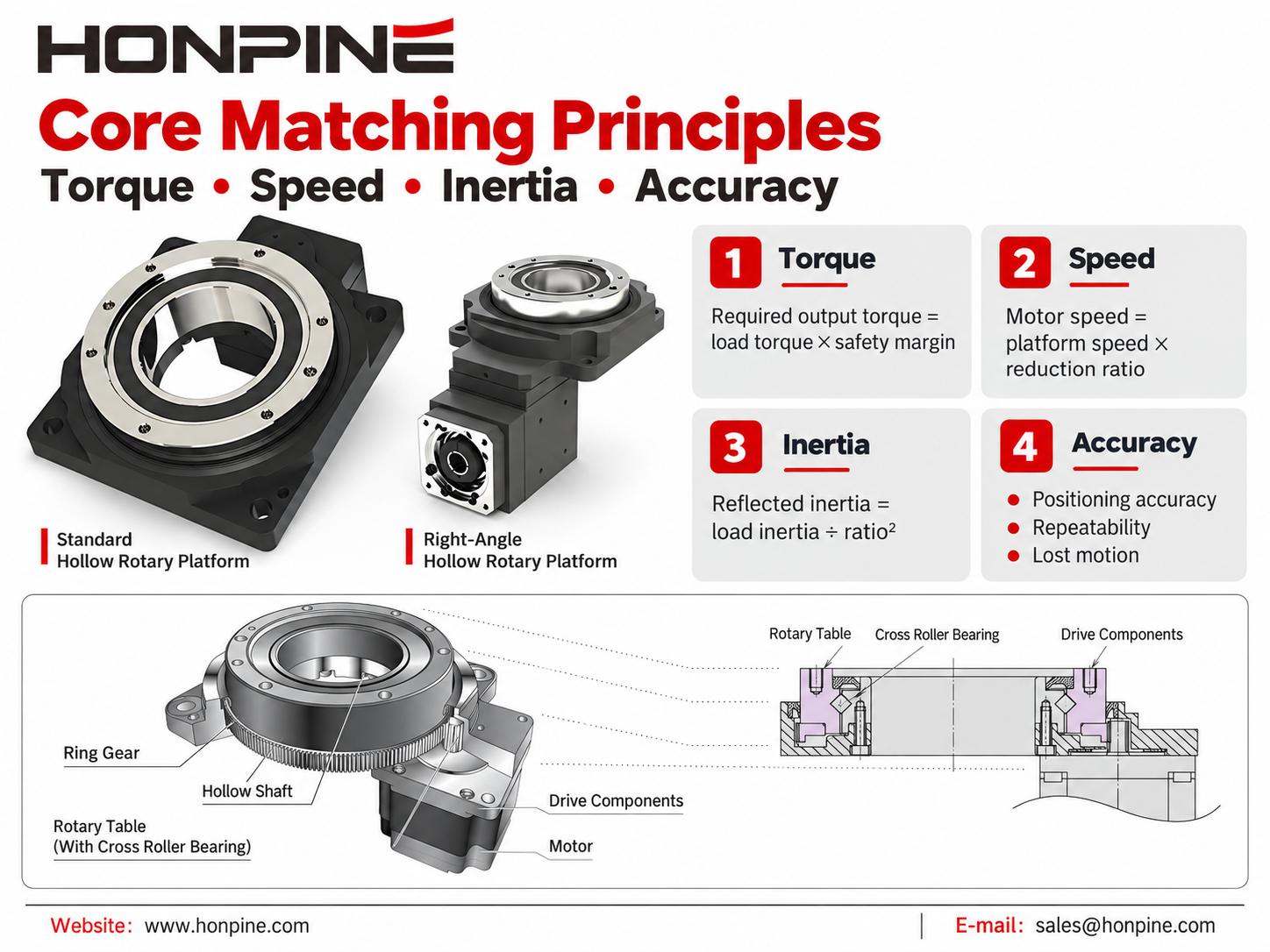
 Hollow Rotary Platform Motor Matching: A Complete GuideSelecting the right motor for a hollow rotary platform is essential for achieving precise positioning, stable operation, and efficient automation. This guide explains how to match servo motors, stepper motors, and brushless DC motors with hollow rotary platforms based on torque, speed, inertia, accuracy, and installation requirements. Explore practical motor selection guidelines, typical application combinations, and space-saving mounting solutions to find the right configuration for your automation project.
 Can Robots Feel Touch? HONPINE HAG Force-Controlled Harmonic Robot Joint MotorsCan robots respond to a gentle touch? The HONPINE HAG robot joint motor with torque sensor combines a harmonic reducer, integrated torque sensing, and closed-loop control to detect external forces and support smooth, compliant motion. In this article, HONPINE founder Allen Li demonstrates the module's response to light contact and hand-guided movement, explains its key force-control technologies, and shares the vision behind joint modules designed for practical industrial robotics.
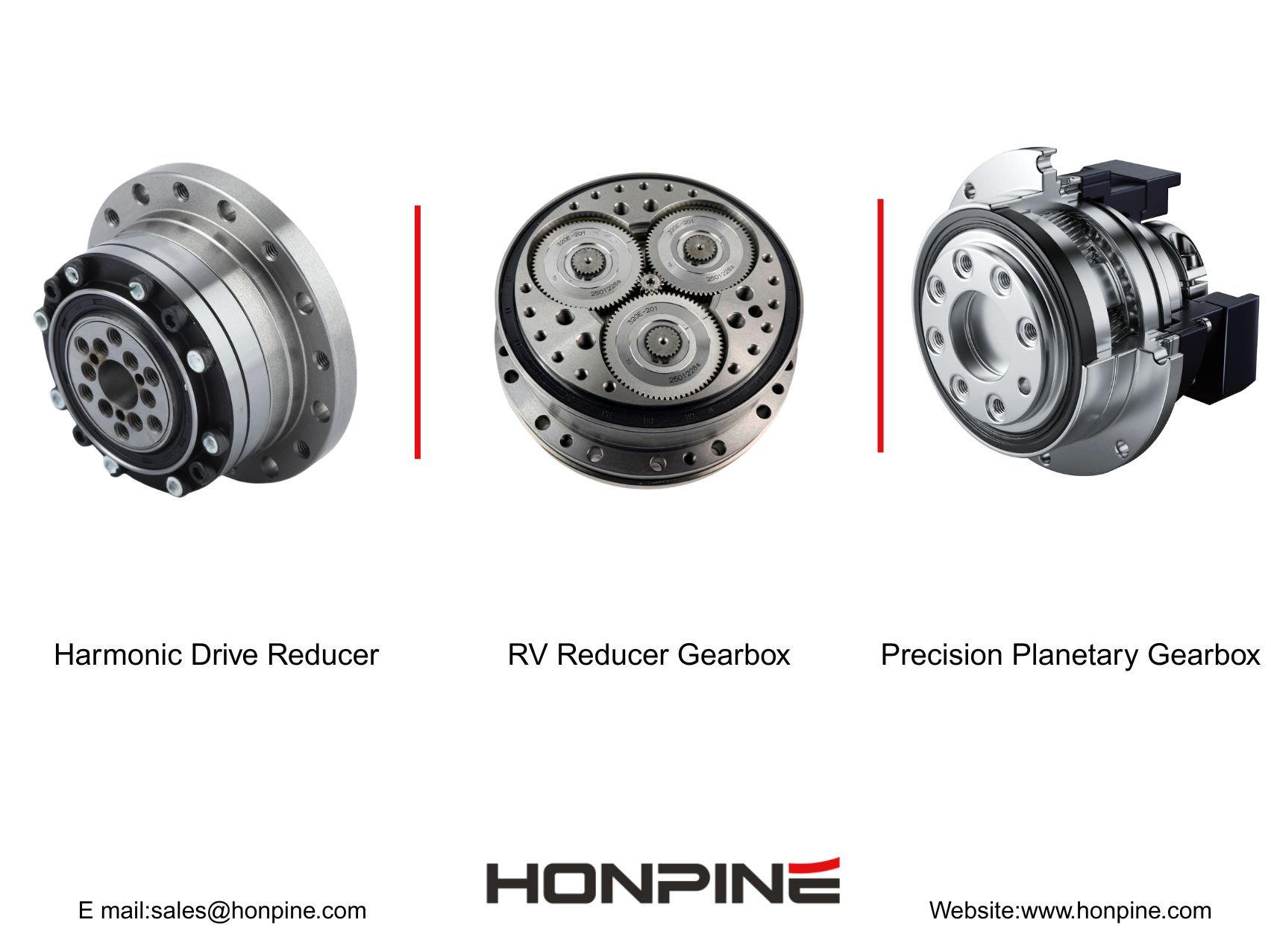
 Does a Higher Gearbox Ratio Mean More Torque? Planetary, Harmonic, and RV Gearboxes ExplainedDoes a higher gearbox ratio mean more torque? This engineering guide explains the relationship between gearbox ratio, output torque, and output speed, and compares planetary gearboxes, harmonic gearboxes, and RV gearboxes. Learn why reduction ratio alone cannot determine gearbox torque capacity, efficiency, dynamic response, precision, or service life, and what engineers should consider when selecting a gearbox for robotics, CNC machines, servo systems, and industrial motion control.
Double Click
We provide harmonic drive reducer,planetary reducer,robot joint motor,robot rotary actuators,RV gear reducer,robot end effector,dexterous robot hand
 What is robot joint actuator?How to Choose the Best Robot Rotary Joint Actuator?In core robot joint transmission solutions, planetary and harmonic rotary actuators each have their own strengths. Choosing the right type based on application requirements is essential to achieve the optimal balance between performance and cost.
 DD Motors VS Harmonic Rotary ActuatorsThis article provides an in-depth comparison between Direct Drive (DD) motors and harmonic rotary actuators, covering their transmission principles, advantages and disadvantages, and typical application fields.
 OMG Ultra Compact Harmonic Drive Joint Module with Built-in Torque SensorHONPINE TCHL series harmonic drive joint module is a game-changing product that achieves disruptive improvements in multiple aspects such as lightweight design, integration level, and connection convenience. This article will analyze its revolutionary enhancements with you.
 Harmonic Reducer vs. Harmonic Rotary Actuator: Which Is Better for CNC Machine Tools?Choosing between a harmonic reducer and a harmonic rotary actuator is an important decision in CNC machine tool design. Both solutions offer high-precision motion control, but they differ in integration, installation requirements, rigidity, and system flexibility. For CNC fourth-axis rotary tables and compact five-axis machining systems, selecting the right harmonic drive can significantly influence machine performance. In this article, HONPINE Technical Director Theodore Li compares harmonic reducers and harmonic rotary actuators to help engineers identify the most suitable solution for their CNC applications.
 How to Choose Harmonic Joint Actuators for a 7-DOF Robotic Arm?I'm Theodore Li, Technical Director at HONPINE. Choosing harmonic joint actuators for a 7-DOF robotic arm starts with the torque, weight, and installation needs of each joint. This guide uses a TCHL 20 shoulder and TCHL 14 wrist configuration as an example, then explores torque sensing, compliant control, and HAG Series considerations for demanding robotic applications.
 AGV Suspension: Should You Choose a Balance Beam or a Spring-Loaded Steering Drive Unit?Choosing an AGV suspension system starts with the vehicle’s load range and floor conditions. Balance beams and spring-loaded steering drive units offer different approaches to maintaining wheel contact and managing wheel loads. This HONPINE guide compares both options and explains how to evaluate traction, suspension travel, installation space, and maintenance before choosing a configuration.
 Hollow Rotary Platform Motor Matching: A Complete GuideSelecting the right motor for a hollow rotary platform is essential for achieving precise positioning, stable operation, and efficient automation. This guide explains how to match servo motors, stepper motors, and brushless DC motors with hollow rotary platforms based on torque, speed, inertia, accuracy, and installation requirements. Explore practical motor selection guidelines, typical application combinations, and space-saving mounting solutions to find the right configuration for your automation project.
 Can Robots Feel Touch? HONPINE HAG Force-Controlled Harmonic Robot Joint MotorsCan robots respond to a gentle touch? The HONPINE HAG robot joint motor with torque sensor combines a harmonic reducer, integrated torque sensing, and closed-loop control to detect external forces and support smooth, compliant motion. In this article, HONPINE founder Allen Li demonstrates the module's response to light contact and hand-guided movement, explains its key force-control technologies, and shares the vision behind joint modules designed for practical industrial robotics.
 Does a Higher Gearbox Ratio Mean More Torque? Planetary, Harmonic, and RV Gearboxes ExplainedDoes a higher gearbox ratio mean more torque? This engineering guide explains the relationship between gearbox ratio, output torque, and output speed, and compares planetary gearboxes, harmonic gearboxes, and RV gearboxes. Learn why reduction ratio alone cannot determine gearbox torque capacity, efficiency, dynamic response, precision, or service life, and what engineers should consider when selecting a gearbox for robotics, CNC machines, servo systems, and industrial motion control.
 High-Precision Hollow Harmonic Rotary Actuator for CNC Machines and Heavy-Duty Rotary AxesHONPINE 58 Series Hollow Harmonic Rotary Actuator is designed for CNC rotary tables, precision rotary axes, laser processing equipment, and heavy-duty rotary positioning applications. With a 50 mm hollow bore, up to 2,722 N·m peak torque, integrated crossed roller bearing, multi-turn absolute encoder options, positioning accuracy below 30 arcsec, and repeat positioning accuracy below 5 arcsec, it combines high torque capacity with precision rotary motion and flexible mechanical integration.
 How Does the HONPINE JRM Planetary Robot Joint Module Address Temperature Rise in Continuous Operation?HONPINE JRM planetary robot joint modules are designed for long-duration and high-load robotic operation. This article examines how motor electromagnetic optimization, high-efficiency planetary transmission, GaN-based drive technology, and system-level low-loss design help control temperature rise. Using the C6345 planetary robot joint module as a test example, HONPINE also presents full-load thermal validation under continuous operation, including motor efficiency up to 92%, planetary gearbox efficiency up to 97%, and a final equilibrium temperature of 61.42°C at a 25°C ambient temperature.
 Direct Drive Motor Sizing: A Complete Guide to Torque Calculation and SelectionSelecting a direct drive motor for a precision rotary system requires more than matching motor torque to the equipment weight. Engineers need to evaluate gravity torque, inertial torque, wind torque, friction, rotational inertia, speed, acceleration, duty cycle, and positioning requirements. In this guide, Theodore Li, Technical Director at HONPINE, explains a practical approach to direct drive motor sizing and torque calculation using an azimuth and elevation turntable as an engineering example. The article covers continuous and peak torque calculation, motor selection criteria, and the application of frameless direct drive motors in integrated rotary systems.