


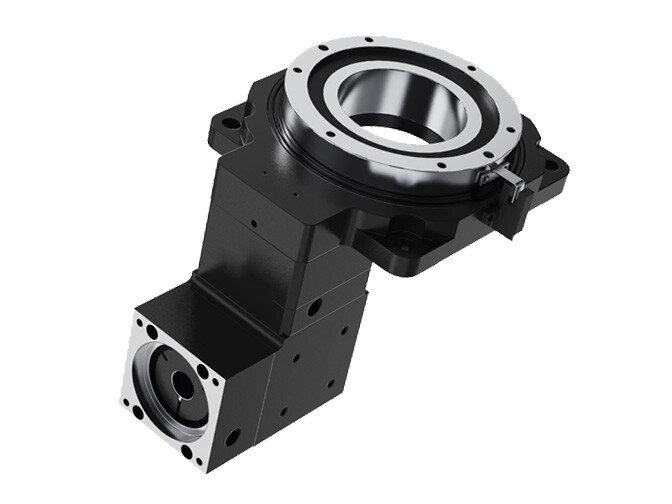
Right Angle High Repeat Positioning Accuracy Hollow Rotary Actuator
● Introduction
Features
● Hollow Structure Design
(a) Central hollow channel facilitates media transmission (air/liquid/electrical), simplifying equipment layout.
(b) Side-mounted motor interface prevents interference between pipelines and moving components.
● Integrated Right-Angle Bevel Gear Set
Redirects the input orientation to optimize space utilization.
● High-Rigidity Support
Precision cross roller bearings with 90° staggered preloaded rollers withstand radial, axial, and overturning loads, providing 5-10x higher rigidity than conventional bearings.
● High Rotational Accuracya
Turntable undergoes secondary grinding to ensure strict geometric tolerances (coaxiality, parallelism), achieving superior rotational precision.
● Flexible Compatibility
(a) Compatible with any brand of servo/stepper motors; supports custom flanges and shaft-bore interfaces.
(b) Modular design enables horizontal/vertical installation for enhanced scalability.
Specification
Sheet 1
FAQ
What is a Hollow Rotary Actuator?
A Hollow Rotary Actuator is a compact rotary motion module that integrates a precision transmission system, bearings, and a hollow rotary output structure into one unit. It is designed to provide accurate and rigid rotary positioning while allowing cables, pneumatic tubes, hydraulic lines, or sensors to pass through the center of the actuator.
Compared with a conventional transmission system assembled from separate motors, belts, gears, and bearings, a Hollow Rotary Actuator can simplify mechanical design, reduce installation work, and provide a more compact rotary axis.
What are the main advantages of a Hollow Rotary Actuator?
The main advantages include high positioning accuracy, high mechanical rigidity, a hollow through-hole, compact construction, flexible installation, and simplified system integration.
The hollow structure is particularly useful when the rotary axis needs to carry cables, air lines, vacuum lines, or other utilities through its center. The integrated mechanical structure also reduces the number of individual components that need to be designed and aligned during machine assembly.
How is a Hollow Rotary Actuator different from a DD Motor?
A DD Motor provides direct-drive rotary motion without a mechanical reduction mechanism. This can offer excellent dynamic response, low transmission compliance, and high rotary accuracy, but the motor itself may require a larger diameter and a higher investment depending on the required torque.
A Hollow Rotary Actuator uses a precision transmission mechanism to increase output torque and provide mechanical reduction. It can therefore offer a practical combination of torque, rigidity, positioning accuracy, and cost for many industrial automation applications.
The appropriate solution depends on the required speed, torque, acceleration, positioning accuracy, inertia, available installation space, and overall system cost.
How is a Hollow Rotary Actuator different from a Cam Indexer?
A cam indexer is designed primarily for predefined intermittent indexing motions. It offers high mechanical rigidity and repeatable indexing, but the motion profile and stopping positions are determined by its mechanical cam mechanism.
A Hollow Rotary Actuator is servo-driven and electronically controlled. The rotation angle, speed, acceleration, deceleration, and positioning sequence can be programmed according to the application.
This makes a Hollow Rotary Actuator more suitable for applications requiring flexible positioning, multiple stopping points, variable motion profiles, or future changes to the production process.
Can a Hollow Rotary Actuator replace a traditional worm gearbox?
In many rotary automation applications, a Hollow Rotary Actuator can be used as an alternative to a conventional worm gearbox system.
Compared with a typical worm-drive system, a precision rotary actuator can provide more accurate positioning and a more integrated mechanical structure. The actual suitability depends on the required torque, reduction ratio, efficiency, backlash, speed, duty cycle, and positioning requirements.
For applications requiring high precision and programmable positioning, a precision rotary actuator can simplify the overall rotary-axis design.
Why is the hollow through-hole important?
The central through-hole allows cables, pneumatic tubes, hydraulic lines, vacuum lines, and sensor wiring to pass through the rotary axis.
This can significantly simplify cable routing and reduce the risk of cable interference or twisting during continuous or indexed rotation.
It is particularly useful for rotary tables, inspection equipment, robot-related automation, semiconductor equipment, and other machines where utilities need to pass through the center of the rotating mechanism.
What types of motors can be used with a Hollow Rotary Actuator?
Depending on the actuator design, it can be configured with different servo or stepper motors.
Common industrial motor brands include Panasonic, Mitsubishi, Delta, and other major servo motor manufacturers. Motor compatibility should be confirmed according to the actuator interface, motor dimensions, shaft configuration, torque requirements, and control system.
HONPINE can also provide actuator configurations based on the customer's required motor and application conditions.
Can a Hollow Rotary Actuator be installed vertically or upside down?
Yes. Depending on the model and load conditions, a Hollow Rotary Actuator can be installed horizontally, vertically, at an inclined angle, or in an inverted configuration.
However, installation orientation should be considered together with the external load, axial load, radial load, moment load, acceleration, and duty cycle.
For applications with unusual mounting orientations or large external moments, the actuator should be selected according to the actual load conditions rather than only the rated output torque.
What applications are suitable for a Hollow Rotary Actuator?
Hollow Rotary Actuators are suitable for automation equipment that requires controlled rotary motion and accurate positioning.
Typical applications include:
Multi-station rotary tables
Automated assembly equipment
Vision inspection systems
Precision alignment equipment
CNC fourth-axis applications
Indexing and positioning systems
Robotic rotary mechanisms
Semiconductor and electronics equipment
Battery and photovoltaic manufacturing equipment
Automated handling systems
They are especially useful when both rotary positioning and centralized cable or tubing routing are required.
Does a Hollow Rotary Actuator provide high positioning accuracy?
The achievable positioning accuracy depends on the transmission mechanism, encoder, servo system, mechanical structure, load, and operating conditions.
HONPINE precision rotary platforms can be configured for high-precision positioning and repeatability. For applications requiring very high accuracy, the complete motion system—including the actuator, motor, encoder, servo drive, mounting structure, and load—should be evaluated as a whole.
Rather than evaluating accuracy based on the actuator alone, engineers should consider both positioning accuracy and repeatability under the actual operating conditions.
How should I select a Hollow Rotary Actuator?
The key parameters for selection include:
Required output torque
Rated and peak load
Maximum rotation speed
Positioning accuracy
Repeatability
Radial load
Axial load
Permissible moment load
Load inertia
Required reduction ratio
Hollow bore diameter
Installation orientation
Motor type
Encoder requirements
Duty cycle
Load inertia and acceleration are particularly important. A rotary actuator should not be selected only according to the maximum static torque of the application.
Can a Hollow Rotary Actuator handle high-inertia loads?
Yes, but the actuator must be selected according to the actual load inertia, acceleration, deceleration, and operating cycle.
When a large inertia is accelerated or stopped rapidly, the required dynamic torque can be significantly higher than the torque required to maintain constant-speed rotation.
For this reason, HONPINE recommends evaluating the complete motion profile rather than selecting an actuator based only on the nominal load weight.
Does a Hollow Rotary Actuator require additional bearings?
Many integrated Hollow Rotary Actuator designs incorporate precision bearings into the actuator structure, reducing the need for customers to design a separate bearing and transmission assembly.
However, whether additional external bearings are required depends on the external load, moment load, table size, and machine structure.
For heavy or eccentric loads, the machine designer should evaluate the permissible radial, axial, and moment loads of the selected model.
Can a Hollow Rotary Actuator be combined with a planetary gearbox?
Yes. Depending on the required speed and torque, an additional planetary reduction stage can be considered.
A planetary gearbox can provide a higher overall reduction ratio and increase the available output torque when the application requires it.
The actual configuration should be determined according to the required speed, torque, inertia, installation space, and transmission efficiency.
Why use a Hollow Rotary Actuator instead of building a rotary axis from separate components?
A conventional rotary axis may require a motor, gearbox, belt or coupling, bearings, shafts, mounting structures, and alignment work.
A Hollow Rotary Actuator integrates many of these mechanical functions into a standardized module. This can reduce mechanical design work, simplify assembly, and reduce the number of components that need to be aligned during machine construction.
For equipment manufacturers developing multiple machines or standardized platforms, this modular approach can also simplify product development and maintenance.
Is a Hollow Rotary Actuator suitable for precision inspection equipment?
Yes. Its combination of rotary positioning, mechanical rigidity, and hollow cable routing makes it suitable for many inspection and positioning systems.
Typical examples include vision inspection, component alignment, multi-position inspection stations, optical equipment, and precision rotary positioning mechanisms.
The final accuracy depends on the actuator specification and the complete mechanical and control system.
What is the difference between a Hollow Rotary Actuator and a Hollow Rotary Platform?
The terminology can vary between manufacturers.
A Hollow Rotary Platform generally emphasizes the mechanical rotary platform, hollow bore, bearing structure, and precision positioning function.
A Hollow Rotary Actuator generally emphasizes the complete rotary motion solution, which may include the transmission mechanism, motor, encoder, and drive system.
When comparing products, engineers should therefore focus on the actual specifications and integrated functions rather than the product name alone.
Can HONPINE customize a Hollow Rotary Actuator?
HONPINE can evaluate rotary actuator configurations according to application requirements such as output torque, speed, hollow bore diameter, motor configuration, encoder requirements, installation orientation, and load conditions.
For a specific project, providing the load inertia, required speed, acceleration, positioning accuracy, duty cycle, and installation dimensions will allow the appropriate actuator configuration to be evaluated.
Download(3D /PDF)